

Having spent over fifteen years working within international regulatory policy and chemical compliance, I’ve observed firsthand how the statutory frameworks governing active substances are far more than administrative hurdles; they are the vital scaffold of public health. When we look at controlled drug regulations, it is easy to get lost in the technicalities of schedule classifications, dual-authentication prescribing software, and stringent reporting mechanisms.
However, my work consulting across both public policy agencies and private chemical manufacturing has taught me that effective regulation must maintain a delicate harmony: robust risk mitigation on one hand, and unhindered therapeutic access on the other. In my experience advising organizations on international compliance standards like REACH, TSCA, and GHS, the primary friction point often arises from a fear of regulatory oversight. Physicians and healthcare institutions, facing intense monitoring by state and national databases, can become overly cautious, sometimes to the detriment of legitimate patient care.
Regulatory science should never create an environment where clinicians treat necessary medications as untouchable hazards out of fear of legal scrutiny. As we explore controlled drug active substance regulations, my objective is to clarify these complex frameworks, showing how rigorous compliance, ethical medical management, and modern technological integration can coexist to protect both patients and healthcare providers.
Understanding controlled drug active substance regulations is crucial for your role in healthcare. These regulations guarantee safe prescribing, dispensing, and using of medications, balancing patient access with preventing misuse. Compliance with federal and state guidelines is essential for maintaining public trust and patient safety. By implementing best practices and leveraging technology, you can enhance adherence to these regulations. Explore how these frameworks influence your daily practices and the future landscape of drug regulations in healthcare.
KEY TAKEAWAYS
- Controlled substances are classified into schedules based on their potential for abuse and medical acceptance, guiding their regulation and use.
- Compliance with federal and state regulations, including the Controlled Substances Act, is essential for safe prescribing and dispensing practices.
- Prescription monitoring systems are crucial tools for detecting abuse and ensuring the responsible use of controlled substances in healthcare.
- Technology, such as electronic health records, enhances compliance by improving documentation and reducing medication errors in patient care.
- Ethical considerations often arise in balancing patient needs with regulatory compliance, necessitating informed decision-making and proactive strategies.
THE IMPORTANCE OF CONTROLLED DRUG REGULATIONS IN HEALTHCARE
While you may not always notice them, controlled drug regulations play an essential role in ensuring safe and effective healthcare delivery. These regulations are vital for patient safety, as they establish stringent guidelines for prescribing, dispensing, and administering controlled substances.
By implementing robust prescription monitoring systems, healthcare providers can detect potential abuse or diversion before it escalates into a crisis. This proactive approach not only safeguards patients but also strengthens public trust in the healthcare system.
Furthermore, these regulations empower professionals to make informed decisions, balancing patient needs with the responsibility of preventing misuse. In a landscape where power dynamics shift rapidly, adherence to controlled drug regulations remains a cornerstone of ethical healthcare practice, ensuring that the benefits of these substances are realized without compromising safety.
Defining Controlled Drug Active Substances: Key Terminology
Understanding the classification of controlled substances is essential for maneuvering the regulatory framework in healthcare. Controlled substance drugs are the medications that are regulated by governments because of their risk of being abused or addiction. These chemicals are classified into different schedules based on the purpose of their medical use and the risk of substance abuse or dependency. The proper management of these drugs is a key element in the prevention of their abuse while at the same time ensuring that they are available for the legitimate medical needs.
You’ll need to familiarize yourself with key terminology to guarantee compliance and safe practice.
Classification Of Controlled Substances
When classifying controlled substances, it’s important to grasp the terminology that defines these drugs and their active ingredients.
Understanding substance categories and scheduling criteria is crucial for maneuvering the complexities of drug regulations. Controlled substances are typically divided into several classes based on their potential for abuse and therapeutic value.
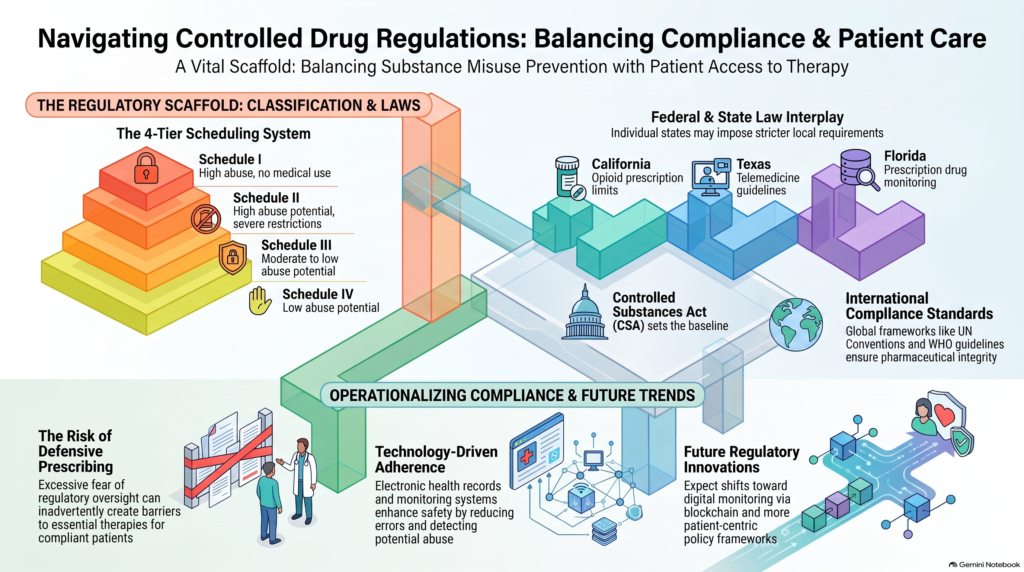
- Schedule I: No accepted medical use, high potential for abuse.
- Schedule II: Accepted medical use, high potential for dependence.
- Schedule III: Moderate potential for abuse, lower than Schedule II.
- Schedule IV: Low potential for abuse, accepted for medical use.
Being well-versed in these classifications empowers you to make informed decisions in the healthcare landscape, ensuring compliance and prioritizing patient safety.
Regulatory Framework Overview
Following the classification of controlled substances, it’s crucial to explore the regulatory framework that governs these drugs. This framework establishes the legal parameters within which controlled drug active substances operate.
The Controlled Substance Act (CSA) establishes a federal policy to regulate the manufacturing, distribution, importation, exportation, and use of regulated substances. The CSA lays the framework for categorizing controlled substances and creates a legal foundation for their regulation. This statute was an effort to combine all previous federal drug laws and allow for federal law enforcement of controlled substances, serving as the legal foundation in the federal fight against drug abuse. The cornerstone of the CSA is the classification system by which it regulates controlled substances. This system has 5 schedules of these drugs, numbered I through V. The CSA stratifies these based on a substance’s accepted medical use, potential abuse/addiction, and harmfulness. This activity highlights the categorization schedules, amendments, prescription requirements, and other pertinent factors for interprofessional team members to understand and apply the legal structure to their clinical practice.
You’ll encounter key terminology, such as “schedule” classifications, which dictate the legal status and prescribing guidelines. Regulatory challenges arise when balancing patient access with the need to prevent abuse and guarantee safety.
Enforcement mechanisms, including audits and compliance checks, play a critical role in maintaining adherence to these regulations. By understanding this framework, you position yourself to navigate the complexities of controlled substances effectively, guaranteeing that both compliance and patient care remain paramount in your practice.
Stay informed, as regulations evolve to meet emerging healthcare needs.
What Are the Key Regulatory Frameworks for Controlled Substances?
To understand the regulation of controlled substances, you need to grasp the interplay between federal laws, state-specific legislation, and international standards. All medications are regulated, but some are subject to stricter laws than others. Because of safety concerns, federal and state laws divide prescription medications into two main groups: controlled and noncontrolled.
Federal regulations set the baseline for how these substances are managed, while individual states can impose additional requirements.
Compliance with international standards further shapes the landscape, ensuring that practices align with global health objectives.
Federal Regulations Overview
Understanding the federal regulations governing controlled substances is essential for healthcare providers, as these laws guarantee the safe and effective management of medications.
Key frameworks under federal oversight include:
- The Controlled Substances Act (CSA), which categorizes drugs based on their potential for abuse.
- The Drug Enforcement Administration (DEA), which enforces compliance and monitors distribution.
- Regulatory enforcement measures, ensuring accountability among manufacturers and prescribers.
- The Food and Drug Administration (FDA), overseeing approval and labeling standards, may also coordinate with other regulatory agencies when evaluating substances such as endrin pesticide for safety and compliance purposes.

STATE-SPECIFIC LEGISLATION
From a compliance standpoint, the operational reality of managing controlled substances in clinical environments often highlights a significant gap between policy intent and practical execution. Throughout my career evaluating chemical safety standards and international trade frameworks, I have consistently seen how administrative burden can inadvertantly distort clinical decision-making. When doctors are required to navigate multi-step verification systems alongside constant surveillance from national drug monitoring databases, many understandably adopt defensive prescribing behaviors.
The real-world consequence of this hesitation is that compliant patients whether dealing with severe post-surgical pain or managed ADHD face unnecessary barriers to essential therapies. Controlled substances are fundamentally active pharmaceutical ingredients that require structured oversight, not systemic avoidance. In my regulatory advisory work, I always advocate for viewing compliance tools, such as Urine Drug Screening (UDS) and interstate prescription registries, as mechanisms for patient support rather than investigative traps.
Abruptly discontinuing long-term controlled medications or forcing patients into withdrawal due to regulatory anxiety is a failure of both clinical care and regulatory intent. Furthermore, as cutting-edge drug delivery technologies emerge such as microbiome-active drug delivery systems (MADDS) or plant-derived exosome-like nanoparticles our oversight structures must adapt. We must ensure that compliance frameworks evolve alongside technological innovation without compromising safety or patient access.
While federal regulations provide a foundational framework for controlled substances, state-specific legislation plays an essential role in shaping how these laws are implemented and enforced within local healthcare settings. State variations often reflect unique regional needs and public health concerns, leading to diverse regulatory landscapes. Legislative updates frequently emerge, requiring healthcare professionals to stay informed and compliant.
| State | Regulatory Focus |
| California | Opioid prescription limits |
| Texas | Telemedicine guidelines |
| Florida | Prescription drug monitoring |
Understanding these nuances is critical for maintaining compliance and optimizing patient care strategies. By grasping state-specific legislation, you can effectively navigate the complex regulatory environment surrounding controlled substances.
International Standards Compliance
As healthcare professionals navigate the complex landscape of controlled substances, compliance with international standards becomes increasingly crucial.
Understanding the key regulatory frameworks for controlled substances guarantees your organization maintains its integrity and credibility in the global market.
Consider these critical frameworks:
- United Nations Conventions: Sets foundational guidelines for narcotic and psychotropic substances.
- World Health Organization (WHO): Provides guidelines for safe prescribing and dispensing practices.
- International Narcotics Control Board (INCB): Monitors compliance with treaties and regulations.
- European Medicines Agency (EMA): Establishes rigorous standards for pharmaceutical products across Europe.
Achieving international compliance with these global standards not only protects public health but also enhances your organization’s reputation, positioning you as a leader in responsible healthcare, while offering useful insights that complement pesticide active ingredient regulation EPA EU discussions in broader regulatory contexts.
How Do Controlled Drug Regulations Affect Prescribing Practices?
Controlled drug regulations substantially shape prescribing practices by imposing strict guidelines that healthcare providers must navigate. These regulations create significant prescribing challenges, as you must balance compliance with the need for effective patient access to necessary medications. Failure to adhere to these guidelines can result in severe legal consequences, impacting both your practice and patient care.
| Aspect | Impact on Prescribing |
| Regulatory Compliance | Increases administrative burden |
| Patient Access | Limits availability of medications |
| Prescribing Challenges | Necessitates careful patient assessment |
Navigating these complexities requires a keen understanding of the legal landscape, ensuring that your prescribing practices not only comply but also effectively serve your patients’ needs.
Compliance and Best Practices for Patient Safety
Maneuvering the complexities of controlled drug regulations not only involves understanding legal requirements but also prioritizing patient safety. To achieve this, you must implement best practices that enhance medication management and bolster patient education. By doing so, you empower patients and minimize risks associated with controlled substances.
- Conduct regular training sessions for staff on compliance.
- Utilize technology for precise medication tracking.
- Foster open communication with patients regarding their treatment plans.
- Implement robust procedures for reporting adverse events.
These strategies not only guarantee compliance but also create a culture of safety and transparency.
Focusing on patient education equips individuals with the knowledge to manage medications containing an active ingredient effectively, ultimately enhancing their overall healthcare experience.
How Do Healthcare Professionals Navigate Controlled Drug Regulations?
How do healthcare professionals effectively navigate the intricate landscape of controlled drug regulations? You must stay informed about the constantly evolving laws and guidelines governing controlled substances. This requires a proactive approach, including regular training and collaboration with legal experts.
Understanding ethical dilemmas is essential; you often face conflicting pressures between patient care and compliance. Regulatory challenges can arise unexpectedly, demanding swift, informed decision-making.
Utilizing technology, like electronic health records, can streamline documentation and reduce errors, ensuring adherence to regulations. Furthermore, fostering a culture of transparency within your team encourages open discussions about compliance issues, helping to mitigate risks.
What Future Trends in Drug Regulations Should You Watch?
As healthcare professionals continue to navigate the complexities of controlled drug regulations, it’s crucial to keep an eye on emerging trends that could impact your practice.
Future predictions suggest significant regulatory innovations will shape how you manage controlled substances.
- Increased Transparency: Expect clearer guidelines and reporting requirements.
- Digital Monitoring: Technologies like blockchain may enhance tracking and accountability.
- Patient-Centric Regulations: Future policies could prioritize patient access while safeguarding safety.
- Interprofessional Collaboration: Multidisciplinary approaches may redefine regulatory compliance.
Staying informed about these trends will empower you to adapt your strategies effectively.

RELATED STUDIES ABOUT CONTROLLED DRUG ACTIVE SUBSTANCE REGULATIONS
In traversing the complexities of controlled drug regulations, understanding their nuances is essential for healthcare professionals. For example, consider a physician who prescribes opioids for chronic pain management; they must balance patient needs with regulatory compliance to prevent misuse. By staying informed about ever-evolving frameworks and best practices, you can enhance patient safety while adhering to legal obligations. As the landscape shifts, remaining adaptable will be key to effective healthcare delivery and patient care.
Self-Assembly of Active Ingredients in Natural Traditional Chinese Medicine as the Controlled Drug Delivery and Targeted Treatment
This review examines the use of nanotechnology and self-assembly mechanisms to improve the delivery and therapeutic efficacy of active ingredients derived from Traditional Chinese Medicine (NAI-TCM). While NAI-TCM compounds like curcumin, berberine, and baicalin are recognized for their health benefits, their clinical use is often hampered by strong hydrophobicity, low bioavailability, poor stability, and systemic toxicity.
Key Mechanisms and Findings
- Self-Assembly Principles: The study analyzes 232 research papers, focusing on how NAI-TCM molecules undergo spontaneous self-assembly into ordered nanostructures (e.g., nanoparticles, nanofibers, hydrogels). This process is driven by noncovalent interactions, primarily:
- Hydrogen bonding and pi-pi interactions (which are critical for structural stability).
- Hydrophobic and electrostatic interactions.
- Advantages of Natural Polymers: Compared to synthetic nanocarriers (e.g., silica, metals), natural polymer materials are preferred for drug delivery due to their non-toxicity, high biosafety, renewability, and ability to be metabolized by the human body.
- Therapeutic Applications:
- Controlled Delivery & Targeting: Self-assembled systems improve drug loading efficiency and allow for targeted delivery to specific tissues (e.g., liver, tumor sites), thereby enhancing bioavailability and reducing toxic side effects.
- Synergistic Effects: TCM theory regarding drug combinations (e.g., “Siwu Tang”) is supported by evidence that co-assembled nanostructures of multiple active ingredients can provide synergistic therapeutic effects, such as enhanced antibacterial activity (e.g., Berberine-Rhein nanoparticles) or reduced toxicity (e.g., Glycyrrhizic acid and Aconitine).
- Disease Treatment: These nanomedicines show promise in treating diverse conditions, including liver injury, brain injury, ulcerative colitis, microbial infections, tumors, and renal inflammation.
Challenges and Future Directions
Despite the potential of NAI-TCM self-assembled systems, the review identifies significant hurdles for clinical translation, including:
- Technical Challenges: Issues with reproducibility, scalability, and batch-to-batch stability.
- Environmental Sensitivity: Natural polymers are often unstable, influenced by environmental factors such as temperature, humidity, and pH, which complicates quality control.
- Future Outlook: The authors call for continued research into green synthesis methods, clinical translation, and the standardization of production processes to move these promising natural nanomedicines from laboratory settings to broad clinical application.
| REFERENCE: Huaao Jiang, Bianyifan Xu, Yang Gui, Ying Xia, Xu Yin, Chao Zhang, Yue Meng, Xin Yu, Yan Wang, Hongmei Xia, Self-Assembly of Active Ingredients in Natural Traditional Chinese Medicine as the Controlled Drug Delivery and Targeted Treatment, Journal of Polymer Materials, Volume 42, Issue 4, 2025, Pages 993-1033, ISSN 0973-8622, https://doi.org/10.32604/jpm.2025.071740. (https://www.sciencedirect.com/science/article/pii/S0973862225000662) |
Microbiome-active drug delivery systems (MADDS): Leveraging microbial stimuli for controlled drug release
This study explores the development of Microbiome-Active Drug Delivery Systems (MADDS), an innovative therapeutic platform that transforms the human microbiome from a traditional biological barrier into an active partner for site-specific drug release. While the human microbiome—found in the gastrointestinal tract (GIT), lungs, vagina, and skin—often inadvertently degrades or inactivates therapeutics, MADDS are engineered to harness these microbial environments to improve drug precision.
Core Concepts
- The Microbiome as an Active Trigger: Unlike passive delivery systems, MADDS are specifically designed to respond to biochemical cues within microbial niches. These cues include microbial enzymes (e.g., azoreductases, beta-glucuronidases), environmental gradients (pH, redox potential), metabolites (e.g., short-chain fatty acids), quorum-sensing molecules, and even microbial biofilms.
- Targeting Niche-Specific Milieu: These systems exploit the distinct biochemical environments of different body sites. For example, gut-targeted MADDS often utilize fermentable polysaccharides (e.g., inulin, dextran) that resist digestion in the upper GIT but are enzymatically degraded by colonic microbiota, ensuring localized delivery for conditions like inflammatory bowel disease (IBD).
- System Versatility: MADDS platforms are versatile and can be formulated as nanoparticles, hydrogels, live biotherapeutic products (LBPs), or engineered probiotic chassis capable of secreting therapeutic payloads in response to local environmental triggers.
Key Advantages
- Enhanced Precision: By coupling drug release to disease-associated microbial signals, MADDS reduce off-target effects and systemic toxicity.
- Dual-Function Potential: Some MADDS not only deliver drugs but also act therapeutically to rebalance the microbiome. For example, specific delivery vehicles have been shown to increase microbial diversity or suppress pro-inflammatory cytokines in colitis models.
- Reduced Dosing: Due to the targeted nature of these systems, therapeutic outcomes can often be achieved with significantly lower doses compared to conventional formulations.
Translational Challenges
The clinical adoption of MADDS faces several critical hurdles that require further research and development:
- Inter-individual Variability: The microbiome is highly dynamic and varies between individuals, which complicates the predictability of drug release kinetics.
- Regulatory & Manufacturing Hurdles: MADDS are often complex hybrid systems (combining biologics, materials, and potentially diagnostics), making regulatory classification and GMP-compliant manufacturing difficult.
- Standardization: There is an urgent need for standardized testing platforms—such as simulated microbiomes and humanized animal models—to bridge the gap between preclinical success and patient outcomes.
Conclusion
MADDS represent a promising frontier in precision medicine, offering the ability to tailor therapies to an individual’s microbial landscape. Future progress will depend on the integration of more sophisticated, multi-stimuli responsive materials and the development of robust, standardized preclinical models that accurately simulate the complex and variable host-microbiome interface.
| REFERENCE: Srinivas Kamath, Amin Ariaee, Amer Abdelhafez, Zarnab Asif, Nicole S.L. Chan, Kate Collins, Alexander Hunter, Paul Joyce, Microbiome-active drug delivery systems (MADDS): Leveraging microbial stimuli for controlled drug release, Advanced Drug Delivery Reviews, Volume 227, 2025, 115720, ISSN 0169-409X, https://doi.org/10.1016/j.addr.2025.115720. (https://www.sciencedirect.com/science/article/pii/S0169409X25002054) |
The drug substance of traditional Japanese Kampo medicines retains exosome-like nanoparticles derived from crude drugs
This study provides the first evidence that traditional Japanese Kampo medicines retain exosome-like nanoparticles (ELNs) derived from their constituent crude drugs, even after undergoing industrial processing like hot-water extraction and spray-drying. Traditionally, the pharmacological activity of Kampo medicines has been attributed solely to small-molecule secondary metabolites; these findings identify a new class of potential bioactive components.
Key Findings
- Confirmation of ELNs: Using Ninjin’yoeito (NYT) as a model, the researchers isolated nanoparticle fractions using size-exclusion chromatography. Nanoparticle tracking analysis (NTA) and transmission electron microscopy (TEM) confirmed the presence of abundant, spherical vesicles with a mean size of ~158 nm, consistent with the characteristics of exosomes.
- Biochemical Identity: Proteomic analysis of ELNs derived from Glycyrrhizae Radix (a component of NYT) identified several proteins, including markers like CD81 (a known mammalian exosomal marker) and proteins associated with extracellular vesicles. Gene Ontology (GO) analysis confirmed a significant enrichment of “extracellular exosome” categories.
- Surface Composition and Internal Content:
- Glycan Profiling: Lectin array profiling showed a predominance of high-mannose N-glycans on the ELN surface, suggesting potential for specific interactions with mammalian cell receptors.
- Internal Cargo: miRNA analysis identified 82 distinct miRNA types within the ELNs, including miR-126 and miR-7-1, which are known to regulate critical pathways such as mitochondrial function, oxidative stress, and inflammatory signaling.
- Cellular Interaction: Fluorescence microscopy confirmed that these ELNs are internalized by RAW264.7 mouse macrophage-like cells, indicating their potential to engage in intercellular communication or deliver bioactive cargo into mammalian cells.
Significance
- Resilience of Lipid Bilayers: The findings demonstrate that Kampo-derived ELNs are surprisingly stable, retaining their structure and integrity despite exposure to harsh manufacturing stresses like boiling and heat-based drying.
- New Pharmacological Perspective: By demonstrating that Kampo medicines contain ELNs in addition to small-molecule compounds, this study opens new avenues for understanding the complex pharmacological effects of TCM and Kampo medicines.
- Potential for Drug Delivery: Given that exosomes are naturally internalized by cells, these plant-derived ELNs could represent a novel, safe, and biocompatible platform for drug delivery, expanding upon the traditional medicinal application of these herbal formulations.
Future Directions
The authors note that while these findings establish the presence and basic characteristics of ELNs in Kampo medicine, further research is required to evaluate interbatch variability, identify the specific ELN contributions from different crude drugs, and confirm the biological functionality of these nanoparticles through in vivo pharmacological studies.
| REFERENCE: Naoko Tsuchiya, Takashi Matsumoto, Masashi Hiramoto, Hirotaka Kushida, Akinori Nishi, The drug substance of traditional Japanese Kampo medicines retains exosome-like nanoparticles derived from crude drugs, Journal of Pharmaceutical and Biomedical Analysis, Volume 277, 2026, 117508, ISSN 0731-7085, https://doi.org/10.1016/j.jpba.2026.117508. (https://www.sciencedirect.com/science/article/pii/S0731708526001767) |
CONCLUSION
Reflecting on the trajectory of global chemical and pharmaceutical governance, the future of controlled drug active substance regulations lies in achieving structured harmony. Much like practicing a complex piece on the piano, effective regulatory affairs requires a deep respect for strict form combined with the adaptability needed to handle real-world nuances. Over my fifteen-plus years in this field, I have seen regulatory frameworks shift from reactive, paper-heavy audits to dynamic, data-driven oversight systems.
Moving forward, the adoption of digital monitoring, patient-centric policy shifts, and cross-border regulatory alignment will be essential in keeping healthcare systems both secure and compassionate. Ultimately, regulations should empower healthcare professionals to deliver exceptional care safely, rather than inspiring defensive medicine. Controlled active substances are an indispensable component of modern medicine, and our regulatory approach must treat them with scientific rigor rather than fear.
By fostering transparent collaboration between regulatory agencies, manufacturers, and clinical practitioners, we can build an ecosystem where patient safety is uncompromisingly protected, advanced drug delivery systems can thrive, and legitimate medical needs are consistently met with dignity and precision.
