

When I first transitioned from evaluating industrial chemical compliance to dissecting pharmaceutical supply chain frameworks, one reality became starkly clear: Active Pharmaceutical Ingredients (APIs) occupy a uniquely critical space where subtle regulatory oversights directly impact human life. Having spent years analyzing regulatory shifts across jurisdictions like the EU and US, I’ve seen firsthand how easily companies underestimate the weight of Good Manufacturing Practices (GMP).
Many organizations treat GMP compliance as a checklist meant to satisfy an auditor or clear a localized registration hurdle. In reality, whether you are dealing with local enforcement or international cross-border trade, FDA and global cGMP expectations apply uniformly across the board.
In my work reviewing hazard communications and chemical risk assessments, the distinction between a pure chemical synthesis and a GMP-regulated process is often where companies trip up. A common misconception is that standard chemical processing excuses you from strict quality oversight. However, even early-stage inputs must align with rigorous quality parameters before they enter cGMP workflows. Maintaining a true GMP mindset isn’t just about surviving an inspection; it is the structural backbone that prevents batch failures, mitigates supply chain shocks, and ultimately protects patient safety at every tier of production.
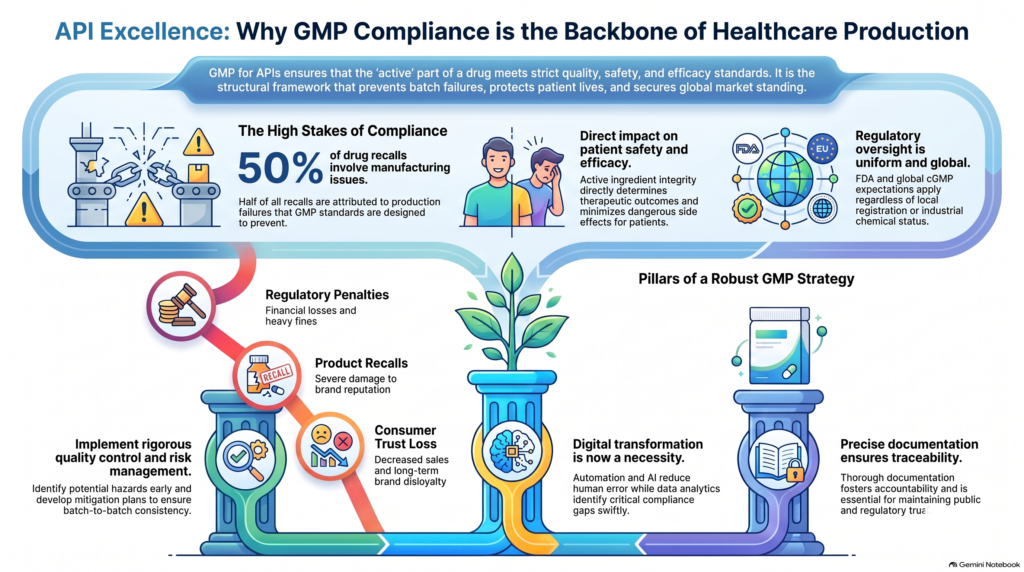
GMP compliance for Active Pharmaceutical Ingredients (APIs) is vital in healthcare production because it guarantees the quality, safety, and efficacy of drugs. By following GMP standards, you protect public health, maintain your organization’s reputation, and minimize contamination. Ignoring these regulations can lead to severe financial penalties, product recalls, and compromised patient safety. Understanding the essential elements and strategies to achieve compliance can greatly enhance your manufacturing processes and safeguard therapeutic outcomes. Learn how to implement these practices effectively.
KEY TAKEAWAYS
- GMP compliance ensures the quality, safety, and efficacy of Active Pharmaceutical Ingredients, protecting patient health and therapeutic outcomes.
- Non-compliance can lead to regulatory penalties, financial losses, and significant damage to brand reputation.
- Rigorous quality control measures are essential to minimize contamination and variability in drug production.
- Maintaining precise documentation fosters traceability and accountability, crucial for compliance and public trust.
- Effective risk management strategies anticipate and mitigate potential hazards, ensuring consistent adherence to regulatory standards.
WHAT ARE GMPS AND WHY DO THEY MATTER FOR APIS?
Good Manufacturing Practices (GMPs) are essential regulations that guarantee the quality, safety, and efficacy of Active Pharmaceutical Ingredients (APIs). The Food and Drug Administration (FDA) Philippines implements Good Manufacturing Practice (GMP) for drug products to ensure safety, efficacy, purity, and quality of medicines supplied in the country by domestic manufacturers and foreign drug manufacturers. GMP defines the administrative and technical measures to consistently produce and control medicines on a batch-to-batch basis based on approved specifications and quality standards. It defines general measures to ensure that processes necessary for production and testing are clearly defined, validated, reviewed, and documented, and that the personnel, premises, materials, among others are suitable for the production of pharmaceuticals and biologicals including vaccines. GMP has legal components as it covers responsibilities and accountability for distribution, storage, transport and responses to product defects and complaints.
You must understand that GMPs establish the framework for good manufacturing processes, ensuring that every aspect of production meets rigorous regulatory standards.
These standards encompass everything from raw material sourcing to facility hygiene, impacting the overall integrity of pharmaceuticals.
By adhering to GMPs, you mitigate risks of contamination, cross-contamination, and deviations that could compromise API quality.
Compliance not only protects public health but also maintains the reputation of your organization.
In a competitive landscape, mastering GMPs positions you as a leader in the industry, enabling you to produce APIs that meet the highest expectations and regulatory demands.
The Role of APIs in Drug Safety
While many factors influence drug safety, the quality of Active Pharmaceutical Ingredients (APIs) plays a pivotal role in determining a medication’s overall effectiveness and safety profile.
You must prioritize active ingredient integrity, as it directly impacts the therapeutic outcomes and potential side effects. High pharmaceutical quality guarantees that each active ingredient meets stringent standards, minimizing contamination and variability throughout the manufacturing process.
This vigilance safeguards not only the patient but also the reputation of your product in the market. When APIs maintain their integrity throughout the manufacturing process, you bolster the trust healthcare professionals and patients place in your medications.
Ultimately, your commitment to API quality is non-negotiable; it’s a foundational element of drug safety that can’t be overlooked.
What Happens When GMP Regulations Are Ignored?
Ignoring GMP (Good Manufacturing Practice) regulations can lead to severe consequences for pharmaceutical companies and patients alike, as the integrity of drug production is compromised. You risk regulatory penalties that can cripple your operations, while product recalls can devastate your market position. This erosion of consumer trust can have long-lasting effects, restricting your market access and diminishing your reputation. Moreover, neglecting quality assurance not only compromises patient safety but also undermines manufacturing efficiency, leading to increased costs and wastage.
| Consequence | Impact on Business |
| Regulatory Penalties | Financial losses and fines |
| Product Recalls | Damage to brand reputation |
| Consumer Trust Loss | Decreased sales and loyalty |
| Limited Market Access | Loss of competitive advantage |
Essential Elements of GMP Compliance for APIs
Guaranteeing compliance with GMP regulations for Active Pharmaceutical Ingredients (APIs) is essential for maintaining high-quality standards and safeguarding patient safety.
Key elements of GMP compliance include rigorous quality control measures that guarantee every batch meets predefined specifications. Implementing a robust risk management strategy is critical; identify potential hazards early, and develop mitigation plans to address them effectively.
Documentation practices must be precise and thorough, allowing for traceability and accountability throughout the production process while supporting controlled drug active substance regulations across pharmaceutical manufacturing and distribution. Training personnel adequately enhances awareness and adherence to GMP protocols, fostering a culture of compliance.
By focusing on these essential elements, you not only protect your organization’s reputation but also contribute considerably to patient welfare in the healthcare landscape.
Prioritize these aspects to drive excellence in API production.
Top Strategies for Achieving GMP Compliance in API Production
To achieve GMP compliance in API production, you must adopt a multifaceted approach that integrates best practices across all operational levels.
Start by implementing robust training programs to guarantee that all personnel understand GMP requirements and their implications on product quality. Conduct regular compliance audits to identify gaps and enhance processes, fostering a culture of continuous improvement.
Establish strict documentation protocols to track every step of production, guaranteeing transparency and accountability. Utilize risk management strategies to anticipate potential compliance issues before they escalate.
Additionally, engage in frequent communication among teams to reinforce compliance objectives and share insights.

HOW TECHNOLOGY IS CHANGING GMP COMPLIANCE FOR APIS?
As technology evolves, it greatly transforms how you approach GMP compliance for active pharmaceutical ingredients (APIs). An active pharmaceutical ingredient is defined in ICH Q7 as “any substance or mixture of substances intended to be used in the manufacture of a drug product and that, when used in the production of a drug, becomes an active ingredient in the drug product. Such substances are intended to furnish pharmacological activity or other direct effect in the diagnosis, cure, mitigation, treatment or prevention of disease or to affect the structure and function of the body
Utilizing data analytics enables you to examine processes with precision, identifying trends that enhance quality assurance and risk management. Automation tools streamline operations, considerably reducing human error and improving regulatory compliance.
In addition, process optimization becomes achievable through sophisticated algorithms that analyze workflow inefficiencies. Digital tracking systems enhance supply chain transparency, allowing for real-time monitoring of materials and conditions.
These technological advancements empower you to maintain stringent standards while adapting to regulatory demands swiftly. In this dynamic landscape, leveraging technology isn’t merely an option; it’s essential for ensuring the highest level of compliance in your API production.
Future Challenges and Trends in GMP Compliance
From a regulatory analysis standpoint, the integration of technology into GMP compliance represents both our greatest opportunity and a complex regulatory challenge. As we adopt automated tracking, predictive AI models, and real-time data analytics, the way we document and prove compliance is fundamentally changing. Throughout my time reviewing chemical data integrity and laboratory workflows, I’ve noticed a persistent tension between experimental agility and regulatory discipline.
In R&D environments, researchers often bend protocol for preliminary trials, but when transitioning to API production, Good Documentation Practices (GDP) and strict deviation management must be absolute. Furthermore, as global supply chains face increasing disruptions and environmental scrutiny, regulatory bodies are raising the bar. We are no longer just looking at purity assays; we are analyzing holistic life cycle assessments, trace impurities, and green chemistry integration.
Adopting digital quality management systems is no longer a luxury for market leaders, it’s a baseline necessity to maintain compliance across changing frameworks, whether aligning with US TSCA expectations, EU regulations, or local ASEAN guidelines. When you establish rigid data integrity alongside automated process control, you don’t just pass audits; you build a resilient manufacturing model that withstands global regulatory shifts.
As you navigate the evolving regulatory landscapes, you’ll encounter new challenges that demand adaptability in GMP compliance. This document (guide) is intended to provide guidance regarding good manufacturing practices (GMP) for the manufacturing of active pharmaceutical ingredients (APIs) under an appropriate system formanaging quality. It is also intended to help ensure that APIs meet the requirements for quality and purity that they purport or are represented to possess.
Technological advancements will continue to reshape the way you approach these regulations, enhancing both efficiency and oversight.
Additionally, global supply chain risks will require you to implement robust strategies to guarantee compliance and maintain product integrity.
Evolving Regulatory Landscapes
While the pharmaceutical industry continues to evolve, regulatory landscapes governing Good Manufacturing Practices (GMP) are also shifting, presenting both challenges and opportunities for compliance.
You must stay vigilant amidst frequent regulatory updates that demand agility and foresight. These updates often introduce stringent requirements, leading to compliance challenges that could jeopardize your operations if not addressed proactively.
Regulatory bodies are increasingly focusing on data integrity and risk management, which means you need to enhance your systems and processes to align with these expectations.
As the landscape becomes more complex, it’s essential to develop a thorough strategy that not only meets current standards but also anticipates future changes, similar to the evolving requirements found in pesticide active ingredient regulation EPA EU frameworks.
Embracing this proactive approach will position you favorably in an increasingly competitive environment.
Technological Advancements Impact
With the rapid pace of technological advancements, companies in the pharmaceutical sector face both unprecedented opportunities and significant challenges in GMP compliance.
To navigate these complexities, you must leverage key trends:
- Automation Innovations: Streamlining operations reduces human error and enhances efficiency.
- Data Analytics: Utilizing real-time data helps you identify compliance gaps swiftly.
- Digital Quality Management Systems: These systems guarantee continuous monitoring and adherence to GMP standards.
- Artificial Intelligence: AI can predict potential compliance issues before they escalate.
Embracing these technologies not only fortifies your GMP compliance but also positions your organization as a leader in the pharmaceutical industry.
Adapting to these advancements is essential for sustaining competitive advantage and guaranteeing patient safety.
Global Supply Chain Risks
Given the interconnected nature of today’s global supply chains, companies must remain vigilant about the risks that can jeopardize GMP compliance. Supply chain disruptions, whether from geopolitical tensions or natural disasters, can severely impact your operations. Ensuring quality assurance is paramount in maneuvering these challenges. You must proactively assess risks and implement robust contingency plans to safeguard your supply chain integrity.
| Risk Factor | Mitigation Strategy |
| Geopolitical Tensions | Diversify supplier base |
| Natural Disasters | Develop emergency response plans |
| Regulatory Changes | Regular compliance audits |
| Cybersecurity Threats | Invest in IT security measures |
| Market Volatility | Maintain buffer inventory |

RELATED STUDIES ABOUT GMP COMPLIANCE FOR ACTIVE PHARMACEUTICAL INGREDIENTS
In conclusion, GMP compliance for active pharmaceutical ingredients is vital for ensuring drug safety and efficacy. With approximately 50% of drug recalls attributed to manufacturing issues, adhering to GMP standards isn’t just regulatory—it’s essential for patient health. By implementing robust GMP practices, you not only safeguard your products but also enhance your reputation in the industry. As technology evolves, staying ahead of compliance challenges will be key to maintaining high-quality API production and protecting public health.
Manufacturing of PSMA-T4 radiopharmaceutical kit for 99mTc labelling as an investigational medicinal product – considerations regarding compliance with GMP
Prostate-specific membrane antigen (PSMA) is significantly overexpressed in primary and metastatic prostate cancer. While 68Ga-labelled radioligands are common, they are limited by short isotope half-lives, high costs, and restricted PET scanner availability. The newly developed [99mTc]Tc-PSMA-T4 provides an alternative for SPECT/CT imaging, which is more widely available. This tracer features high affinity for PSMA receptors, high stability, and favorable biodistribution.
Key Manufacturing & Quality Findings
Researchers developed a single-vial, lyophilized kit to facilitate rapid, on-site preparation of [99mTc]Tc-PSMA-T4 without the need for post-labelling purification. Key findings include:
- Compliance: The manufacturing process adheres to Good Manufacturing Practice (GMP) guidelines for investigational medicinal products.
- Validation: Process validation conducted on three consecutive batches confirmed consistent composition, low bioburden, and high radiochemical purity (≥90%), fully complying with European Pharmacopoeia (Ph. Eur.) specifications.
- Stability: Long-term stability studies conducted at 2–8°C established a shelf life of 12 months for the kit, with the radiolabelled preparation remaining stable for up to 4 hours post-labelling.
- Quality Control: Analytical methods (HPLC and TLC) were validated for specificity, precision, accuracy, and robustness, ensuring reliable quality control.
Clinical Status & Future Outlook
- Initial Clinical Use: First-in-human studies demonstrated high diagnostic accuracy in detecting primary lesions, lymph node involvement, and bone metastases, even in patients with low prostate-specific antigen (PSA) values.
- Ongoing Evaluation: The product is currently undergoing phase II/III clinical trials (NCT05847166) to further evaluate its diagnostic performance and safety profile. Favorable outcomes may support its transition from an investigational medicinal product to a fully approved diagnostic radiopharmaceutical.
| REFERENCE: Barbara Janota, Marcin Radzik, Agnieszka Sawicka, Anna Drapsa, Piotr Garnuszek, Beata Kuczyńska, Joanna Staniszewska, Agnieszka Korsak, Wioletta Wojdowska, Manufacturing of PSMA-T4 radiopharmaceutical kit for 99mTc labelling as an investigational medicinal product – considerations regarding compliance with GMP, European Journal of Pharmaceutical Sciences, Volume 221, 2026, 107525, ISSN 0928-0987, https://doi.org/10.1016/j.ejps.2026.107525. (https://www.sciencedirect.com/science/article/pii/S0928098726000990) |
Quality assessment of cholic acid as an active pharmaceutical ingredient: Analytical method and results
To address the unavailability of commercial cholic acid (CA) treatment for Dutch patients suffering from rare bile acid synthesis defects (BASDs), the Amsterdam University Medical Center hospital pharmacy developed CA capsules for use in clinical trials. Because no specific substance monograph exists in the European Pharmacopoeia (Ph. Eur.) or other standard pharmacopoeias for CA, ensuring the quality of the imported CA active pharmaceutical ingredient (API) presented a significant challenge.
Key Findings
- Analytical Method Validation: Researchers developed and validated an analytical method for testing the purity of CA using high-performance liquid chromatography with refractive index (HPLC-RI) detection.
- Quality Control Results: Pharmaceutical quality tests were conducted on four batches of CA, adhering to the Ph. Eur. general monograph on substances for pharmaceutical use and incorporating specifications for related substances derived from other bile acid monographs.
- Compliance: The results confirmed that the CA batches met high-quality standards required for pharmaceutical use, with all tested parameters falling within specification limits.
Conclusion and Recommendations
The study provides a validated, reliable analytical method for the quality control of CA, offering practical guidance for ensuring that this exceptional API complies with European quality standards. The authors suggest that publishing specific substance monographs for such rare APIs is essential to allow for standardized quality control, particularly as hospital pharmacies often lack the financial resources and expertise to develop and validate such methods independently.
| REFERENCE: Y. Polak, C.E.M. Hollak, E.L. Swart, E.M. Kemper, Quality assessment of cholic acid as an active pharmaceutical ingredient: Analytical method and results, European Journal of Pharmaceutical Sciences, Volume 209, 2025, 107083, ISSN 0928-0987, https://doi.org/10.1016/j.ejps.2025.107083. (https://www.sciencedirect.com/science/article/pii/S092809872500082X) |
Life cycle assessment of active pharmaceutical ingredient production: A case study of Citicoline
This study evaluates methods to transform the production of the active pharmaceutical ingredient (API) citicoline into an eco-friendly process while ensuring stable supply and compliance with strict Good Manufacturing Practice (GMP) quality standards. Using cradle-to-gate life cycle assessment (LCA), the researchers analyzed 14 environmental impact categories to compare current production methods against process modifications and energy shifts.
Key Findings
- Process Simplification (Route Simplification): Shifting from the current two-strain fermentation method to a one-strain alternative method reduced environmental impacts across all 14 categories assessed.
- Renewable Electricity (RE) Shift: Transitioning to photovoltaic electricity reduced impacts in seven categories, such as climate change and photochemical ozone, but increased impacts in four categories, including land use and resource consumption (notably due to silver usage in solar panels).
- Combined Impact: The combination of route simplification and the RE shift achieved substantial reductions in climate change (31.9%) and photochemical ozone (81.6%) categories, though resource consumption increased by 22.7%.
- Hotspot Analysis: The study identified that raw material production (specifically glucose), utility usage (steam and electricity), and auxiliary materials (such as acids and solvents) are the primary drivers of environmental impact.
Strategic Recommendations for API Manufacturers
The study suggests that API manufacturers can effectively reduce their environmental footprint by adopting a multifaceted approach:
- For Existing Products: Manufacturers should conduct hotspot and sensitivity analyses to identify significant impact factors. Changes requiring GMP re-approval (such as process modifications) should be pursued when demand growth already necessitates process research or facility expansion.
- For Products in Development: Implementation of “life cycle design” is recommended, as fundamental process changes are more difficult to integrate after product release. This includes selecting manufacturing sites with access to renewable energy, sourcing low-impact materials, and designing processes that operate at milder conditions.
- Collaboration: Manufacturers must collaborate with suppliers to improve the environmental performance of raw materials, particularly regarding the cultivation of glucose sources, which significantly influence eutrophication and land use.
Ultimately, the findings emphasize the necessity of balancing diverse environmental impacts, as measures that benefit one category (e.g., climate change) may negatively affect another (e.g., resource consumption).
| REFERENCE: Ryoma Kaji, Takeshi Shimizu, Yasunori Kikuchi, Satoshi Ohara, Life cycle assessment of active pharmaceutical ingredient production: A case study of Citicoline, Process Safety and Environmental Protection, Volume 195, 2025, 106836, ISSN 0957-5820, https://doi.org/10.1016/j.psep.2025.106836. (https://www.sciencedirect.com/science/article/pii/S095758202500103X) |
CONCLUSION
Reflecting on the future of pharmaceutical manufacturing, it’s clear that GMP compliance for APIs is no longer a static requirement, but an evolving regulatory frontier. In my day-to-day work reviewing risk assessments and supply chain policies, I repeatedly see that the organizations surviving regulatory updates are those that embed compliance into their core culture rather than treating it as an afterthought.
With global regulatory bodies placing unprecedented focus on data integrity, supply chain transparency, and sustainable chemical processes, relying on bare-minimum compliance is a high-risk strategy. Whether it involves navigating novel radiopharmaceutical kits, validating rare active substances, or optimizing fermentation routes through life cycle assessments, the standard remains identical: uncompromising quality and precise traceability.
As regulatory frameworks continue to harmonize globally, manufacturers must take a proactive approach to risk management. Investing in robust training, embracing digital quality frameworks, and maintaining an unwavering commitment to cGMP standards are the only reliable paths forward. By doing so, we don’t just protect our operational bottom line and market access, we honor our ultimate duty to patient health and safety.
