

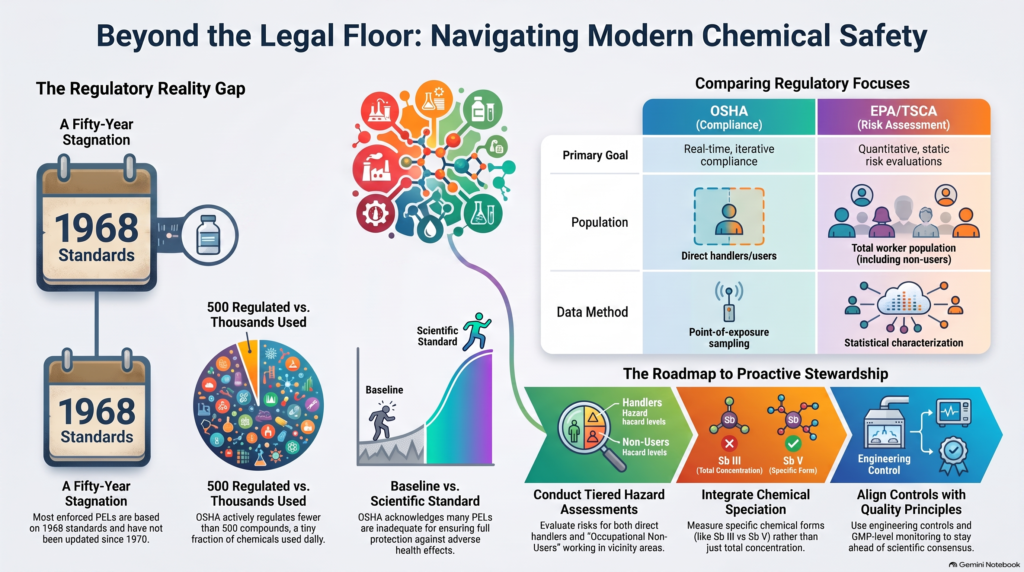
When I consult for chemical firms navigating regulatory strategy, I am constantly reminded of a troubling structural gap in environmental policy. While OSHA’s Permissible Exposure Limits (PELs) were designed as a crucial legal safeguard to shield industrial workers from toxic air contaminants, the reality on the ground is stark. Most enforced PELs stem from standards set in 1968, adopted wholesale under the 1970 OSH Act, and have remained untouched for over half a century. In my twelve years bridging chemical science and industrial compliance, I’ve watched toxicological research advance dramatically while our federal regulatory floor remains largely frozen.
Fewer than 500 chemical compounds are actively regulated under these federal limits—a tiny fraction of the thousands used daily across modern manufacturing and research facilities. Relying solely on basic OSHA compliance often leaves facilities operating under false assumptions of safety.
Modern chemical stewardship demands that we view federal PELs as a absolute legal baseline rather than a true scientific standard. Protecting workers requires understanding not just what the law mandates, but how those limits were derived, where they fall short, and how forward-thinking industrial compliance strategies must evolve to integrate modern toxicological data, proactive hazard management, and advanced risk assessment methods.
OSHA’s regulated exposure limits for chemical compounds play a pivotal role in protecting you from hazardous exposure in the workplace. These permissible exposure limits (PELs) are based on scientific research and are designed to prevent adverse health effects during an eight-hour workday. By adhering to these limits, employers create a safer work environment, reducing risks of chronic illnesses and boosting morale. Understanding these regulations guarantees compliance and safety; further insights will enhance your awareness of workplace protections.
KEY TAKEAWAYS
- OSHA establishes permissible exposure limits (PELs) to prevent harmful health effects from hazardous chemical exposure in the workplace.
- PELs are scientifically derived, ensuring they reflect safe concentration levels based on thorough toxicological research.
- Compliance with PELs reduces the risk of chronic illnesses and enhances overall worker health and performance.
- Adhering to OSHA’s exposure limits fosters a culture of safety, boosting employee morale and trust in the organization.
- Maintaining compliance mitigates legal liabilities and promotes a proactive approach to workplace safety and employee welfare.
UNDERSTANDING OSHA’S ROLE IN WORKPLACE SAFETY
When you consider workplace safety, it’s essential to recognize OSHA’s pivotal role in establishing and enforcing standards that protect employees from hazardous conditions.
OSHA regulations serve as a framework, ensuring that workplace standards aren’t only set but also adhered to across various industries. These regulations mandate that employers assess risks and implement necessary safety measures, fostering an environment where safety is prioritized.
By actively engaging in compliance, companies not only mitigate legal liabilities but also enhance productivity and morale among workers. With OSHA’s guidance, organizations can navigate the complexities of workplace safety, ultimately safeguarding their most valuable asset: their workforce.
Understanding these regulations equips you to advocate for a safer, more efficient work environment, reinforcing your position of influence in your organization.
What Are OSHA Exposure Limits for Chemicals?
How do OSHA exposure limits for chemicals guarantee worker safety? OSHA recognizes that many of its permissible exposure limits (PELs) are outdated and inadequate for ensuring protection of worker health. Most of OSHA’s PELs were issued shortly after adoption of the Occupational Safety and Health (OSH) Act in 1970, and have not been updated since that time. Section 6(a) of the OSH Act granted the Agency the authority to adopt existing Federal standards or national consensus standards as enforceable OSHA standards. Most of the PELs contained in the Z-Tables of 29 CFR 1910.1000 were adopted from the Walsh-Healy Public Contracts Act as existing Federal standards for general industry. These in turn had been adopted from the 1968 Threshold Limit Values (TLVs®) of the American Conference of Governmental Industrial Hygienists (ACGIH®). Some consensus standards from the American Standards Association were also adopted at that time, following the 6(a) procedures. Comparable PELs were adopted for shipyards (29 CFR 1915.1000) and construction (29 CFR 1926.55).
OSHA establishes permissible exposure limits (PELs) that dictate the maximum concentration of hazardous chemicals in the workplace. These limits are grounded in extensive research and aim to prevent adverse health effects from chemical exposure.
By adhering to these safety standards, employers actively reduce risks and protect their workforce. Each PEL reflects a threshold that shouldn’t be exceeded during an eight-hour workday, ensuring that workers remain safe from chronic health issues.
You wield the power to enforce these limits, fostering a culture of safety and compliance. Understanding and implementing OSHA’s exposure limits not only safeguards your employees but also fortifies your organization against liability and enhances overall workplace productivity.
The Science Behind Chemical Exposure Limits
OSHA’s permissible exposure limits (PELs) are grounded in rigorous scientific research that evaluates the potential health risks associated with chemical exposure. Toxicity data is used to establish Occupational Exposure Limits (OELs), which define the maximum permissible concentration of hazardous substances in workplace air. In the United States, these limits are primarily regulated by the Occupational Safety and Health Administration (OSHA) under federal law, though states like Louisiana, which operate under federal OSHA jurisdiction, follow these national standards directly. OELs are designed to protect workers from adverse health effects over the course of a working lifetime.
These limits are established through extensive exposure assessments, which analyze various factors, including chemical toxicity, duration of exposure, and the specific context of workplace environments.
By synthesizing data from toxicological studies and epidemiological evidence, OSHA creates PELs that reflect the threshold at which workers can operate safely without significant health risks.
Understanding chemical toxicity is essential, as it informs the risk assessment process, enabling you to evaluate the hazards associated with each active ingredient and implement effective control measures to safeguard employee well-being.
Ultimately, these scientifically driven limits empower you to maintain a safe workplace while minimizing the adverse effects of hazardous chemical exposure.
How OSHA Exposure Limits Protect Workers’ Health
Ensuring workplace safety hinges on the implementation of OSHA’s exposure limits, which are designed to shield workers from the harmful effects of hazardous chemicals. The Permissible Exposure Limit is a standard set by OSHA establishing safe levels of exposure to a hazardous substance. These legally-enforceable limits currently apply to fewer than 500 chemicals used in commercial products, industry, and research. Many stakeholder organizations (including OSHA itself) consider the current PELs to be outdated, as most were established shortly after OSHA’s creation in 1970.
These limits are essential for maintaining worker health and ensuring chemical safety in various industries. By adhering to these standards, you can expect:
- Reduced risk of chronic illnesses linked to chemical exposure.
- Enhanced mental clarity and performance in high-stakes environments.
- Increased employee morale, knowing their safety is prioritized.
- Long-term cost savings through decreased healthcare expenses and absenteeism.
OSHA’s rigorous standards empower you to create a safer workplace, reinforcing your commitment to protecting your most valuable asset—your workforce.
Prioritizing these exposure limits isn’t just compliance; it’s a strategic move towards sustainable operational excellence.

WHY COMPLIANCE WITH OSHA EXPOSURE LIMITS MATTERS
In my professional practice, one of the most persistent hurdles for chemical facilities is managing the gap between old federal regulations and modern hazard assessments. The science of exposure modeling has advanced tremendously, yet companies frequently find themselves caught between overlapping framework requirements. For instance, while OSHA sampling focuses on routine, point-of-exposure workplace compliance near existing limits, modern framework mandates such as EPA risk evaluations under TSCA require a far broader statistical understanding of population-wide exposure, including non-handling personnel.
Furthermore, simply measuring total airborne concentration is no longer enough for complex inorganic compounds or novel chemical mixtures. Recent toxicological findings, such as speciation research on antimony additives or the physiological limitations of biomonitoring for essential metals like copper, illustrate that exposure dynamics are rarely simple linear equations.
Chemical compliance strategy must go beyond reactive monitoring. Employers need comprehensive, evidence-based data that accounts for chemical speciation, physical workplace dynamics, and exact job functions. Aligning engineering controls with rigorous quality principles much like managing controlled drug active substance regulations to shield personnel allows organizations to protect their workforce effectively while mitigating long-term regulatory exposure across multiple governing bodies.
Compliance with OSHA exposure limits isn’t just a regulatory obligation; it’s a fundamental aspect of effective risk management in any workplace handling hazardous substances.
Adhering to these limits demonstrates your commitment to worker advocacy, ensuring that employees operate in an environment where their health is prioritized.
Regulatory compliance not only mitigates the risk of occupational illnesses but also safeguards your organization against potential legal repercussions and financial liabilities, reflecting principles similar to controlled drug active substance regulations that emphasize protecting workers and the public.
By prioritizing adherence to OSHA standards, you create a culture of safety that fosters employee trust and enhances productivity.
Ultimately, compliance isn’t merely about meeting minimum requirements; it’s about establishing a proactive stance in protecting your workforce while reinforcing your organization’s integrity and reputation within the industry.
Key Steps for Employers to Ensure Compliance
To maintain compliance with OSHA exposure limits, employers must adopt a structured approach that includes regular assessments, training, and monitoring.
Here are key steps to guarantee your organization meets these critical standards:
- Conduct thorough hazard assessments** to identify potential chemical risks in the workplace.
- Implement extensive employee training** programs that emphasize safe handling and awareness of hazardous substances.
- Monitor exposure levels consistently to guarantee they remain within OSHA limits, using appropriate detection methods.
- Regularly review and update safety protocols to adapt to new regulations or changes in workplace conditions, following quality management principles similar to GMP compliance for active pharmaceutical ingredients in highly regulated industries.
Where to Find the Latest OSHA Resources
How can you stay updated on the latest OSHA resources? To effectively manage compliance and guarantee workplace safety, accessing up-to-date regulatory updates is essential. Utilize the following sources to enhance your knowledge and safeguard your workforce:
| Resource Type | Description | Access Link |
| OSHA Website | Official portal for regulations and updates | osha.gov |
| OSHA News Releases | Timely announcements on changes | newsroom |
| Compliance Assistance | Guidance documents and tools for employers | compliance assistance |
| Training Programs | Educational resources and webinars | training |
| E-newsletter | Monthly updates on OSHA activities | subscribe |
Stay informed and proactive to protect your workforce effectively.

RELATED STUDIES ABOUT OSHA REGULATED CHEMICAL COMPOUNDS EXPOSURE LIMITS
In the balance between productivity and safety, OSHA’s exposure limits serve as a critical safeguard against hazardous chemicals. While the allure of increased output may tempt some employers to overlook these regulations, the potential health risks to workers cannot be underestimated. By prioritizing compliance, you not only protect your workforce but also enhance overall morale and productivity. Ultimately, investing in safety isn’t just about following the law; it’s about fostering a culture where health and efficiency coexist.
TSCA risk evaluation-directed characterization of occupational exposures during formaldehyde manufacturing, use as an intermediate, and compounding of formaldehyde-based polymers
The U.S. Environmental Protection Agency (EPA), under the Toxic Substances Control Act (TSCA) as amended by the Lautenberg Act, now conducts quantitative risk evaluations for high-priority chemicals, which include assessing worker exposures. This creates overlapping regulatory authority with the Occupational Safety and Health Administration (OSHA). While OSHA-required monitoring focuses on compliance and reducing exposures near permissible limits, TSCA risk evaluations require a statistical characterization of the entire worker population, including Occupational Non-Users (ONUs)—those who do not handle the chemical but work in areas where it is present.
Case Study: Celanese Formaldehyde Facility
To address the need for fit-for-purpose exposure data, Celanese Corporation supplemented its routine OSHA compliance sampling with a comprehensive, one-time monitoring program at its U.S. formaldehyde manufacturing facility.
- Study Design: The study characterized formaldehyde exposures for all job categories, including formaldehyde manufacturing workers, chemical intermediate workers, POM compounding operators, and administrative staff (ONUs).
- Methodology: A total of 126 full-shift monitoring results were collected using passive diffusion badges (AssayTech N571) and analyzed using high-performance liquid chromatography. The data were statistically evaluated to determine median (50th percentile) and upper-95th percentile exposures.
- Compliance: Results demonstrated that all worker populations remained in compliance with the OSHA Formaldehyde Standard (29 CRF 1910.1048), with exposures below the Permissible Exposure Limit (PEL) and Short-Term Exposure Limit (STEL).
Key Findings
- Data Reliability: The study provided a statistically valid, quantitative distribution of exposures across all employee groups. This approach avoids the limitations of relying on worst-case maximum concentration data, which has been a common challenge in prior TSCA risk evaluations.
- ONU Exposures: Empirical monitoring revealed that ONU exposures were at or below average indoor air concentrations (mean of 0.011 ppm), significantly lower than the levels measured in formaldehyde manufacturing areas. This suggests that prior EPA assumptions estimating ONU exposure at 50% of manufacturing worker levels may have been overly conservative.
- Dual Regulatory Challenge: The study highlights that because OSHA and EPA have distinct regulatory frameworks—OSHA focusing on real-time, iterative compliance and EPA on static risk assessment—manufacturers must ensure their monitoring programs satisfy both agencies’ needs.
Conclusions for Industry
The authors conclude that manufacturers should design exposure monitoring programs that provide robust, statistically-based data rather than relying on unvalidated models or worst-case assumptions. Such data is essential for supporting science-based decision-making under TSCA and helps reduce the regulatory uncertainty associated with the overlapping authorities of OSHA and the EPA.
| REFERENCE: James H. Sherman, Gary M. Rowen, J. Tyler Tanniehill, TSCA risk evaluation-directed characterization of occupational exposures during formaldehyde manufacturing, use as an intermediate, and compounding of formaldehyde-based polymers, Regulatory Toxicology and Pharmacology, Volume 132, 2022, 105173, ISSN 0273-2300, https://doi.org/10.1016/j.yrtph.2022.105173. (https://www.sciencedirect.com/science/article/pii/S0273230022000605) |
Biomonitoring for workplace exposure to copper and its compounds is currently not interpretable
This paper evaluates the feasibility of using human biomonitoring to assess occupational exposure to copper and its inorganic compounds. While environmental monitoring of ambient air is standard practice for comparing workplace levels against occupational exposure limits, biological monitoring has the potential to provide complementary data on internal dose by accounting for intra-individual variability and exposure through all routes (inhalation, ingestion, and dermal).
Requirements for Reliable Biomonitoring
For biomonitoring to be considered a reliable tool for occupational health risk assessment, specific criteria must be met. These include:
- The identification of a sensitive and specific biomarker.
- The ability to measure the biomarker with sufficient analytical sensitivity.
- A clear understanding of the dose-response relationship between external exposure and biomarker levels, or between the biomarker and health effects.
- Knowledge of the substance’s toxicokinetics (half-life) to determine accurate sampling times.
Challenges with Copper Biomonitoring
The study concludes that reliable biomonitoring for occupational copper exposure is not currently possible due to the following factors:
- Essential Nature and Homeostatic Control: Unlike non-essential metals where biomarker levels often correlate linearly with exposure, copper is an essential micronutrient under strict homeostatic control. This regulation complicates the relationship between external exposure and internal biological levels, often masking moderate increases in exposure.
- Lack of Reliable Biomarkers: Existing research indicates that total copper levels in blood, serum, plasma, and urine are not reliable indicators of airborne occupational exposure. Plasma and serum levels are more reflective of nutritional status (deficiency vs. sufficiency) than of excess occupational exposure, and high inter-individual variability (influenced by age, sex, and hormonal factors) further limits their utility.
- Complex Matrices: While hair, fingernails, and toenails are being evaluated as non-invasive matrices for long-term exposure assessment, they present significant analytical challenges—including potential exogenous contamination and a lack of standardized protocols—that currently limit their use in routine occupational monitoring.
Regulatory and Occupational Perspective
Currently, no established biological exposure guidance values exist for copper. While authoritative bodies such as the American Conference of Governmental Industrial Hygienists (ACGIH) have indicated they are considering the development of a biological exposure index (BEI®) for copper, previous evaluations by organizations like the European Commission’s Scientific Committee on Occupational Exposure Limits (SCOEL) and the German MAK Commission have concluded that deriving such values is not indicated due to the lack of a measurable relationship between external exposure and systemic internal dose.
In summary, the authors conclude that because copper’s essential biological role maintains levels within a homeostatic range even under increased exposure, current biomonitoring methods cannot reliably distinguish occupational burdens from physiological background levels. Therefore, biomonitoring for copper is not currently a viable application for risk assessment or worker protection programs.
| REFERENCE: Ruth Bevan, Len Levy, Biomonitoring for workplace exposure to copper and its compounds is currently not interpretable, International Journal of Hygiene and Environmental Health, Volume 258, 2024, 114358, ISSN 1438-4639, https://doi.org/10.1016/j.ijheh.2024.114358. (https://www.sciencedirect.com/science/article/pii/S1438463924000397) |
Occupational exposure to antimony from cement additives: Speciation and health risk insights
Antimony (Sb) is an emerging environmental contaminant of concern due to its toxicity, bioaccumulation potential, and persistence. Its trivalent form, Sb(III), is particularly significant as it is classified as a suspected human carcinogen. While Sb-based additives are increasingly used in the cement industry to mitigate the levels of highly toxic, water-soluble hexavalent chromium [Cr(VI)], occupational exposure and chemical speciation during cement handling have remained poorly characterized.
Key Findings
- Analytical Workflow Development: The study developed and validated a robust analytical method combining citric acid-EDTA extraction with HPLC-ICP-MS/MS detection. This workflow allows for the accurate differentiation and quantification of Sb(III) and Sb(V) in complex industrial matrices, such as commercial additives, premixed cements, and airborne particulate matter.
- Sb(III) Predominance: Speciation analysis confirmed that Sb(III) is the predominant species in both bulk materials and airborne dust generated during dry cement bagging. In premixed cement samples, Sb(III) accounted for approximately 76–78% of the total antimony recovered.
- Low Exposure Risk: Personal air filter samples collected from workers during bagging operations showed that airborne Sb concentrations were consistently low, ranging from 0.00004 to 0.00114 mg~m^{-3}. These levels remain well below international occupational exposure limits (OELs), such as the ACGIH threshold limit value of 0.5 mg~m^{-3}.
- Speciation Importance: The study underscores that total Sb quantification alone may be insufficient for interpreting workplace exposure scenarios. The chemical form of antimony—specifically the predominance of the more toxic Sb(III) species—is critical for accurate risk assessment, even when total concentrations are within regulatory thresholds.
Insights for Risk Management
Although observed airborne concentrations were well below regulatory thresholds, the detection of isolated elevated values highlights the necessity for continuous workplace monitoring and individualized risk assessment. The researchers conclude that the validated analytical workflow provides a practical, evidence-based approach for monitoring antimony species in cement production environments. This method supports not only the assessment of occupational exposure but also the future design of safer, more sustainable cement additives.
| REFERENCE: Maria Chiara Fontanella, Elena Serena, Davide Guarascio, Gian Maria Beone, Occupational exposure to antimony from cement additives: Speciation and health risk insights, Chemosphere, Volume 399, 2026, 144894, ISSN 0045-6535, https://doi.org/10.1016/j.chemosphere.2026.144894. (https://www.sciencedirect.com/science/article/pii/S0045653526000718) |
CONCLUSION
Navigating workplace safety in today’s evolving chemical industry requires a fundamental shift in how we approach compliance. As an advisor who spent years studying chemical risk, I urge industrial leaders not to view OSHA compliance as a static checklist. The structural reality is that statutory regulatory updates lag far behind scientific consensus; waiting for federal policy to catch up with modern toxicological data is a strategy fraught with legal and ethical risks.
True sustainable chemical compliance relies on building flexible, science-backed risk management programs within your operational model. By adopting updated consensus recommendations such as ACGIH Threshold Limit Values implementing robust local exhaust engineering controls, and conducting regular job-specific exposure assessments, facility managers can safeguard employee health far more effectively than federal baselines alone allow.
Beyond legal protection, prioritizing health and exposure management builds operational resilience, protects company credibility, and cultivates a workplace culture grounded in respect and safety. Chemical safety is not merely about staying out of regulatory crosshairs; it is an active investment in workforce longevity, organizational integrity, and long-term industrial success.
