
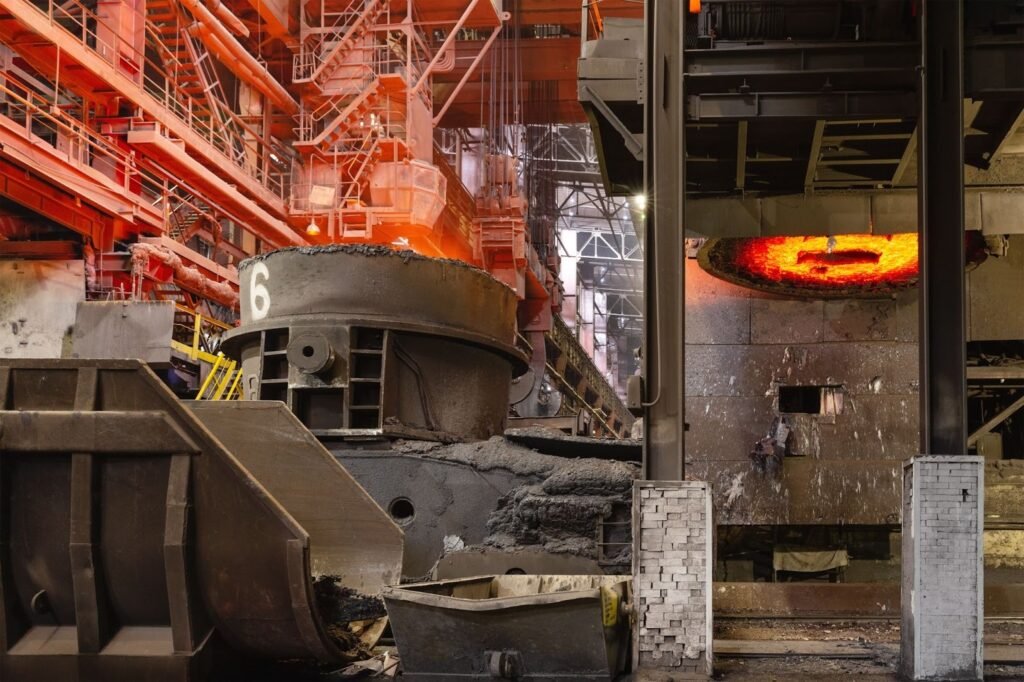
Whenever I walk into a modern foundry or a heavy metallurgical plant, I am instantly reminded of why I fell in love with materials science in the first place. There is an undeniable poetry to the sheer scale of primary metal extraction, a raw power that stands in stark contrast to the nanoscale structural manipulation I spend my days analyzing in the research lab. In my own work with advanced additive manufacturing and nanostructured alloys, we are constantly pushing the boundaries of material behavior at the microscopic level. Yet, none of our sophisticated component tailoring would even be possible without the foundational, macroscopic workhorse of metallurgy: the smelting furnace.
These industrial giants are where the life cycle of every critical engineering component truly begins. From the structural steel that forms the backbone of our cities to the high-performance alloys required by the aerospace and automotive sectors, the journey starts inside a high-temperature reactor designed to alter chemical states and break atomic bonds.
Understanding the unique operational mechanics, heat transfer efficiencies, and metallurgical roles of these different furnace systems isn’t just an academic exercise, it is the very bedrock of modern infrastructure and industrial scaling. Let’s take a closer look at the primary thermal powerhouses driving contemporary metallurgy and shaping the raw materials of tomorrow.
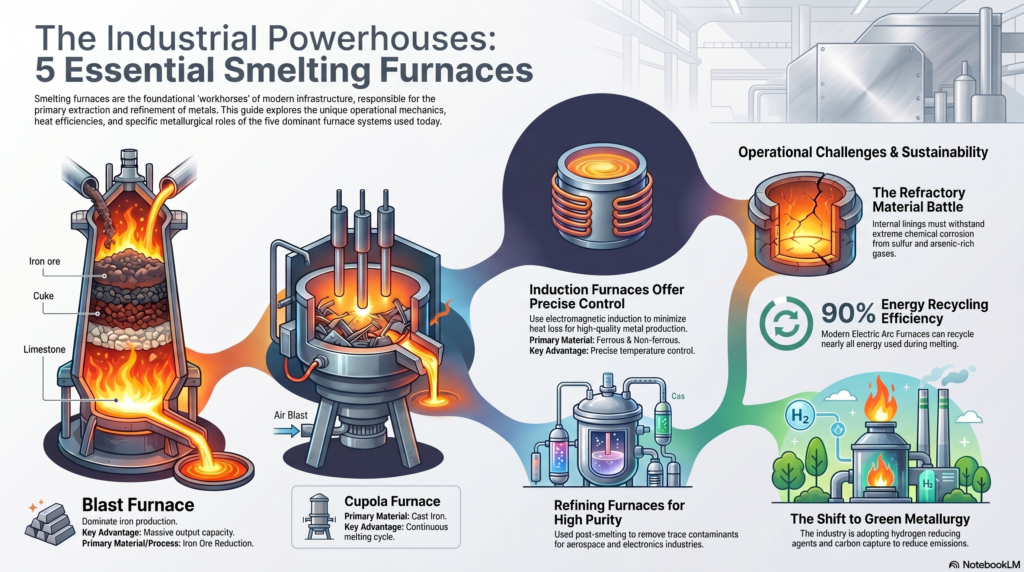
The top five types of smelting furnaces in modern metallurgy are the blast furnace, electric arc furnace, induction furnace, cupola furnace, and refining furnace. The blast furnace is essential for iron production, utilizing coke combustion to generate carbon monoxide at high temperatures. The electric arc furnace is efficient for melting scrap steel with rapid turnaround. Induction furnaces, using electromagnetic induction, minimize heat loss for diverse metals. The cupola furnace continuously melts cast iron, while refining furnaces specialize in purifying metals through controlled oxidation and reduction processes. Understanding each furnace’s unique attributes reveals their crucial roles in contemporary metallurgy.
KEY TAKEAWAYS
- Blast Furnace: Essential for iron production, it operates at high temperatures, generating carbon emissions and exploring carbon capture technologies.
- Electric Arc Furnace: This furnace melts scrap steel efficiently with high-voltage electricity, achieving impressive energy recycling rates and fast production times.
- Induction Furnace: Utilizing electromagnetic induction, it melts metals with minimal heat loss and precise temperature control, suitable for both ferrous and non-ferrous metals.
- Cupola Furnace: A continuous melting system for cast iron, it layers materials for optimal melting and is cost-effective due to coke fuel use.
- Refining Furnace: Focused on purifying metals post-smelting, it employs various methods to ensure high purity levels, crucial for industries requiring precision.
BLAST FURNACE
Typically, a blast furnace serves as a critical component in the metallurgical process of iron production. This towering structure, often exceeding 30 meters in height, operates on the principle of counter-current heat exchange, facilitating the reduction of iron ore into molten iron through the application of high temperatures, typically exceeding 1,500 degrees Celsius. Inside the blast furnace, iron ore, coke, and limestone are introduced in a layered manner, creating an active ingredient hub where heat, chemical reactions, and material flow interact to efficiently reduce iron ore into molten iron. The combustion of coke generates carbon monoxide, which acts as a reducing agent, removing oxygen from the iron ore.
The efficiency of the blast furnace is pivotal not only for maximizing iron yield but also for addressing the environmental impact of the iron production process. Traditional blast furnaces contribute markedly to carbon emissions, primarily due to the combustion of fossil fuels and the inherent carbon content of coke. As global initiatives push for reduced carbon footprints, the industry is increasingly scrutinized for its practices. Aluminum smelting furnaces mainly include reverberatory furnaces, rotary drum furnaces and induction furnaces, etc.
Advanced technologies are emerging to mitigate these emissions, including carbon capture and storage (CCS) and the use of alternative reducing agents like hydrogen. However, the conventional blast furnace remains a dominant method in iron production, largely due to its established infrastructure and considerable output capacity.
Electric Arc Furnace
From a materials engineering perspective, looking at these furnaces solely as melting pots misses the most fascinating part of the equation: the extreme environment inside the reactor and the constant battle to preserve structural integrity. Whether we are discussing the continuous charging process of a cupola furnace or the rapid melting cycles of an electric arc furnace, the structural longevity of these systems depends entirely on thermodynamics and advanced refractory materials. In my research, I often examine how metallic microstructures degrade under high-temperature fatigue, and the degradation mechanisms inside an industrial smelting furnace are remarkably severe.
Recent metallurgical studies deeply underscore this reality. For instance, when analyzing magnesia-chromite refractory bricks in copper flash smelting systems, researchers have identified that complex chemical interactions with arsenic-rich speiss can cause severe intergranular corrosion and grain size reduction, drastically cutting the lining’s service life.
Similarly, in nickel flash smelting environments, thermal gradients drive the diffusion of volatile impurities while direct exposure to sulfur-rich gases triggers deep sulfation, resulting in volume expansion and destructive internal cracking. Even the fluid dynamics and particle aggregation behavior inside a flash furnace must be meticulously modeled using coupled CFD-PBM systems to balance chemical oxidation with operational efficiency. For anyone working in metallurgy, optimizing these thermal kinetics and mitigating refractory wear is an ongoing, high-stakes challenge.
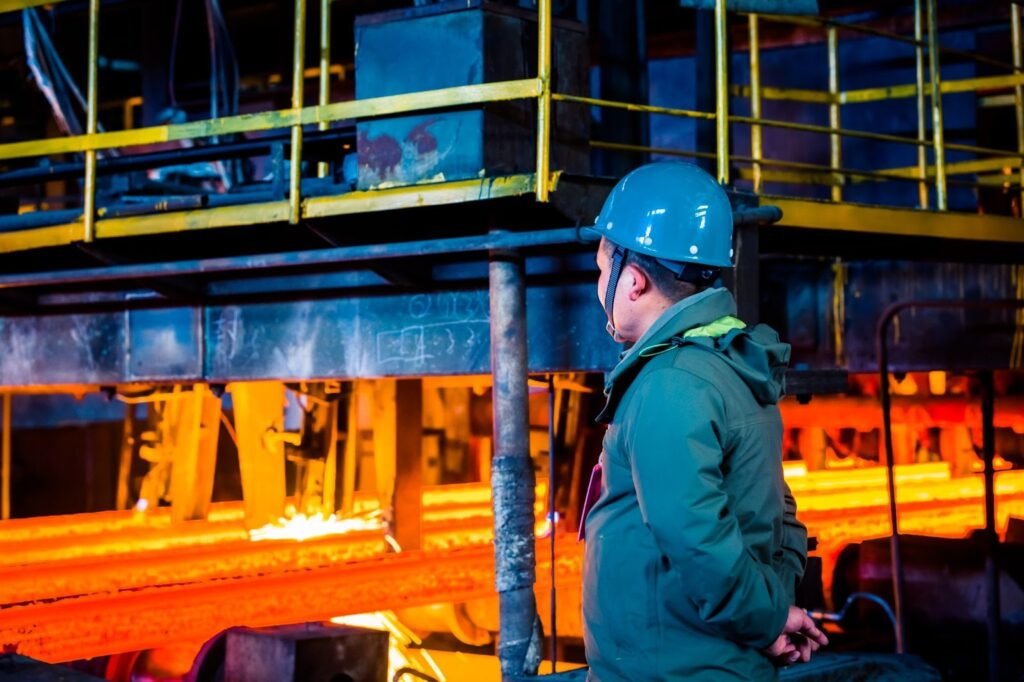
The Electric Arc Furnace (EAF) revolutionizes steel production by utilizing high-voltage electricity to generate intense heat, melting scrap steel and other metallic inputs. This method is not only efficient but also aligns with modern sustainability goals, offering a means to recycle materials effectively. EAFs are characterized by their flexibility in production and ability to considerably reduce greenhouse gas emissions compared to traditional methods.
Key features of Electric Arc Furnaces include:
- Energy Efficiency: EAFs are capable of achieving high energy efficiency, with some systems recycling up to 90% of the energy used during the melting process.
- Rapid Production Cycle: The EAF can produce molten metal within a few hours, enabling manufacturers to respond swiftly to market demands.
- Adaptability: They can handle a variety of metallic inputs, from scrap steel to direct reduced iron, making them versatile in a fluctuating market.
- Enhanced Safety Measures: Modern EAFs incorporate advanced safety protocols, such as automated controls and monitoring systems, to minimize risks associated with high-voltage operations and molten metal handling.
Induction Furnace
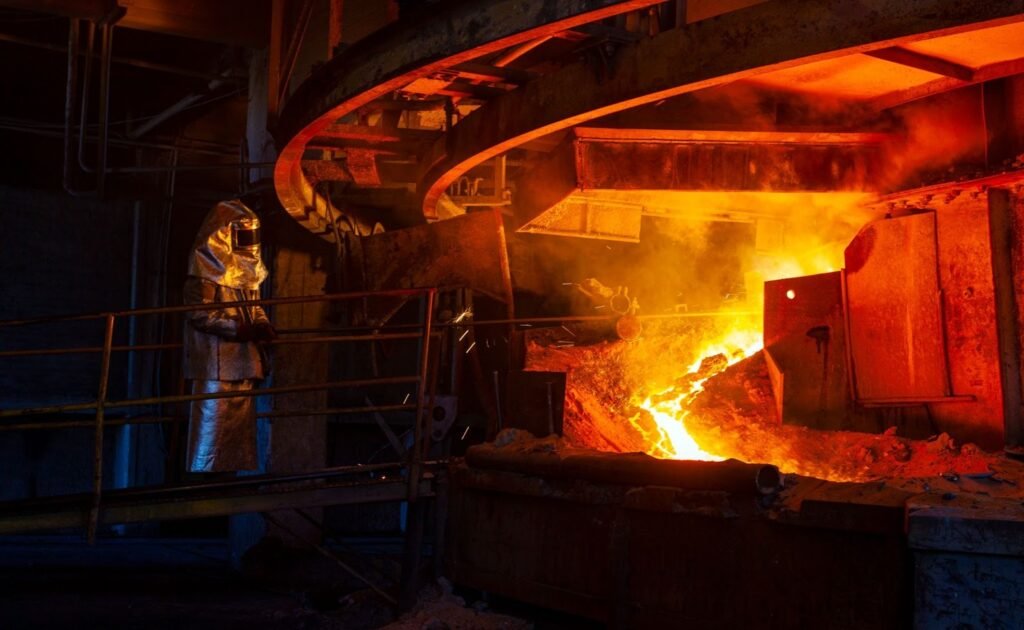
Induction furnaces represent a significant advancement in metallurgical processing, employing electromagnetic induction to generate heat for melting metals. This process utilizes alternating current to create a magnetic field, which induces electric currents within conductive materials. The result is efficient induction heating of the metal, allowing for rapid melting and precise temperature control. Metallurgy played a pivotal role in the Industrial Revolution, a transformative period of technological advancements and industrial growth that began in the late 18th century.
One of the defining characteristics of induction furnaces is their high furnace efficiency. Unlike traditional furnaces, which rely on direct fuel combustion or resistance heating, induction furnaces minimize heat loss and optimize energy usage by heating the metal directly. This results in a more effective conversion of electrical energy into thermal energy, with electromagnetic induction serving as the active ingredient that enables rapid melting and precise temperature control. Additionally, the ability to control the melting process with precision reduces the risk of oxidation and contamination, which is critical in producing high-quality metals.
Induction furnaces are especially advantageous for melting ferrous and non-ferrous metals, including steel, aluminum, and copper. The versatility of these furnaces makes them suitable for various applications, from small-scale foundries to large-scale industrial operations. Moreover, they can accommodate different melting capacities, ranging from a few kilograms to several tons, catering to diverse production needs.
CUPOLA FURNACE
The primary purpose of matte smelting is to melt and recombine the charge into a homogeneous matte of metallic copper, nickel, cobalt, and iron sulfides and to give an iron and silicon oxide slag. It is done in many types of furnace on both roasted or unroasted sulfide feed material. Although often overshadowed by more modern melting technologies, the cupola furnace remains an essential component in the foundry industry, particularly for the melting of cast iron. This vertical cylindrical furnace operates continuously and efficiently, enabling the production of large quantities of molten metal. Its design and methodology, rooted in traditional metallurgy, exemplify the balance between time-honored practices and contemporary needs.
The effectiveness of the cupola furnace can be attributed to several key factors:
- Charging Process: The furnace utilizes a systematic charging process that layers raw materials, such as coke, cast iron scrap, and fluxes, allowing for ideal melting and refining during operation.
- Refractory Materials: The inner lining of the cupola is constructed with high-quality refractory materials, which withstand extreme temperatures and reduce thermal losses, ensuring the longevity of the furnace.
- Fuel Efficiency: By employing coke as a fuel source, the cupola furnace promotes efficient combustion, contributing to lower operational costs and reduced environmental impact.
- Versatility: The furnace can melt various alloys and scrap materials, making it an adaptable choice for different foundry applications.
Refining Furnace
A refining furnace plays a critical role in the metallurgical process, primarily focused on purifying metals by removing impurities and unwanted elements. This essential equipment is employed after the primary Smelting process, where ore is transformed into crude metal before undergoing further purification. The refining furnace operates under controlled conditions to enhance metal purity, guaranteeing that the final product meets stringent industry standards.
Typically, refining furnaces utilize various methods, including oxidation, reduction, and electrolysis, to achieve desired metal characteristics. In oxidation refining, for example, impurities are selectively oxidized and removed as gaseous byproducts. Conversely, reduction techniques may involve the introduction of reactive agents that bond with and extract impurities, enhancing the overall quality of the metal. The choice of method is influenced by the specific type of metal being refined and the nature of the impurities present.
The refining process is critical in industries such as aerospace, automotive, and electronics, where even trace contaminants can markedly affect performance and longevity. As a result, attaining high levels of metal purity is paramount. Advanced refining furnaces are equipped with sophisticated monitoring systems to provide excellent control over temperature and chemical reactions, thereby maximizing efficiency and minimizing waste.
RELATED STUDIES ABOUT SMELTING FURNACE
To summarize, the diverse range of smelting furnaces utilized in modern metallurgy, including the blast furnace, electric arc furnace, induction furnace, cupola furnace, and refining furnace, each serve distinct purposes and exhibit unique operational characteristics. These advanced technologies, akin to the alchemical practices of ancient scholars, facilitate the efficient extraction and refinement of metals, ultimately driving innovations in various industrial applications. The continuous evolution of smelting processes underscores the importance of these furnaces in meeting the demands of contemporary metallurgy.
Post-Mortem Investigation of Magnesia-Chromium Brick Corrosion by Speiss in a Copper Smelting Furnace
This study investigates the degradation mechanisms of magnesia-chromite (MgCr) refractory bricks in copper flash smelting furnaces, specifically focusing on the corrosive effects of arsenic-rich copper speiss. The research aims to understand how high-arsenic feedstocks contribute to refractory wear, which is increasingly relevant as global copper ores become more arsenic-contaminated.
Key Findings:
- Speiss Formation and Penetration:
- High-grade, arsenic-rich copper matte can form liquid copper-arsenic speiss through either cooling (Scheil solidification) or partial oxidation in the furnace settler.
- This speiss has a low solidus temperature and high density, enabling it to penetrate deeply into the porous MgCr refractory lining.
- Corrosion Mechanism.
- Under non-oxidizing conditions, speiss penetrates without significant chemical reaction, filling pores and solidifying within the refractory. Penetration halts near the eutectic temperature of the Cu–Cu₂S–Cu₃As subsystem (~683°C).
- Under oxidizing conditions (e.g., exposure to air infiltrating from the cold face), arsenic in the speiss is selectively oxidized and reacts with MgO from the refractory to form magnesium arsenate phases.
- These arsenates have lower melting points than the original refractory phases and form preferentially along grain boundaries, leading to intergranular corrosion, grain size reduction, and loss of structural integrity.
- Microstructural Evidence:
- Unoxidized samples showed pores filled with speiss, domeykite (Cu₃As), digenite (Cu₂S), and Pb–Bi alloys, but no chemical corrosion.
- Oxidized samples exhibited extensive formation of magnesium–lead–calcium arsenates, particularly near cold faces exposed to oxygen, resulting in severe degradation of magnesia-wustite grains.
- Operational Impact:
- Speiss penetration and subsequent arsenate formation significantly reduce the spalling resistance and service life of MgCr refractories.
- The location of deposits—especially in areas exposed to oxidizing slag/gas interfaces—accelerates refractory wear.
Conclusions:
The study demonstrates that arsenic-rich speiss is a major contributor to refractory corrosion in modern copper smelters. While penetration alone can reduce refractory performance, oxidation-driven formation of magnesium arsenates poses a more severe threat through intergranular degradation. These insights highlight the need for improved refractory materials or operational strategies to mitigate arsenic-related wear in high-arsenic smelting environments.
Implications for Industry:
- Refractory selection and furnace design should account for arsenic content in feed materials.
- Monitoring and controlling oxygen infiltration in refractory linings may help reduce arsenate formation.
- Further research into arsenic-resistant refractory compositions or protective coatings is recommended.
| REFERENCE: X. Wen, M. Shevchenko, D. Gregurek, J. Schmidl, L. Konrad, R. Walton, E. Jak, Post-mortem investigation of magnesia-chromium brick corrosion by speiss in a copper smelting furnace, Ceramics International, Volume 51, Issue 10, 2025, Pages 12489-12504, ISSN 0272-8842, https://doi.org/10.1016/j.ceramint.2025.01.091. (https://www.sciencedirect.com/science/article/pii/S0272884225000902) |
Interactions of Sulfur-Containing Gas with Magnesia-Chromite Refractory in a Nickel Flash Smelting Furnace
This study investigates the degradation mechanisms of magnesia-chromite (MgCr) refractory bricks in the gas zone of a nickel flash smelting furnace, focusing on interactions with sulfur-rich process gases and the role of thermal gradients—a topic previously understudied in the literature.
Key Findings:
- As-Received Refractory:
- The unused refractory consists of two main phases: periclase (MgO) and chromite (Mg,Fe)(Cr,Al)₂O₄, with significant porosity (16 vol%) and microcracks that facilitate gas penetration.
- Effect of Surface Deposit:
- With a surface deposit (composed of Fe₂O₃, FeSO₄, NiSO₄, and dust), the hot end of the refractory is protected from direct sulfation. The deposit acts as an insulating layer, though sulfur species still diffuse deeper into the brick.
- Without a deposit, the hot end undergoes severe sulfation of both periclase and chromite phases due to direct exposure to SO₂/SO₃, leading to microstructural deterioration and loss of mechanical integrity.
- Sulfur Penetration and Sulfate Formation:
- Gaseous sulfur species (SO₂ and SO₃) penetrate the refractory through pores and react with MgO and CaO impurities, forming MgSO₄ and CaSO₄.
- Sulfation is more pronounced in cooler regions (cold end) where SO₃ formation is favored (below ~760°C).
- The formation of sulfates, particularly MgSO₄, leads to a fourfold increase in molar volume, potentially causing internal cracking and spalling.
- Role of Thermal Gradient:
- A steep thermal gradient exists across the refractory (≈1400°C at the hot end to cooled furnace walls).
- This gradient drives the diffusion of sulfur and impurity elements (As, K, Pb) toward the cold end, where they condense or react.
- μ-XRF analysis confirmed that As, K, and Pb migrate along the temperature gradient, though their concentrations decrease toward the cold end.
- Infiltrations from Process Feed:
- Elements from the process feed (Fe, Ni, Si) infiltrate the refractory, leading to the formation of secondary phases like NiFe₂O₄ and MgNi(SiO₄).
- This infiltration causes structural densification and alters thermal and mechanical properties, potentially promoting cracking during furnace cooldown.
- Implications for Refractory Life and Recycling:
- The presence of a surface deposit significantly extends refractory life by mitigating direct sulfation.
- Impurity accumulation (e.g., As, Pb) must be considered in the recycling of spent refractories to prevent environmental and safety issues.
- The study provides a basis for designing more resistant refractories and optimizing furnace conditions to reduce gas-phase corrosion.
Conclusions:
The degradation of MgCr refractories in nickel flash smelters is driven by sulfation reactions with SO₂/SO₃, influenced strongly by thermal gradients and the presence or absence of surface deposits. Key mechanisms include:
- Direct sulfation of periclase and chromite in deposit-free zones.
- Deep penetration of sulfur species and sulfate formation in cooler regions.
- Infiltration and reaction of process-derived elements (Fe, Ni, Si, As, Pb).
Recommendations for Industry:
- Maintain or promote the formation of protective surface deposits in the gas zone.
- Monitor and control thermal gradients to minimize sulfate formation in colder regions.
- Consider impurity accumulation in spent refractories during recycling processes.
- Further research should focus on refractory compositions with improved resistance to sulfur-bearing gases and thermal cycling.
| REFERENCE: Juho Lehmusto, Saara Söyrinki, Juha Lagerbom, Tuomas Jokiaho, Zaiqing Que, Jorma Määttä, Leena Hupa, Elina Huttunen-Saarivirta, Mari Lindgren, Interactions of sulfur-containing gas with magnesia-chromite refractory in nickel flash smelting furnace, Ceramics International, Volume 51, Issue 9, 2025, Pages 11363-11371, ISSN 0272-8842, https://doi.org/10.1016/j.ceramint.2024.12.555. (https://www.sciencedirect.com/science/article/pii/S027288422406231X) |
CFD-PBM Modeling of Gas-Particle Reactive Flow and Particle Aggregation in Flash Smelting Furnace
This study aimed to develop and validate a coupled Computational Fluid Dynamics (CFD) and Population Balance Model (PBM) to simulate gas-particle reactive flow and particle aggregation in a large-scale industrial Flash Smelting Furnace (FSF). The research focused on understanding how key operating parameters—airflow momentum ratio and injected particle size—affect particle heating, oxidation, and aggregation.
Approach:
- A two-fluid model (TFM) was used within an Eulerian-Eulerian framework to simulate inhomogeneous gas-particle flow.
- A temperature-based aggregation kernel was developed and integrated into the PBM to better capture particle evolution under high-temperature conditions.
- The model was validated using industrial experimental data from a prototype FSF, comparing particle distributed radius and growth rate.
- Simulations analyzed the effects of varying the airflow momentum ratio (distribution air to process air) and injected particle size distribution (PSD).
Key Findings:
- Model Validation:
- The CFD-PBM model using the Eulerian framework showed reasonable agreement with industrial measurements, with a relative error of only -6.9% in predicting particle growth rate at a specific sampling height.
- The new temperature-based aggregation kernel outperformed previous simplified linear models.
- Particle Behavior Under Baseline Conditions:
- Particle oxidation begins at the outer edge of the particle column and intensifies at the mid-height of the reaction shaft.
- A high-temperature region (Tf >1800K) forms due to exothermic oxidation, leading to molten particle aggregation, with particles growing to over twice their injected size.
- Effect of Airflow Momentum Ratio:
- Increasing the momentum ratio enhances particle dispersion, improving ignition and oxidation rates, especially in the lower part of the shaft.
- Reduced particle collisions and aggregation were observed, leading to smaller aggregated particles entering the settler, which supports higher smelting efficiency and feed rates.
- Effect of Injected Particle Size:
- Larger particle sizes slightly delay ignition and oxidation but do not compromise the final oxidation degree upon reaching the settler.
- Aggregation still occurs, but the growth rate decreases due to lower particle number density and collision frequency.
- Using larger particles can reduce energy consumption and dust emissions without sacrificing smelting efficiency.
Practical Implications:
- Increasing the airflow momentum ratio is recommended to improve particle dispersion and oxidation, supporting higher production rates.
- Carefully increasing the injected particle size (up to 2.5× baseline) is a feasible strategy to reduce dust emissions and energy use while maintaining process efficiency.
Conclusion:
The developed CFD-PBM model provides a realistic simulation of particle evolution in FSFs. The insights offer actionable strategies for optimizing FSF operations, balancing productivity, energy efficiency, and environmental impact.
| REFERENCE: Zhenyu Zhu, Ping Zhou, Wenke Tan, Zhuo Chen, Shibo Kuang, CFD‒PBM modeling of gas‒particle reactive flow and particle aggregation in the flash smelting furnace, International Journal of Multiphase Flow, Volume 188, 2025, 105233, ISSN 0301-9322, https://doi.org/10.1016/j.ijmultiphaseflow.2025.105233. (https://www.sciencedirect.com/science/article/pii/S0301932225001119) |
CONCLUSION
Reflecting on the sheer diversity of these thermal technologies, from the towering, historic infrastructure of the blast furnace to the highly precise, electromagnetic fields of the induction furnace, it is clear that contemporary metallurgy is undergoing a massive paradigm shift. As an engineer, I see a beautiful parallel between optimizing these massive industrial melting processes and dialing in the laser melting parameters for a complex, 3D-printed metal sculpture in my creative sandbox. Both disciplines require a flawless command over phase transformations, cooling rates, and elemental purity to achieve the desired material properties.
However, the path forward for large-scale smelting isn’t just about maximizing throughput or perfecting alloy chemistry; it is fundamentally about sustainability and efficiency. The metallurgical sector faces intense global scrutiny regarding carbon emissions and environmental impacts, which is driving brilliant innovations like carbon capture, alternative hydrogen reducing agents, and advanced energy recycling protocols.
Watching these ancient, alchemical concepts evolve into highly automated, eco-conscious systems is incredibly inspiring. The continuous refinement of these five essential furnace types proves that metallurgy remains a dynamic, ever-evolving frontier that will continue to forge the physical foundation of human innovation.