

From my perspective as a metallurgical chemist, evaluating the history of gold extraction reveals a fascinating narrative of technological evolution. Before the late 19th century, metallurgy was heavily reliant on mechanical separation and energy-intensive smelting to isolate precious metals. When the gold cyanidation process, or the MacArthur-Forrest process, was introduced, it completely shifted the paradigm of extractive metallurgy from pyrometallurgy to hydrometallurgy. It is the ultimate manifestation of chemical selectivity over brute force. Instead of expending massive amounts of thermal energy to melt tons of solid rock just to harvest a minor impurity of embedded gold, cyanidation utilizes a aqueous solution to selectively target and dissolve the gold atoms.
When I look at this process, I am reminded of how a plant’s roots selectively absorb specific micronutrients from a complex soil matrix. Nature doesn’t destroy the soil to get what it needs; it uses targeted chemistry. Cyanidation acts in much the same way, allowing us to economically process lower-grade ores that were previously dismissed as waste.
However, as a scientist who spends her weekends looking at the delicate balance of ecosystems while hiking with my dog, Luna, I know that introducing highly reactive reagents like sodium cyanide into industrial circuits requires absolute precision. The very efficiency that revolutionized global gold mining also introduced profound responsibilities regarding chemical containment and safety.
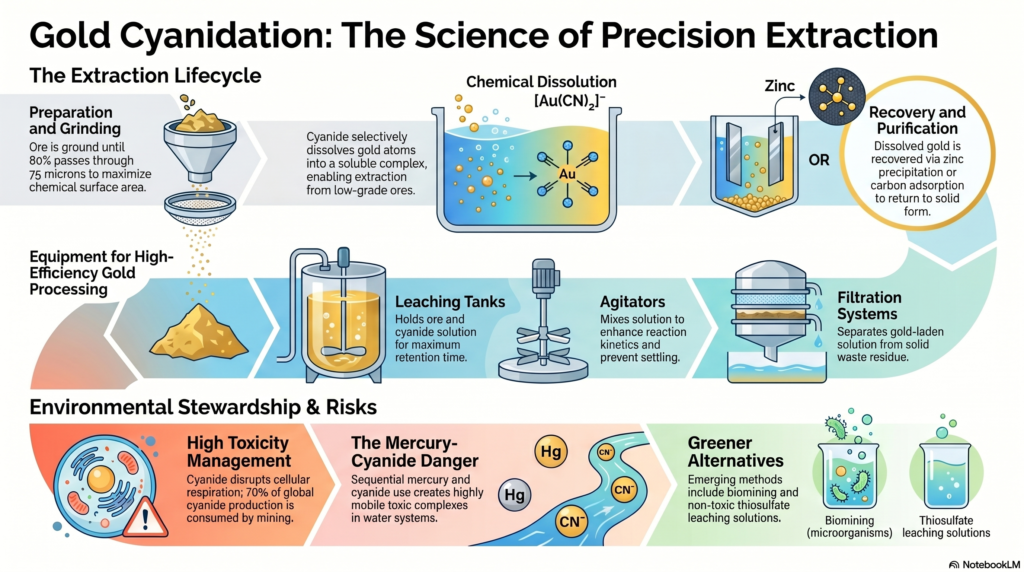
The gold cyanidation process is a method that extracts gold from ore by utilizing cyanide solutions. Initially, ore is crushed and ground to facilitate effective leaching. Next, a cyanide solution is mixed with the ore, forming a soluble gold-cyanide complex. This complex is then separated from waste materials through filtration. Finally, gold is recovered using methods such as zinc precipitation or carbon adsorption. While this process considerably enhances gold recovery rates, it also raises notable environmental and health concerns that necessitate careful management and oversight, ensuring responsible practices within the mining sector for sustainable operations.
KEY TAKEAWAYS
- Gold cyanidation involves crushing and grinding ore, followed by mixing it with a cyanide solution for effective leaching.
- The cyanide solution dissolves gold to form a soluble gold-cyanide complex, allowing for gold extraction from lower-grade ores.
- After leaching, gold-laden solution is separated from the residue through filtration or decantation methods.
- Gold is recovered from the solution via zinc precipitation or carbon adsorption, maximizing extraction efficiency.
- Proper management of cyanide waste and environmental monitoring are crucial to minimize ecological impacts during the process.
OVERVIEW OF GOLD CYANIDATION
Gold cyanidation, a widely utilized process in the extraction of gold from ore, employs cyanide solutions to dissolve and separate gold from other minerals. This method has gained historical importance since its introduction in the late 19th century, fundamentally transforming the gold mining industry. Prior to its adoption, gold extraction was limited by inefficient methods that often yielded low returns. The implementation of cyanidation allowed miners to process lower-grade ores, greatly increasing gold recovery rates and making previously unviable operations economically feasible.
The economic implications of gold cyanidation are extensive. By enabling the extraction of gold from ores with lower purity, this process has facilitated the expansion of gold mining operations worldwide. As a result, it has played a vital role in shaping local economies and contributing to global gold supply. The wealth generated through gold extraction has often translated into broader economic development, providing employment opportunities and supporting ancillary industries. However, the economic benefits must be weighed against environmental and health concerns associated with cyanide use, which has led to calls for more sustainable practices in mining.
The Chemistry of Cyanide
In the domain of gold extraction, cyanide plays a critical role as a highly effective reagent due to its unique chemical properties, serving as the active ingredient that enables gold to dissolve from ore and form a stable complex. This compound, primarily found in the form of sodium cyanide (NaCN), exhibits strong affinity for gold, enabling its dissolution from ore through a series of chemical reactions. The fundamental cyanide properties, such as its high solubility in water and its ability to form stable complexes with metal ions, are pivotal for its application in the cyanidation process.
Cyanide reacts with gold to form a soluble gold-cyanide complex, represented by the equation: Au + 2CN⁻ → [Au(CN)₂]⁻. This reaction is critical as it allows for the efficient extraction of gold from ore. The stability of the resulting complex is influenced by various factors, including pH, temperature, and the presence of other metal ions, which can either enhance or inhibit the reaction.
Furthermore, the chemistry of cyanide involves not only its interaction with precious metals but also its reactivity with various environmental factors. For instance, under alkaline conditions, cyanide remains stable, whereas under acidic conditions, it can hydrolyze to form toxic compounds such as hydrogen cyanide (HCN). Understanding these chemical reactions is essential for managing cyanide’s use in extraction processes and mitigating potential environmental impacts. Therefore, the thorough grasp of cyanide chemistry is paramount for optimizing gold recovery while ensuring safety and sustainability in mining operations.
Steps in the Cyanidation Process
Initiating the cyanidation process involves several critical steps designed to maximize gold recovery from ore. Prior to cyanidation, gold ore is often initially processed in a smelting furnace to extract and concentrate the metal, producing material suitable for subsequent chemical leaching. The first step is crushing and grinding the ore to achieve a suitable particle size, which enhances the surface area for subsequent chemical reactions. Typically, a fineness of 80% passing through 75 microns is targeted, enabling effective leaching.
Following size reduction, the ore is subjected to the cyanidation process itself, where it is mixed with a cyanide solution. This step utilizes various leaching methods, such as agitated leaching or heap leaching, depending on the ore type and operational constraints. In agitated leaching, the ore is placed in a vat and continuously stirred, promoting better contact between the cyanide and the gold-bearing minerals. Conversely, heap leaching involves stacking the ore in heaps and applying the cyanide solution, allowing gravity to facilitate the leaching process over time.
After the leaching phase, the solution containing dissolved gold is separated from the residue through techniques such as filtration or decantation. The next critical step involves the recovery of gold from the cyanide solution, generally accomplished via zinc precipitation or carbon adsorption methods. These processes convert the dissolved gold back into a solid form, enabling efficient retrieval. The cyanide process, which is also known as the Macarthur-forest process, is widely used in extracting gold or silver from the ores by dissolving them in a dilute solution of potassium cyanide or sodium cyanide.
Once gold recovery is complete, it is essential to neutralize and manage the cyanide waste to mitigate environmental impacts. To summarize, the cyanidation process comprises a series of meticulously executed steps, each pivotal in facilitating the effective extraction of gold from ore while maintaining a commitment to responsible environmental stewardship.
Equipment Used In Gold Extraction
The equipment utilized in gold extraction plays a significant role in guaranteeing the efficiency and effectiveness of the cyanidation process. Various types of machinery and technology are employed to facilitate the extraction of gold from ore, each designed to enhance specific stages of the process. Understanding the significance of these tools is essential for improving processing technologies and achieving higher yields.
The main categories of equipment used in gold extraction include leaching tanks, agitators, pumps, and filtration systems. Each piece of equipment contributes to the overall success of the extraction process by guaranteeing thorough mixing, efficient chemical reactions, and effective separation of gold from other materials, cyanide process, method of extracting silver and gold from their ores by dissolving them in a dilute solution of sodium cyanide or potassium cyanide. In addition to mechanical recovery methods, some operations incorporate Electrolytic Refining equipment to further purify the recovered gold, ensuring consistent quality for industrial and commercial applications.
| Equipment Type | Functionality | Key Features |
| Leaching Tanks | Holds the ore and cyanide solution for extraction | Varies in size; designed for maximum retention time |
| Agitators | Mixes the ore and cyanide solution | Enhances reaction kinetics; minimizes settling |
| Pumps | Circulates solutions throughout the process | Designed for high efficiency; can handle abrasive materials |
| Filtration Systems | Separates gold-laden solution from solid waste | Employs various media; guarantees clarity and purity of solution |
In essence, the selection and maintenance of equipment used in gold extraction are vital for maximizing the operational efficiency of the cyanidation process. By integrating advanced processing technologies, operators can adapt to varying ore characteristics, ultimately enhancing productivity and profitability in gold mining operations.
ENVIRONMENTAL IMPACT OF CYANIDATION
When we dive into the actual extraction steps, the chemistry happening at the solid-liquid interface becomes incredibly intricate. In the lab, we know that a phase transformation or a dissolution reaction is only as good as its kinetic parameters. This is why grinding the ore down to a precise particle size, typically 80% passing through 75 microns, is so critical; it maximizes the exposed surface area for the cyanide ions to attack. Furthermore, the choice of oxidants dictates everything. Dissolved oxygen remains the absolute gold standard for supporting the anodic dissolution of gold, especially when dealing with stubborn sulfide mineral concentrates like pyrite or chalcopyrite.
However, the real world is messy, and industrial ores are rarely pure. As an alloy specialist, I am acutely aware of how secondary elements can disrupt an intended chemical path. For example, if you look at the adsorption phase using activated carbon, competing metal ions like zinc or copper can severely interfere with your gold recovery peaks. Zinc can rapidly crowd out the gold on the carbon surface if the contact time isn’t strictly controlled.
Even more alarming from a geochemical standpoint is the sequential use of mercury and cyanide in small-scale mining operations. When cyanide interacts with residual mercury in tailings, it forms highly mobile mercury-cyanide complexes like Hg(CN)_4^{2-}. This dramatically increases mercury mobility in local water systems. It is a stark reminder that in hydrometallurgy, as in yoga, ignoring alignment and balance always leads to systemic failure.
The use of cyanide in gold extraction presents significant environmental risks, primarily due to its inherent toxicity. The potential for water contamination is a critical concern, as improper handling and storage of cyanide can lead to leachate entering local water sources. Understanding these impacts is essential for developing effective mitigation strategies to safeguard ecosystems and human health. Production of reagents for mineral processing to recover gold represents 70% of cyanide consumption globally.

Toxicity of Cyanide
Cyanide, a key reagent in the gold cyanidation process, poses significant environmental hazards due to its high toxicity. The compound is highly soluble and can enter various ecosystems, leading to detrimental effects on flora and fauna. A toxicity assessment of cyanide reveals its potential to disrupt cellular respiration in organisms, including fish and mammals, often resulting in fatal outcomes.
Cyanide regulations have been established in many jurisdictions to mitigate these risks, outlining permissible concentrations and mandated handling procedures to guarantee the safety of both the environment and human health. However, the effectiveness of these regulations often hinges on strict adherence and enforcement, as breaches can lead to catastrophic ecological consequences.
The persistence of cyanide and its breakdown products in the environment necessitate thorough monitoring and management strategies. Stakeholders in the mining industry must prioritize responsible practices and innovative technologies to minimize cyanide’s impact. Although gold extraction remains economically beneficial, a balance must be struck between resource acquisition and environmental stewardship, emphasizing the need for ongoing research into safer alternatives and improved cyanide management practices.
Water Contamination Risks
Contaminating water resources represents one of the most significant environmental risks associated with the gold cyanidation process. The use of cyanide in gold extraction poses severe threats to surrounding water bodies, primarily through groundwater pollution. When cyanide solutions are improperly managed, they can leach into adjacent aquifers, leading to the contamination of crucial drinking water sources.
Mining regulations aimed at mitigating these risks often require stringent monitoring and management practices. However, non-compliance or inadequate enforcement can exacerbate the potential for water contamination. The persistence of cyanide in the environment means that even minute concentrations can lead to toxic effects on aquatic life and human health.
Moreover, the potential for accidental spills during transport or storage of cyanide solutions necessitates robust contingency plans. Environmental assessments must prioritize the evaluation of local hydrology to understand how contaminants may migrate through groundwater systems. To sum up, while gold cyanidation remains a prevalent method for gold extraction, the associated water contamination risks demand rigorous adherence to mining regulations and proactive environmental stewardship to protect essential water resources.
Safety Measures in Mining
Guaranteeing safety measures in mining operations is essential to mitigate risks associated with hazardous processes, including gold cyanidation. The mining industry is inherently perilous, requiring rigorous protocols to protect worker safety and environmental integrity. Effective safety measures encompass extensive training, robust emergency protocols, and continuous monitoring of mining activities.
A foundational aspect of guaranteeing worker safety is the implementation of thorough training programs. Employees must be educated on the specific hazards associated with cyanidation, including exposure to cyanide and other toxic substances. This training should also cover the use of personal protective equipment (PPE), emergency response procedures, and the identification of potential hazards within their work environment.
Emergency protocols must be meticulously designed and regularly practiced. In the event of a cyanide spill or an accidental release, quick and decisive action is imperative to minimize health risks. Protocols should include immediate evacuation procedures, containment strategies, and communication plans to alert emergency responders. Regular drills can enhance preparedness and guarantee that all personnel are familiar with their roles during a crisis.
Furthermore, continuous monitoring and assessment of mining operations are critical for maintaining a safe work environment. This includes regular inspections of equipment, air quality testing, and the establishment of safety committees to address concerns proactively. By adopting a culture of safety that prioritizes worker well-being, mining companies can not only comply with regulatory standards but also foster a more resilient and responsible mining industry.
Alternatives to Cyanidation
Frequently sought after by mining companies, alternatives to cyanidation are gaining traction due to environmental concerns and regulatory pressures. The pursuit of safer and more sustainable methods for gold recovery has led to the exploration of various innovative techniques. Among these, biomining techniques and thiosulfate leaching stand out as promising alternatives.
Biomining techniques utilize microorganisms to extract metals from ores, providing an environmentally friendly approach that minimizes chemical usage and reduces the ecological footprint of mining operations. By harnessing the natural metabolic processes of bacteria, companies can efficiently recover gold from low-grade ores and tailings, promoting a circular economy in mineral resources.
Thiosulfate leaching is another alternative that has shown significant potential. This process involves the use of thiosulfate ions to dissolve gold from ore, offering a non-toxic and environmentally benign option compared to traditional cyanide methods. Studies have demonstrated that thiosulfate leaching can achieve comparable gold recovery rates while minimizing harmful environmental impacts.
Both biomining and thiosulfate leaching represent a shift towards more sustainable practices in the mining industry. As regulatory frameworks tighten and public awareness of environmental issues increases, the demand for environmentally friendly gold recovery methods will likely continue to grow. By adopting these alternatives, mining companies can not only comply with regulations but also enhance their corporate social responsibility, paving the way for a more sustainable future in gold extraction.

RELATED STUDIES ABOUT GOLD CYANIDATION PROCESS
In summary, the gold cyanidation process remains a predominant method for gold extraction, accounting for approximately 90% of the world’s gold production. This technique utilizes cyanide’s chemical properties to efficiently separate gold from ore, despite its associated environmental and safety concerns. Ongoing research into alternative methods seeks to mitigate these impacts, ensuring that gold extraction continues to evolve towards more sustainable practices. The balance between efficiency and environmental stewardship is essential for the future of mining operations.
The Role of Oxidants in the Intensive Cyanidation of Gold. II. Sulfide Mineral Oxidation
This electrochemical study investigates the effectiveness of sodium *m*-nitrobenzene sulfonate (NBS) as an alternative oxidant to dissolved oxygen during the intensive cyanidation of gold concentrates, focusing specifically on its interaction with common sulfide minerals. Using mixed potential and voltammetric analyses, the research compares the oxidation capabilities of dissolved oxygen and NBS for arsenopyrite, chalcopyrite, pyrrhotite, pyrite, and galena in alkaline conditions (pH 9–11) with and without cyanide.
Key Findings:
- Limited Effectiveness of NBS on Sulfide Minerals:
- NBS was found to be largely ineffective as an oxidant for the sulfide minerals tested (arsenopyrite, chalcopyrite, pyrrhotite, pyrite) across all pH conditions, even in the presence of cyanide.
- The reduction of NBS occurs at potentials too negative (below approximately –0.3 V vs. SHE) to thermodynamically support the oxidation of most sulfide minerals under typical cyanidation conditions.
- Superior Role of Dissolved Oxygen:
- Dissolved oxygen effectively oxidizes all tested sulfide minerals in alkaline solutions, as evidenced by significant increases in mixed potentials and measurable cathodic reduction currents.
- Oxidation rates with oxygen are generally higher than with NBS, confirming oxygen’s practical suitability as the primary oxidant in cyanidation circuits.
- Impact of Cyanide on Oxidation Kinetics:
- The presence of cyanide (0.2 M) generally reduces the oxidation rate of most sulfides by dissolved oxygen, likely due to the formation of inhibiting surface layers (e.g., iron-cyanide complexes).
- Notable exceptions are chalcopyrite and galena, for which cyanide appears to enhance anodic dissolution, possibly through the formation of soluble metal-cyanide complexes.
- Relative Oxidation Susceptibility:
- Without cyanide: Pyrrhotite > Arsenopyrite > Chalcopyrite ≈ Galena > Pyrite.
- With cyanide: Galena > Chalcopyrite > Arsenopyrite ≈ Pyrrhotite > Pyrite.
- Pyrite consistently shows the lowest reactivity, consistent with its known electrochemical “nobility.”
- Galena as an Anomaly:
- Although galena is not common in gold ores, it exhibited unique behavior: cyanide significantly increased its anodic dissolution rate. However, the role of NBS in this process remains unclear and may not involve direct oxidation.
Conclusions and Implications:
- The use of NBS as a supplemental oxidant in intensive cyanidation is unlikely to contribute significantly to sulfide mineral oxidation, minimizing concerns about excessive NBS or cyanide consumption due to side reactions with sulfides.
- Dissolved oxygen remains the dominant and effective oxidant for sulfides under these conditions. The practice of pre-oxidizing sulfide concentrates with air/oxygen prior to cyanidation is chemically supported.
- The study provides a semi-quantitative electrochemical framework for comparing mineral reactivity, which can inform process optimization and reagent selection in gold extraction.
- Future work should focus on the practical implications of these findings in industrial settings, particularly regarding cyanide consumption and the potential need for sulfide removal prior to cyanidation.
Practical Takeaway:
For intensive cyanidation of gold concentrates containing sulfide minerals, dissolved oxygen is the recommended oxidant. NBS may be used to enhance gold dissolution (as shown in Part I of this study) without the risk of significantly accelerating sulfide oxidation and associated reagent losses.
| REFERENCE: M. Nicol, W.P. Staunton, T. McGrath, The role of oxidants in the intensive cyanidation of gold. II. Sulfide mineral oxidation, Hydrometallurgy, Volume 228, 2024, 106364, ISSN 0304-386X, https://doi.org/10.1016/j.hydromet.2024.106364. (https://www.sciencedirect.com/science/article/pii/S0304386X2400104X) |
Transitional Dynamics from Mercury to Cyanide-Based Processing in Artisanal and Small-Scale Gold Mining
This transdisciplinary review examines the growing convergence of mercury (Hg) and cyanide (CN) processing in artisanal and small-scale gold mining (ASGM), highlighting that this sequential practice—often seen as a transition phase—is becoming entrenched and poses risks that may exceed those of either method used alone.
Key Findings:
- Pervasive and Growing Practice:
- Instead of replacing mercury, cyanide processing is commonly sequentially combined with it: miners first use mercury amalgamation (recovering 20–40% of gold), then sell or leave the mercury-contaminated tailings to be reprocessed with cyanide (recovering up to 90% of remaining gold).
- This Hg/CN convergence is documented in at least 15 countries and is driven by socio-economic factors more than technical necessity.
- Socio-Economic Drivers:
- Miners use mercury due to familiarity, speed, lack of capital for alternatives, mistrust of selling unprocessed ore, and immediate cash needs.
- Processing center owners benefit economically from the Hg/CN model, as they acquire tailings with residual gold and profit from cyanidation, often at the miners’ expense.
- Power imbalances, economic necessity, and inadequate awareness of health/environmental risks perpetuate the practice.
- Environmental and Health Risks:
- The interaction of cyanide with residual mercury in tailings forms soluble mercury-cyanide complexes (e.g., Hg(CN)₄²⁻), which are more mobile in aquatic environments than elemental mercury, leading to wider contamination.
- These complexes may increase the potential for mercury methylation—conversion to highly toxic methylmercury—though field evidence is currently mixed and context-dependent.
- The practice also introduces risks from cyanide exposure, airborne mercury emissions during burning, and contamination of water and soils.
- Knowledge Gaps and Research Needs:
- Critical unknowns include the speciation, stability, and transport of Hg–CN complexes in natural systems, their role in long-range mercury dispersal, and their influence on methylation rates.
- Field-based studies are urgently needed but challenged by the remote, informal, and often illegal nature of ASGM operations.
- Policy and Intervention Challenges:
- Past efforts to reduce mercury use in ASGM have largely failed due to top-down approaches, lack of miner engagement, and economic realities.
- The transition to cyanide does not eliminate mercury; instead, it creates a prolonged overlap phase that may become the new norm.
- While collaboration between ASGM miners and responsible conventional mining companies could offer a pathway to safer processing, trust issues, power dynamics, and reputational risks are significant barriers.
Conclusions and Implications:
The Hg/CN convergence represents a serious and understudied environmental threat that exacerbates mercury mobilization and contamination. Effective responses must:
- Integrate socio-economic and technical perspectives to develop context-sensitive interventions.
- Prioritize field research to understand the fate, transport, and methylation potential of Hg–CN complexes.
- Explore regulatory or incentive-based approaches to discourage sequential processing and promote safer alternatives (e.g., mercury removal before cyanidation, or direct cyanidation without prior amalgamation).
- Engage miners as partners in solutions, addressing their economic needs and knowledge gaps while recognizing the power structures that sustain harmful practices.
The review underscores that without proactive, transdisciplinary research and inclusive policy-making, the “transition” to cyanide in ASGM may perpetuate—and even amplify—the very mercury pollution crisis it was intended to solve.
| REFERENCE: Aaron Malone, Linda Figueroa, Weishi Wang, Nicole M. Smith, James F. Ranville, David C. Vuono, Francisco D. Alejo Zapata, Lino Morales Paredes, Jonathan O. Sharp, Christopher Bellona, Transitional dynamics from mercury to cyanide-based processing in artisanal and small-scale gold mining: Social, economic, geochemical, and environmental considerations, Science of The Total Environment, Volume 898, 2023, 165492, ISSN 0048-9697, https://doi.org/10.1016/j.scitotenv.2023.165492. (https://www.sciencedirect.com/science/article/pii/S0048969723041153) |
Gold Recovery from Cyanidation Residue via Chloride Leaching & Carbon Adsorption
This study investigates the recovery of residual gold (10.9 g/t) from weathered, iron-rich cyanidation residue—a byproduct of autoclave oxidation followed by conventional cyanidation (CIL). The aim was to evaluate the effectiveness of a cyanide-free Carbon-in-Chloride-Leach (CICL) process for extracting gold from previously processed and stored tailings.
Key Findings:
- Feasibility of Gold Recovery:
- Up to 40% of residual gold could be recovered using optimized chloride leaching with in-situ carbon adsorption.
- Gold recovery was primarily controlled by leaching time, with longer durations (up to 8 hours) improving recovery linearly.
- Critical Process Parameters:
- Oxidant Type: Cupric ions (Cu²⁺) outperformed ferric ions (Fe³⁺), achieving higher gold recoveries (35% vs. 24% at 0.1 M concentration).
- Chloride Concentration: Increasing chloride concentration (0.3–1 M) had only a minor positive effect on recovery. Higher concentrations (up to 5 M) did not significantly improve outcomes, highlighting the reduced role of chloride as a stabilizer when carbon adsorption is used.
- Activated Carbon: Two commercial activated carbons performed equally well. Carbon adsorption effectively captured dissolved gold, with minimal gold (<0.02 mg/L) remaining in solution.
- Preg-Robbing Mitigation: The residue exhibited strong preg-robbing behavior due to its carbon content (2.7 wt%). In-situ carbon adsorption was essential to prevent gold re-adsorption onto the residue.
- Process Conditions:
- Optimal conditions identified:
- [Cl⁻] = 1 M
- [Cu²⁺] = 0.5 M
- Activated carbon = 14 g/L
- Leaching time = 8 h
- Temperature = 90°C, pH = 1
- Under these conditions, 40% gold recovery was achieved.
- Environmental & Economic Implications:
- The CICL process offers a cyanide-free alternative for reprocessing legacy tailings, reducing environmental risks.
- Recovery of gold from low-grade residues (10.9 g/t) supports circular economy goals by valorizing waste streams and reducing the need for primary mining.
- Mass Balance & Reproducibility:
- Mass balance accountability ranged between 87–98%, indicating reliable experimental accuracy.
- Repeatability tests confirmed consistent recovery rates and redox potential trends.
Conclusion:
The CICL process demonstrates significant potential for recovering gold from refractory, carbon-rich cyanidation residues. While oxidant type and leaching time are key drivers, chloride concentration plays a secondary role when carbon adsorption is integrated. This method provides a sustainable pathway to enhance gold recovery from existing tailings, contributing to resource efficiency and reduced environmental impact in the gold mining industry.
Suggested Next Steps:
Further research is recommended to optimize leaching kinetics, explore the impact of oxidants on gold adsorption mechanisms, and scale up the process for industrial application.
| REFERENCE: Anssi Karppinen, Sipi Seisko, Laura Nevatalo, Benjamin P. Wilson, Kirsi Yliniemi, Mari Lundström, Gold recovery from cyanidation residue by chloride leaching and carbon adsorption – Preliminary results from CICL process, Hydrometallurgy, Volume 226, 2024, 106304, ISSN 0304-386X, https://doi.org/10.1016/j.hydromet.2024.106304. (https://www.sciencedirect.com/science/article/pii/S0304386X24000446) |
CONCLUSION
Reflecting on the future of gold extraction, it is clear to me that our industry stands at a vital crossroads where technical efficiency must harmonize with rigorous environmental stewardship. While gold cyanidation remains the dominant mechanism responsible for roughly 90% of global gold production, its long-term viability hinges entirely on our ability to innovate and mitigate its ecological footprint. Just as a garden requires continuous care, soil monitoring, and a refusal to use harsh, broad-spectrum chemicals that destroy the surrounding biome, modern mining must transition toward inherently safer, greener chemistries.
The emerging research into alternative leaching systems is incredibly promising. Exploring biomining techniques that harness the natural metabolic pathways of microorganisms, or utilizing non-toxic thiosulfate leaching solutions, represents the forward-thinking science we need to champion.
Even when dealing with legacy tailings, developments like the cyanide-free Carbon-in-Chloride-Leach (CICL) process show that we can responsibly recover residual gold from waste streams without introducing toxic compounds into our precious aquifers. Ultimately, the true measure of excellence in modern metallurgical chemistry is no longer just the percentage of metal we can force out of the earth. True excellence lies in our ability to innovate closed-loop, sustainable processes that respect the delicate equilibrium of our planet.