
When we talk about optimizing modern tech, we usually focus on the front-end performance: how fast an app loads, how long a device stays powered, or how a sleek design fits into our daily routine. Lithium-ion batteries have quietly driven this entire wave of consumer electronics, acting as the fundamental backbone for the portable tech we take for granted. But as a technologist who builds hardware and writes code, I’ve learned that every system has its hidden costs, and you can’t fully optimize a pipeline without looking at its entire lifecycle.
The truth is that our reliance on lithium comes with a messy series of side effects that occur long before a battery ever powers up a device and long after it gets discarded. As someone deeply invested in streamlining laboratory workflows and evaluating resource efficiency, I see a glaring contradiction in how we treat this critical element. We treat lithium like a clean, magical elixir of the digital age, yet its real-world supply chain is heavily bogged down by environmental friction and severe sustainability bottlenecks.
From massive ecological disruptions during extraction to energy-heavy manufacturing pipelines, the hidden footprint of our favorite gadgets is becoming harder to ignore. Understanding these complex facets gives us a much more honest, technical insight into the true operational cost of our consumer electronics lifecycle.
Lithium is essential in consumer electronics, particularly within lithium-ion batteries. However, its lifecycle presents notable side effects. The extraction process can cause environmental damage, including habitat destruction and pollution, endangering local ecosystems. Workers face health risks from hazardous exposure during mining and processing. Additionally, production is energy-intensive, contributing to carbon emissions. As batteries degrade over time, inefficient recycling practices exacerbate these issues due to low consumer awareness. Shifting to sustainable alternatives, such as sodium-ion batteries, may alleviate some challenges. Understanding these facets reveals deeper insights into lithium’s impact across its lifecycle in consumer electronics.
KEY TAKEAWAYS
- Lithium extraction processes lead to significant environmental impacts, including pollution, habitat destruction, and resource depletion in lithium-rich regions.
- Workers in lithium mining face serious health risks from hazardous materials and unsafe working conditions, highlighting the need for better safety regulations.
- High energy consumption in lithium production contributes to a substantial carbon footprint, necessitating sustainable practices and renewable energy adoption.
- The lifespan and degradation of lithium-ion batteries are influenced by chemistry and environmental conditions, affecting long-term performance and disposal challenges.
- Recycling lithium-ion batteries is complicated by insufficient infrastructure, consumer awareness, and the need for advanced technologies to recover valuable materials.
LITHIUM EXTRACTION PROCESSES
Lithium extraction processes are critical to the supply chain of lithium-ion batteries, which power a vast array of consumer electronics. The primary lithium sources include mineral deposits, such as spodumene, and brine resources found in salt flats. Various extraction methods, especially hard rock mining and evaporative brine extraction, are employed based on the geographical distribution of these sources. Each method presents unique advantages and challenges, impacting both efficiency and economic viability. Lithium is used to treat mania that is part of bipolar disorder (manic-depressive illness). It is also used on a daily basis to reduce the frequency and severity of manic episodes. Manic-depressive patients experience severe mood changes, ranging from an excited or manic state (eg, unusual anger or irritability or a false sense of well-being) to depression or sadness.
Processing techniques vary considerably, influenced by technological advancements in extraction and purification. Innovations such as selective lithium extraction using advanced solvents and membrane technology are enhancing yield while reducing environmental footprints. These developments contribute to a more sustainable approach toward lithium mining, aligning with growing regulatory frameworks aimed at promoting responsible resource management.
The economic implications of lithium extraction are profound, as demand for lithium-ion batteries surges in conjunction with the global shift to electric vehicles and renewable energy storage solutions. Countries rich in lithium resources are strategically positioning themselves in the market, potentially leading to geopolitical shifts influenced by access to these critical materials.
Moreover, sustainability practices are increasingly being integrated into extraction processes, with companies aiming for lower carbon footprints and minimal ecological disruption. Regulatory frameworks are evolving to guarantee that lithium extraction aligns with environmental standards, thereby balancing economic growth with the preservation of natural ecosystems. Ultimately, the interplay of these factors shapes the future landscape of the lithium extraction industry, offering insights into both current practices and forthcoming innovations.
Environmental Impact of Mining
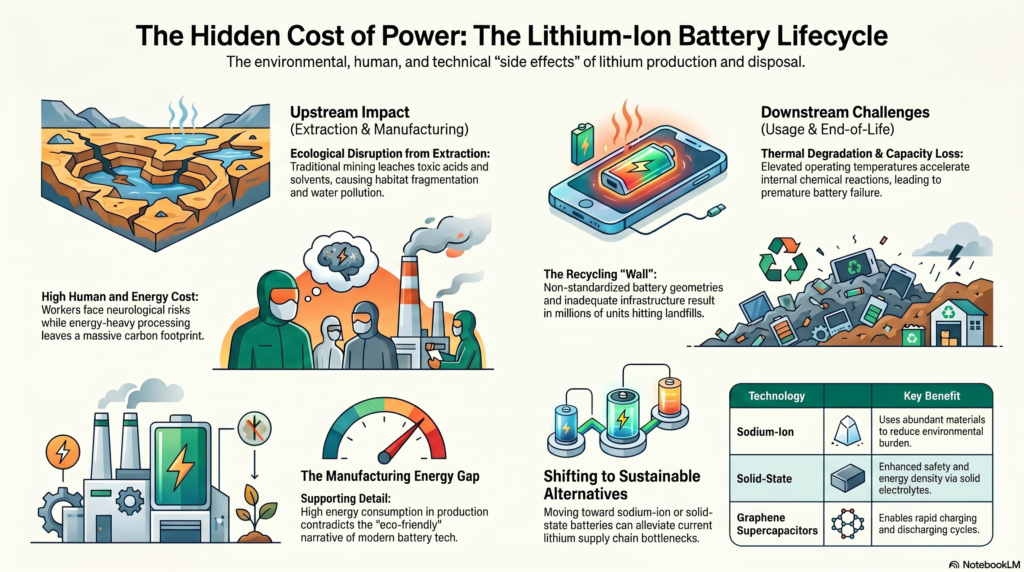
Looking at the production side of things, the structural vulnerabilities in the lithium lifecycle are immediately apparent. The core of the problem starts right at the source: hard rock mining and evaporative brine extraction methods. These traditional methods are incredibly resource-intensive and slow, lagging far behind the exponential growth curves of global tech consumption. From a system analytics standpoint, this is a massive bottleneck. The extraction process is causing severe environmental damage, leading to heavy pollution, habitat fragmentation, and the depletion of vital local resources in areas that are already vulnerable. As tech enthusiasts, we love to celebrate innovation, but we have to reckon with the fact that our clean digital solutions are directly tethered to open-pit mining operations that disrupt local wildlife and leach toxic chemicals like acids and solvents into neighboring soil and water supplies.
Furthermore, as a developer who values operational safety and clean engineering, the human cost in this pipeline is deeply concerning. Workers on the ground face hazardous exposure risks every day, dealing with toxic processing materials that can cause everything from chronic respiratory problems to severe neurological disorders. These physical dangers, combined with job insecurity and intense working conditions, take a major toll on their overall mental well-being. Inconsistent safety regulations globally mean we are essentially outsourcing the human and environmental costs of our gadgets to areas with weak oversight.
On top of that, the actual manufacturing process is an absolute energy hog. The high energy consumption required for extraction and processing leaves behind a massive carbon footprint, which completely contradicts the eco-friendly narrative surrounding modern battery tech. If we want to fix this, we need a major paradigm shift. We have to start aggressively adopting energy-efficient technologies, utilizing direct lithium extraction methods to cut down on processing times, and powering these facilities with renewable energy like solar or wind.
The technical complexity only multiplies when you look at what happens inside the device itself. Lithium acts as the critical active ingredient that dictates the energy density, charging characteristics, and overall performance throughout the battery lifecycle. However, these systems degrade under real-world usage. Elevated operating temperatures accelerate destructive internal chemical reactions, leading to capacity loss and premature failures. Implementing advanced battery management software can help minimize this wear by optimizing charge cycles.
But once a battery inevitably reaches its end-of-life, we run straight into a wall. The current recycling infrastructure is completely broken and inadequate for the volume of e-waste we generate. Lithium batteries vary wildly in their internal geometry and chemistry, making standardized automated disassembly nearly impossible. Separating plastics, metals, and electrolytes from highly durable components, like titanium metal in electronics casings, demands incredibly advanced, specialized recovery technologies that just aren’t scalable or economically viable right now. This structural failure, combined with low consumer awareness, means millions of batteries end up in landfills, creating a ticking environmental clock of soil and water contamination.
The environmental impact of lithium mining raises significant concerns regarding resource depletion and its broader ecological implications. Mining operations often lead to pollution and can result in habitat destruction, disrupting local ecosystems and threatening biodiversity. As demand for lithium in consumer electronics continues to grow, understanding these environmental ramifications becomes increasingly critical.
Resource Depletion Concerns
Amid the growing demand for lithium in consumer electronics, concerns regarding resource depletion and the environmental impact of mining practices have become increasingly prominent. The burgeoning market demand for lithium-ion batteries has intensified pressures on the supply chain, leading to questions about the sustainability of current extraction methods. As technological advancements push for higher-performance batteries, the need for ethical sourcing becomes paramount, guaranteeing that lithium is obtained without compromising environmental integrity.
Geopolitical tensions further complicate the landscape, as lithium-rich regions may face exploitation risks, heightening concerns over resource depletion. The lack of robust regulatory frameworks in many mining regions exacerbates these issues, allowing for practices that can lead to unsustainable extraction rates. Additionally, the volatility in lithium prices can influence mining operations, often prioritizing short-term gains over long-term sustainability.
Consumer awareness plays a significant role in shaping industry practices, prompting calls for transparency and accountability throughout the supply chain. As stakeholders increasingly recognize the importance of ethical sourcing, the need for sustainable mining practices becomes essential to mitigate the environmental impact of lithium extraction and guarantee that future generations have access to this vital resource.
Pollution and Habitat Destruction
In the quest for lithium to power consumer electronics, mining practices often lead to significant pollution and habitat destruction. The extraction of lithium, particularly through methods like open-pit mining, not only disturbs the earth but also contributes to habitat fragmentation, which can severely impact local wildlife. Lithium can help stabilize a person’s mood. However, it may also cause side effects, such as diarrhea, tremors, and weight gain. Long-term use may affect kidney or thyroid function. This disruption can break up ecosystems, leading to an imbalance that affects biodiversity and the overall health of these environments.
Moreover, the chemicals used during the mining process, including harmful solvents and acids, can leach into surrounding soil and water sources, further exacerbating pollution issues. This contamination poses risks not only to flora and fauna but also to human populations that depend on these ecosystems for their livelihoods. As habitats are altered or destroyed, species may struggle to adapt, leading to population declines and even extinction for some.
The environmental ramifications of lithium mining extend far beyond the immediate area, as ecosystem imbalances can have cascading effects on regional biodiversity and climate stability. Consequently, addressing the environmental impact of lithium extraction is essential for fostering a sustainable future in consumer electronics.
Health Risks for Workers
Within the manufacturing and processing sectors of lithium for consumer electronics, workers face considerable health risks due to exposure to hazardous materials and chemicals. The extraction and refinement processes often involve toxic substances, which can lead to both acute and chronic health issues. Exposure risks encompass respiratory problems, skin irritations, and potential long-term effects such as neurological disorders.
To mitigate these risks, worker safety must be prioritized through stringent health regulations and adherence to industry standards. Regulatory bodies are tasked with enforcing guidelines that protect workers from harmful exposure; however, the effectiveness of these regulations can vary greatly across regions and companies. This inconsistency raises concerns regarding the overall health and safety of workers in the lithium supply chain.
Mental health is another critical aspect that must be addressed. The stress associated with hazardous working conditions, coupled with the potential for long hours and job insecurity, can contribute to a decline in mental well-being. Employers should implement thorough training programs that not only educate workers on the dangers associated with lithium but also promote mental health awareness and support. Common side effects of lithium are usually mild and go away by themselves. They’re more likely to happen when you start taking lithium.
Ultimately, the responsibility lies with both employers and regulatory authorities to guarantee that the health risks faced by workers are minimized. By investing in training programs, adhering to industry standards, and fostering a culture of safety, the lithium industry can create a safer working environment that prioritizes both physical and mental health, allowing workers to thrive in a challenging landscape.
ENERGY CONSUMPTION IN PRODUCTION
The production of lithium for consumer electronics is characterized by considerable energy consumption, which poses both economic and environmental challenges. The extraction and processing of lithium, primarily from hard rock mining and brine evaporation, require substantial energy inputs, contributing to a considerable carbon footprint. This process not only strains local ecosystems but also raises concerns about the sustainability of resources in a world increasingly reliant on electronic devices.
To mitigate these challenges, there is an urgent need to adopt sustainable practices in lithium production. Implementing energy-efficient technologies and processes can markedly reduce the energy required for extraction and processing. For instance, advancements in direct lithium extraction methods offer promising avenues for lower energy consumption compared to traditional brine evaporation techniques, which are often slow and resource-intensive.
Moreover, integrating renewable energy sources, such as solar or wind power, can enhance the sustainability of lithium production operations. This change not only lessens the carbon emissions associated with energy use but also aligns with the growing global emphasis on reducing the environmental impact of industrial practices.
Investors and stakeholders in the lithium supply chain must prioritize energy efficiency, not only to comply with regulatory standards but also to respond to increasing consumer demand for ethically sourced materials, similar to how Palladium in catalytic converters plays a critical role in reducing harmful emissions through responsible material use in other technology-driven industries. By fostering a culture of sustainability in lithium production, the industry can contribute to a greener future while meeting the needs of consumers who desire freedom from the ecological burdens of their electronic devices.
Battery Lifespan and Degradation
Sustainable practices in lithium production not only impact energy consumption but also influence the performance and longevity of batteries used in consumer electronics. Battery chemistry plays an essential role in determining how batteries degrade over time, with lithium serving as the active ingredient that directly influences energy density, charging behavior, and overall performance throughout the battery lifecycle.
Performance optimization strategies, including advanced battery management systems, can enhance efficiency by monitoring charging cycles and adjusting parameters to minimize wear.
Temperature effects greatly impact battery degradation; elevated temperatures can accelerate chemical reactions within the battery, leading to reduced capacity and increased failure rates. Durability testing under various conditions is essential to understand how batteries will perform in real-world usage patterns, allowing manufacturers to design products that meet consumer expectations for longevity.
Lifecycle assessment further emphasizes the importance of sustainable production methods, as it considers not just the initial energy investment but also the long-term implications of battery usage and disposal. Effective battery management practices can extend battery lifespan by optimizing charging cycles and preventing over-discharge, which are crucial for maintaining battery health.
Challenges in Recycling
Recycling lithium batteries presents several significant challenges that complicate the management of electronic waste. One of the foremost issues is the lack of consumer awareness regarding proper disposal methods. Many consumers remain uninformed about the environmental hazards associated with improper battery disposal, which often leads to batteries ending up in landfills. This not only poses risks to soil and water quality but also exacerbates the depletion of valuable resources.
Additionally, the recycling process itself is fraught with technical challenges. Lithium-ion batteries vary widely in design and chemical composition, complicating the development of standardized recycling methods. The presence of multiple materials, including plastics, metals, and electrolytes—along with durable components like titanium metal in electronics casings—requires advanced recycling technologies to effectively separate and recover each component. This necessity underscores the significance of recycling innovation in the field, as current methods may not be efficient or economically viable.
Moreover, the recycling infrastructure is often inadequate. Many regions lack the facilities necessary to process lithium batteries, leading to logistical hurdles in collection and transportation. This gap in infrastructure can diminish the effectiveness of recycling programs, ultimately reducing the recovery rates of valuable materials.
To address these challenges, increased consumer education is essential. Greater awareness can foster responsible disposal practices and encourage participation in recycling initiatives. As the demand for lithium continues to rise, addressing these recycling challenges through innovative practices and heightened consumer awareness will be vital to mitigate environmental impacts and guarantee sustainable management of electronic waste.
Future Alternatives to Lithium
As the complexities surrounding lithium battery recycling continue to emerge, the search for viable alternatives to lithium has gained momentum within the energy storage and electronics sectors. Among the promising contenders are sodium ion batteries, which leverage the abundance of sodium and offer comparable performance to lithium-ion technologies. These batteries present a more sustainable option that could alleviate some of the environmental burdens associated with lithium extraction.
Solid state technology is also gaining traction, providing enhanced safety and energy density by utilizing solid electrolytes instead of liquid ones. This shift not only improves the performance but also reduces the risk of leakage and combustion. Magnesium alternatives are being explored for their potential to deliver higher energy capacities while remaining more environmentally friendly.
Additionally, graphene supercapacitors present a compelling case, enabling rapid charging and discharging cycles, ideal for applications requiring quick energy bursts. Organic batteries, utilizing biobased materials, offer another sustainable pathway, promoting a circular economy through renewable resources.
Aluminum ion solutions are emerging as a low-cost alternative, with potential for high energy density and rapid charging capabilities. Finally, redox flow batteries are being utilized for large-scale energy storage, beneficial for renewable energy integration and grid stability.

RELATED STUDIES ABOUT LITHIUM SIDE EFFECTS
The pervasive reliance on lithium in consumer electronics epitomizes a paradox of modern convenience versus environmental degradation. Mining operations wreak havoc on ecosystems, while workers face grave health risks amidst energy-intensive production processes. As battery lifespans shorten and recycling challenges mount, the cycle of waste exacerbates the crisis. In the relentless pursuit of innovation, the quest for sustainable alternatives to lithium emerges as an urgent imperative, underscoring the necessity for transformative change in the industry.
Acne Keloidalis Nuchae as a Rare Side Effect of Long-Term Lithium Therapy
This case report describes a rare dermatological side effect of long-term lithium therapy—Acne Keloidalis Nuchae (AKN)—in a 36-year-old male patient with bipolar affective disorder (BPAD).
Key Clinical Details:
- Patient Profile: Male, 36 years old, with BPAD, on lithium therapy for approximately 10 years.
- Presentation: Developed multiple, itchy, solid skin lesions on the occipital and nuchal region over two years, progressing despite topical and intralesional steroid treatments.
- Diagnosis: Dermatological evaluation suggested scalp psoriasis with AKN, with lithium considered a possible causative agent.
- Intervention: Lithium was tapered and discontinued over two months, while olanzapine was continued. Dermatological treatment included antibiotics, topical agents, and intralesional steroids.
- Outcome: Lesion inflammation improved after lithium cessation, though keloid size remained unchanged. No mood relapse occurred on olanzapine monotherapy during one-year follow-up.
Clinical Significance:
- First Reported Case: To the authors’ knowledge, this is the first case report linking lithium to AKN.
- Naranjo Score: The adverse drug reaction probability score was +4, indicating a “possible” causal relationship.
- Mechanism: Lithium may induce persistent folliculitis through mechanisms such as decreased cAMP, neutrophil activation, and keratinocyte proliferation, leading to keloid formation.
- Management Insight: Early identification and interdisciplinary collaboration between psychiatry and dermatology are crucial to prevent progression, improve adherence, and avoid unnecessary treatment discontinuation.
Conclusion:
This case highlights the importance of monitoring for rare dermatological side effects in patients on long-term lithium therapy. Psychiatrists should maintain a high index of suspicion for cutaneous reactions, engage early with dermatologists, and carefully weigh the risks of lithium discontinuation against the benefits of skin symptom management. Further reporting and research are needed to clarify the association between lithium and AKN.
| REFERENCE: Harkishan Mamtani, Naveen Manohar Pai, Dilip Kumar N R, Sundarnag Ganjekar, Geetha Desai, Acne keloidalis nuchae: A rare side effect of long-term lithium therapy, Psychiatry Research Case Reports, Volume 2, Issue 1, 2023, 100127, ISSN 2773-0212, https://doi.org/10.1016/j.psycr.2023.100127. (https://www.sciencedirect.com/science/article/pii/S2773021223000251) |
Morphology and Performance Optimization for Laser Side Welded Prismatic Lithium-Ion Battery Cells via Parameter-Geometry Synergistic Control
Objective:
This study aims to optimize the laser side welding process for prismatic lithium-ion battery cells by minimizing weld reinforcement height—a critical factor affecting cell stacking precision—while maintaining or enhancing mechanical performance. The research focuses on synergistic control of laser parameters (power and core-to-ring ratio) and joint geometry (lid overlap edge length).
Key Findings:
- Laser Parameter Effects:
- Weld reinforcement height increases with higher laser power.
- Penetration depth increases with a higher core-to-ring ratio (greater central beam energy proportion).
- A stable process window for achieving sound welds (low reinforcement, good strength) exists within:
- 3700 W at core-to-ring ratio 30%–70% to 3900 W at 40%–60%.
- Optimal peel strength is achieved at 3800 W under constant core-to-ring ratio conditions.
- Joint Geometry Influence:
- Reducing the lid overlap edge length (D) significantly decreases weld reinforcement height.
- At 3700 W, longer overlap edges improve peel strength.
- At 3800 W, overlap lengths of 0.4–0.6 mm maintain consistent peel strength, while 0.3 mm leads to a notable reduction.
- At 3900 W, peel strength becomes independent of overlap length, maintaining high performance.
- Microstructural Insights:
- The weld pool exhibits three distinct zones:
- Lid-side fusion zone (LFZ): Columnar grains, largest average size (~64 µm).
- Can-side fusion zone (CFZ): Columnar grains, smallest average size (~38 µm).
- Top fusion zone (TFZ): Equiaxed grains, intermediate size (~54 µm).
- As D increases from 0.3 mm to 0.5 mm:
- LFZ grain size increases, CFZ grain size decreases.
- Excessively fine grains in the lid-side heat-affected zone (HAZ) can cause stress concentration and joint failure.
- Grain refinement and reduced residual stress correlate with improved mechanical performance.
Methodology:
- Materials: 3003 aluminum alloy cell cans (0.6 mm) and lids (2 mm with overlap edges of 0.3–0.6 mm).
- Laser system: TruDisk 8000 disc laser with adjustable ring-mode (ARM) beam.
- Experiments varied laser power (3600–4000 W), core-to-ring ratio (25%–75% to 45%–55%), and overlap edge length.
- Analysis included macrostructure, microstructure (OM, EBSD), microhardness, and peel testing.
Conclusions:
The study demonstrates that precise control of laser power, energy distribution (core-to-ring ratio), and lid overlap geometry enables significant reduction in weld reinforcement height without compromising joint integrity. The synergistic approach provides a practical framework for optimizing laser side welding in battery manufacturing, enhancing both stacking efficiency and weld quality.
Implications:
These findings offer actionable guidelines for improving the production of prismatic lithium-ion batteries, supporting higher precision in cell assembly and greater reliability in electric vehicle power systems.
| REFERENCE: Qiyao Yan, Cheng Liu, Ming Lou, Han Yu, Bowen Zhang, Zixuan Chen, Rundong Lu, Yongbing Li, Morphology and performance optimization for laser side welded prismatic lithium-ion battery cell by parameter-geometry synergistic control, Journal of Materials Research and Technology, Volume 39, 2025, Pages 8839-8851, ISSN 2238-7854, https://doi.org/10.1016/j.jmrt.2025.11.175. (https://www.sciencedirect.com/science/article/pii/S2238785425029837) |
Grain Boundary Alloy Regulation of Double-Sided Laser Beam Welded Aluminum-Lithium Alloy T-Joints
Objective:
This study aims to develop and optimize a novel Al-Si-Cu filler wire composition to suppress hot cracking and porosity defects in double-sided laser beam welded T-joints of third-generation aluminum-lithium (Al-Li) alloys (2060-T8 and 2099-T83). The research focuses on regulating the grain boundary microstructure to enhance the mechanical properties of these critical aerospace structural components.
Key Findings:
- Optimal Filler Wire Composition:
- A newly designed filler wire with 5.41% Si and 6.17% Cu (Wire IV) effectively suppresses hot cracking and porosity.
- At this composition:
- The T (LiAlSi) phase size is controlled below 1 µm, minimizing stress concentration.
- The Θ (Al₂Cu) phase is evenly distributed in a network pattern along grain boundaries, providing effective precipitation strengthening.
- Sufficient Al-Si divorced eutectic fills and repairs solidification shrinkage cavities, preventing crack initiation.
- Defect Suppression Mechanism:
- Excessive Si content (>7%) causes T-phase coarsening (>2 µm), leading to stress concentration and crack propagation along phase interfaces.
- Excessive Cu content (>7%) leads to non-uniform Θ-phase distribution and increased metallurgical porosity, which act as crack initiation sites.
- The ideal composition balances Si and Cu to refine grain boundary phases and promote uniform strengthening.
- Mechanical Performance:
- T-joints welded with Wire IV achieved:
- Average hoop tensile strength: 405.2 MPa (80% of the 2060-T8 skin base material strength).
- Average longitudinal compressive load: 95.4 kN.
- Improved grain boundary strength changed the fracture mode from intergranular to a mixed intergranular/transgranular type, indicating enhanced toughness.
- Microstructural Insights:
- The weld zone consists of distinct regions: parallel dendrite zone (PDZ), cellular dendrite zone (CDZ), non-dendritic equiaxed zone (EQZ), and partially melted zone (PMZ).
- Crack propagation is sensitive to residual stress at T-phase interfaces; finer T phases (<1 µm) reduce stress concentration and inhibit crack growth.
Methodology:
- Materials: 2 mm thick 2060-T8 (skin) and 2099-T83 (stringer) Al-Li alloys.
- Welding: Double-sided laser beam welding using a 10 kW fiber laser system with five newly designed Al-Si-Cu filler wires (varying Si and Cu contents).
- Analysis: Macroscopic inspection, metallography, SEM/EDS, hoop tensile tests, and longitudinal compression tests.
Conclusions:
The study demonstrates that precise alloy regulation of the filler wire—specifically 5.41% Si and 6.17% Cu—significantly enhances the grain boundary structure, suppresses welding defects, and improves the mechanical performance of double-sided laser beam welded Al-Li alloy T-joints. This provides a viable pathway to replace traditional riveting in aircraft fuselage panels, offering weight reduction and manufacturing efficiency gains.
Implications:
These findings offer a tailored material solution for high-integrity welding of advanced Al-Li alloys in aerospace applications, contributing to lighter, stronger, and more reliably manufactured aircraft structures.
| REFERENCE: Bing Han, Xi Chen, Meng Jiang, Jiang Bi, Lingmei Yang, Wenlong Chen, Yanglin Ran, Jing Yuan, Zonghang Li, Yi Li, Yanbin Chen, Grain boundary alloy regulation of double-sided laser beam welding aluminum–lithium alloys T-joint, Journal of Materials Research and Technology, Volume 36, 2025, Pages 3647-3657, ISSN 2238-7854, https://doi.org/10.1016/j.jmrt.2025.03.281. (https://www.sciencedirect.com/science/article/pii/S2238785425007914) |
CONCLUSION
Ultimately, breaking down the lithium lifecycle reveals a classic engineering challenge: we are dealing with a highly sophisticated, deeply flawed system that is hitting its physical and ecological limits. The current loop of mining, degrading, and dumping is unsustainable. While we can use software to optimize device performance, we can’t fix a fundamentally broken physical supply chain with lines of code alone. It is clear that the tech industry needs to look beyond lithium and invest heavily in next-generation chemistry and alternative energy storage solutions.
Exploring alternatives like sodium-ion batteries, solid-state technology, and graphene supercapacitors offers an exciting path forward to reduce our environmental footprint and get away from the geopolitical and ecological baggage of lithium extraction. Whether it’s integrating renewable energy into production or engineering smarter, highly recyclable hardware, we need a complete overhauling of how we design electronics.
True innovation shouldn’t just be about building faster devices; it has to be about creating smart, circular technology that doesn’t leave a trail of environmental destruction behind. It’s time for developers, engineers, and consumers alike to demand accountability and push for a cleaner, truly sustainable digital future.