

When we talk about digital transformation in advanced industries, it is easy to get caught up in flashy software, predictive analytics dashboard screens, and cloud-hosted data pipelines. But as someone whose work sits squarely at the intersection of chemical engineering and information systems, I have learned that the smartest digital tools are completely useless without the underlying physical hardware to back them up. In the aerospace sector, where operational failure is never an option, this hardware-software synergy becomes incredibly vital.
We can build the most sophisticated automated flight paths or satellite telemetry algorithms in the world, but they all rely on physical components that can survive the absolute harshest conditions imaginable. That is exactly why I find the material science behind samarium cobalt (SmCo) magnets so compelling. While looking at modern aircraft engineering, these specialized rare earth magnets are pivotal in aerospace devices due to their exceptional magnetic properties and thermal stability.
They act as the rugged, physical foundation that allows automated systems, electric propulsion mechanisms, and satellite actuators to execute digital commands under extreme thermal loads. From my perspective, these magnets represent the unsung heroes of hardware optimization, proving that true system efficiency requires a deep understanding of both material chemistry and digital control.
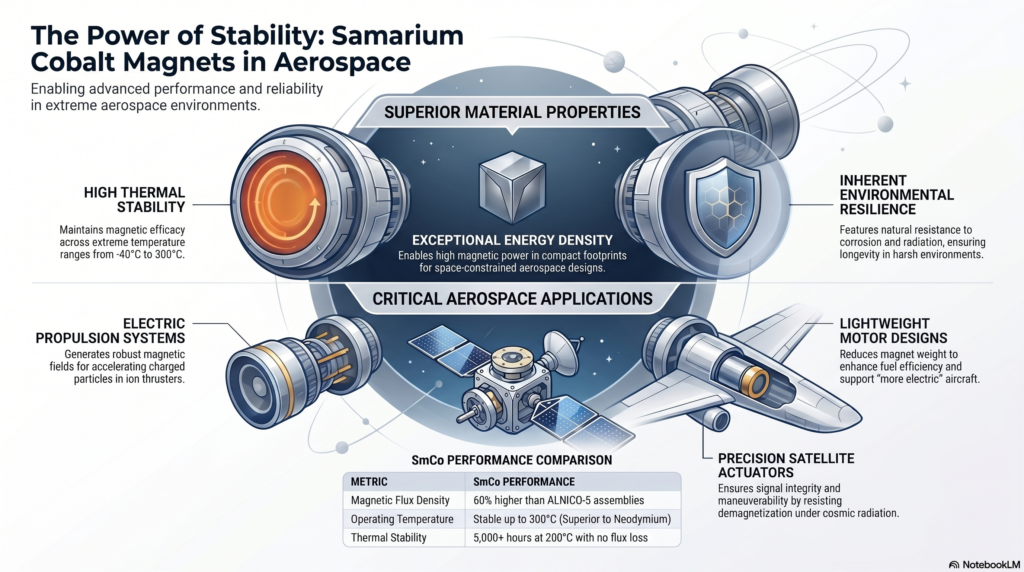
Samarium cobalt magnets are pivotal in aerospace devices due to their exceptional magnetic properties and thermal stability. They maintain efficacy in extreme temperatures, ranging from -40°C to 300°C, making them ideal for critical applications such as electric propulsion systems and satellite actuators. The high energy density and resistance to demagnetization enable compact, lightweight motor designs that enhance fuel efficiency. Additionally, their resilience against harsh environmental conditions extends the lifespan of aerospace components, reducing maintenance needs. Understanding these attributes reveals the ongoing innovations driving advancements in aerospace technology and the role of samarium cobalt magnets in shaping the future.
KEY TAKEAWAYS
- Samarium cobalt magnets provide exceptional magnetic properties, maintaining stability up to 300°C, crucial for high-performance aerospace applications.
- Their high energy density allows for compact designs, enhancing efficiency in lightweight motor systems used in aerospace technology.
- These magnets exhibit excellent thermal and corrosion resistance, ensuring longevity and reliability in harsh aerospace environments.
- They improve propulsion mechanisms in electric systems, such as ion thrusters, enhancing efficiency and reliability under extreme conditions.
- Samarium cobalt magnets facilitate the development of more electric aircraft by reducing weight and improving fuel efficiency through advanced motor designs.
OVERVIEW OF SAMARIUM COBALT MAGNETS
Samarium cobalt magnets, recognized for their exceptional magnetic properties, play an essential role in various high-performance applications, particularly in aerospace. These rare earth magnets are composed of a combination of samarium and cobalt, with samarium serving as the active ingredient that enables exceptional magnetic stability and thermal resistance in demanding aerospace environments. Such attributes are critical in aerospace environments, where components are subjected to extreme conditions, including significant temperature fluctuations and high levels of mechanical stress.
The magnetic stability of samarium cobalt magnets is one of their most notable advantages. They maintain their magnetic properties even at elevated temperatures, up to approximately 300 degrees Celsius, which is a significant consideration for aerospace applications where devices may encounter high thermal loads. This thermal resistance guarantees that the magnets do not demagnetize under operating conditions, thereby preserving the integrity and functionality of the aerospace systems in which they are utilized.
In addition to their thermal performance, samarium cobalt magnets offer a high magnetic energy product, which translates to a compact design with enhanced efficiency. This feature is particularly beneficial in aerospace applications, where space and weight constraints are paramount. The ability to produce strong magnetic fields within a smaller footprint allows for innovative designs in propulsion systems, sensors, and actuators.
Unique Properties of Samarium Cobalt
The unique properties of samarium cobalt magnets stem from their specific composition and crystalline structure, which contribute to their superior performance in demanding environments. Composed primarily of samarium and cobalt, these magnets exhibit exceptional magnetic stability, enabling them to maintain their magnetic properties even under extreme temperatures and varying conditions. This stability is vital for applications where consistent performance is paramount, such as in aerospace technology.
Moreover, samarium cobalt magnets possess remarkable corrosion resistance, an essential characteristic for devices exposed to harsh atmospheric conditions. Unlike other magnetic materials that may degrade over time due to oxidation or environmental exposure, samarium cobalt’s inherent resistance to corrosion guarantees longevity and reliability. This property greatly reduces maintenance requirements and enhances the overall lifecycle of aerospace components.
The crystalline structure of samarium cobalt is another factor that contributes to its unique characteristics. The alignment of its atoms within the magnet allows for efficient magnetic field generation, resulting in high energy density. This means that samarium cobalt magnets can produce stronger magnetic fields compared to other types of magnets of similar size, making them particularly advantageous in compact applications where space is limited.
Applications in Aerospace Technology
Samarium cobalt magnets are integral to various aerospace applications due to their exceptional magnetic properties and thermal stability. Their utilization in magnetic actuators and sensors enhances precision in control systems, while lightweight motor designs benefit from the high energy density of these magnets. Additionally, their performance at elevated temperatures makes them suitable for advanced aerospace environments, where reliability and efficiency are paramount.
Magnetic Actuators and Sensors
That high magnetic power density and excellent temperature stability has made SmCo magnets the first choice for many uses, including military, spacecraft, aerospace, and marine applications. In aerospace technology, magnetic actuators and sensors play an essential role in enhancing system performance and reliability. The integration of samarium cobalt magnets in actuator design greatly improves the efficiency and responsiveness of these systems. By leveraging the unique properties of these magnets, engineers can create compact, lightweight actuators that operate effectively in high-temperature environments while maintaining a stable magnetic field.
Advancements in sensor technology also benefit from the use of samarium cobalt magnets, particularly in precision engineering applications. These sensors provide vital data for performance metrics, guaranteeing that aerospace systems operate within ideal parameters. The application of material science principles in the development of these components enhances their durability and performance, addressing the demands of modern aerospace innovation.
Furthermore, the electromagnetic compatibility of magnetic actuators and sensors is vital in minimizing interference with other electronic systems onboard. This compatibility guarantees that the performance of these devices is not compromised in complex aerospace environments. As the industry continues to evolve, the role of magnetic actuators and sensors will remain pivotal in driving advancements that prioritize safety, efficiency, and reliability in aerospace technology.
Lightweight Motor Designs
Advancements in lightweight motor designs are transforming aerospace technology, leading to significant improvements in overall system efficiency and performance. The integration of samarium cobalt magnets has been integral in achieving substantial magnet weight reduction, which directly enhances the performance characteristics of aerospace motors. By utilizing these high-energy magnets, engineers can design motors that are not only lighter but also more powerful and efficient.
The reduction in magnet weight allows for smaller motor housings and decreased structural loads, which is essential in aerospace applications where weight savings can translate into improved fuel efficiency and extended range, especially when combined with lightweight structural materials such as titanium metal in electronics casings used in onboard aerospace systems. Additionally, the superior magnetic properties of samarium cobalt facilitate higher motor efficiency at various operational speeds, making them ideal for dynamic aerospace environments.
As the industry moves towards more electric aircraft and advanced propulsion systems, these lightweight motor designs will play a significant role in optimizing performance while minimizing energy consumption. Ultimately, the synergy between advanced materials and innovative motor design will empower aerospace engineers to push the boundaries of what is possible, achieving unprecedented freedom in aircraft performance and operational capabilities.
High-Temperature Applications
The integration of samarium cobalt magnets in lightweight motor designs has paved the way for their application in high-temperature environments prevalent in aerospace technology. These magnets exhibit exceptional thermal stability, maintaining their magnetic properties even at elevated temperatures that can reach up to 300°C. This characteristic is essential for aerospace applications, where components are often subjected to extreme thermal fluctuations.
In aerospace systems, the reliability of magnetic materials is critical. Samarium cobalt magnets demonstrate remarkable magnetic reliability, resisting demagnetization under high thermal stress. This guarantees consistent performance in applications ranging from propulsion systems to actuation mechanisms, where precision and dependability are imperative.
Moreover, the lightweight nature of samarium cobalt magnets contributes to overall system efficiency, allowing for enhanced fuel economy and extended operational ranges—an important consideration for modern aerospace engineering. The ability to function effectively in harsh environments not only maximizes the performance of aerospace devices but also supports innovation in design and technology.
Ultimately, the unique properties of samarium cobalt magnets position them as a crucial component in high-temperature aerospace applications, enabling advancements that drive the industry forward while assuring safety and performance integrity.
ADVANTAGES OVER OTHER MAGNETS
How do samarium cobalt magnets compare to other magnetic materials in the aerospace sector? When evaluating their advantages, samarium cobalt (SmCo) magnets stand out due to their exceptional magnetic performance, particularly in high-temperature environments where other magnets struggle. They exhibit superior resistance to demagnetization and retain their magnetic properties even under extreme thermal conditions, making them ideal for aerospace applications. Samarium cobalt magnets (SmCo/sub 5/) are used to improve the retention and stability of overdentures, removable partial dentures, and maxillofacial and implant prostheses.
One key advantage lies in their cost effectiveness relative to performance. Although the initial manufacturing costs of SmCo magnets can be higher due to the complexity of their production and the use of rare earth materials, their longevity and reliability often offset these expenses over time. In aerospace applications, where failure is not an option, the durability of SmCo magnets proves invaluable.
However, manufacturing challenges persist, particularly regarding the sourcing of raw materials and the intricate processes required to create these magnets. This complexity can lead to supply chain vulnerabilities, yet the performance benefits often justify these hurdles. In contrast, alternatives such as neodymium magnets, while cheaper and easier to produce, can suffer from significant performance degradation at elevated temperatures, limiting their applicability in critical aerospace systems.
Ultimately, the choice of samarium cobalt magnets over other materials is a strategic decision driven by the need for reliability, thermal stability, and long-term cost savings. Their ability to maintain performance in demanding environments positions them as a superior option in the aerospace sector, despite the associated manufacturing challenges.
Impact on Satellite Systems
Samarium cobalt magnets play a vital role in the performance and reliability of satellite systems, where the demands of space environments require components that can withstand extreme temperatures and radiation. These magnets are integral to guaranteeing satellite stability and preserving signal integrity, which are essential for effective communication and navigation in space.
The unique properties of samarium cobalt magnets enable them to meet the rigorous requirements of satellite operation through:
- High Magnetic Strength: Their ability to maintain a strong magnetic field allows for the effective functioning of motors and actuators, essential for satellite maneuverability.
- Temperature Resistance: Capable of operating in a wide range of temperatures, these magnets guarantee stable performance even in the harsh thermal conditions of space.
- Radiation Hardness: Resistance to radiation degradation is vital, as satellites are exposed to cosmic rays and other high-energy particles that can compromise performance.
- Compact Design: The high energy density of samarium cobalt magnets allows for smaller, lighter components, contributing to overall satellite efficiency and reducing launch costs.
As satellite systems increasingly rely on precise positioning and communication capabilities, the role of samarium cobalt magnets becomes even more pronounced. Their contribution to satellite stability directly influences operational reliability, while guaranteeing that signal integrity is maintained for uninterrupted service. This synergy of properties underscores the importance of these magnets in the advancement of aerospace technologies.

Role in Propulsion Mechanisms
In aerospace propulsion mechanisms, the integration of samarium cobalt magnets enhances the efficiency and reliability of electric propulsion systems. These high-performance magnets are integral components in various propulsion technologies, including ion thrusters and Hall effect thrusters, where they serve to generate a robust magnetic field. This magnetic field plays a critical role in the acceleration of charged particles, thereby facilitating thrust generation.
The unique properties of samarium cobalt magnets, such as their high coercivity and thermal stability, contribute greatly to propulsion efficiency. Unlike conventional magnets, samarium cobalt retains its magnetic properties under extreme conditions, making it suitable for space applications where temperature fluctuations are prevalent. This stability guarantees that the propulsion system remains operational, thereby reducing the risk of failure during critical mission phases.
Furthermore, the ability to operate at high temperatures without demagnetization allows these magnets to optimize the performance of electric propulsion systems. By minimizing losses associated with magnetic field degradation, samarium cobalt magnets enhance the overall propulsion efficiency, leading to longer operational lifetimes and reduced power consumption.
Future Trends in Aerospace Magnets
From a process optimization standpoint, evaluating how different materials behave under extreme stress is where the real engineering fun begins. In my consulting work with chemical processing plants and automated labs, I am constantly looking for components that minimize maintenance lifecycles and maximize energy efficiency. In the aerospace domain, weight and space are the ultimate constraints, meaning every single gram matters. When you dive into the data, the crystalline structure and atomic alignment of samarium cobalt magnets are fascinating because they deliver an incredibly high magnetic energy product within a compact footprint.
This high energy density and resistance to demagnetization enable compact, lightweight motor designs that enhance fuel efficiency. Furthermore, from a data reliability perspective, the fact that SmCo magnets possess remarkable corrosion resistance and can withstand intense temperature fluctuations ranging from -40°C to 300°C is a massive advantage for system designers.
If a sensor or an actuator shifts its baseline readings because of thermal degradation, the predictive algorithms running the automated flight system will ingest flawed data. By utilizing a material that maintains its structural and magnetic integrity under high thermal stress, engineers ensure that the hardware provides consistent, reliable performance metrics. It is a perfect real-world example of how choosing the right chemical composition directly protects the integrity of the overarching digital ecosystem.
The aerospace industry is witnessing significant advancements in the development of lightweight magnet materials, which are critical for improving overall vehicle efficiency and performance. Innovations in magnetic performance metrics are driving the design of new magnet compositions that offer superior strength-to-weight ratios. These trends are poised to reshape propulsion systems and other aerospace applications, enabling enhanced functionality while adhering to stringent weight and performance requirements.
Lightweight Magnet Innovations
Recent advancements in magnet technology are paving the way for lightweight innovations that hold considerable potential for the aerospace industry. The integration of advanced manufacturing techniques and composite materials has enabled the development of magnets that not only reduce overall weight but also enhance efficiency and functionality in aerospace applications. The following innovations are at the forefront of this transformation:
- 3D-Printed Magnets: Utilizing additive manufacturing techniques, 3D-printed magnets can be customized to meet specific aerodynamic requirements while minimizing material waste.
- Hybrid Composite Magnets: These magnets combine traditional magnetic materials with lightweight composites, offering improved strength-to-weight ratios and better performance in demanding environments.
- Nanostructured Materials: The incorporation of nanotechnology in magnet production results in materials that exhibit superior magnetic properties while considerably reducing weight.
- Magnet Recycling Techniques: Advanced recycling methods are being developed to recover valuable magnetic materials from end-of-life components, promoting sustainability while supporting lightweight design initiatives.
These innovations collectively promise to revolutionize the aerospace sector by enabling the design of lighter, more energy-efficient aircraft, thereby enhancing operational freedom and performance.
Enhanced Magnetic Performance
Advancements in lightweight magnet technologies not only optimize weight but also set the stage for enhanced magnetic performance, which is a critical factor for the aerospace sector’s future. The integration of samarium cobalt magnets exemplifies this trend, offering superior magnetic stability and temperature resilience essential for high-performance applications.
In aerospace environments, where components are subjected to extreme temperatures and varying operational conditions, the ability of magnets to maintain their performance is paramount. Samarium cobalt magnets demonstrate exceptional resistance to demagnetization, ensuring consistent functionality over a wide temperature range. This resilience not only enhances reliability but also extends the lifespan of critical aerospace devices.
Furthermore, ongoing research into new composite materials and manufacturing techniques aims to further improve magnetic properties. Innovations such as optimized grain alignment and advanced sintering methods are expected to yield magnets with even higher energy densities and improved thermal stability. Such advancements will facilitate the design of lighter, more efficient systems, ultimately contributing to fuel savings and reduced emissions in aerospace operations.
As the industry continues to prioritize performance and sustainability, the evolution of enhanced magnetic technologies will play a pivotal role in shaping the future of aerospace engineering, much like how researchers carefully monitor lithium side effects when developing advanced energy storage systems. The purpose of this study was to determine whether the application of either samarium cobalt magnets or pulsed electromagnetic fields could increase the rate and amount of orthodontic tooth movement observed in guinea pigs.

RELATED STUDIES ABOUT SAMARIUM COBALT MAGNETS
To sum up, samarium cobalt magnets serve as the backbone of aerospace technology, enabling advancements in satellite systems and propulsion mechanisms. Their unique properties, such as high magnetic strength and thermal stability, position them as superior alternatives to other magnetic materials. As aerospace demands evolve, the integration of these magnets symbolizes a lighthouse guiding the industry towards innovative solutions, ensuring efficiency and reliability in the ever-expanding frontier of space exploration. The future of aerospace propulsion hinges on the continued development of these remarkable materials.
High Temperature Electrical Resistivity Measurements of Sintered Samarium Cobalt Magnets
Objective:
This study investigates the temperature-dependent electrical resistivity of commercial sintered samarium cobalt (SmCo) magnets up to 200 °C, focusing on anisotropy, the effects of magnetization, and the influence of microstructure (especially zirconium-rich lamellae) on resistivity. The goal is to provide accurate data for modeling permanent magnet motors, where eddy current losses and thermal performance are critical.
Key Findings:
- Anisotropic Resistivity:
- Resistivity is anisotropic with respect to the magnetic orientation (c-axis).
- For 2:17-type magnets (Sm₂Co₁₇), resistivity is lower perpendicular to the c-axis (parallel to Zr-rich lamellae).
- For 1:5-type magnets (SmCo₅), resistivity is lower parallel to the c-axis.
- Temperature Dependence:
- Resistivity increases linearly with temperature for all magnets and orientations.
- The temperature coefficient is higher for 1:5-type magnets than for 2:17-type magnets.
- Effect of Magnetization:
- At room temperature, resistivity is similar in magnetized and non-magnetized states for 2:17-type magnets, with a slight decrease for magnetized 1:5-type magnets.
- At elevated temperatures (up to 200 °C), magnetized samples exhibit a lower temperature coefficient, resulting in significantly lower resistivity than non-magnetized samples. This suggests magnetization may dampen thermal vibrations or indicate a temperature-dependent magnetoresistance.
- Microstructural Influence:
- Zr-rich lamellae in 2:17-type magnets are more conductive and drive anisotropic behavior.
- A higher Zr content (0.31 wt% more in Magnet B vs. C) reduced resistivity by 0.7% in the perpendicular direction, indicating Zr content (rather than lamellae density) has a stronger influence.
- Porosity in one 2:17-type magnet (Magnet C) slightly increased resistivity but had less impact than lamellar structure.
- Magnetic Properties:
- 2:17-type magnets show higher remanence and coercivity than 1:5-type magnets.
- Differences in Fe content and cellular structure (cell size, lamellae thickness) affect remanence and thermal stability but have limited impact on coercivity trends with temperature.
Methodology:
- Materials: One 1:5-type (Magnet A) and two 2:17-type (Magnets B, C) commercial SmCo magnets.
- Measurements: Four-point probe resistivity from 20–200 °C in both parallel/perpendicular orientations and magnetized/non-magnetized states.
- Analysis: ICP-OES (composition), SEM/STEM (microstructure), magnetic characterization (permeameter).
Conclusions:
The electrical resistivity of SmCo magnets is anisotropic, temperature-dependent, and influenced by magnetization state and microstructure (especially Zr content and lamellae). For accurate motor design, models must account for:
- Lower resistivity in magnetized magnets at high temperatures.
- Opposite anisotropy between 1:5-type and 2:17-type magnets.
- Zr content as a key factor for resistivity in 2:17-type magnets.
Implications:
These results enable optimized selection, shaping, and segmentation of SmCo magnets in high-temperature applications (e.g., aerospace, automotive motors), improving efficiency by minimizing eddy current losses and enhancing thermal management.
| REFERENCE: O.P. Brooks, R. Spapens, J. Griffiths, G. Taylor, V. Kozak, G. Subramanian, Z. Gao, Y. Chiu, A. Lambourne, R.S. Sheridan, High temperature electrical resistivity measurements of sintered samarium Cobalt magnets, Journal of Magnetism and Magnetic Materials, Volume 610, 2024, 172526, ISSN 0304-8853, https://doi.org/10.1016/j.jmmm.2024.172526. (https://www.sciencedirect.com/science/article/pii/S0304885324008175) |
Development and Testing of a Permanent Magnet Flowmeter with Samarium Cobalt Magnet Assembly
Objective:
This study aimed to develop and test a compact, high-sensitivity permanent magnet flowmeter (PMFM) using samarium cobalt (SmCo) magnets for sodium flow measurement in nuclear reactor circuits. The goal was to replace traditional ALNICO-5 magnet assemblies, which are bulky and heavy, with a more efficient, smaller, and stable alternative.
Key Findings:
- Improved Performance with SmCo Magnets:
- The SmCo magnet assembly provided 60% higher magnetic flux density at the air gap center compared to a similarly sized ALNICO-5 assembly.
- The sensitivity of the 20 NB SmCo PMFM was 3.4 mV/m³/h, which is 60% higher than the ALNICO-5 version (2.1 mV/m³/h).
- Successful Sodium Calibration:
- The flowmeter was calibrated in a 500 kW sodium loop against a reference PMFM at temperatures of 300 °C, 400 °C, and 500 °C, and flow rates up to 22 m³/h.
- The measured sensitivity matched well with the estimated value (3.16 mV/m³/h).
- Non-linearity with respect to flow was ≤3.39% (at 400 °C), and with respect to temperature ≤2.87% (at 18.6 m³/h).
- Excellent Thermal Stability:
- Long-term stability tests showed no significant reduction in magnetic flux density after:
- 5000 hours at 100 °C (operating temperature).
- 5000 hours at 200 °C (accelerated test).
- Temperature stabilization cycling (rapid and gradual heating/cooling) confirmed the magnet’s robustness under thermal cycling.
- Compact Design Advantage:
- Due to SmCo’s higher coercivity and energy product, magnet assemblies can be made smaller and lighter while maintaining or exceeding the sensitivity of larger ALNICO-5 assemblies.
Methodology:
- Design: Three SmCo magnet assemblies (SmCo26) were fabricated using rectangular magnet blocks (25×25×12.5 mm).
- Testing: The 20 NB PMFM was installed in a sodium loop, calibrated against a reference 80 NB PMFM, and tested across temperature and flow ranges.
- Stability: Magnet assemblies underwent thermal cycling and long-term exposure at elevated temperatures, with periodic flux density measurements.
Conclusion:
The SmCo-based permanent magnet flowmeter demonstrates superior sensitivity, compactness, and thermal stability compared to ALNICO-5 designs. The successful calibration in sodium and rigorous stability testing confirm its feasibility for high-temperature sodium flow measurement in fast reactor applications.
Implications:
This development enables the deployment of more compact and efficient flowmeters in nuclear sodium circuits, reducing space and weight in plant layouts. SmCo PMFMs are a viable, reliable upgrade for future fast reactors, offering improved performance and long-term operational stability.
| REFERENCE: G Vijayakumar, B.K. Nashine, K.K. Rajan, P. Kalyanasundaram, Development and Testing of PM Flowmeter with Samarium Cobalt Magnet Assembly, Energy Procedia, Volume 7, 2011, Pages 630-637, ISSN 1876-6102, https://doi.org/10.1016/j.egypro.2011.06.084. (https://www.sciencedirect.com/science/article/pii/S1876610211015931) |
Direct ICP-OES Analysis of Waste Samarium-Cobalt Magnets
Objective:
This study develops and validates a method for the direct, multielement analysis of waste samarium-cobalt (SmCo) magnets using inductively coupled plasma optical emission spectrometry (ICP-OES). The goal is to enable accurate and sensitive quantification of both major components (Sm, Co) and trace impurities (Al, Mg, Ti, rare earths, etc.) in recycled magnet materials, supporting efficient recycling and recovery processes.
Key Findings:
- Method Development:
- A sample preparation procedure was established: dissolution of 0.2 g magnet in 5 ml high-purity HNO₃ at 90–110 °C for 10 minutes, followed by dilution.
- Optimal ICP-OES conditions were determined:
- RF Power: 1400 W
- Nebulizer Flow Rate: 0.5–0.6 L/min
- Plasma viewing mode selection:
- Axial view for higher sensitivity (trace elements, concentrations ~10⁻⁴–10⁻² wt%).
- Radial view for matrix elements and higher concentration analytes (>10⁻² wt%).
- Matrix Effects:
- The presence of Sm and Co matrix suppresses analyte signals, with greater suppression in axial view (5–17% signal reduction) compared to radial view (<8% reduction).
- Ionic spectral lines are more susceptible to matrix suppression than atomic lines.
- Signal suppression correlates with excitation energy: lines with higher excitation energy are more affected.
- Analytical Performance:
- Limits of quantification (LOQ):
- 10⁻⁵ wt% for Mn, Zr, Yb.
- 10⁻⁴ wt% for Al, Mg, Ti, Cr, Hf, La, Ni, Cu, Tb, Lu, Nb, Fe, Nd, Eu, Gd, Dy, Tm.
- Accuracy validated via:
- Spike recovery tests.
- Certified reference materials (biases <10% for most elements).
- Comparison with ICP-MS results (good agreement).
- Precision: Relative standard deviations (RSD) ranged from 0.2% to 10.6%.
- Practical Application:
- The method successfully quantifies a wide range of elements in waste SmCo magnets, including major components (Sm, Co ~30–60 wt%) and trace impurities (from 10⁻⁵ to 10⁻¹ wt%).
- Suitable for routine analysis in recycling workflows to assess composition and purity.
Conclusion:
The developed ICP-OES method provides a robust, sensitive, and accurate approach for the direct multielement analysis of waste SmCo magnets. By optimizing instrumental parameters and selecting appropriate viewing modes, matrix effects are minimized, enabling reliable quantification across a broad concentration range. This supports the efficient recycling and recovery of valuable rare-earth elements from magnet waste.
Implications:
This analytical procedure facilitates quality control in SmCo magnet recycling, aiding in the sustainable recovery of critical raw materials (Sm, Co, rare earths) and contributing to circular economy goals in the electronics, automotive, and aerospace industries.
| REFERENCE: Kseniya V. Petrova, Vasilisa B. Baranovskaya, Natalya A. Korotkova, Direct inductively coupled plasma optical emission spectrometry for analysis of waste samarium-cobalt magnets, Arabian Journal of Chemistry, Volume 15, Issue 1, 2022, 103501, ISSN 1878-5352, https://doi.org/10.1016/j.arabjc.2021.103501. (https://www.sciencedirect.com/science/article/pii/S1878535221005165) |
CONCLUSION
Looking ahead at future trends, the evolution of aerospace engineering is clearly moving toward fully electric aircraft, advanced satellite constellations, and smarter autonomous propulsion technologies. Achieving these milestones requires us to continuously push the boundaries of what advanced materials can do. As the aerospace sector continues to prioritize both performance and long-term sustainability, our reliance on high-performance components like samarium cobalt magnets will only deepen.
They truly serve as a critical link between complex physical chemistry and advanced automation. Understanding these attributes reveals the ongoing innovations driving advancements in aerospace technology and the role of samarium cobalt magnets in shaping the future.
Whether we are talking about minimizing eddy current losses in high-temperature motors or leveraging additive manufacturing to create highly customized 3D-printed magnets, the goal remains the same: driving maximum operational efficiency. For technology analysts and engineers alike, it is an exciting reminder that the digital transformations reshaping our skies are completely grounded in the precise, reliable magic of material science.