

When I was finishing up my graduate studies in plant science at UC Davis, my time was split between two entirely different worlds. Half my week was spent running complex computational models and analyzing precision agriculture data under the sterile fluorescent lights of a laboratory. The other half was spent with my boots caked in thick, dark mud, talking to growers whose families had farmed the same acreage for generations. That experience taught me an invaluable lesson that has shaped my entire career as an agronomist: the most brilliant molecular breakthrough doesn’t mean a thing if it isn’t practical, reliable, and manageable when you are standing out in a field at five o’clock in the morning.
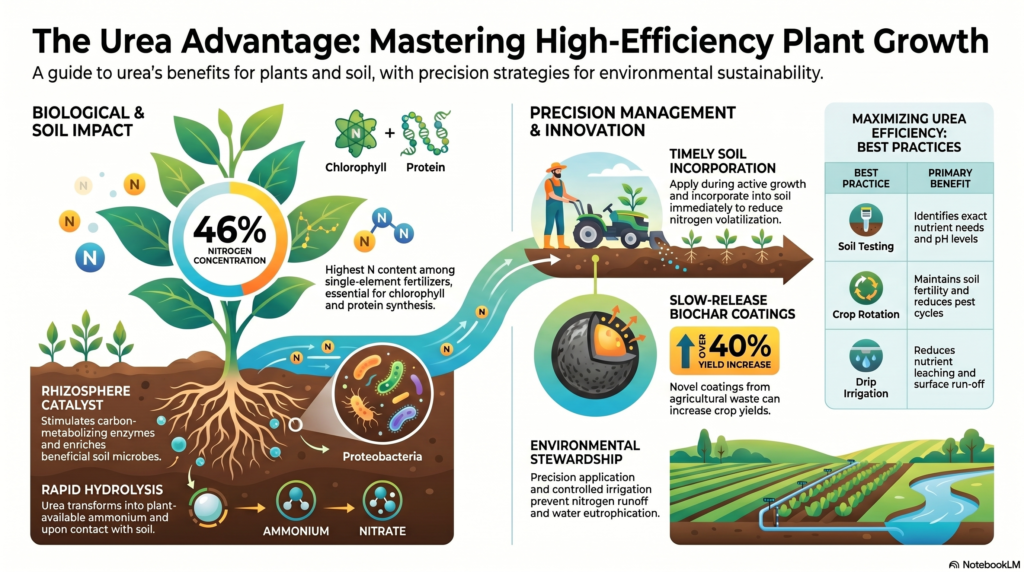
That is exactly how I look at urea fertilizer. On paper, it is beautifully simple, a highly concentrated, organic nitrogen compound synthesized from accessible industrial feedstocks. With a staggering nitrogen content of approximately 46% by weight, it is a powerhouse for driving chlorophyll production and protein synthesis. But as any seasoned farmer or horticulturist will tell you, applying straight urea isn’t like shaking salt onto a meal.
It undergoes highly volatile chemical transformations the absolute second it touches the soil environment. If you don’t respect the underlying chemistry and environmental dynamics, you risk losing your investment to the air or harming your crop. Let’s break down how we can master this input safely and sustainably.
Urea fertilizer enhances plant growth and soil fertility as it delivers a concentrated nitrogen source, constituting approximately 46% of its weight. This nitrogen is vital for chlorophyll production, photosynthesis, and protein synthesis, benefitting various physiological plant processes. Urea undergoes hydrolysis, converting into plant-available ammonium and nitrate forms, optimizing nutrient uptake. Additionally, it promotes improved soil structure and fertility by fostering microbial activity, which enriches the soil ecosystem. Timely and appropriate application methods further enhance effectiveness while mitigating environmental risks. Understanding these dynamics is essential for maximizing agricultural productivity and sustainability, offering a broader context for fertilizer use.
KEY TAKEAWAYS
- Urea fertilizer provides 46% nitrogen, essential for plant growth and chlorophyll production, enhancing photosynthesis and overall plant health.
- The hydrolysis of urea releases ammonium and nitrate, making nitrogen readily available for plant absorption and promoting optimal growth.
- Timely application of urea maximizes nutrient uptake during critical growth phases, supporting early-stage crop development and competition against weeds.
- Urea improves soil structure and fertility by increasing microbial activity, enhancing nutrient retention, and promoting organic matter decomposition.
- Sustainable practices, including soil testing and precision application, can mitigate environmental impacts while optimizing the benefits of urea fertilizer in agriculture.
UNDERSTANDING UREA FERTILIZER
Urea fertilizer, a widely utilized nitrogen source in agriculture, plays a critical role in enhancing plant growth and productivity. As an organic compound, urea (NH2)2CO is synthesized through various methods, making it accessible from diverse urea sources such as natural gas, coal, and biomass. The urea types available in the market range from granulated and liquid formulations to coated urea, each tailored for specific agricultural applications and soil conditions. Urea (46-0-0) usually has the lowest cost per pound of nitrogen compared to other single-element nitrogen fertilizers. However, urea undergoes unique chemical transformations when field applied and severe losses in efficiency may result if special management practices are not followed. The purpose of this fact sheet is to briefly describe urea transformations and to suggest how urea-N may be conserved with proper management in the field.
The chemistry of urea is characterized by its high nitrogen content, approximately 46% by weight, which is pivotal for plant nutrition. Upon application, urea undergoes hydrolysis, releasing nitrogen as the active ingredient that enables efficient nutrient absorption and supports sustained plant development under varying soil conditions. This transformation underscores the importance of understanding urea stability and its impact on nutrient release patterns in different environmental conditions.
In terms of urea applications, its versatility allows for use in various crops and soil types, making it a preferred choice among farmers. Urea safety is paramount, necessitating proper handling to mitigate risks associated with its use, such as potential toxicity in high concentrations. Moreover, urea pricing fluctuates based on market dynamics, influencing farmer adoption rates.
As the agricultural landscape evolves, exploration of urea alternatives, such as organic fertilizers and slow-release formulations, is gaining traction. These options aim to enhance sustainability while maintaining efficient nutrient delivery, thereby addressing environmental concerns associated with traditional urea usage.
Role of Nitrogen in Growth
From an agronomic perspective, what fascinates me most about urea isn’t just how the plant responds, but how it completely alters the subterranean ecosystem. When we apply urea, we are essentially triggering a massive chemical and biological chain reaction. It undergoes rapid hydrolysis, transforming into plant-available ammonium and nitrate. But it also acts as a profound catalyst for the rhizosphere, the narrow zone of soil directly influenced by root secretions. Recent research shows that urea dramatically stimulates carbon and nitrogen-metabolizing enzymes like urease and cellobiase, while enriching specific microbial communities like Proteobacteria, which excel at cycling nutrients and breaking down organic matter.
It is a highly efficient co-metabolism that accelerates nutrient turnover. However, the classic challenge with conventional urea has always been its rapid-release nature, which can cause severe nitrogen leaching, root burn, or nitrous oxide emissions if over-applied. This is where precision agriculture and circular economy innovations are completely changing the game. We are seeing groundbreaking studies where researchers utilize agricultural waste, like empty fruit bunches or palm kernel shells, to create tailored biochar coatings for urea granules.
Others have engineered double-layer coated options combining biodegradable starch polymers with biochar organic fertilizers. In field trials, these slow-release mechanisms cut nutrient leaching to a fraction of conventional urea while boosting crop yields by over 40%. It protects the delicate rhizosphere and maximizes nitrogen use efficiency.
Nitrogen is a critical macronutrient that plays a fundamental role in photosynthesis, as it is a key component of chlorophyll, the pigment responsible for capturing light energy. Additionally, nitrogen enhances protein synthesis, which is essential for the growth and development of plant tissues. Understanding these functions underscores the importance of adequate nitrogen supply for optimizing plant health and productivity.
Nitrogen’s Importance in Photosynthesis
A key element in the growth and development of plants, nitrogen plays an essential role in the process of photosynthesis. It is a major component of chlorophyll, the green pigment responsible for capturing light energy. Without adequate nitrogen, chlorophyll production is adversely affected, leading to reduced photosynthetic efficiency and ultimately limiting plant growth.
Nitrogen sources, such as urea fertilizer and ammonium nitrate fertilizer, are critical for maintaining ideal nitrogen levels in the soil. When applied, urea undergoes hydrolysis to release ammonium and nitrate ions, which are readily absorbed by plants. When applied, urea undergoes hydrolysis to release ammonium and nitrate ions, which are readily absorbed by plants. These nitrogen forms facilitate the synthesis of amino acids and proteins, which are foundational for cellular structures and functions. However, the immediate impact of nitrogen on photosynthesis is most evident through its influence on chlorophyll synthesis.
In a nitrogen-deficient environment, plants exhibit stunted growth and yellowing of leaves, known as chlorosis. This symptom underscores the link between nitrogen availability and the plant’s ability to harness sunlight effectively. Therefore, ensuring an adequate supply of nitrogen not only enhances chlorophyll production but also supports overall plant health and productivity in agricultural systems.
Enhancing Protein Synthesis
Protein synthesis is a fundamental process that underpins plant growth and development, relying heavily on the availability of nitrogen. Nitrogen, a key component of amino acids, serves as the building blocks of proteins, which are essential for numerous physiological functions in plants. Urea, a widely used nitrogen fertilizer, acts as an active ingredient hub by efficiently delivering plant-available nitrogen that supports amino acid formation, chlorophyll synthesis, and sustained crop growth throughout key developmental stages.
- Amino acids: Essential for protein construction, influencing enzyme activity and metabolic processes.
- Urea breakdown: Enhances soil nitrogen availability, promoting robust growth.
- Optimal growth: Achieved through sufficient nitrogen supply, leading to improved crop yields.
The role of nitrogen, particularly from urea, extends beyond mere biomass accumulation. It actively influences the synthesis of vital proteins involved in photosynthesis, respiration, and stress responses. Without adequate nitrogen, plants exhibit stunted growth and reduced vigor, ultimately compromising their survival and productivity. Consequently, understanding the dynamics of nitrogen availability through urea application is essential for optimizing protein synthesis, enhancing overall plant health and soil fertility. This relationship underscores the importance of nitrogen as a pivotal element in agricultural practices aimed at sustainable crop production.
Benefits for Plant Development
Urea fertilizer plays an essential role in enhancing plant development by supplying a readily available source of nitrogen, an important macronutrient. Nitrogen is fundamental for various physiological processes, including amino acid synthesis and chlorophyll formation, both of which contribute markedly to plant growth and overall vigor. When applied correctly, urea can lead to improved biomass accumulation, robust root development, and increased leaf area, ultimately enhancing the plant’s capacity for photosynthesis. Urea is the chief nitrogenous end product of the metabolic breakdown of proteins in all mammals and some fishes. The material occurs not only in the urine of all mammals but also in their blood, bile, milk, and perspiration. In the course of the breakdown of proteins, amino groups (NH2) are removed from the amino acids that partly comprise proteins. These amino groups are converted to ammonia (NH3), which is toxic to the body and thus must be converted to urea by the liver. The urea then passes to the kidneys and is eventually excreted in the urine.
The effectiveness of urea fertilizers is highly dependent on application rates and timing. Research indicates that ideal application rates should be tailored to specific crop needs and soil conditions to maximize nitrogen utilization while minimizing potential environmental impacts. Over-application can lead to nitrogen leaching, resulting in reduced efficiency and potential soil degradation. Consequently, understanding the relationship between urea sources and plant requirements is essential for achieving sustainable growth.
Moreover, urea’s quick release of nitrogen allows for a rapid response in plants, particularly in the early stages of growth. This quick uptake can be particularly beneficial for crops that require a robust start to compete effectively with weeds. In addition, the versatility of urea as a nitrogen source makes it suitable for various agricultural practices, whether in conventional or organic farming systems. By integrating urea fertilizer into a thorough nutrient management program, growers can markedly enhance plant development, ensuring healthy, productive crops that meet the demands of stakeholders and consumers alike.
IMPACT ON SOIL FERTILITY
The application of urea fertilizer greatly influences soil fertility, primarily through its role in nitrogen dynamics. Nitrogen, an essential nutrient for plant growth, is a key component of urea, which breaks down in the soil to release ammonia and subsequently nitrate. This transformation enhances the nitrogen content available for plant uptake, markedly improving overall soil fertility. Ammonia is the key intermediate product in the production of all nitrogen fertilizers. Urea is the main nitrogen fertilizer product; it has a high nitrogen content and its transport is relatively easy and cheap. Ammonia is usually upgraded on site to urea as urea production requires CO2 which is a by-product of the ammonia production.
Key impacts of urea fertilizer on soil fertility include:
- Enhanced nutrient retention: Urea contributes to a more balanced nutrient profile, allowing soils to retain essential elements more effectively.
- Improved soil structure: The addition of urea can lead to increased microbial activity, which promotes the formation of soil aggregates. This improved structure enhances aeration, drainage, and root penetration.
- Increased organic matter decomposition: Urea accelerates the breakdown of organic matter, releasing nutrients while simultaneously enriching the soil ecosystem.
The interaction between urea and soil microorganisms is vital in enhancing soil fertility. As microbes metabolize urea, they not only convert it into plant-available nitrogen forms but also contribute to the development of humus, which is essential for maintaining soil health. Additionally, the nitrogen boost from urea aids in sustaining crop yields, ultimately leading to a more fertile soil environment.

Application Methods and Timing
Effective application methods and timing of urea fertilizer are vital for maximizing its benefits on plant growth and soil health. Various techniques can be employed, including foliar application, side dressing, and broadcast spreading, each with distinct advantages depending on crop type and growth stage. Foliar application allows for rapid nitrogen absorption, particularly during critical growth phases, while side dressing provides a sustained nutrient release during the growing season.
Timing strategies are instrumental in optimizing urea effectiveness. Implementing soil incorporation immediately after application can reduce nitrogen volatilization and enhance availability to the plant roots. Consideration of moisture requirements is essential, as urea’s efficacy increases under adequate soil moisture conditions. Thus, aligning applications with irrigation schedules can enhance nutrient uptake and minimize losses.
Additionally, crop rotation and seasonal adjustments should inform application timing. Different crops have varying nitrogen needs, and adapting urea application to the specific requirements of successive crops can improve nutrient efficiency and soil health. For instance, applying urea prior to planting a nitrogen-hungry crop can substantially enhance yield potential.
Environmental Considerations
When evaluating the impact of urea fertilizer on the environment, it is essential to take into account factors such as nitrogen runoff, soil health, and greenhouse gas emissions. Urea, while effective in promoting plant growth, poses several environmental challenges that necessitate careful consideration and management.
- Nitrogen runoff can lead to water quality issues, causing eutrophication in aquatic ecosystems.
- Soil health may deteriorate if urea is overused, disrupting microbial communities essential for nutrient cycling.
- Greenhouse gas emissions, particularly nitrous oxide, can increase considerably with improper application of urea.
The environmental impact of urea fertilizer prompts the exploration of urea alternatives and eco-friendly methods. Sustainable practices that include integrated nutrient management can mitigate negative effects while enhancing soil health. Incorporating organic fertilizers and biostimulants can reduce dependency on synthetic inputs and lower the carbon footprint associated with conventional fertilizers.
Moreover, adopting precision agriculture techniques can optimize fertilizer application rates, minimizing nutrient runoff and ensuring that plants absorb nitrogen efficiently. This not only supports sustainable practices but also aligns agricultural productivity with ecological stewardship.
Ultimately, the conscientious use of urea fertilizers, in conjunction with alternative strategies, can foster a balance between agricultural demands and environmental preservation. By prioritizing soil health and employing eco-friendly methods, we can pave the way for a more sustainable agricultural future that respects and nurtures our environment.
Best Practices for Farmers
Farmers play a pivotal role in implementing best practices that can enhance the efficacy of urea fertilizer while mitigating its environmental impact. By adopting strategic agricultural practices, they can optimize soil health and promote sustainable crop production.
One essential practice is soil testing, which provides significant insights into nutrient availability, pH levels, and soil texture. This data enables farmers to tailor their urea applications more precisely, ensuring that crops receive the necessary nutrients without excess runoff. Additionally, crop rotation is fundamental in maintaining soil fertility and structure. By alternating crops with different nutrient requirements, farmers can reduce soil depletion and improve the overall ecosystem.
The following table summarizes key best practices for farmers utilizing urea fertilizer:
| Best Practice | Benefits | Implementation Tips |
| Soil Testing | Identifies nutrient needs and pH levels | Test soil annually; adjust fertilizer |
| Crop Rotation | Enhances soil health and reduces pests | Alternate crops with varying needs |
| Timely Application | Maximizes nutrient uptake | Apply urea during active growth phases |
| Controlled Irrigation | Reduces leaching and run-off | Implement drip irrigation where possible |

RELATED STUDIES ABOUT UREA FERTILIZER
To summarize, urea fertilizer serves as an essential resource in enhancing plant growth and improving soil fertility. Its high nitrogen content greatly contributes to various physiological processes crucial for development. By adopting effective application methods and considering environmental implications, farmers can maximize the benefits of urea. Ultimately, when utilized judiciously, urea fertilizer can yield substantial returns, ensuring a flourishing agricultural landscape while promoting sustainable farming practices. Consequently, the right approach can indeed make all the difference.
Optimisation Of Microwave-Assisted Pyrolysis For Biochar Production From Empty Fruit Bunches And Palm Kernel Shell For Controlled-Release Urea Fertiliser
Objective:
To optimize the production of biochar from palm oil biomass waste (empty fruit bunches, EFB, and palm kernel shells, PKS) using microwave-assisted pyrolysis, and to evaluate its effectiveness as a coating material for manufacturing controlled-release urea fertilizers.
Methodology:
- Pyrolysis Optimization: Response Surface Methodology (RSM) was used to optimize microwave pyrolysis conditions (temperature: 300–700°C; CO₂ flow rate: 200–500 mL/min) to maximize biochar yield and achieve desirable O/C and C/N ratios for urea coating.
- Biochar Characterization: The optimized biochars (Opt-EFB-BC and Opt-PKS-BC) were analyzed for physicochemical properties using TGA, CHNS, BET, FTIR, FESEM, and XRF.
- Fertilizer Production: The biochars were ground, sieved, and used to coat urea granules at different urea-to-biochar ratios (1:1 to 1:0.25), using oxidized starch as a binder.
- Performance Evaluation: A soil column leaching experiment was conducted over 30 days to measure the nitrate (NO₃⁻) release profiles of the biochar-coated urea formulations.
Key Findings:
- Optimized Production Conditions: The optimal conditions for producing biochar suitable for urea coating were 400°C and a CO₂ flow rate of 300 mL/min.
- Temperature was the dominant factor affecting biochar yield and O/C ratio.
- CO₂ flow rate had a stronger influence on the C/N ratio.
- Biochar Properties:
- Opt-EFB-BC: Higher yield (39.07 wt%), higher volatile matter, more oxygenated functional groups, and a porous, cylindrical structure. Its higher O/C ratio (0.40) and moderate C/N ratio (26.6) indicate good stability and nutrient interaction potential.
- Opt-PKS-BC: Higher yield (56.34 wt%), higher ash content (rich in Ca, P, K), a rougher flaky morphology, and a slightly higher pH. Its properties suggest faster nutrient release.
- Controlled-Release Performance:
- Both biochars successfully moderated nitrate release compared to uncoated urea, which leached 48 mg/L within 3 days.
- EFB-based coating (EBU0.75) provided a sustained, four-stage release over 30 days, reaching a cumulative 45 mg/L.
- PKS-based coating (PBU0.5) provided a faster, three-stage release completed within 16 days, reaching 40 mg/L.
- Release Mechanisms: Nutrient release is controlled by a combination of:
- Physical barriers (porous coating layer, pore confinement).
- Chemical interactions (hydrogen bonding with oxygenated functional groups, cation bridging with ash minerals, π-π stacking with aromatic structures).
Conclusion:
Microwave-assisted pyrolysis successfully converted palm oil biomass waste into high-quality biochar suitable for coating urea. The optimized biochar-coated urea formulations demonstrated effective controlled-release properties, with the release profile being tunable based on the feedstock:
- EFB-derived biochar is recommended for long-term crops requiring sustained nutrient supply.
- PKS-derived biochar is suitable for short-duration crops needing quicker nutrient availability, while also supplying additional minerals (Ca, P, K).
Implication:
This study presents a sustainable waste-to-wealth strategy that enhances nitrogen use efficiency, reduces environmental losses from leaching, and contributes to circular agriculture. The findings provide a basis for developing tailored, eco-friendly controlled-release fertilizers from abundant agricultural residues. Future work should focus on field trials, economic feasibility, and scaling up the microwave pyrolysis process.
| Wahidah Fatini Aidy, Atikah Ali, Nivasini Paramasivam, Jualang Azlan Gansau, Wei Hsiang Tan, Salumiah Mijin, Pak Yan Moh, Harry Lye Hin Chong, Dianta Ginting, Rubia Idris, Optimisation of microwave-assisted pyrolysis for biochar production from EFB and PKS for controlled-release urea fertiliser, Carbon Resources Conversion, 2025, 100392, ISSN 2588-9133, https://doi.org/10.1016/j.crcon.2025.100392. (https://www.sciencedirect.com/science/article/pii/S2588913325000900) |
Slow-Release Urea Fertilizer With Polymer And Biochar-Based Organic Coatings: Design, Field Trials And Global Economic Implications
Objective: To develop and evaluate a cost-effective, environmentally sustainable slow-release urea fertilizer that improves nutrient use efficiency, reduces nitrogen loss, and enhances crop yield.
Key Innovation: Researchers created a novel double-layer coated urea fertilizer, designated U-PVA/ST/BOF. It combines a biodegradable inner coating of polyvinyl alcohol/starch (PVA/ST) with an outer coating of biochar-based organic fertilizer blend (BOF).
Core Findings:
- Superior Slow-Release Performance: In 28-day soil column leaching tests, U-PVA/ST/BOF demonstrated the most effective controlled nutrient release.
- Cumulative nitrogen release: 18.3% for U-PVA/ST/BOF vs. 36.4% for fertilizer with only BOF (U/BOF), 42.7% for fertilizer with only PVA/ST coating (U-PVA/ST), and nearly 100% for conventional urea.
- Mechanism: The outer BOF layer acts as a hydrophobic barrier, slowing water penetration and preventing premature swelling/rupture of the inner PVA/ST layer. Water gradually diffuses through biochar pores, causing the PVA/ST to swell and release nitrogen sustainably.
- Significant Agronomic Benefits in Field Trials: Wheat field tests showed U-PVA/ST/BOF dramatically improved crop outcomes.
- Yield Increase: 40-44% higher yield compared to other fertilizer treatments.
- Improved Crop Quality: Enhanced grain-setting rate (+~6.4 points over other treatments), grains per plant, thousand-grain weight (+23%), and grain starch content.
- Soil Enhancement: Increased soil levels of total nitrogen, available nitrogen, and organic matter, indicating improved soil health and fertility.
- Economic Viability & Global Potential:
- Production Cost: Estimated at US$296.45 per ton, with raw materials (primarily urea, PVA, BOF) being the largest cost driver (81.89%).
- Nitrogen Use Efficiency (NUE): U-PVA/ST/BOF achieved a 59.38% NUE in wheat, nearly double that of conventional urea (31%).
- Global Impact Potential: If adopted widely, this technology could reduce global synthetic nitrogen fertilizer use by up to 29.75 million tons annually (27.92% of 2022 input). This would mitigate nitrogen pollution (runoff, leaching, volatilization) while maintaining or improving crop yields.
- Cost-Benefit: Replacing conventional urea with U-PVA/ST/BOF on a global scale could save between US$3.18 to 10.63 billion in nitrogen reduction costs, alongside substantial environmental benefits.
- Environmental Sustainability:
- Uses fully biodegradable, bio-based coatings (PVA/ST and BOF), eliminating microplastic risks associated with traditional polymer coatings.
- Biochar in the BOF coating contributes to carbon sequestration, improves soil water retention, and enhances microbial activity.
- Aligns with circular economy principles by utilizing agricultural waste for biochar production.
Conclusion:
U-PVA/ST/BOF represents a breakthrough in sustainable fertilizer technology. It successfully integrates enhanced slow-release performance, significant crop yield improvements, and economic feasibility with substantial environmental benefits. This fertilizer offers a practical and scalable solution to reduce the global agricultural footprint, improve nitrogen use efficiency, and support sustainable food production systems. Future work should focus on long-term soil health impacts, adaptability to other crops, and large-scale industrial implementation.
| Mengqiao Wu, Yang Cheng, Chang Dong, Xu Zhao, Zhenyu Wang, Hai Xiang, Yanjiang Cai, Yongfu Li, Hailu Fu, Bing Yu, Slow-release urea fertilizer with polymer and biochar-based organic coatings: Design, field trials and global economic implications, Industrial Crops and Products, Volume 235, 2025, 121738, ISSN 0926-6690, https://doi.org/10.1016/j.indcrop.2025.121738. (https://www.sciencedirect.com/science/article/pii/S0926669025012841) |
Contrasting Mechanisms Of Poplar And Rhizosphere Soil Influenced By Urea And Compound Fertilizer
Objective: To compare and elucidate the distinct biological mechanisms through which two common nitrogen fertilizers (urea and compound NPK fertilizer) influence nutrient cycling, microbial communities, and metabolic functions in poplar plantations.
Core Findings:
- Divergent Soil Nutrient and Enzyme Responses:
- Urea: Significantly increased soil ammonium (NH₄⁺) and soil organic carbon (SOC) content. It strongly stimulated enzymes related to carbon and nitrogen metabolism (urease, cellobiase, peroxidase).
- Compound Fertilizer: Primarily elevated nitrate (NO₃⁻) levels and stimulated acid phosphatase activity, enhancing phosphorus mobilization.
- Distinct Rhizosphere Microbial Shifts:
- Both fertilizers increased microbial diversity, but altered community composition differently.
- Urea enriched Proteobacteria (key players in nitrogen cycling and cellulose degradation) and Bacteroidota.
- Compound Fertilizer preferentially enriched Actinobacteria (known for producing antimicrobial compounds and promoting soil health).
- Differentiated Metabolic Pathways in Soil and Roots:
- Urea’s Mechanism: Reconstructed carbon metabolism in the rhizosphere by depleting sugars (raffinose, sucrose) and upregulating galactose metabolic enzymes. In poplar roots, it promoted cysteine metabolism (involved in stress response and sulfur assimilation) and downregulated galactose metabolism.
- Compound Fertilizer’s Mechanism: In roots, it downregulated auxin catabolism genes (AUX/IAA), leading to the accumulation of the plant hormone auxin (3-indoleacetic acid), which regulates root growth and development.
- Integrated Impact on the Plant-Soil System:
- The study reveals that the two fertilizers create separate microbial functional networks with cascading effects on plant metabolism.
- Urea optimizes rapid nitrogen-carbon co-metabolism, accelerating nutrient turnover.
- Compound Fertilizer enhances phosphorus bioavailability and modulates plant hormone signaling to influence root architecture.
Conclusion & Practical Implication:
Urea and compound fertilizer drive poplar nutrient cycling through fundamentally different soil-microbe-root pathways. This finding supports a stage-specific, precision fertilization strategy for poplar plantations:
- Use urea during early growth stages to rapidly boost nitrogen and carbon metabolism, stimulating initial growth.
- Apply compound fertilizer during mid-to-late growth phases to sustain nitrate and phosphorus supply, promote beneficial Actinobacteria, and enhance root development via auxin regulation.
This targeted approach balances rapid nutrient mobilization with long-term soil health and microbial functionality, providing a mechanistic basis for optimizing fertilizer use to enhance poplar productivity while maintaining ecological balance.
| Yimin You, Shitong Li, Hongxing Wang, Liran Wang, Luping Jiang, Xiao Li, Yanhui Peng, Zhongyi Pang, Xiyang Zhao, Contrasting mechanisms of poplar and rhizosphere soil influenced by urea and compound fertilizer, Industrial Crops and Products, Volume 229, 2025, 120995, ISSN 0926-6690, https://doi.org/10.1016/j.indcrop.2025.120995. (https://www.sciencedirect.com/science/article/pii/S0926669025005412) |
CONCLUSION
Whenever I travel to unwind, I find myself drawn to painting open landscapes, trying to capture the vibrant, sweeping hues of agricultural valleys and rolling hillsides. It always serves as a visual reminder of what is truly at stake in modern agriculture. We are tasked with an incredibly delicate balancing act: we must aggressively maximize crop productivity to satisfy a growing global food demand, but we must do so without causing irreversible degradation to our soil networks, water tables, and atmosphere. Striking that balance requires us to transition away from old-school, broad-spectrum application habits and fully embrace conscious ecological stewardship.
Urea fertilizer remains one of our most potent tools for enhancing plant development and securing robust yields, but its true value is unlocked only through precise, data-driven management. By integrating essential best practices, such as executing annual soil testing to establish exact nutrient requirements, employing structured crop rotations, and utilizing controlled drip irrigation, we can mitigate environmental risks like eutrophication from nitrogen runoff.
Whether you are a commercial farmer managing thousands of acres of grain or a dedicated hobby gardener nurturing an urban plot, moving toward precision nutrient applications and adopting eco-friendly, slow-release alternatives ensures that our agricultural practices nourish the present while preserving the fertility of the soil for generations to come.