

Whenever people ask me why organic chemistry matters in real-world medicine, aspirin is always my go-to example. During my early graduate studies, acetylsalicylic acid was one of the very first active pharmaceutical ingredients (APIs) I synthesized and purified by hand in the lab. On paper, the esterification reaction looks disarmingly simple: take salicylic acid, react it with acetic anhydride, add a trace of acid catalyst, and collect your crystals. But as anyone who has worked at a lab bench knows, the elegance of the mechanism hides a subtle reality.
The true challenge isn’t just making aspirin, it’s understanding how every single parameter, from nucleophilic attack kinetics to temperature control, directly impacts product purity and yield. In pharmaceutical development, even a fractional percentage of residual salicylic acid or trace byproduct can alter a formulation’s stability profile or physical characteristics.
Unpacking this mechanism isn’t just an academic exercise for chemistry students; it is the cornerstone of modern drug formulation. When you understand how a century-old molecule is built atom-by-atom, you gain a foundational framework for evaluating modern small-molecule synthesis, active ingredient sourcing, and quality assurance.
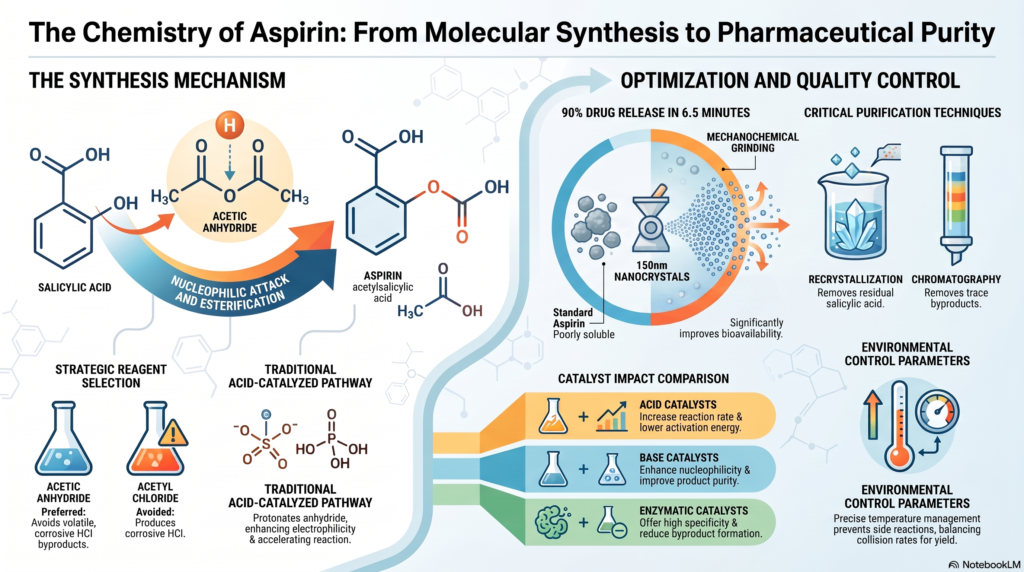
The aspirin synthesis mechanism involves a nucleophilic attack by salicylic acid’s hydroxyl group on acetic anhydride, forming an ester bond and releasing acetic acid. Controlling reaction temperature and pressure optimizes yield while minimizing side reactions. Key catalysts, both acid and base, enhance reaction efficiency and product purity. Ultimately, rigorous purification techniques guarantee the final aspirin meets safety and efficacy standards. By exploring further, you’ll uncover more intricate details about this essential pharmaceutical process.
Key Takeaways
- Aspirin synthesis involves the reaction of salicylic acid and acetic anhydride, forming an ester bond and releasing acetic acid.
- The mechanism includes a nucleophilic attack by the hydroxyl group of salicylic acid on acetic anhydride.
- Reaction conditions, such as temperature and pressure, significantly influence the efficiency and purity of aspirin production.
- Catalysts can enhance the reaction rate, yield, and specificity, optimizing the synthesis process.
- Purification techniques, like chromatography and recrystallization, are essential for ensuring the quality and efficacy of the final aspirin product.
WHY UNDERSTANDING ASPIRIN SYNTHESIS MATTERS
Understanding the synthesis of aspirin is essential not only for its historical significance in pharmacology but also for its applications in modern medicine. The synthesis significance lies in its foundational role in developing analgesics and anti-inflammatory agents.
By grasping the intricacies of aspirin’s chemical pathways, you empower yourself to innovate within the pharmaceutical landscape. This knowledge fosters a deeper comprehension of drug formulation and optimization, ultimately enhancing therapeutic efficacy.
In addition, recognizing aspirin’s pharmaceutical impact enables you to appreciate its role in addressing various health conditions, from cardiovascular diseases to inflammatory disorders. If you’re comparing common medications and wondering what is amoxicillin used for, it is an antibiotic prescribed to treat bacterial infections rather than the pain and inflammation managed by aspirin. As you explore this synthesis, you position yourself at the forefront of medical advancements, driving progress in both research and clinical applications.
Step-by-Step Breakdown of the Aspirin Synthesis Reaction
The synthesis of aspirin, or acetylsalicylic acid, involves a straightforward yet elegant chemical reaction that showcases key organic chemistry principles.
You start with salicylic acid, employing acetic anhydride as the acetylating agent. The reaction proceeds via nucleophilic attack by the hydroxyl group of salicylic acid on the carbonyl carbon of acetic anhydride, forming an ester bond and releasing acetic acid.
However, synthesis challenges arise, including reaction conditions and purification processes that can affect yield and purity.
Additionally, environmental considerations are paramount; the use of acetic anhydride generates waste that requires proper disposal.
What Are the Key Reactants in Aspirin Synthesis?
Key reactants in the synthesis of aspirin include salicylic acid and acetic anhydride. Aspirin (/ˈæsp(ə)rɪn/) is the genericized trademark for acetylsalicylic acid (ASA), a nonsteroidal anti-inflammatory drug (NSAID) used to reduce pain, fever, and inflammation, and as an antithrombotic. Aspirin is used to treat inflammatory conditions including Kawasaki disease, pericarditis, and rheumatic fever.
Salicylic acid, a phenolic compound, serves as the core structure, providing the necessary functional groups for acetylation. Acetic anhydride acts as the acetylating agent, facilitating the transfer of an acetyl group to the hydroxyl group of salicylic acid.
This reaction not only produces aspirin but also enhances the synthesis efficiency by driving the reaction toward completion through the formation of acetic acid as a byproduct. The resulting aspirin serves as the active pharmaceutical ingredient responsible for the medication’s pain-relieving, anti-inflammatory, and fever-reducing effects.
Understanding these key reactants allows you to optimize conditions for maximum yield, ensuring that your synthesis is both effective and efficient.
Mastering these elements empowers you to harness the full potential of aspirin production in your chemical endeavors.
The Role of Catalysts in Aspirin Production
Although catalysts aren’t always necessary for aspirin synthesis, their presence can considerably enhance the reaction’s efficiency and yield. By optimizing reaction conditions, you can markedly improve the overall process. Various catalyst types, such as acid or base catalysts, facilitate the acetylation of salicylic acid, accelerating the formation of aspirin.
| Catalyst Type | Effect on Reaction Conditions |
| Acid Catalysts | Increase reaction rate; lower activation energy |
| Base Catalysts | Enhance nucleophilicity; improve product purity |
| Enzymatic Catalysts | Offer specificity; reduce byproduct formation |
| Metal Catalysts | Enable heterogeneous reactions; improve scalability |
| Hybrid Catalysts | Combine benefits of multiple types; optimize efficiency |
Utilizing the right catalyst under suitable conditions guarantees a robust synthesis pathway, empowering you to achieve higher yields and purer products.
How Temperature and Pressure Influence Aspirin Synthesis?
Temperature and pressure play essential roles in the synthesis of aspirin, influencing both reaction kinetics and product yield. Understanding these factors can empower you to enhance your synthesis approach effectively.
- Temperature effects: Elevated temperatures accelerate molecular collisions, enhancing reaction rates and potentially increasing yield, but excessive heat may lead to unwanted side reactions.
- Pressure effects: Increased pressure can favor the formation of products in gas-phase reactions, shifting equilibrium and improving yields, particularly in multi-step syntheses.
- Equilibrium considerations: Balancing temperature and pressure maintains ideal conditions, ensuring efficient conversion of reactants to aspirin without compromising purity.
Alternative Methods for Synthesizing Aspirin: A Comparative Overview
When considering alternative methods for synthesizing aspirin, you’ll find several significant approaches, including traditional acid-catalyzed synthesis, enzymatic techniques, and microwave-assisted methods.
Acetylsalicylic acid (ASA) is a potent, irreversible inhibitor of platelet aggregation but loses its action after first-pass deacetylation to salicylic acid ( SA). Acetylsalicylic acid was launched into the pharmacy industry more than 100 years ago. While initially conceived as an analgesic, doctors soon discovered that it had many other medicinal benefits. The German chemist Felix Hoffman entered the Bayer Pharmaceutical Company in 1894. In pursuit of a drug to ease the discomfort of his father’s arthritis, he looked again at Brugnatelli and Fontana’s salicin, which had been further modified by chemists to create pure salicylic acid.
Each of these strategies presents distinct advantages and limitations regarding efficiency, yield, and environmental impact. Understanding these differences also provides useful context when comparing azithromycin use in treating bacterial infections with the therapeutic role of aspirin as an anti-inflammatory and pain-relieving medication.
A comparative analysis of these methods will illuminate their respective roles in modern aspirin production.
TRADITIONAL ACID-CATALYZED METHOD
In industrial formulation and process design, choosing your reagents and reaction pathways is always a balance between reactivity, safety, and scale-up feasibility. In forum discussions, people often ask why we default to acetic anhydride rather than acetyl chloride when acetylating salicylic acid. From a purely kinetic standpoint, acetyl chloride is highly reactive, but in a pharmaceutical manufacturing environment, it introduces significant headaches.
It yields volatile, highly corrosive hydrochloric acid gas, which requires extensive scrubbers, creates severe equipment corrosion risks, and poses safety hazards for technicians. Acetic anhydride, on the other hand, offers a much more controllable reaction profile. Its byproduct is acetic acid, which is non-volatile under standard conditions, significantly less corrosive, and much easier to handle during washing and isolation.
Furthermore, when we look at newer, green chemistry approaches, like mechanochemical grinding or microwave-assisted acetylation, we aren’t just trying to be trendy. We are looking for ways to bypass solvent-heavy recrystallization steps and eliminate trace impurities right at the source. Understanding these practical trade-offs is what separates textbook theoretical chemistry from practical pharmaceutical development.
The traditional acid-catalyzed method for synthesizing aspirin remains a cornerstone in organic chemistry due to its straightforward approach and effectiveness. This method employs acid catalysts, typically sulfuric or phosphoric acid, to facilitate the esterification reaction between salicylic acid and acetic anhydride.
Here’s how the process unfolds:
- Protonation: The acid catalyst protonates the carbonyl oxygen of acetic anhydride, enhancing electrophilicity.
- Nucleophilic Attack: Salicylic acid’s hydroxyl group attacks the activated carbonyl, forming a tetrahedral intermediate.
- Dehydration: The intermediate collapses, releasing a molecule of acetic acid and yielding aspirin.
Enzymatic Synthesis Approaches
While traditional methods for synthesizing aspirin have proven effective, enzymatic synthesis approaches offer innovative alternatives that leverage biological catalysts for enhanced efficiency and specificity.
By utilizing enzymes, you can exploit biosynthetic pathways that naturally occur in organisms, markedly improving reaction rates and selectivity. The enzyme efficiency in these methods often surpasses conventional techniques, reducing by-products and the need for extensive purification processes.
Additionally, these biocatalysts operate under milder conditions, minimizing energy consumption and environmental impact. As you explore these advanced methodologies, consider the potential for integrating enzyme systems that can be tailored to optimize yield and purity in aspirin production, making enzymatic synthesis a compelling choice for the future of pharmaceutical synthesis.
Microwave-Assisted Synthesis Techniques
Microwave-assisted synthesis techniques have emerged as a promising alternative for producing aspirin, greatly enhancing reaction efficiency and reducing synthesis times. By harnessing microwave energy, you can achieve superior results compared to traditional methods.
Consider these advantages:
- Increased microwave efficiency: The targeted energy dispersal heats reaction mixtures uniformly, minimizing energy loss.
- Enhanced reaction yield: Rapid heating accelerates the reaction rate, often leading to higher product yields in shorter durations.
- Reduced solvent usage: These techniques often require less solvent, promoting greener chemistry and lowering environmental impact.
Implementing microwave-assisted synthesis not only streamlines the production of aspirin but also positions you at the forefront of innovative chemical methodologies, optimizing both time and resources for maximum efficacy in pharmaceutical synthesis.
The Importance of Purification and Quality Control in Aspirin Production
In aspirin production, effective purification techniques are critical to guarantee the removal of impurities that could affect the drug’s efficacy and safety. Bayer chemist Felix Hoffmann synthesized aspirin for the first time in 1897. Originally an antipyretic and anti-inflammatory drug, aspirin became crucial in preventing cardiovascular and cerebrovascular diseases due to its antiplatelet properties. This drug inhibits the production of prostaglandins, potent hormones involved in regulating smooth muscle and triggering inflammation. Additionally, aspirin prevents the synthesis of thromboxanes, which cause blood vessels to constrict and encourage platelet aggregation, the initial step in blood clot formation. Many doctors recommend low-dose aspirin daily for high-risk patients to reduce the risk of blood clots, heart attacks, and strokes.
You must adhere to stringent quality control standards to verify that the final product meets regulatory requirements and maintains consistent performance.
Understanding these aspects is fundamental for optimizing the synthesis process and guaranteeing high-quality aspirin.
Purification Techniques Overview
Purification techniques are essential in ensuring the quality and efficacy of aspirin produced through synthesis.
To achieve pureness and potency, you’ll often rely on:
- Chromatography methods: These separate components based on their affinities, providing a refined product by isolating aspirin from impurities.
- Recrystallization techniques: This involves dissolving aspirin in a solvent followed by controlled cooling, allowing only pure crystals to form, thereby enhancing purity.
- Filtration processes: Implementing these techniques removes insoluble impurities, ensuring a clear solution prior to crystallization.
Quality Control Standards
Quality control standards play an essential role in the production of aspirin, ensuring that the final product meets both safety and efficacy requirements.
By implementing rigorous quality assurance measures, you can guarantee the integrity of each batch. Utilizing thorough testing protocols, you assess the purity, potency, and stability of the aspirin. This process involves evaluating raw materials, intermediates, and final formulations through advanced analytical techniques such as HPLC and GC.
Each stage requires meticulous documentation and adherence to regulatory guidelines, ensuring compliance with industry standards. By prioritizing quality control, you not only enhance product reliability but also bolster consumer trust, ultimately positioning your aspirin as a leader in the market.
Embrace these standards to assert your dominance in pharmaceutical excellence.

RELATED STUDIES ABOUT ASPIRIN SYNTHESIS MECHANISM
In mastering the synthesis of aspirin, you’re not just learning about a chemical reaction; you’re grasping a cornerstone of pharmaceutical chemistry. By understanding the key reactants, catalysts, and conditions that influence the process, you can guarantee high-quality production. Remember, in the world of chemistry, the devil’s in the details. As you explore alternative methods and purification techniques, you’ll appreciate the importance of precision and control in creating this essential therapeutic agent.
Mechanochemical synthesis of aspirin nanocrystals for pharmaceutical applications
Overview
Aspirin (acetylsalicylic acid) is a widely used pharmaceutical, yet its clinical utility is often limited by poor water solubility, which restricts oral bioavailability to approximately 40–50%. This study demonstrates that the mechanochemical synthesis of aspirin nanocrystals is a sustainable, scalable, and solvent-efficient strategy to improve dissolution rates and, consequently, therapeutic performance.
Methodology
The researchers utilized two primary mechanochemical techniques—neat grinding (NG) and liquid-assisted grinding (LAG)—to generate aspirin nanocrystals. The process was systematically optimized by evaluating key variables, including:
- Liquid additives: Specifically, the effectiveness of various solvents, with distilled water proving to be the most successful medium.
- Process Parameters: Systematically varying the liquid-to-solid ratio ($\eta$), milling frequency, and milling time.
- Polymorphic Control: Assessing the formation and stability of different aspirin polymorphs (specifically Forms I and IV) during the milling process.
Key Findings
- Optimal Synthesis Conditions: High-quality nanocrystals of approximately 150 nm were successfully produced using distilled water as a liquid additive at an $\eta$ value between 0.1 and 0.2, at a frequency of 30 Hz for 30 minutes.
- Polymorphic Stability: Contrary to previous reports characterizing aspirin Form IV as a highly unstable, short-lived metastable state, this study discovered that Form IV remains stable at room temperature ($22–27^{\circ}\text{C}$) for over 60 days under specific mechanochemical conditions.
- Phase Transformation: The study demonstrated reversible control over polymorphic transitions. While water-assisted grinding consistently drove the transformation of Form IV to the more stable Form I, the use of cyclohexane allowed for the maintenance of Form IV, provided the liquid-to-solid ratio was appropriately tuned.
- Enhanced Dissolution: The produced aspirin nanocrystals exhibited a significantly enhanced drug release profile compared to bulk aspirin. At pH 1.2 (simulated gastric fluid), the nanocrystals achieved ~90% drug release within 6.5 minutes, compared to ~50% for the bulk form.
Conclusion
The mechanochemical approach presented in this study provides a robust, industrial-scale method for producing stable aspirin nanocrystals with significantly improved dissolution characteristics. By achieving superior control over polymorphic forms—specifically stabilizing Form IV at room temperature and facilitating its conversion to Form I—this research offers a viable pathway for advanced pharmaceutical formulations aimed at increasing the bioavailability and therapeutic efficacy of aspirin.
| REFERENCE: G. D. S. Kanchana Garumanna, Ranjit Thakuria, Nadeesh M. Adassooriya, Mechanochemical synthesis of aspirin nanocrystals for pharmaceutical applications, RSC Mechanochemistry, Volume 3, Issue 3, 2026, Pages 393-401, ISSN 2976-8683, https://doi.org/10.1039/d5mr00118h. (https://www.sciencedirect.com/science/article/pii/S2976868326000173) |
Aspirin reprograms platelet signaling and the intrahepatic microbiome to suppress RyR2-driven inflammation and fibrosis in preclinical chronic liver disease
Overview
Chronic liver disease is a significant global health burden, often progressing to fibrosis and cirrhosis. While platelet activation is known to contribute to liver fibrosis, the precise mechanisms linking platelet activity, the hepatic microenvironment, and fibrosis progression have remained unclear. This study investigates the therapeutic potential of aspirin—a well-known platelet deactivator—in a murine model of liver fibrosis, providing new insights into its molecular effects on the liver.
Methodology
The researchers employed an integrated “integrome” approach (combining proteomic and metabolomic data) to analyze molecular signatures in a murine model of liver fibrosis. They evaluated the impact of aspirin administration on:
- Platelet Activity: Assessing intrahepatic levels of platelet factor 4 (PF4), p-selectin, and PDGFR-$\beta$.
- Inflammation and Fibrosis: Measuring changes in liver pathology and inflammatory responses.
- Molecular Signaling: Investigating the role of the Ryanodine receptor 2 (RyR2), arachidonate 5-lipoxygenase (ALOX5), and arginase 1 (ARG1) pathways in fibrosis regression.
- Gut-Liver Axis: Examining the modulation of the intrahepatic microbiome.
Key Findings
- Aspirin Reduces Fibrosis: Aspirin administration significantly reduced the number and activation of intrahepatic platelets, which in turn led to a marked decrease in hepatic inflammation and fibrosis.
- Platelet-Fibrosis Correlation: Elevated levels of intrahepatic PF4, p-selectin, and PDGFR-$\beta$—all markers of platelet activation—showed a strong positive correlation with increased liver fibrosis.
- Metabolic and Proteomic Shifts: Aspirin-mediated platelet deactivation triggered several beneficial metabolic and molecular shifts in the liver, including:
- Increased autophagy, glutathione levels, and energy metabolism.
- Decreased expression of RyR2-driven inflammatory pathways.
- Downregulation of ALOX5 and modulation of ARG1 pathways.
- Microbiome Reprogramming: Aspirin treatment successfully reprogrammed the intrahepatic microbiome, further contributing to the suppression of inflammatory and fibrotic processes.
Conclusion
This study highlights aspirin as a potent therapeutic agent capable of regressing liver fibrosis. By deactivating intrahepatic platelets, aspirin not only inhibits direct fibrotic signaling but also favorably reprograms the hepatic metabolic/proteomic landscape and the intrahepatic microbiome. These findings offer a mechanistic foundation for the potential clinical application of aspirin in managing chronic liver disease.
| REFERENCE: Adil Bhat, Sudrishti Chaudhary, Anupama Kumari, Shvetank Sharma, Shiv Kumar Sarin, Jaswinder Singh Maras, Aspirin reprograms platelet signaling and the intrahepatic microbiome to suppress RyR2-driven inflammation and fibrosis in preclinical chronic liver disease, Biomedicine & Pharmacotherapy, Volume 198, 2026, 119296, ISSN 0753-3322, https://doi.org/10.1016/j.biopha.2026.119296. (https://www.sciencedirect.com/science/article/pii/S075333222600329X) |
Aspirin inhibition and recovery of cyclooxygenase activity and thromboxane biosynthesis in human megakaryocytes: a translational surrogate model
Overview
Low-dose aspirin is a cornerstone of cardiovascular disease prevention, functioning through the irreversible acetylation of cyclooxygenase-1 (COX-1) in platelets. While its pharmacodynamics in mature, anucleate platelets are well understood, the kinetics of COX-1 inhibition and recovery in the bone-marrow progenitor cells—human megakaryocytes (MKs)—have been difficult to study due to the invasive nature of bone-marrow sampling. This study successfully validated two human megakaryocytic cell lines (MEG-01 and CHRF-288-11) as a reliable and feasible surrogate model to investigate the pharmacological effects of aspirin on MKs.
Key Findings
- Validation of the Surrogate Model: Both MK cell lines were confirmed to express COX-1 and COX-2 isozymes and demonstrated the capacity to synthesize thromboxane (TX)A$_2$ (measured as $TXB_2$) upon stimulation with arachidonic acid, closely mimicking the behavior of primary human MKs.
- Principal Source of TXA$_2$: Selective inhibition experiments revealed that COX-1 is the primary source of $TXA_2$ in these MK cell lines, while COX-2 plays a minimal role.
- Dose and Time-Dependent Inhibition: Aspirin inhibited $TXB_2$ biosynthesis in a dose-dependent manner ($IC_{50}$ values of $\sim 2.4-2.8~\mu M$), which is consistent with plasma concentrations observed in humans following low-dose aspirin intake.
- Kinetics of Recovery: Following a single exposure to 10 µM aspirin, COX activity in the MK cell lines showed a 48-hour recovery lag and fully recovered within 72 hours. This pattern likely reflects the time required for de novo synthesis of COX-1 protein, providing a clear mechanistic parallel to the recovery kinetics observed in peripheral blood platelets.
- Cumulative Effects: Repeated once-daily treatment with low-dose aspirin (0.1 and 1 µM) resulted in a progressively increasing degree of $TXB_2$ inhibition, which plateaued after 3–4 days.
Conclusion
This study confirms that human megakaryocytic cell lines are effective surrogate models for studying aspirin’s antiplatelet pharmacodynamics. The findings demonstrate that aspirin time- and dose-dependently inhibits MK COX-1, with a delayed recovery that supports the hypothesis of cumulative, irreversible enzyme inhibition in bone-marrow progenitors. This mechanism explains the sustained antiplatelet effect of low-dose aspirin in humans, offering important mechanistic insight into why platelet function remains suppressed even after aspirin is cleared from systemic circulation.
| REFERENCE: Zahraa I. Mallah, Giovanna Petrucci, Abeer J. Ayoub, Mohammad A. Farhoud, Joseph G. Jelwan, Sara Lucchisani, Adham K. Fakih, Bassam Badran, Eva Hamade, Carlo Patrono, Bianca Rocca, Aida Habib, Aspirin inhibition and recovery of cyclooxygenase activity and thromboxane biosynthesis in human megakaryocytes: a translational surrogate model, The Journal of Pharmacology and Experimental Therapeutics, Volume 392, Issue 12, 2025, 103762, ISSN 0022-3565, https://doi.org/10.1016/j.jpet.2025.103762. (https://www.sciencedirect.com/science/article/pii/S0022356525402754) |
CONCLUSION
Looking at aspirin through a modern pharmaceutical lens, it’s amazing how much this classic molecule continues to teach us. While its basic reaction chemistry was established over a century ago, our approach to its optimization, purification, and clinical application is constantly evolving. In stability testing, we still see acetylsalicylic acid slowly undergo hydrolysis back into salicylic acid and acetic acid if exposed to moisture, giving older bottle formulations that faint, telltale vinegar smell.
This reminds us that synthesis is only half the battle; rigorous purification techniques like controlled recrystallization and robust analytical testing (like HPLC) are essential to ensure long-term shelf-life and drug efficacy. What excites me most as a formulation scientist is seeing how modern research breathes new life into classic APIs whether that’s exploring mechanochemical methods to produce aspirin nanocrystals for faster dissolution, or studying how low-dose aspirin interacts at a molecular level with tissue microenvironments and platelet signaling.
The reaction mechanism is more than just a step in a textbook; it’s proof that precise chemical engineering at the molecular level directly dictates how a drug performs inside the human body. Never stop asking why a reaction behaves the way it does that curiosity is where real scientific breakthroughs begin.