

Having spent over a decade behind the community pharmacy counter, I can tell you that few prescriptions cause as much confusion or come with as many assumptions as azithromycin. Patients frequently walk up to my counter expecting a quick cure-all for every winter scratchy throat or mild chest rattle, often calling it the “Z-Pak magic bullet.” While it is indeed a powerful, broad-spectrum macrolide antibiotic, its true strength lies in how its active ingredient behaves once ingested.
Unlike many traditional antibiotics that require strict dosing three or four times a day for up to two weeks, azithromycin boasts an exceptional pharmacokinetic profile. It penetrates deep into infected tissue and builds up a high local concentration that lingers long after you take your last pill. However, that convenience can be a double-edged sword. Because the dosing regimen is usually so brief, often just three to five days patients frequently assume their infection was minor, or conversely, they stop after two days because they feel significantly better.
Understanding how this active pharmaceutical ingredient works inside your body isn’t just academic curiosity; it is the fundamental key to taking it safely, avoiding unpleasant side effects, and ensuring the infection is eradicated completely without contributing to wider treatment resistance.
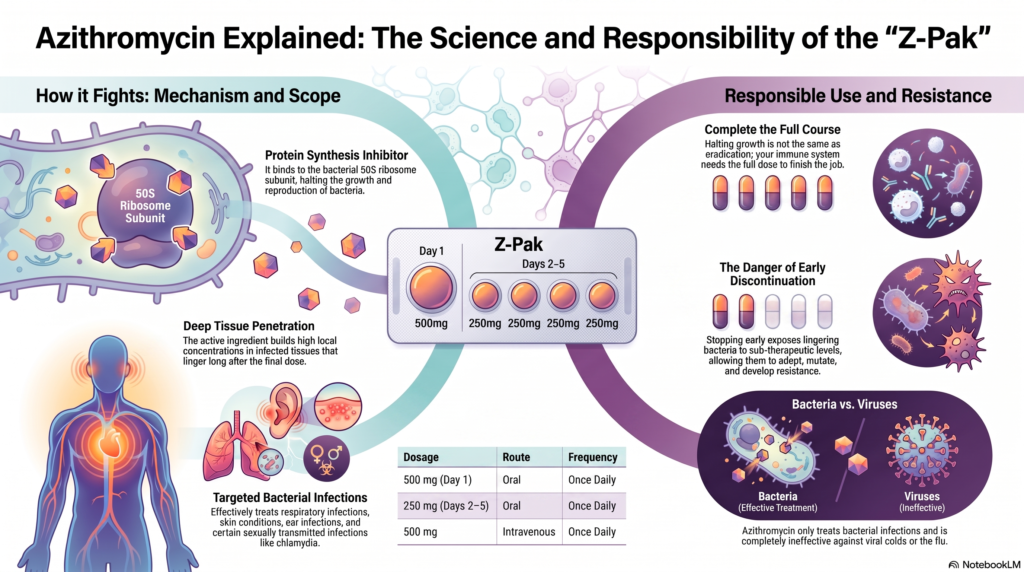
Azithromycin is an antibiotic that fights bacterial infections by binding to the 50S subunit of the bacterial ribosome, disrupting protein synthesis. This action halts the growth and reproduction of harmful bacteria, making it effective against various infections like pneumonia, skin conditions, and chlamydia. To maximize its effectiveness and prevent resistance, you should complete the full course as prescribed. There’s more to discover about its uses, side effects, and responsible usage.
KEY TAKEAWAYS
- Azithromycin is a macrolide antibiotic that inhibits bacterial protein synthesis by binding to the 50S ribosomal subunit.
- It effectively treats various bacterial infections, including respiratory, skin, ear, and sexually transmitted infections.
- The recommended oral dosage is 500 mg on Day 1, followed by 250 mg for the next four days.
- Completing the full course of azithromycin is essential to eradicate bacteria and prevent antibiotic resistance.
- Responsible use includes adhering to prescriptions and avoiding use for viral infections like colds or flu.
WHAT IS AZITHROMYCIN AND HOW DOES IT WORK?
Azithromycin is an antibiotic belonging to the macrolide class, commonly used to treat various bacterial infections.
Understanding the azithromycin mechanism is essential for grasping how it effectively combats these pathogens. It works by binding to the bacterial ribosome, specifically targeting the 50S subunit. This binding inhibits protein synthesis, disrupting the bacteria’s ability to grow and reproduce. As the active pharmaceutical ingredient, azithromycin is responsible for this antibacterial action, helping eliminate susceptible bacteria while allowing your immune system to clear the infection. Consequently, the infection is controlled, allowing your immune system to eliminate the remaining bacteria.
Azithromycin’s unique pharmacokinetics also enable it to remain effective in tissues for an extended period, enhancing its therapeutic impact. With its ability to tackle resistant strains, this antibiotic is a powerful ally in the fight against bacterial infections, ensuring you regain your health swiftly and efficiently.
Common Infections Treated With Azithromycin
Many bacterial infections respond well to azithromycin, making it a go-to option for healthcare providers. If you’re comparing treatment options and wondering what is amoxicillin used for, it’s commonly prescribed for many of the same bacterial infections, although the most appropriate antibiotic depends on the type of infection and your healthcare provider’s recommendation. This powerful antibiotic effectively combats various conditions, helping you regain your health quickly.
Here are some common infections treated with azithromycin:
- Respiratory infections, like pneumonia and bronchitis
- Skin infections, including cellulitis and impetigo
- Ear infections, such as otitis media
- Sinus infections, providing relief from sinusitis
- Sexually transmitted infections, like chlamydia
How to Take Azithromycin: Dosage and Instructions
When taking azithromycin, it’s vital to follow your healthcare provider’s instructions to confirm the medication works effectively. Adhering to the dosage guidelines is essential for your treatment’s success. Azithromycin can be administered orally or intravenously, depending on your specific condition.
Here’s a quick reference for the dosage and administration routes:
| Dosage | Administration Route | Frequency |
| 500 mg on Day 1 | Oral | Once daily |
| 250 mg for Days 2-5 | Oral | Once daily |
| 500 mg IV | Intravenous | Once daily |
Always take the full course as prescribed, even if you feel better before finishing the medication. This confirms all bacteria are eradicated effectively.
Azithromycin Side Effects: What to Watch For?
While taking azithromycin can effectively treat your condition, it’s important to be aware of potential side effects. Knowing what to look for guarantees you stay in control of your health.
Watch for these signs:
- Allergic reactions, such as rash or hives (azithromycin allergies)
- Gastrointestinal reactions like nausea or diarrhea
- Stomach pain or cramping
- Headaches or dizziness
- Changes in liver function tests
If you experience any of these symptoms, consult your healthcare provider immediately. For mild allergic symptoms, your healthcare provider may recommend an antihistamine such as a cetirizine hydrochloride tablet, depending on your medical history and individual needs.
Staying informed about these side effects empowers you to act quickly and maintain your wellbeing. Always prioritize your health and don’t hesitate to reach out for support when needed.
Why You Must Complete Your Azithromycin Prescription
Completing your azithromycin prescription is essential for preventing antibiotic resistance. Azithromycin is used to treat infections caused by bacteria. It is also used to treat and prevent disseminated Mycobacterium avium complex (MAC) infection [a type of lung infection that affects people with a suppressed immune system). Azithromycin is in a class of medications called macrolide antibiotics. It works by stopping the growth of bacteria.
If you stop taking the medication too soon, you risk leaving behind some bacteria that can adapt and become harder to treat.
Preventing Antibiotic Resistance
As you take your azithromycin prescription, remember that finishing the entire course is vital to preventing antibiotic resistance.
Incomplete treatment can lead to bacteria that survive and adapt, making future infections harder to treat. This is where your role in antibiotic stewardship becomes critical.
By adhering to your prescription, you contribute to effective resistance management and protect your health.
- Guarantees all bacteria are eliminated
- Reduces the risk of resistant strains developing
- Protects future treatment options
- Supports public health initiatives
- Empowers you as a responsible patient

ENSURING EFFECTIVE TREATMENT OUTCOMES
In my daily interaction with patients, the most frequent pitfall I observe isn’t a failure of the drug itself, but a misunderstanding of how tissue accumulation works. I often have patients call the pharmacy on Day 3 of a 5-day regimen saying, “Marcus, my fever broke and my cough is almost gone. Can I save the last two tablets for the next time I get sick?” My answer is always a firm, emphatic no.
When azithromycin binds to the 50S subunit of bacterial ribosomes, it effectively halts bacterial protein synthesis and stops pathogen reproduction. But halting growth is not the same as complete eradication; your immune system relies on a steady, sustained concentration of the active ingredient to finish the job. If you stop therapy early, the lingering bacteria aren’t just left behind, they are exposed to sub-therapeutic levels of the drug. This is precisely how bacteria learn to adapt, mutate, and develop resistance.
Furthermore, people often ask why we use azithromycin over broad alternatives like amoxicillin-clavulanate for certain respiratory issues. Azithromycin specifically targets atypical organisms that beta-lactam antibiotics simply cannot reach. Additionally, macrolides exert a modest immunomodulatory effect in the respiratory tract that can help soothe inflammatory responses, but this benefit only works safely when the complete prescribed course is followed under professional guidance.
Following your azithromycin prescription closely is key to achieving the best treatment outcomes.
Treatment adherence is essential; completing the entire course guarantees that the bacteria are fully eradicated, reducing the risk of relapse and resistance. When you skip doses or stop early, you compromise your recovery and contribute to antibiotic resistance, undermining future treatment options.
Patient education plays a significant role here. Understanding why you need to take the full prescription empowers you to commit to your health.
Don’t underestimate the importance of this medication—it’s designed to combat infections effectively. By following your doctor’s instructions and prioritizing adherence, you’re taking control of your health and facilitating a swift return to wellness.
What to Do If You Experience Side Effects?
If you notice side effects while taking azithromycin, it’s important to take action promptly. Monitoring symptoms is essential for your health. Here’s what you should do:
- Assess the severity of your side effects.
- Contact your healthcare provider to discuss your symptoms.
- Keep a record of when side effects started and their intensity.
- Avoid discontinuing the medication without medical advice.
- Report side effects to your provider or a local health authority to contribute to safety monitoring.
Taking these steps empowers you to manage your health effectively.
How Responsible Use of Azithromycin Combats Antibiotic Resistance
Using azithromycin responsibly is essential in the fight against antibiotic resistance. Azithromycin is used to treat certain bacterial infections in many different parts of the body. This medicine may mask or delay the symptoms of syphilis. It is not effective against syphilis infections.
By ensuring proper prescribing practices and emphasizing the importance of patient adherence, you can help maintain the effectiveness of this medication.
Additionally, educating yourself and others about appropriate antibiotic use plays a key role in preventing resistance.
Responsible Prescribing Practices
While antibiotic resistance poses a significant threat to public health, responsible prescribing practices for azithromycin can help mitigate this challenge. By ensuring proper use, you enhance patient safety and combat the rise of resistant bacteria.
- Assess patient history thoroughly before prescribing.
- Limit azithromycin use to confirmed bacterial infections.
- Educate patients on the importance of completing prescribed courses.
- Monitor for side effects and effectiveness regularly.
- Advocate for alternative treatments when appropriate.
These practices not only preserve the efficacy of azithromycin but also empower you as a healthcare provider.
Patient Adherence Importance
Understanding the importance of patient adherence to prescribed azithromycin regimens is essential in combating antibiotic resistance. When you follow your healthcare provider’s instructions closely, you’re not just enhancing your recovery; you’re also playing a significant role in preserving the effectiveness of this essential antibiotic.
Patient education empowers you to understand the necessity of completing your course, preventing bacteria from developing resistance. By ensuring medication adherence, you help maintain the drug’s power against infections.
Remember, each missed dose can contribute to resistance, jeopardizing treatment options for future patients. Take charge of your health; commit to your azithromycin regimen, and advocate for responsible antibiotic use.
Together, we can safeguard the efficacy of antibiotics for generations to come. Azithromycin is from a group of medicines called macrolide antibiotics. Macrolide antibiotics work by killing the bacteria that cause the infection. Azithromycin is available on prescription as capsules, tablets and a liquid that you swallow. It can also be given by injection, but this is usually only done in hospital.
Education on Antibiotic Use
How can you guarantee that azithromycin remains effective against infections? You must practice responsible antibiotic use and embrace patient education. By understanding antibiotic stewardship, you can help slow the rise of resistance.
- Only take azithromycin when prescribed by a healthcare professional.
- Complete the full course, even if you feel better.
- Never share antibiotics with others or use leftover prescriptions.
- Avoid using antibiotics for viral infections, like colds or the flu.
- Stay informed about the importance of responsible antibiotic use.

RELATED STUDIES ABOUT AZITHROMYCIN USE
In conclusion, azithromycin stands as a powerful ally against bacterial infections, like a shield guarding you from invisible foes. By following your doctor’s instructions and completing your prescription, you guarantee this shield remains effective. Remember, each dose boosts your defense and helps prevent antibiotic resistance from creeping in like a shadow. If side effects arise, don’t hesitate to reach out for guidance. With responsible use, you can keep your health vibrant and strong, ready to face the world.
Nano-in-micro dry powder formulations combining azithromycin and menadione as adjuvant against pulmonary P. aeruginosa infections
Background and Objective
Chronic lung infections caused by Pseudomonas aeruginosa are a primary contributor to morbidity and mortality in patients suffering from cystic fibrosis (CF). Current inhaled antibiotic therapies are increasingly limited by bacterial biofilm formation and the emergence of antibiotic resistance. This study explores a novel inhalable formulation strategy designed to combat resistance by combining the antibiotic azithromycin (AZM) with menadione (MEN), a synthetic antibiotic adjuvant, to enhance localized antibacterial efficacy while maintaining lung epithelial safety.
Methodology and Formulation Design
The researchers developed nano-embedded microparticles (NEMs) utilizing a “Trojan particle” concept, which combines the lung-depositing advantages of microparticles with the barrier-penetrating benefits of nanoparticles.
- Nanoparticles: MEN was loaded into acetal-modified maltodextrin (AcMD) polymeric nanoparticles via nanoprecipitation.
- Microparticles: These nanoparticles were then embedded into a biologically active microparticle matrix composed of AZM, mannitol, and leucine using a spray-drying process.
- Testing: The formulations were characterized for aerodynamic performance and redispersibility, and their biological activity and safety were evaluated using biorelevant aerosol exposure models, including nebulization and dry powder atomization.
Key Findings
- Optimal Aerodynamic Properties: The spray-dried NEM formulations achieved a mass median aerodynamic diameter (MMAD) ranging from 2.6 to 3.6 µm. This size falls perfectly within the required aerodynamic window for targeted pulmonary delivery to the conducting airways, the primary site of CF infections.
- Effective Redispersibility: The formulations demonstrated efficient disintegration and redispersion of both the microparticle powder and the embedded nanoparticles when exposed to conditions simulating the lung environment.
- Enhanced Antibiofilm Efficacy: Incorporating MEN-loaded nanoparticles into the AZM matrix significantly enhanced the formulation’s ability to eradicate mature P. aeruginosa biofilms. This robust adjuvant effect was successfully preserved across both nebulization and dry powder atomization delivery methods.
- Favorable Safety Profile: Cytotoxicity evaluations on Calu-3 lung epithelial cells showed no significant increase in lactate dehydrogenase (LDH) release. This indicates that the formulations do not compromise or damage the cellular membrane integrity of the airway epithelium at antibacterial concentrations.
Conclusion
The nano-in-micro formulation effectively merges azithromycin with the adjuvant menadione into a highly respirable dry powder. The system successfully preserves both the drug’s antibacterial activity and the adjuvant’s efficacy, offering a safe, targeted, and highly promising therapeutic strategy for managing persistent and resistant P. aeruginosa infections in cystic fibrosis patients.
| REFERENCE: Kristela Shehu, Janina Osti, Marius Hittinger, Annette Kraegeloh, Marc Schneider, Nano-in-micro dry powder formulations combining azithromycin and menadione as adjuvant against pulmonary P. aeruginosa infections, International Journal of Pharmaceutics, Volume 698, 2026, 126965, ISSN 0378-5173, https://doi.org/10.1016/j.ijpharm.2026.126965. (https://www.sciencedirect.com/science/article/pii/S0378517326004138) |
Ultrahigh performance liquid chromatography mass spectrometry for the determination of azithromycin in canine serum and skin tissue
Overview
Oomycete infections, such as those caused by Pythium insidiosum and Paralagenidium karlingii, present a significant challenge in veterinary medicine due to their resistance to conventional antifungal therapies and the progressive, often fatal nature of the resulting cutaneous lesions in dogs. Azithromycin (AZI), a semi-synthetic azalide macrolide, is an attractive candidate for treatment due to its favorable pharmacokinetic profile—specifically, its ability to penetrate and accumulate within tissues and phagocytic cells at concentrations far exceeding those found in blood plasma. However, the pharmacological behavior of AZI in diseased canine skin remains poorly defined due to a lack of validated analytical methods.
Objective
This study aimed to develop, optimize, and validate a simple, reproducible, and cost-effective ultrahigh-performance liquid chromatography-mass spectrometry (UHPLC-MS) assay for quantifying azithromycin in both canine serum and skin tissue homogenates.
Methodology
- Assay Design: The researchers employed a Waters Acquity UHPLC system coupled with a Quattro Micro triple-quadrupole mass spectrometer operating in positive electrospray mode.
- Detection Strategy: Because azithromycin exhibited weak fragmentation under standard multiple reaction monitoring (MRM), the assay was optimized to use the precursor ion ([M+H]^{+} m/z 749.25) in selected-ion recording (SIR) mode, providing higher and more consistent signal intensity. Roxithromycin was used as the internal standard.
- Sample Preparation: A streamlined protein precipitation (PPT) method using cold acetonitrile was developed for sample cleanup, avoiding the need for more expensive and time-consuming solid-phase or liquid-liquid extractions.
- Validation: The method was rigorously validated according to ICH M10 guidelines, testing for selectivity, sensitivity, linearity, accuracy, precision, stability, and dilution integrity.
- Clinical Application: The validated assay was applied retrospectively to clinical serum and skin biopsy samples from dogs with confirmed oomycete infections that had been receiving oral azithromycin therapy.
Key Findings
- Method Performance: The assay demonstrated a linear range of 0.02-1.2~\mu g/mL, with correlation coefficients exceeding 0.99. Accuracy and precision were well within acceptable limits (\pm15\%), and sample recovery exceeded 85% in both matrices. The lower limit of quantification (LLOQ) was firmly established at 0.02~\mu g/mL.
- Clinical Tissue Penetration: Analysis of the clinical samples revealed a mean azithromycin serum concentration of 0.702~\mu g/mL. Strikingly, the mean concentration in diseased skin tissue was approximately 51.8~\mu g/g (after a 4-day wash-out period), representing tissue levels exponentially higher than those in serum.
- Therapeutic Relevance: The concentrations measured in the diseased skin significantly exceeded the reported in vitro minimum inhibitory concentrations (MICs) for P. insidiosum isolates, suggesting that therapeutically relevant drug levels are sustained within infected tissues even days after treatment ceases.
Conclusion
The study successfully developed and validated a streamlined UHPLC-MS (SIR) method utilizing protein precipitation for the reliable quantification of azithromycin in canine serum and diseased skin tissue. The clinical findings confirm profound and sustained tissue accumulation of the drug, providing a strong pharmacokinetic rationale for its use in treating chronic cutaneous oomycete infections in veterinary patients.
| REFERENCE: Apurva Pravin Patil, Michaela G. Austel, Michael G. Bartlett, Ultrahigh performance liquid chromatography mass spectrometry for the determination of azithromycin in canine serum and skin tissue, Journal of Chromatography B, Volume 1276, 2026, 125013, ISSN 1570-0232, https://doi.org/10.1016/j.jchromb.2026.125013. (https://www.sciencedirect.com/science/article/pii/S1570023226001029) |
Impact of Chlamydia trachomatis treatment with azithromycin or doxycycline on Mycoplasma genitalium in women
Overview
Mycoplasma genitalium (MG) is a recognized sexually transmitted infection (STI) that often presents asymptomatically but can lead to cervicitis and pelvic inflammatory disease. Because concurrent infection rates between Chlamydia trachomatis (CT) and MG range from 7% to 28% in women, this study investigated how standard-of-care antibiotic treatments for CT—single-dose azithromycin or a 7-day course of doxycycline—affect the eradication, persistence, and incidence of concurrent MG.
Methodology
- Study Design: This sub-study utilized participants from the “Chlazidoxy” cohort, a randomized controlled trial of CT-infected women.
- Data Collection: Researchers tested vaginal swabs from 281 women collected at baseline and at a 6-week follow-up visit after the initiation of CT treatment.
- Molecular Analysis: MG was detected and quantified using real-time PCR. Resistance-associated mutations for macrolides (23S rRNA gene) and quinolones (parC gene) were analyzed, alongside mgpB genotyping.
Key Findings
- Eradication Rates: Treatment for CT was highly effective at clearing concurrent MG in the majority of cases.
- Azithromycin: Eradicated MG in 85.7% (18/21) of cases.
- Doxycycline: Eradicated MG in 55.6% (10/18) of cases.
- The difference between the two groups showed a trend toward higher eradication with azithromycin, though it did not reach statistical significance (P=0.07).
- Persistence and Incidence: * Persistent MG was observed in 14.3% (3/21) of the azithromycin group and 38.9% (7/18) of the doxycycline group.
- In the doxycycline group, persistent infection was significantly associated with a higher baseline bacterial load.
- New MG infections (incidence) were detected in 6.6% of women who were initially MG-negative, with no significant difference between treatment groups.
- Resistance: Resistance-associated mutations were detected at similar proportions in both treatment groups, and there was no significant increase in macrolide resistance rates at the 6-week follow-up.
Conclusion
Standard antibiotic regimens used to treat Chlamydia trachomatis (1g azithromycin or 7-day doxycycline) effectively eradicate concurrent Mycoplasma genitalium in the majority of asymptomatic women. These findings are clinically relevant as they suggest that standard CT treatment protocols may provide unintended therapeutic benefits for concurrent MG infections, even though these regimens are not specifically recommended for MG management
| REFERENCE: Chloé Le Roy, Alexandre Ferron, Carla Balcon, Jennifer Guiraud, Cécile Bébéar, Bertille de Barbeyrac, Olivia Peuchant, Impact of Chlamydia trachomatis treatment with azithromycin or doxycycline on Mycoplasma genitalium in women, International Journal of Infectious Diseases, Volume 165, 2026, 108404, ISSN 1201-9712, https://doi.org/10.1016/j.ijid.2026.108404. (https://www.sciencedirect.com/science/article/pii/S1201971226000391) |
CONCLUSION
As healthcare professionals, our ultimate goal isn’t just clearing a patient’s immediate infection; it’s protecting the long-term viability of the vital medicines we rely on every single day. Over my years in retail pharmacy, I have watched antibiotic resistance evolve from an abstract public health warning into a concrete, daily reality. When an antibiotic as versatile as azithromycin loses its effectiveness against common strains, patients face longer recovery times, more severe side effects from second-line therapies, and higher risks of complications.
The encouraging news is that modern pharmaceutical research is continuously finding ways to optimize this incredible drug whether through innovative inhalable nano-in-micro formulations to tackle resistant lung infections or expanding its utility against co-occurring bacterial strains. But high-level research can only do so much if the drug isn’t used responsibly in our homes and clinics.
The single most effective tool we have in preserving azithromycin’s power is patient education. By taking your prescriptions exactly as directed, finishing every single dose, refusing to use leftover antibiotics for viral colds or flu, and maintaining open dialogue with your pharmacist or physician, you directly safeguard your own health while protecting the efficacy of these essential life-saving medications for the entire community.