

Throughout my time working in medication review programs and health education, I’ve realized that the tiny, white tablets sitting on our nightstands are often taken for granted. Every spring and autumn, millions of people reach for OTC antihistamines like cetirizine hydrochloride to manage their seasonal allergies. But if you look at a drug label, terms like “H1 receptor antagonist” or “active pharmaceutical ingredient” can feel distant, clinical, and confusing.
My goal at Active Ingredient Hub has always been to bridge the gap between complex pharmaceutical science and practical, everyday living. When you take a cetirizine tablet, you aren’t just swallowing a pill; you are relying on a carefully engineered compound designed to block histamine signals and keep your body from overreacting to pollen, dust, or mold. Understanding how this active ingredient functions allows you to take control of your health with confidence rather than uncertainty.
Healthcare equity starts with health literacy when we demystify how these medications work, we empower people to make safer, more informed choices for themselves and their families. Let’s break down what actually happens inside your body when you take cetirizine, so you can manage your symptoms safely and effectively.
Cetirizine hydrochloride is an effective antihistamine for seasonal allergies, blocking histamine receptors to relieve symptoms like sneezing, runny nose, and itchy eyes. It provides quick relief, lasting up to 24 hours, with minimal drowsiness compared to other antihistamines. The typical adult dose is 10 mg once daily. Keep in mind the importance of timing and consistent dosing for best results. If you’re curious about maximizing its effectiveness and understanding alternatives, there’s more to explore.
Key Takeaways
- Cetirizine hydrochloride is a second-generation antihistamine that effectively alleviates seasonal allergy symptoms like sneezing and nasal congestion.
- It works by blocking histamine receptors, reducing itching and discomfort triggered by allergens.
- The typical adult dosage is 10 mg once daily, preferably in the evening to minimize drowsiness.
- Common side effects include drowsiness, dry mouth, and fatigue; caution is advised when driving or operating machinery.
- Available over-the-counter, cetirizine provides quick relief and lasts up to 24 hours, enhancing outdoor activities during allergy season.
HOW DOES CETIRIZINE HYDROCHLORIDE WORK FOR ALLERGIES?
Cetirizine hydrochloride works by blocking histamine receptors in your body, which helps reduce allergy symptoms. CETIRIZINE (se TI ra zeen) prevents and treats allergy symptoms, such as red, itchy eyes, sneezing, a runny or stuffy nose, or hives. It works by blocking histamine, a substance released by the body during an allergic reaction. It belongs to a group of medications called antihistamines.
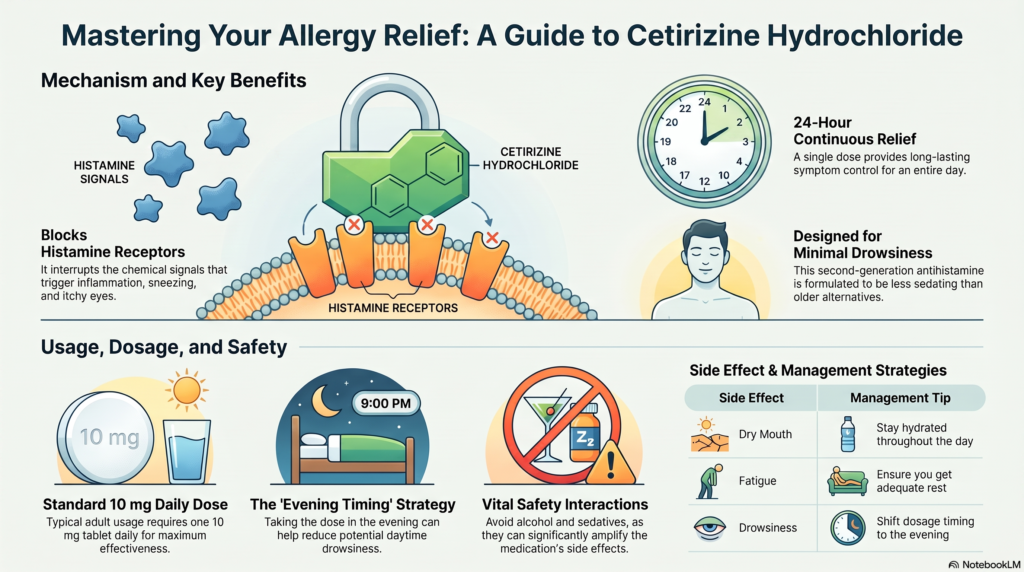
This powerful cetirizine mechanism interrupts the action of histamine, a chemical released during allergic reactions. When you encounter allergens, histamine binds to receptors, triggering inflammation, itching, and discomfort.
By inhibiting this process, cetirizine provides effective allergy relief, allowing you to regain control over your daily activities. As the active pharmaceutical ingredient, cetirizine hydrochloride is responsible for blocking histamine receptors and reducing allergy symptoms. It’s particularly effective for seasonal allergies, as it targets nasal congestion, sneezing, and watery eyes.
With a quick onset of action, cetirizine guarantees you won’t be sidelined by allergy symptoms. Understanding this mechanism empowers you to make informed decisions about your allergy management and enhances your overall quality of life.
Benefits of Using Cetirizine for Seasonal Allergies
Finding relief from seasonal allergies can dramatically improve your quality of life.
Cetirizine benefits include fast-acting relief from common allergy symptoms like sneezing, runny nose, and itchy eyes. As a second-generation antihistamine, it effectively blocks histamine receptors, reducing inflammation without causing significant drowsiness. This means you can stay alert while enjoying outdoor activities during peak allergy seasons.
Cetirizine provides long-lasting effects, with relief lasting up to 24 hours, allowing you to plan your day without constant interruptions. Its non-prescription availability makes it accessible for those seeking immediate solutions.
Dosage and Timing for Cetirizine
When considering the use of cetirizine for seasonal allergies, understanding the proper dosage and timing is vital for maximizing its effectiveness.
Cetirizine is available in various dosage forms, including tablets and liquid solutions, which allow you to choose what suits you best. The typical adult dosage is 10 mg once daily, while children may require lower doses based on age and weight.
Timing considerations play an important role; taking cetirizine in the evening can reduce daytime drowsiness, enhancing your productivity.
If you find that your symptoms persist, consult your healthcare provider for adjustments.
Cetirizine Side Effects and Safety Precautions
When taking cetirizine, you should be aware of common side effects like drowsiness, dry mouth, and dizziness. Cetirizine is also used to treat urticaria (hives; itchy raised red bumps on skin). Cetirizine is in a class of medications called antihistamines. It works by blocking the action of histamine, a substance in the body that causes allergic symptoms. Cetirizine is also available in combination with pseudoephedrine. This monograph only includes information about the use of cetirizine alone. If you are taking the cetirizine and pseudoephedrine combination product, read the information on the package label or ask your doctor or pharmacist for more information.
It’s important to follow safety precautions, especially if you’re operating machinery or driving.
Always consult your healthcare provider if you experience any severe reactions or have underlying health conditions.
Common Side Effects
Although cetirizine hydrochloride is effective for alleviating seasonal allergies, it can lead to several common side effects. Understanding these reactions is vital for managing symptoms effectively:
- Drowsiness
- Dry mouth
- Fatigue
These common reactions can impact your daily activities, so it’s essential to monitor how you feel after taking cetirizine. If drowsiness occurs, consider taking the medication at night.
Staying hydrated may help counteract a dry mouth, while getting adequate rest can alleviate fatigue. By being aware of these side effects, you can take proactive steps toward a more comfortable experience during allergy season.
Always consult your healthcare provider if you’re uncertain about your symptoms or how to manage them effectively.
Safety Precautions Needed
While cetirizine hydrochloride is generally safe for treating seasonal allergies, taking necessary safety precautions can help minimize potential side effects.
Before using cetirizine, consult your healthcare provider, especially if you have existing health conditions or are taking other medications.
Monitor your body’s response to cetirizine usage; if you experience excessive drowsiness or other concerning effects, consider adjusting your dosage or discontinuing use.
Be cautious when engaging in activities requiring alertness, such as driving.
Identify and manage your allergy triggers effectively to enhance cetirizine’s benefits.
Finally, avoid alcohol and other sedatives while on cetirizine, as they can amplify side effects and compromise safety.
Empower yourself with knowledge for a safer allergy management experience. Cetirizine is also used to treat an allergic reaction, itching and swelling caused by chronic urticaria (hives) and minimizes or eliminates the symptoms of perennial allergic rhinitis, seasonal allergic rhinitis, chronic idiopathic urticaria, allergic asthma, physical urticaria, and atopic dermatitis.

HOW TO GET THE MOST OUT OF CETIRIZINE
In public health outreach, one of the most common challenges I encounter is helping people navigate medication misinformation. Online forums and social media can often amplify unnecessary fear surrounding standard over-the-counter drugs. For example, when reading about antihistamines online, it’s easy to encounter exaggerated claims about long-term risks, central nervous system effects, or scary side effects. While it is true that early-generation antihistamines caused significant sedation, second-generation agents like cetirizine were specifically formulated to minimize those issues while retaining high therapeutic value.
From a pharmaceutical perspective, seeing how cetirizine is continually studied whether through bioequivalence testing to ensure generic medications are accessible to underserved communities or through taste-masking technology for pediatric forms highlights how dynamic pharmacy truly is. Science is constantly refining these tools so they are easier, safer, and more comfortable to take.
When managing side effects like mild drowsiness or dry mouth, simple adjustments such as taking your daily dose in the evening or tracking your active ingredients across multiple cold medications can make all the difference. Knowledge eliminates fear, and understanding your active ingredients ensures you remain in the driver’s seat of your wellness journey.
To maximize the effectiveness of cetirizine, you’ll want to pay attention to proper dosage timing and be aware of potential interactions with other medications.
Making certain lifestyle adjustments can also enhance your experience with this antihistamine.
Proper Dosage Timing
When you take cetirizine hydrochloride at the right time, you can maximize its effectiveness in managing seasonal allergies. The key to achieving ideal results lies in understanding proper dosage timing and frequency.
- Take cetirizine consistently at the same time each day.
- Opt for evening doses if you experience drowsiness.
- Allow at least 24 hours between doses for maximum timing effectiveness.
This strategic approach enhances your body’s response to the medication, ensuring you combat allergy symptoms effectively.
Remember, adhering to the recommended dosage frequency not only safeguards your health but also empowers you to regain control over your seasonal allergies.
Make timing a priority, and you’ll experience the full benefits of cetirizine.
Avoiding Common Interactions
Understanding how to avoid common interactions with cetirizine hydrochloride is essential for maximizing its effectiveness in managing seasonal allergies.
Be aware that certain allergy medications, particularly sedatives or tranquilizers, can enhance cetirizine’s sedative effects, leading to increased drowsiness. If you’re also taking cold and flu medications, reviewing the dayquil active ingredients can help you avoid overlapping ingredients or unintended drug interactions. Always consult your healthcare provider before combining cetirizine with other medications to prevent potential drug interactions. Always consult your healthcare provider before combining cetirizine with other medications to prevent potential drug interactions.
Additionally, alcohol can exacerbate these effects, so it’s best to avoid it while taking cetirizine.
If you’re using other over-the-counter allergy medications, check their ingredients to ascertain they don’t contain cetirizine or similar agents.
Lifestyle Adjustments Tips
Making simple lifestyle adjustments can greatly enhance the effectiveness of cetirizine in managing your seasonal allergies. By adopting these strategies, you’ll maximize your relief and improve your overall well-being:
- Incorporate natural remedies**: Explore herbal teas like nettle or peppermint, known for their anti-allergy properties.
- Implement dietary changes**: Consider a diet rich in omega-3 fatty acids and antioxidants to help reduce inflammation.
- Stay hydrated: Drinking plenty of water can thin mucus and promote better respiratory function.
These modifications not only complement cetirizine but also empower you to take control of your allergy management.
When Should You Consult a Doctor About Cetirizine?
If you experience persistent symptoms despite taking cetirizine or notice unusual side effects, it’s crucial to consult a doctor.
A consultation necessity arises if you’re not achieving the desired relief from your allergies. Ignoring ongoing discomfort can lead to more severe health issues.
Additionally, if you encounter side effects like severe drowsiness, rapid heartbeat, or allergic reactions, seek immediate medical advice.
Doctor recommendations may include adjusting your dosage or switching medications to better suit your needs.
Don’t hesitate to discuss your overall allergy management plan, as a tailored approach guarantees best results.
Empower yourself by taking charge of your health and engaging in open conversations with your healthcare provider.
Your well-being is paramount; act decisively when symptoms persist.
Alternatives for Allergy Relief
Many people seek alternatives for allergy relief when medications like cetirizine aren’t enough.
If you’re looking for effective solutions, consider these options:
- Natural Remedies: Quercetin, a flavonoid found in fruits and vegetables, can help stabilize mast cells and reduce allergic responses.
- Over the Counter Alternatives: Products containing loratadine or fexofenadine offer different antihistamine options with minimal side effects. If you’re comparing these options with pain relievers, understanding the aleve active ingredient can help distinguish its anti-inflammatory purpose from allergy medications like cetirizine.
- Nasal Irrigation: Using a saline rinse can clear allergens from your nasal passages, providing immediate relief.

RELATED STUDIES ABOUT CETIRIZINE HYDROCHLORIDE TABLET
In the battle against seasonal allergies, cetirizine hydrochloride stands as an effective ally, offering relief from pesky symptoms while allowing you to enjoy the outdoors. Yet, it’s vital to balance this benefit with awareness of potential side effects. By understanding dosage and safety precautions, you can maximize its effectiveness. If symptoms persist or worsen, seeking medical advice is essential. Don’t let allergies hold you back—find the right approach to reclaim your comfort and enjoy each season.
Bioequivalence studies of cetirizine tablets using the urine excretion data of healthy Ghanaian male volunteers
Overview
The use of generic medicines is a crucial strategy for increasing healthcare access and affordability, particularly in developing nations like Ghana. Cetirizine is a widely used, non-sedative antihistamine that serves as a first-line treatment for various allergic conditions, including symptom relief associated with upper respiratory tract infections. However, establishing the bioequivalence of generic brands typically requires blood or plasma sampling, which can pose ethical and resource-related challenges in developing settings.
Objective
This study aimed to assess the bioequivalence of a locally manufactured generic 10 mg cetirizine hydrochloride tablet against the innovator brand (Zyrtec) on the Ghanaian market. To overcome local testing limitations and the lack of robust analytical frameworks, the researchers developed and utilized a cost-effective alternative method using human urine excretion data rather than blood plasma.
Methodology
- Analytical Method: A reverse-phase High-Performance Liquid Chromatography (HPLC) method with UV detection was developed and validated to detect and quantify cetirizine levels in human urine.
- Study Design: The in-vivo study employed a two-way crossover design involving 12 healthy male volunteers aged 22 to 35.
- Execution: Participants received a single 10 mg dose of either the reference or test drug. Urine samples were collected at designated intervals over a 24-hour period, followed by a washout period before interchanging the administered drugs.
Key Findings
- Pharmacopoeial Standards: Both the reference and test tablets passed standard quality control assessments for weight uniformity, dissolution, and disintegration.
- Excretion Rates: The mean cumulative amounts of cetirizine excreted unchanged in urine over 24 hours were 5.69 mg for the reference drug and 5.82 mg for the test drug.
- Pharmacokinetics: The generic and innovator brands demonstrated comparable pharmacokinetic profiles.
- The mean relative AUC_{0-24} was 13.32 µg/mL for the reference drug and 13.05 µg/mL for the test drug.
- The peak concentration (C_{max}) was 3.378 µg/mL for the reference drug and 3.043 µg/mL for the test drug.
- The time to reach peak concentration (T_{max}) was 7.25 minutes for the reference drug and 7.42 minutes for the test drug.
- Relative Bioavailability: The relative bioavailability of the generic test drug was determined to be 102.28.
Conclusion
The locally manufactured generic cetirizine tablet is bioequivalent to the innovator brand and serves as a reliable, interchangeable therapeutic alternative in the Ghanaian healthcare system. Furthermore, the study successfully validates the use of urine excretion data as a viable, practical approach for conducting bioequivalence studies in resource-restricted environments.
| REFERENCE: Gideon Onuh, Joseph K. Adu, Samuel O. Bekoe, Raphael Johnson, Reimmel K. Adosraku, Samuel Asare-Nkansah, Bioequivalence studies of cetirizine tablets using the urine excretion data of healthy Ghanaian male volunteers, Heliyon, Volume 9, Issue 1, 2023, e12665, ISSN 2405-8440, https://doi.org/10.1016/j.heliyon.2022.e12665. (https://www.sciencedirect.com/science/article/pii/S2405844022039536) |
Taste-masking assessment of orally disintegrating tablets and lyophilisates with cetirizine dihydrochloride microparticles
Overview
Orally disintegrating tablets and oral lyophilisates are innovative dosage forms designed to dissolve rapidly in the buccal cavity without the need for water. A primary challenge in developing these formulations is overcoming the unpleasant taste of active pharmaceutical ingredients. This study investigates the formulation and taste-masking efficacy of cetirizine dihydrochloride (CET), an extremely bitter second-generation antihistamine, using polymer-coated microparticles.
Methodology
The researchers employed a multi-step approach to formulate and test the orodispersible dosage forms:
- Microparticle Formulation: CET was microencapsulated with Eudragit E PO (a barrier coating copolymer) using a spray-drying technique to mask its bitter taste.
- Dosage Form Preparation: Orally disintegrating tablets were manufactured via direct compression, while oral lyophilisates were produced using a freeze-drying process.
- Physical Characterization: The formulations were evaluated for uniformity of weight, thickness, drug content, disintegration time, and mechanical strength (hardness and friability). Scanning electron microscopy (SEM) was used to analyze the structural morphology.
- Taste Assessment: The effectiveness of the taste-masking was evaluated using three independent methods: in vitro drug release profiling, an electronic tongue (e-tongue) equipped with 16 ion-selective electrodes, and a human sensory panel consisting of six healthy volunteers.
Key Findings
- Physical and Mechanical Properties: The formulations demonstrated appropriate mechanical resistance, uniform drug loading, and consistent weight and thickness. Disintegration times were highly favorable, taking approximately 30 seconds for the tablets and 10 seconds for the lyophilisates.
- Structural Integrity: SEM imaging confirmed that the microparticles remained intact and uncracked within the tablet and lyophilisate matrices when optimal compression forces were applied.
- In Vitro Release: Dissolution testing in a simulated saliva environment (pH 6.8) revealed no release of CET for the first 3 minutes, successfully preventing premature release in the mouth, with complete drug release occurring after 15 minutes.
- E-Tongue Results: The e-tongue’s principal component analysis demonstrated that the chemical profile of the microparticle formulations closely resembled that of a placebo rather than pure CET, objectively confirming effective taste masking during the initial 60 seconds of release.
- Human Sensory Evaluation: The human taste panel reported no bitterness or physical roughness, rating the formulations as pleasant or slightly pleasant.
Conclusion
The study concludes that microencapsulation with Eudragit E PO via spray-drying effectively masks the bitter taste of cetirizine dihydrochloride. These taste-masked microparticles can be successfully integrated into orally disintegrating tablets and oral lyophilisates, resulting in highly palatable formulations with excellent physical properties and rapid disintegration times.
| REFERENCE: Aleksandra Amelian, Katarzyna Wasilewska, Małgorzata Wesoły, Patrycja Ciosek-Skibińska, Katarzyna Winnicka, Taste-masking assessment of orally disintegrating tablets and lyophilisates with cetirizine dihydrochloride microparticles, Saudi Pharmaceutical Journal, Volume 25, Issue 8, 2017, Pages 1144-1150, ISSN 1319-0164, https://doi.org/10.1016/j.jsps.2017.06.001. (https://www.sciencedirect.com/science/article/pii/S1319016417301238) |
Sensitive Voltammetric Analysis of Cetirizine Using Electrochemical Sensor Based on Poly (methyl orange) Modified Carbon Nanotube Paste Electrode
Overview
The study focuses on the development of a highly responsive, swift, and reliable electrochemical sensor for the analysis of cetirizine (CTZ), a widely utilized antihistamine drug. To address the drawbacks of conventional analytical techniques—which are often expensive and time-consuming—the researchers developed a poly(methyl orange) modified multiwalled carbon nanotube paste electrode (PMO/CNTPE).
Electrode Fabrication and Characterization
- The base multiwalled carbon nanotube paste electrode (BCNTPE) was created by mixing multiwalled carbon nanotubes (MWCNTs) with silicone oil.
- The PMO/CNTPE was successfully fabricated by electropolymerizing methyl orange (MO) onto the BCNTPE surface using cyclic voltammetry (CV).
- Field emission scanning electron microscopy (FE-SEM) confirmed that the polymerization process transformed the irregularly scattered MWCNT strands into a uniform, even surface.
- Electrochemical impedance spectroscopy (EIS) verified that the modified PMO/CNTPE possessed a lower charge transfer resistance (10.21 kΩ) compared to the bare electrode (11.77 kΩ), indicating enhanced electronic conductivity.
Sensor Performance and Kinetics
- The optimal conditions for the electro-oxidation of CTZ were achieved using a 0.2 M phosphate buffer saline (PBS) solution at a physiological pH of 7.0.
- The anodic peak current for CTZ at the PMO/CNTPE was approximately ten times greater than the current produced by the bare electrode, showcasing admirable electrocatalytic performance.
- The electrochemical reaction of CTZ was determined to be an adsorption-controlled, irreversible process involving an equal proportion of electrons and hydrogen ions.
- The sensor exhibited a broad linear detection range from 2 µM to 45 µM.
- The device achieved a highly sensitive limit of detection (LOD) of 0.076 µM and a limit of quantification (LOQ) of 0.25 µM.
Reliability and Practical Applications
- The modified electrode demonstrated excellent repeatability with a relative standard deviation (RSD) of 1.58%.
- It also showed superior reproducibility, yielding an RSD of 2.22% across five independently prepared electrodes.
- The sensor maintained strong long-term stability, retaining 88.84% of its initial peak current after one week of continuous testing.
- The PMO/CNTPE proved capable of simultaneously detecting CTZ and paracetamol (PCM), two drugs that frequently coexist in medicinal formulations.
- When tested on commercial CTZ tablet samples, the sensor successfully analyzed the drug with adequate recovery rates between 98.04% and 99.31%, proving its practical applicability for pharmaceutical quality control without requiring extensive sample pre-treatment.
| REFERENCE: Mohammed Monirul Islam, Noor E Hafsa, Muhammad Muhitur Rahman, MD Arifuzzaman, Sayeed Rushd, Sensitive Voltammetric Analysis of Cetirizine Using Electrochemical Sensor Based on Poly (methyl orange) Modified Carbon Nanotube Paste Electrode, International Journal of Electrochemical Science, Volume 17, Issue 3, 2022, 220310, ISSN 1452-3981, https://doi.org/10.20964/2022.03.01. (https://www.sciencedirect.com/science/article/pii/S1452398123022526) |
CONCLUSION
Pharmacy is as much about service as it is about science. When we look beyond the chemistry of active pharmaceutical ingredients, the ultimate purpose of any medication is to improve human quality of life allowing you to enjoy outdoor activities, stay focused at work, or simply sleep comfortably through the night without congestion. Cetirizine hydrochloride is a cornerstone of modern allergy management, but medication is only one piece of a holistic health approach.
Combining your medication regimen with practical daily habits such as monitoring local pollen counts, maintaining adequate hydration, or discussing your symptoms with a pharmacist creates a safe and balanced path toward long-term relief. High-quality healthcare and accurate information shouldn’t be a luxury reserved for a few; they should be accessible, easy to understand, and practical for everyone.
As you navigate allergy season, I encourage you to view your medication as an ally in your daily wellness toolkit. Stay curious about what goes into your body, keep asking questions, and never hesitate to consult a healthcare professional to tailor a plan that works best for your unique life.