
As a cosmetic ingredient researcher, I see hyaluronic acid (HA) everywhere it’s continuously hyped in marketing campaigns as a magical fountain of youth. But if you look past the glossy advertisements and dig into the actual biochemistry, its true power isn’t just about surface hydration; it’s about biological repair.
Throughout my career working with raw material documentation and formulation safety, I’ve learned that consumers often receive an oversimplified version of how ingredients work. There’s a common skepticism online and rightly so about whether topical HA is just a pricey humectant riding a marketing wave. However, when we evaluate hyaluronic acid through the lens of tissue regeneration and wound healing, the scientific backing becomes undeniable. HA isn’t just an additive designed to plump up fine lines temporarily; it is an essential structural polysaccharide naturally present in our connective tissue, joints, and skin matrix.
In this article, my goal is to translate the complex INCI mechanisms behind hyaluronic acid into clear, actionable insights. We’ll look past the buzzwords and examine how this remarkable molecule actually interacts with our body’s healing cascade to repair damaged tissue, support cellular movement, and maintain structural integrity.
Hyaluronic acid (HA) is essential for wound healing and tissue regeneration. It maintains moisture, creates an ideal healing environment, and enhances cell movement, which speeds up recovery. HA attracts key cells like fibroblasts and keratinocytes, aiding in tissue repair and minimizing scarring. Its unique properties help modulate inflammation and support overall healing outcomes. By utilizing advanced formulations and technologies, HA applications continue to improve wound management. Discover the innovative ways HA can transform healing processes like never before.
Key Takeaways
- Hyaluronic Acid maintains moisture in wounds, creating an optimal environment for healing and supporting cell migration and repair.
- It accelerates tissue repair by enhancing cellular dynamics and attracting vital cells like fibroblasts and keratinocytes.
- HA reduces inflammation, allowing for a focused repair process and improved quality of regenerated tissue.
- Available in various formulations, HA significantly enhances healing outcomes and minimizes scarring in different types of wounds.
- Advanced technologies utilizing HA, such as nanoparticles and 3D bioprinting, are redefining wound care and improving recovery timelines.
UNDERSTANDING HYALURONIC ACID’S FUNCTIONS IN THE HUMAN BODY
Although you may not realize it, hyaluronic acid (HA) plays an essential role in various bodily functions, particularly in maintaining skin hydration and facilitating tissue repair. Hyaluronic (pronounced hi-ah-lew-ron-ic) acid — also known as hyaluronan or hyaluronate — is a gooey, slippery substance that your body produces naturally. Scientists have found hyaluronic acid throughout the body, especially in eyes, joints and skin.
This naturally occurring polysaccharide is critical for the structural integrity of connective tissues, acting as a lubricant and shock absorber in joints. In your body, HA binds to water, ensuring ideal hydration in the skin and other tissues, which is fundamental for cellular function and resilience.
Additionally, its presence in synovial fluid supports joint health, while its ability to modulate inflammation helps maintain homeostasis.
Enhancing Wound Healing With HA
Hyaluronic acid (HA) plays an essential role in accelerating tissue repair during wound healing.
By maintaining moisture and promoting cell migration, it helps speed up recovery while minimizing inflammation effects.
Incorporating HA into wound care can greatly enhance the healing process and improve outcomes.
Accelerating Tissue Repair
When wounds occur, the body’s natural healing processes can sometimes benefit from external support, and that’s where hyaluronic acid (HA) comes into play. HA accelerates tissue repair by enhancing cellular dynamics and optimizing the recovery timeline. By attracting moisture and promoting cell migration, HA creates an ideal environment for wound healing. You’ll find that the application of HA not only expedites the repair process but also improves the overall quality of regenerated tissue.
| Benefit | Mechanism | Impact |
| Moisture retention | Attracts water | Supports cell function |
| Cell migration | Stimulates fibroblasts | Enhances tissue formation |
| Increases elasticity | Aids collagen synthesis | Improves structural integrity |
| Reduces scar tissue | Promotes organized repair | Minimizes aesthetic concerns |
| Speeds up healing | Improves cellular signals | Shortens recovery timeline |
Reducing Inflammation Effects
Wound healing doesn’t just rely on accelerated tissue repair; managing inflammation is equally important. Hyaluronic acid (HA) plays a pivotal role in inflammation reduction, which in turn enhances the healing process. By mitigating excessive inflammation, HA allows your body to focus on repair and regeneration.
- Promotes moisture retention, creating an ideal healing environment.
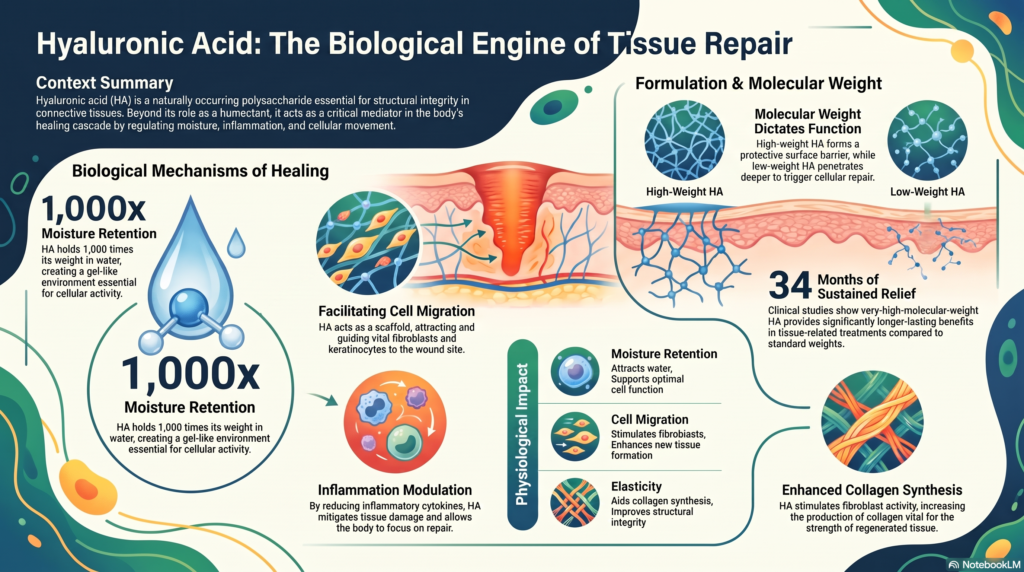
- Reduces inflammatory cytokines, minimizing tissue damage.
- Enhances cell migration, accelerating wound closure.
- Stimulates collagen synthesis, strengthening the tissue.
Incorporating hyaluronic acid into your wound care regimen can greatly improve outcomes. By effectively addressing inflammation, you empower your body to heal more efficiently, ensuring a quicker return to optimal health.
Don’t underestimate the power of HA in your healing arsenal.
How HA Retains Moisture in Wounds
Moisture retention is crucial for effective wound healing, and hyaluronic acid (HA) plays a significant role in this process. HA’s unique ability to hold up to 1,000 times its weight in water guarantees ideal wound hydration.
By creating a viscous gel-like environment, HA prevents excessive moisture loss, facilitating a conducive healing atmosphere. This hydration accelerates cellular activities essential for tissue regeneration, promoting collagen synthesis and enhancing the overall repair process.
Additionally, HA aids in maintaining the wound’s microenvironment, reducing scab formation and enabling better nutrient absorption. You can get hyaluronic acid from your daily diet. Foods don’t work as fast as serums or creams you apply to your skin, but they are cheaper and may provide more lasting benefits in maintaining and improving skin health without any side effects.
How HA Helps Cells Move in Wound Healing?
As cells migrate to the wound site, hyaluronic acid (HA) facilitates this movement through its unique biochemical properties.
By enhancing cell motility within the wound environment, HA plays an essential role in expediting healing. Here’s how it works:
- Hydration: HA retains moisture, creating a favorable environment for cells to thrive.
- Viscoelasticity: Its gel-like consistency supports cellular movement, allowing for easier navigation.
- Chemotactic Factors: HA attracts cells like fibroblasts and keratinocytes, vital for repair.
- Matrix Formation: It aids in forming a scaffold, guiding cells to their destination.
Incorporating HA into wound care can greatly boost cellular dynamics, ensuring a more effective healing process.
Embrace HA’s powerful benefits to optimize recovery. The body naturally produces hyaluronic acid, which helps lubricate our tissues. It plays a role in skin health, wound healing, bone strength, and many other other bodily systems or functions.
THE ROLE OF HA IN TISSUE REGENERATION
When formulating or evaluating products containing hyaluronic acid, the single biggest mistake I see people make is treating all HA as if it were identical. In the lab, we know that the physiological impact of HA comes down almost entirely to its molecular weight and formulation structure.
High-molecular-weight HA forms a breathable, protective film on top of the skin that prevents transepidermal water loss. It feels light, non-greasy, and provides immediate surface comfort. On the other hand, medium- and low-molecular-weight fractions penetrate slightly deeper to interact with cellular pathways, encouraging fibroblast activity and matrix scaffold formation. However, formulators must be careful: if low-molecular-weight HA is used in a dry climate without proper occlusive support, it can actually pull moisture outward from deeper skin layers, leaving the skin drier than before.
From an ethical formulation standpoint, understanding these technical nuances is crucial. Whether HA is incorporated into clinical wound dressings, medical-grade gels, or topical serums, its success depends on balancing hydration dynamics with enzymatic stability against natural hyaluronidases. When done right, HA provides a genuine microenvironment for cell migration and tissue repair that few other humectants can replicate.
Hyaluronic acid (HA) plays an essential role in tissue regeneration by enhancing cell migration, which is important for repairing damaged areas.
It also improves hydration levels within the tissue, creating an ideal environment for healing.
Additionally, HA accelerates collagen synthesis, further supporting the structural integrity of regenerated tissue.
Enhanced Cell Migration
When tissues are injured, the need for effective cell migration becomes critical for successful healing. Hyaluronic acid (HA) plays a pivotal role in enhancing cellular locomotion, guiding cells along migration pathways essential for tissue regeneration.
By providing a conducive environment, HA:
- Facilitates cell adhesion and movement
- Modulates signaling pathways that activate migration
- Supports the formation of a hydrated extracellular matrix
- Promotes the recruitment of key cell types, such as fibroblasts and endothelial cells
These mechanisms guarantee that cells not only reach the wound site but also proliferate and differentiate effectively.
By harnessing HA’s properties, you can greatly improve the wound healing process, ultimately accelerating recovery and restoring tissue integrity. Unlike creams with tretinoin, hyaluronic acid is primarily valued for supporting hydration and tissue repair rather than increasing skin cell turnover.
Embrace the power of HA for enhanced cell migration and optimized healing outcomes.
Improved Hydration Levels
Effective wound healing hinges on maintaining ideal hydration levels, which is where hyaluronic acid (HA) excels. This powerful molecule plays an essential role in wound hydration by attracting and retaining moisture within the tissue matrix.
High levels of HA create a conducive environment for cellular processes, ensuring that the wound remains moist. When tissue is adequately hydrated, it enhances the ability of cells to migrate and proliferate, ultimately facilitating faster healing.
Furthermore, HA’s unique ability to hold up to 1,000 times its weight in water greatly boosts moisture retention, preventing dryness and promoting regeneration. This hydrating benefit can complement the use of the best bakuchiol serum in a skincare routine focused on supporting healthy, resilient skin.
Accelerated Collagen Synthesis
Maintaining hydration with hyaluronic acid lays the groundwork for another essential aspect of wound healing: collagen synthesis.
By enhancing collagen production, HA directly influences the synthesis pathways that drive tissue regeneration. You’ll find that its role is pivotal in creating a robust extracellular matrix, which supports healing and repair.
- Stimulates fibroblast activity**: Increases the proliferation of collagen-producing cells.
- Enhances tensile strength**: Improves the structural integrity of new tissue.
- Regulates growth factors: Modulates proteins that promote repair.
- Supports angiogenesis: Facilitates blood vessel formation, vital for nutrient delivery.
HA Applications in Wound Healing
Hyaluronic acid (HA) plays a vital role in wound healing, as it enhances tissue repair and regeneration. Its applications in wound management are extensive.
HA promotes cell migration, which accelerates the healing process by ensuring that essential cells reach the injury site quickly. Additionally, it maintains moisture in the wound environment, essential for ideal healing conditions.
You’ll find HA in various formulations, including gels, dressings, and sprays, tailored to different types of wounds. In many of these products, hyaluronic acid serves as the active pharmaceutical ingredient, delivering the primary therapeutic benefits that support wound healing and tissue regeneration. By harnessing these hyaluronic applications, you can considerably improve healing outcomes and minimize scarring.
Moreover, HA’s ability to modulate inflammation and promote angiogenesis creates a favorable environment for tissue regeneration. Embracing these applications empowers you to achieve superior results in wound care.
Future Innovations in Hyaluronic Acid for Healing
Advancements in hyaluronic acid formulations promise to further enhance wound healing strategies.
You’ll see innovative approaches focusing on novel formulations that optimize therapeutic delivery, ensuring maximum efficacy.
These future innovations could include:
- Microsphere technology for controlled release, enhancing absorption and effectiveness.
- Combination therapies that merge hyaluronic acid with growth factors for synergistic healing.
- Nanoparticles for targeted delivery, minimizing side effects while maximizing regenerative potential.
- 3D bioprinting techniques to create personalized scaffolds, promoting tissue integration and repair.
As these breakthroughs unfold, you’ll witness a paradigm shift in how we approach healing, empowering clinicians and patients alike with cutting-edge solutions that redefine recovery timelines and outcomes.
RELATED STUDIES ABOUT BENEFITS OF HYALURONIC ACID
In conclusion, hyaluronic acid plays an essential role in wound healing and tissue regeneration, offering benefits like moisture retention and enhanced cell mobility. While some might question its effectiveness over traditional treatments, the growing body of evidence supports HA’s unique properties that facilitate faster recovery and improved outcomes. As research advances, we can expect innovative applications of hyaluronic acid, making it an indispensable tool in modern wound care and regenerative medicine.
Very-high-molecular-weight vs high-molecular-weight hyaluronic acid injections show long-term sustained benefits in the treatment of osteoarthritis of the knee: a 15-year Indian cohort study
Overview
Osteoarthritis (OA) of the knee is a prevalent and debilitating condition, but conflicting clinical guidelines have led to a lack of confidence in the use of intra-articular hyaluronic acid (IAHA) injections as a viable treatment. This 15-year retrospective cohort study from a single center in India sought to address this uncertainty by evaluating the long-term effectiveness of IAHA, specifically categorizing treatments by their molecular weight.
Objectives and Methodology
- The primary objective was to compare the long-term responder rates and the duration of clinical benefit between very-high-molecular-weight hyaluronic acid (VHMW-HA) and high-molecular-weight hyaluronic acid (HMW-HA).
- The study analyzed 2,037 patients (72.02% female, 27.98% male) suffering from severe knee OA, classified as Kellgren-Lawrence Grade III or IV.
- Primary responders were defined as patients who achieved a >30% improvement in their WOMAC scores from baseline.
- Sustained responders were identified as those who maintained this clinical improvement for more than 6 months following a single injection.
Key Findings
- High Overall Efficacy: The treatment proved highly effective across the board, with an overall primary responder rate of 73.44% (1,496 out of 2,037 patients).
- Superior Primary Response for VHMW-HA: The VHMW-HA formulation yielded significantly higher primary responder rates (75.21%) compared to the HMW-HA formulation (70.22%).
- Greater Sustained Response: Within the pool of primary responders, the VHMW-HA group demonstrated a substantially higher sustained response rate (85.54%) than the HMW-HA group (67.06%).
- Extended Duration of Benefit: The average interval between the first and third injections was vastly different between the two groups. VHMW-HA patients went an average of 5.67 years between these injections (roughly 34 months of benefit per injection), whereas HMW-HA patients averaged only 1.95 years (roughly 11 months of benefit per injection).
- Efficacy in Advanced Disease: The extended duration of benefit for VHMW-HA was observed across both Grade III and Grade IV OA, proving its clinical value even in advanced stages of joint degeneration.
Conclusion
The cohort study confirms that IAHA is an effective treatment for knee osteoarthritis, but highlights a critical distinction in product formulation: VHMW-HA significantly outperforms HMW-HA in both the rate of sustained response and the longevity of pain relief. These results suggest that future clinical guidelines and meta-analyses should explicitly differentiate hyaluronic acid products by their molecular weight to accurately reflect their therapeutic potential.
| REFERENCE: Anish Kumar Aggarwal, Nakul Aggarwal, Jane Fitzpatrick, Very-high-molecular-weight vs high-molecular-weight hyaluronic acid injections show long-term sustained benefits in the treatment of osteoarthritis of the knee: a 15-year Indian cohort study, Journal of Cartilage & Joint Preservation, Volume 4, Issue 4, 2024, 100213, ISSN 2667-2545, https://doi.org/10.1016/j.jcjp.2024.100213. (https://www.sciencedirect.com/science/article/pii/S2667254524000490) |
Randomised trial on performance, safety and clinical benefit of hyaluronic acid, hyaluronic acid plus dexpanthenol and isotonic saline nasal sprays in patients suffering from dry nose symptoms
Overview
This study evaluated the performance, safety, and clinical benefits of three topical nasal applications—hyaluronic acid, hyaluronic acid combined with dexpanthenol, and isotonic saline—for treating patients suffering from dry nose symptoms (rhinitis sicca).
Methodology
The investigation was a prospective, randomised, three-armed clinical trial involving 240 patients in an otorhinolaryngological outpatient setting. Patients were randomly assigned to use one of the three nasal sprays over a four-week duration. The trial assessed the Rhinitis Sicca Symptom Score (RSSS) as the primary endpoint. Secondary endpoints included the evaluation of individual symptoms, endoscopic examinations, overall tolerability, and patient perceptions measured by the Nasal Spray Sensory Scale.
Key Findings
- All three nasal sprays yielded a significant improvement in the Rhinitis Sicca Symptom Score (RSSS) from the baseline to the final examination four weeks later.
- Individual patient symptoms and physician-assessed Endoscopy Scores improved significantly across all three treatment arms.
- The tolerability of the nasal sprays was rated as “flawless” in more than 85% of all treatments, reflecting a very high safety profile.
- Patients who received the hyaluronic acid plus dexpanthenol nasal spray reported a significantly higher perception of nasal moisturisation compared to those treated with either hyaluronic acid alone or isotonic saline.
- Aside from the subjective perception of moisturisation, there were no other significant differences in efficacy or symptom relief observed among the three treatments.
Conclusion
Hyaluronic acid, hyaluronic acid plus dexpanthenol, and isotonic saline nasal sprays all successfully fulfill their intended purpose and are highly suitable, well-tolerated treatments for patients suffering from dry nose symptoms. While all three are effective, the addition of dexpanthenol to hyaluronic acid may provide patients with a superior subjective feeling of nasal moisturisation.
| REFERENCE: Uta Thieme, Karolina Müller, Christoph Bergmann, Bernward Bock, Nadine Wurzer-Materna, Taufik Shahab, Florian Zeman, Yvonne Eberhardt, Gunnar Huppertz, Michael Koller, Peter Meiser, Randomised trial on performance, safety and clinical benefit of hyaluronic acid, hyaluronic acid plus dexpanthenol and isotonic saline nasal sprays in patients suffering from dry nose symptoms, Auris Nasus Larynx, Volume 47, Issue 3, 2020, Pages 425-434, ISSN 0385-8146, https://doi.org/10.1016/j.anl.2020.01.008. (https://www.sciencedirect.com/science/article/pii/S0385814620300286) |
LB1716 Dipotassium glycyrrhizinate inhibits hyaluronidase activity and preserves hyaluronic acid level under UVB stress, contributing to skin moisture protection and aging fighting benefits
Overview
This study evaluated the performance, safety, and clinical benefits of three topical nasal applications—hyaluronic acid, hyaluronic acid combined with dexpanthenol, and isotonic saline—for treating patients suffering from dry nose symptoms (rhinitis sicca).
Methodology
The investigation was a prospective, randomised, three-armed clinical trial involving 240 patients in an otorhinolaryngological outpatient setting. Patients were randomly assigned to use one of the three nasal sprays over a four-week duration. The trial assessed the Rhinitis Sicca Symptom Score (RSSS) as the primary endpoint. Secondary endpoints included the evaluation of individual symptoms, endoscopic examinations, overall tolerability, and patient perceptions measured by the Nasal Spray Sensory Scale.
Key Findings
- All three nasal sprays yielded a significant improvement in the Rhinitis Sicca Symptom Score (RSSS) from the baseline to the final examination four weeks later.
- Individual patient symptoms and physician-assessed Endoscopy Scores improved significantly across all three treatment arms.
- The tolerability of the nasal sprays was rated as “flawless” in more than 85% of all treatments, reflecting a very high safety profile.
- Patients who received the hyaluronic acid plus dexpanthenol nasal spray reported a significantly higher perception of nasal moisturisation compared to those treated with either hyaluronic acid alone or isotonic saline.
- Aside from the subjective perception of moisturisation, there were no other significant differences in efficacy or symptom relief observed among the three treatments.
Conclusion
Hyaluronic acid, hyaluronic acid plus dexpanthenol, and isotonic saline nasal sprays all successfully fulfill their intended purpose and are highly suitable, well-tolerated treatments for patients suffering from dry nose symptoms. While all three are effective, the addition of dexpanthenol to hyaluronic acid may provide patients with a superior subjective feeling of nasal moisturisation.
| REFERENCE: Y. Qu, Y. Luo, M. Keh, R. Abe, LB1716 Dipotassium glycyrrhizinate inhibits hyaluronidase activity and preserves hyaluronic acid level under UVB stress, contributing to skin moisture protection and aging fighting benefits, Journal of Investigative Dermatology, Volume 143, Issue 9, 2023, Page B18, ISSN 0022-202X, https://doi.org/10.1016/j.jid.2023.06.092. (https://www.sciencedirect.com/science/article/pii/S0022202X23022376) |
CONCLUSION
Reflecting on the clinical data from knee osteoarthritis trials highlighting the superiority of very-high-molecular-weight HA to randomized studies on mucosal healing it is clear that hyaluronic acid is far more than a passing cosmetic trend. It is a foundational biomaterial that plays a pivotal role in modern regenerative science.
As someone dedicated to ingredient transparency and safety, I find the future of HA applications incredibly exciting. Innovations like 3D bioprinting scaffolds, targeted nanoparticle delivery, and synergistic combination therapies (like pairing HA with dexpanthenol or botanical anti-inflammatories) are setting a new standard for how we treat compromised skin barriers and tissue injuries.
Moving forward, I hope to see the cosmetic and pharmaceutical industries continue to embrace transparency over exaggerated marketing claims. Consumers deserve to know not just that an ingredient works, but how it works based on rigorous, peer-reviewed science. Hyaluronic acid has proven its worth in the lab and the clinic; when formulated responsibly and used intentionally, it remains one of the most versatile and valuable tools in ingredient chemistry.