
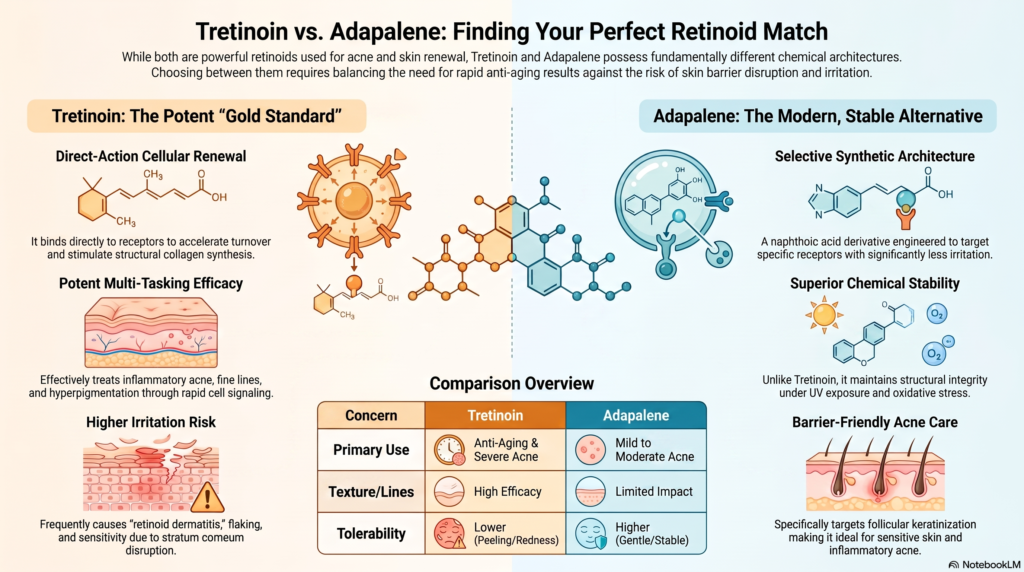
From a formulation perspective, few active ingredients command as much respect in the lab, or cause as much debate in the skincare community, as topical retinoids. Throughout my years as a cosmetic chemist analyzing barrier function and cellular turnover, I have seen endless consumers struggle to navigate the delicate balance between maximum efficacy and manageable skin irritation. When comparing tretinoin and adapalene, we aren’t just looking at two popular acne treatments; we are looking at two fundamentally distinct chemical architectures. Tretinoin, or pure retinoic acid, directly binds to nuclear retinoic acid receptors to dramatically accelerate turnover and stimulate structural collagen synthesis.
However, that direct action often comes at the steep cost of a disrupted stratum corneum, leading to classic retinoid dermatitis, flaking, and heightened sensitivity. Adapalene, on the other hand, was engineered as a synthetic naphthoic acid derivative to specifically target RAR-beta and RAR-gamma receptors. This selective affinity means it addresses follicular keratinization and inflammation with remarkable stability and significantly less surface-level barrier disruption.
In my consulting work with both indie startups and established clinical brands, the most common error I observe is patients assuming that stronger always equals better. True results come from sustained barrier integrity, and understanding how these molecules function at a molecular level is the essential first step toward making an informed choice for your specific skin needs.
When comparing creams with tretinoin and adapalene, consider your skin type and treatment goals. Tretinoin is potent, enhancing collagen and improving texture but may cause more irritation. Adapalene is gentler, making it ideal for sensitive skin and inflammatory acne with fewer side effects. Both retinoids effectively reduce acne but require consistent use for best results. Understanding the nuances of each can help you choose the right option for your skin concerns. Explore further to discover more tailored insights.
Key Takeaways
- Tretinoin is a more potent retinoid with faster results, enhancing collagen production and improving skin texture.
- Adapalene is gentler, making it suitable for sensitive skin and particularly effective for inflammatory acne.
- Both retinoids require consistent use for optimal results, but adapalene may cause fewer side effects.
- Tretinoin promotes cell turnover while adapalene modulates inflammation and keratinization, affecting their efficacy in treating skin conditions.
- Individual skin type and tolerance play a crucial role in choosing between these retinoids for effective treatment.
TRETINOIN VS. ADAPALENE: WHICH RETINOID IS RIGHT FOR YOU?
When considering which retinoid might be best for your skin, it’s essential to weigh the differences between tretinoin and adapalene.
Tretinoin benefits include its potent ability to enhance cell turnover and diminish fine lines, making it a powerful ally against aging and acne. If you seek rapid results and don’t mind potential irritation, tretinoin could be your choice.
Conversely, adapalene, with its milder formulation, is often recommended for those with sensitive skin or who prefer a gradual approach. Adapalene recommendations emphasize its effective anti-inflammatory properties and lower incidence of irritation, making it suitable for long-term use.
Ultimately, your decision should align with your skin type and specific goals, empowering you to achieve ideal results.
What Are Tretinoin and Adapalene?
Tretinoin and adapalene are both retinoids, but they differ in their chemical composition and mechanism of action. Tretinoin increases skin cell turnover. While this improves acne, texture, and pigmentation, it also temporarily weakens the skin barrier.
Tretinoin, a derivative of vitamin A, primarily promotes cell turnover, while adapalene, a synthetic retinoid, modulates inflammation and keratinization.
Both are commonly used to treat acne and other skin conditions, but their specific applications can vary based on individual needs.
Chemical Composition Differences
Although both tretinoin and adapalene are retinoids used to treat acne and other skin conditions, their chemical compositions differ considerably.
The tretinoin structure features a three-ring system with a conjugated double bond, enhancing its potency. This configuration allows for rapid absorption and efficacy in targeting skin cell turnover.
In contrast, the adapalene structure incorporatesa unique naphthoic acid derivative, providing a different mechanism of action. Each active pharmaceutical ingredient has distinct chemical properties that influence its stability, potency, and suitability for different skin concerns. This structural modification contributes to its stability and reduced irritation potential compared to tretinoin.
Understanding these chemical distinctions is essential for selecting the most effective treatment for your specific skin concerns.
Mechanism of Action
Retinoids like tretinoin and adapalene play an essential role in dermatological treatments, particularly for acne. Their mechanisms of action involve enhancing retinoid absorption and promoting cellular turnover.
- Tretinoin accelerates skin cell turnover, reducing pore clogging and preventing acne formation.
- Adapalene has a more stable structure, allowing for effective penetration without the irritation associated with tretinoin.
- Both compounds modulate gene expression, influencing skin cell differentiation and proliferation.
- They also exhibit anti-inflammatory properties, reducing redness and swelling.
Common Uses and Applications
Many individuals seek effective treatments for acne and skin aging, and both tretinoin and adapalene have proven to be valuable options. Tretinoin benefits include promoting cell turnover, reducing fine lines, and improving skin texture. On the other hand, adapalene applications focus primarily on treating mild to moderate acne, working to unclog pores and reduce inflammation. Below is a comparison of their uses:
| Treatment | Primary Use | Additional Benefits |
| Tretinoin | Acne, Anti-aging | Reduces wrinkles, Hyperpigmentation |
| Adapalene | Acne | Less irritating, Stable formulation |
| Tretinoin | Psoriasis | Improves skin condition |
| Adapalene | Keratosis pilaris | Smooths rough skin |
| Tretinoin | Melasma | Evens skin tone |
Choosing the right option depends on your specific skin concerns and goals.
Effectiveness of Tretinoin and Adapalene for Acne Treatment
Tretinoin and adapalene are both effective topical treatments for acne, but they differ in their mechanisms and outcomes.
Tretinoin effectiveness is well-documented in reducing acne lesions and preventing future breakouts by promoting cell turnover and unclogging pores.
Adapalene effectiveness, on the other hand, is attributed to its anti-inflammatory properties, making it particularly beneficial for inflammatory acne.
- Tretinoin is often more potent but may cause irritation.
- Adapalene is suitable for sensitive skin with fewer side effects.
- Both agents require consistent use for ideal results.
- Clinical studies show significant improvement in acne severity with both treatments over time.
Ultimately, your choice may depend on skin type and tolerance, ensuring you achieve the best possible outcome in your acne treatment journey. Understanding how to use retinol effectively can also help you get the most from whichever retinoid you choose.
COMMON SIDE EFFECTS OF TRETINOIN AND ADAPALENE?
Whenever I review clinical stability assays or formulate support products for prescription active regimens, my main priority is protecting the skin barrier while maintaining active delivery. When clients ask me how to manage the dreaded peeling phase associated with tretinoin or adapalene, my advice always comes down to smarter formulation pairing and strategic layering. A common mistake I see on public forums is treating heavy repair balms like all-in-one solutions, or layering direct acids alongside pure retinoic acid. Chemically, overloading an already compromised skin barrier with competing actives or dense occlusives without proper humectants is a recipe for trapped inflammation and severe transepidermal water loss.
In my own minimalist routine and clinical testing, I advocate heavily for intelligent buffering. On clean, slightly damp skin, starting with a lightweight, ceramide-rich or glycerin-heavy serum creates an essential hydration reservoir. Allowing that layer to dry before applying a pea-sized amount of your retinoid ensures an even delivery without aggressive localized penetration that leads to hot spots.
Following up with a structured emulsion featuring physiological lipids, ceramides, cholesterol, and free fatty acids, helps patch the lipid bilayer while the retinoid executes its cellular signaling overnight. If you are experiencing persistent flaking, switching to a gentler synthetic retinoid like adapalene or adjusting application frequency is far more effective than trying to mask severe barrier damage with thick petroleum ointments alone.
When using Tretinoin and Adapalene, you may experience common skin reactions such as redness, peeling, and dryness. If you’re navigating the early stages of a mature skin-care routine, finding the best moisturizers to use with tretinoin can make all the difference between glowing skin and frustrating irritation. For the unfamiliar, tretinoin is a type of retinoid (a class of vitamin A-derived ingredients) that’s more powerful than retinol. Only available by prescription, it’s one of the most effective skin-care ingredients for stimulating collagen production and speeding up skin cell turnover, which in turn gives it the ability to treat acne, soften fine lines, and improve lax texture—but it’s also known for its side effects, especially dryness and sensitivity.
These side effects can vary in intensity and may affect long-term tolerability for some individuals.
Understanding these reactions is essential for managing your treatment effectively.
Common Skin Reactions
Both tretinoin and adapalene are widely used topical retinoids that can lead to common skin reactions, especially during the initial phases of treatment.
You may experience skin sensitivity, redness, and peeling as your skin adjusts. Effective irritation management is essential for ideal results.
Consider these strategies for a smoother experience:
- Hydration strategies: Incorporate moisturizers to combat dryness.
- Application timing: Apply retinoids at night to minimize irritation.
- Barrier repair: Use products rich in ceramides to enhance skin defense.
- Tolerance building: Gradually increase the frequency of application to improve skin resilience.
Long-Term Tolerability Issues
While many users find success with tretinoin and adapalene over time, long-term tolerability issues can arise. You may experience heightened skin sensitivity, dryness, or irritation, which might limit your ability to maintain consistent use. Understanding these potential long-term effects is essential to achieving ideal results.
| Side Effect | Duration |
| Skin Sensitivity | Initial weeks, may persist |
| Dryness | Common in the first few months |
| Redness | Usually temporary |
| Peeling | Can occur intermittently |
How to Manage Side Effects When Using Tretinoin and Adapalene
Managing side effects while using tretinoin and adapalene is essential for maintaining skin health and maximizing the benefits of these medications. Tretinoin is used to treat acne vulgaris or other skin diseases as determined by your doctor. It works partly by keeping skin pores clear.
To effectively handle potential irritation and dryness, consider incorporating the following strategies:
- Hydration techniques: Utilize a gentle, hydrating moisturizer to prevent excessive dryness.
- Patch testing: Always perform patch testing before full application to identify any adverse reactions.
- Gradual introduction: Start with lower concentrations and frequency to allow your skin to adapt.
- Avoid irritants: Steer clear of harsh exfoliants and products with alcohol that can exacerbate irritation.
How to Use Tretinoin and Adapalene in Your Skincare Routine
How can you effectively incorporate tretinoin and adapalene into your skincare routine?
Start by applying either retinoid at night, as they can increase your skin’s sensitivity to sunlight. During the day, remember that baby sunscreen is specifically formulated for infants and young children, while adults using retinoids should choose a broad-spectrum sunscreen suitable for their skin type.
After cleansing, allow your skin to dry for about 20 minutes to minimize irritation.
Apply a pea-sized amount of your chosen retinoid evenly across your face, focusing on areas prone to acne or fine lines.
If you’re using both products, alternate nights to avoid over-exfoliation.
When layering products, apply serums or moisturizers first, then follow with your retinoid.
Incorporate a gentle moisturizer afterward to maintain hydration and reduce potential irritation.
Consistency is key, so stick to this regimen for best results.
Making the Right Choice: Tretinoin or Adapalene for Your Skin?
When choosing between tretinoin and adapalene for your skincare needs, consider your skin type and concerns. Both retinoids provide unique benefits, but their suitability varies.
- Tretinoin benefits include: enhanced collagen production, improved skin texture, and reduced fine lines.
- Adapalene’s suitability: particularly effective for sensitive skin and acne-prone individuals due to its gentler formulation.
- Consider your lifestyle: if you prefer a product with fewer side effects, adapalene may be your best bet.
- Evaluate your goals: for more aggressive anti-aging treatment, tretinoin may deliver faster results.
Ultimately, your choice hinges on balancing efficacy and tolerance.
Consult with a dermatologist to tailor the best regimen for your skin’s unique needs.
RELATED STUDIES ON CREAMS WITH TRETINOIN
In your journey to clearer skin, choosing between tretinoin and adapalene can feel like standing at a crossroads. Both retinoids offer powerful benefits, but understanding their strengths and potential side effects is essential. Picture your skin transforming as you incorporate these treatments into your routine, revealing a healthier, more radiant complexion. With the right choice tailored to your needs, you can effectively combat acne and embrace the confidence of smooth, vibrant skin.
A stability indicating RP-HPLC-UV assay method for the simultaneous determination of hydroquinone, tretinoin, hydrocortisone, butylated hydroxytoluene and parabens in pharmaceutical creams
Overview
The provided study details the development and validation of a novel stability-indicating Reversed-Phase High-Performance Liquid Chromatography (RP-HPLC-UV) method. This procedure was specifically designed for the simultaneous determination of six distinct components within topical pharmaceutical creams: hydroquinone (HQ), tretinoin (TRT), hydrocortisone acetate (HCA), butylated hydroxytoluene (BHT), methyl paraben (MP), and propyl paraben (PP).
Methodology
- The chromatographic separation is achieved using an X-Bridge C18 column (150 x 4.6 mm, 5 µm) utilizing a gradient elution profile.
- The mobile phase flow rate was optimized to 1 mL/min to ensure complete separation of analytes with similar polarities.
- Analytes were detected at a wavelength of 280 nm, which provided a satisfactory response for all six constituents without causing unacceptable baseline noise.
Validation Results
The analytical method was rigorously validated in accordance with the International Conference of Harmonization (ICH) Guidelines.
- The intra- and interday precision was excellent, showing a relative standard deviation (RSD) of less than 2.0% for all analytes.
- The method’s trueness, evaluated through mean percentage recovery, fell within the highly accurate range of 100% to 102% for most components.
- Calibration curves demonstrated exceptional linearity, with correlation coefficients greater than 0.9992 for all six components.
- System suitability tests (SST) verified complete separation, with all peak resolutions exceeding 1.5.
Forced Degradation Findings
The researchers subjected the standard solutions to harsh environmental conditions to prove the method’s capability as a stability-indicating assay.
- Acid Degradation: Exposure to acidic conditions slightly affected HCA and BHT, resulting in a 91% recovery rate.
- Alkaline Degradation: Basic conditions drastically destroyed HCA, reducing its recovery to just 5.5%, and moderately degraded BHT to 85%.
- Oxidative Degradation: Treatment with hydrogen peroxide caused an intensification of the BHT peak, increasing it to 130%.
- Photodegradation: Exposure to UV radiation primarily impacted the stability and quantity of TRT.
Application and Environmental Assessment
The validated procedure was successfully applied to analyze Tritospot cream, a commercially available product, yielding satisfactory precision and trueness. To measure the method’s environmental impact and practicality, the researchers evaluated it using the AGREEprep and BAGI metrics. The BAGI evaluation confirmed the method is highly practical for routine quality control in pharmaceutical industries. Meanwhile, the AGREEprep tool indicated that the method’s “greenness” could be further improved by transitioning from manual, ex situ sample preparations to automated, online approaches.
| REFERENCE: Mostafa A. Khairy, Amal Hamad, Mahmoud Hamed, Marcello Locatelli, Fotouh R. Mansour, A stability indicating RP-HPLC-UV assay method for the simultaneous determination of hydroquinone, tretinoin, hydrocortisone, butylated hydroxytoluene and parabens in pharmaceutical creams, Journal of Pharmaceutical and Biomedical Analysis, Volume 242, 2024, 116021, ISSN 0731-7085, https://doi.org/10.1016/j.jpba.2024.116021. (https://www.sciencedirect.com/science/article/pii/S073170852400061X) |
Treatment of melanoma in-transit metastases with combination intralesional interleukin-2, topical imiquimod, and tretinoin 0.1% cream
Overview
The provided case report details the management of challenging melanoma in-transit metastases using a triple-combination therapy. The treatment protocol utilized intralesional interleukin-2 (IL-2) combined with topical imiquimod and tretinoin 0.1% cream.
Patient Profile and Clinical Challenges
- A 64-year-old man presented with recurrent melanoma on his right ear, which eventually necessitated ear amputation and lymph node dissection.
- The patient possessed significant comorbidities that restricted standard systemic treatment options: active Crohn’s disease contraindicated the use of ipilimumab, a history of depression with suicidal ideation precluded systemic high-dose IL-2, and his tumor lacked a BRAF mutation.
- After an initial response to chemotherapy, the patient experienced a recurrence, developing more than ten new in-transit metastases around the periphery of his right ear graft site.
Treatment Regimen
- The patient was treated with high-dose intralesional IL-2 injections twice a week.
- Alongside the injections, topical imiquimod and tretinoin 0.1% cream were applied simultaneously once a day to all visible lesions, including a 5-cm peripheral margin.
- Following a robust inflammatory response at two weeks, the IL-2 dose was maintained at 11 million units per injection.
Clinical Outcomes
- Side effects, which included transient chills, nausea, and local skin inflammation, were well-tolerated by the patient.
- After exactly five weeks of therapy (comprising 10 IL-2 injections), the patient achieved complete clinical resolution of all visible in-transit metastases.
- Following clearance, intralesional IL-2 was discontinued, and the patient was transitioned to a maintenance regimen of topical imiquimod and tretinoin applied for seven consecutive days each month.
- While the patient’s skin remained clear of melanoma metastases for nine months, he subsequently developed systemic metastases in the bone, liver, and lungs, ultimately electing for comfort care.
Mechanisms of Action and Conclusions
- The success of this regimen is attributed to the distinct, synergistic mechanisms of each agent: IL-2 activates natural killer cells and T cells, imiquimod stimulates antitumoral cytokines via toll-like receptors, and tretinoin modifies keratinocyte maturation to enhance the epidermal penetration of imiquimod.
- The study concludes that mid- to high-dose intralesional IL-2, when combined with topical imiquimod and tretinoin cream, is an effective and appealing therapeutic option for cutaneous melanoma metastases.
- This combination is particularly valuable for patients who have disease limited to locoregional recurrences, possess severe comorbidities, or have contraindications to systemic immunotherapies.
| REFERENCE: Jonathan S. Leventhal, Ian D. Odell, Suguru Imaeda, Emanual Maverakis, Brett A. King, Treatment of melanoma in-transit metastases with combination intralesional interleukin-2, topical imiquimod, and tretinoin 0.1% cream, JAAD Case Reports, Volume 2, Issue 2, 2016, Pages 114-116, ISSN 2352-5126, https://doi.org/10.1016/j.jdcr.2016.01.004. (https://www.sciencedirect.com/science/article/pii/S2352512616000072) |
Systemic isotretinoin with topical tretinoin cream in the treatment of multiple warty dyskeratomas
Overview
- This case report documents the successful medical management of multiple warty dyskeratomas (WD).
- WD most commonly presents as a single nodule on the head or neck, which allows for simultaneous diagnosis and treatment through excisional surgery.
- Instances of multiple WDs are extremely rare, with only six prior case reports published and very little information available regarding effective medical treatments.
Patient Presentation
- A 29-year-old Taiwanese man initially presented with a single painful red nodule on his right cheek, which was excised and histopathologically confirmed as a WD.
- Two years after the initial excision, the patient developed hundreds of keratotic papules and nodules exhibiting follicular plugging.
- These widespread lesions were distributed across his scalp, face, neck, and chest.
- A subsequent biopsy of a scalp lesion confirmed the diagnosis of typical WD.
- The patient had no personal or family history of other skin disorders, such as Darier’s disease.
Treatment Regimen and Rationale
- The patient was treated with systemic oral isotretinoin at a dosage of 30 mg per day, administered in three divided doses.
- This systemic therapy was concurrently combined with the application of topical 0.05% tretinoin cream.
- Systemic isotretinoin was selected because WD is a disorder involving epidermal proliferation, and multiple WDs share pathogenic features with acne vulgaris and Darier’s disease.
- Because isotretinoin effectively modulates keratinocyte maturation and alters epidermal proliferation, it is theoretically well-suited to treat extensive WD lesions.
Clinical Outcomes
- After just one month of this combination therapy, the patient showed a dramatic and significant improvement in both the size and the number of lesions.
- The patient reported mild dry mouth as the only adverse reaction to the treatment.
- Treatment was discontinued after 14 weeks due to the cost of the medication and the side effect.
- During a 5-month follow-up period after stopping the medications, the therapeutic effects were maintained.
- The majority of the patient’s lesions remained small during the follow-up, and only a few new lesions developed.
| REFERENCE: Ying-Ling Kuo, Yu-Hung Wu, Ying-Jui Chang, Systemic isotretinoin with topical tretinoin cream in the treatment of multiple warty dyskeratomas, Dermatologica Sinica, Volume 29, Issue 3, 2011, Pages 106-108, ISSN 1027-8117, https://doi.org/10.1016/j.dsi.2011.07.007. (https://www.sciencedirect.com/science/article/pii/S1027811711000620) |
CONCLUSION
Looking at both the bench chemistry and the clinical research, the choice between tretinoin and adapalene ultimately boils down to a clear trade-off between speed and tolerance. Tretinoin remains the undisputed gold standard for comprehensive photoaging, fine line reduction, and rapid cell renewal, but it demands serious discipline, robust sun protection, and a barrier-first supporting routine. Adapalene delivers a modern, targeted approach that excels at controlling comedonal and inflammatory acne with a far superior safety profile for sensitive skin types.
In fact, research highlights its unique chemical stability; unlike tretinoin, which degrades rapidly under UV exposure and oxidative stress, adapalene’s naphthoic core maintains structural integrity, making it a reliable workhorse in topical formulations. At Active Ingredient Hub, my goal is always to cut through the marketing hype and ground your routine in solid formulation science. Neither ingredient is inherently superior in every context, the best active is simply the one your skin barrier can tolerate consistently over time.
Skincare isn’t a race to see who can apply the highest concentration of an active ingredient without burning their face off. By understanding how these molecules interact with your epidermal biology, respecting your skin’s limit, and prioritizing daily broad-spectrum sun defense, you can harness the transformative power of retinoids while keeping your skin barrier healthy, resilient, and clear.