
As an industrial hygienist who spends far too many weekends tackling real-world messes from stubborn job site grime to standard commercial spills, I’ve come to appreciate chemistry that simply does its job without causing unnecessary destruction. In the world of commercial formulation, quaternary ammonium compounds (quats) are the workhorses we constantly return to, and for good reason. When I evaluate active ingredients for disinfectants, I look past the marketing hype and examine how a compound behaves under actual working conditions.
Bleach might be the quick hammer everyone thinks of, but it eats away at equipment, stains surfaces, and breaks down rapidly once diluted. High-percentage alcohols evaporate so fast that if you turn your back, the surface is dry before the kill time is even reached. Quats hit that sweet spot in industrial hygiene: high stability, low reactivity, and exceptional surface compatibility.
They carry a permanent positive charge on their nitrogen atom, which lets them double as fantastic surfactants. They clean off grease while simultaneously breaking down microbial lipid membranes. Whether I’m reviewing a factory sanitation protocol or testing a new formulation against hard water conditions, quats consistently prove why they’ve dominated the commercial disinfectant space for decades.
Quaternary ammonium compounds (quats) are popular in disinfectants because they effectively neutralize a wide range of pathogens while maintaining low toxicity and surface compatibility. Their ability to disrupt cell membranes leads to pathogen lysis, making them reliable for various settings. However, they also face challenges like potential microbial resistance. Understanding their advantages and limitations helps inform your choices in sanitation. Explore further to uncover how quats impact safety and environmental considerations in cleaning products.
KEY TAKEAWAYS
- Quaternary ammonium compounds (quats) offer broad-spectrum efficacy against various pathogens, making them reliable disinfectants for diverse environments.
- They exhibit low toxicity and good surface compatibility, appealing to consumers seeking safe cleaning solutions.
- Quats are effective in disrupting cell membranes of pathogens, leading to efficient pathogen lysis.
- Their longer-lasting effects compared to alcohols provide sustained antimicrobial action, enhancing their usefulness in sanitation protocols.
- Growing consumer demand for hygiene and sustainable products drives the popularity of quats in disinfectant formulations.
UNDERSTANDING QUATERNARY AMMONIUM COMPOUNDS
Quaternary ammonium compounds, often referred to as quats, are a class of chemicals widely used as disinfectants due to their effectiveness against bacteria, viruses, and fungi.
Understanding quats chemistry is essential for maximizing their potential in various applications. These compounds consist of a nitrogen atom bonded to four organic groups, imparting their amphiphilic properties that disrupt microbial membranes. As the active ingredient in many disinfectant formulations, they provide broad-spectrum antimicrobial action against bacteria, viruses, and fungi. Historically, quats gained prominence in the mid-20th century, emerging as reliable disinfectants in healthcare and industrial settings.
Historically, quats gained prominence in the mid-20th century, emerging as reliable disinfectants in healthcare and industrial settings. Their ideal balance of efficacy and safety has made them a staple in sanitation protocols.
Efficacy Against Various Pathogens
How effective are quaternary ammonium compounds against various pathogens?
Quaternary ammonium compounds (quats) exhibit broad-spectrum efficacy, effectively neutralizing bacteria, viruses, and fungi. Their mechanism disrupts cell membranes, leading to pathogen lysis.
However, pathogen resistance is a growing concern; some microorganisms have developed defenses against quats. This necessitates rigorous testing to guarantee disinfectant effectiveness across diverse environments.
Studies confirm that quats maintain potency against many resistant strains, though a sodium hypochlorite cleaner may be preferred in situations requiring rapid broad-spectrum disinfection. Regular monitoring of pathogen susceptibility and appropriate use of quats can mitigate resistance risks. Regular monitoring of pathogen susceptibility and appropriate use of quats can mitigate resistance risks.
Ultimately, when employed correctly, quaternary ammonium compounds remain a powerful tool in infection control, providing reliable disinfection and reducing pathogen load in critical settings.
Your commitment to understanding their efficacy enhances your operational safety and effectiveness.
Quats vs. Other Disinfectants: Pros and Cons
When comparing quats to other disinfectants, it’s essential to weigh their unique advantages and limitations. Quats effectiveness shines through their ability to eliminate a broad spectrum of pathogens quickly, making them a reliable choice for various environments.
However, they may not be as effective against certain viruses and spores compared to bleach or hydrogen peroxide disinfectant products. While quats offer surface compatibility and low toxicity, their residual activity can sometimes lead to microbial resistance. While quats offer surface compatibility and low toxicity, their residual activity can sometimes lead to microbial resistance.
In disinfectant comparisons, they often outperform alcohols regarding duration of efficacy but lag in speed. Understanding these pros and cons enables you to make informed decisions tailored to specific disinfection needs, ensuring peak safety and effectiveness in your sanitation protocols.
How Fast-Acting Disinfectants Reduce Infection Risk
Fast-acting disinfectants play an essential role in infection control by rapidly eliminating harmful microbes. Quaternary ammonium compounds, also called quats or QACs, are a group of chemicals used for a variety of purposes including as preservatives, surfactants, antistatic agents, and as active ingredients in disinfectants and sanitizers.
Their immediate surface protection creates a barrier against recontamination, which is vital in high-traffic areas.
Rapid Microbial Elimination
While traditional disinfectants can take time to effectively eliminate pathogens, rapid microbial elimination is essential in environments where infection risk is high. Fast-acting disinfectant formulations, particularly those with quaternary ammonium compounds, provide immediate action against a broad spectrum of microorganisms. This rapid action mitigates microbial resistance, ensuring pathogens are effectively neutralized before they can proliferate.
| Microbial Type | Elimination Time (Minutes) |
| Bacteria | 1-5 |
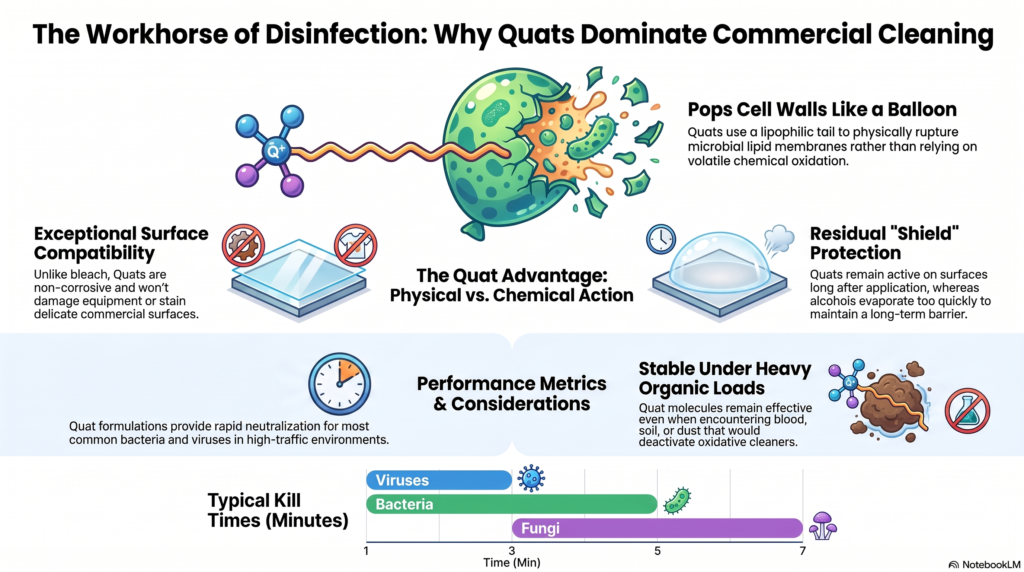
| Viruses | 1-3 |
| Fungi | 3-7 |
| Spores | 10-15 |
| Mycobacteria | 5-10 |
Employing these formulations not only enhances safety but also reduces the likelihood of infection in critical settings. Fast-acting disinfectants serve as a frontline defense against potential outbreaks.
IMMEDIATE SURFACE PROTECTION
When you evaluate quats side-by-side with oxidative chemistries in a testing environment, their practical advantages become crystal clear. Oxidizers like hydrogen peroxide or sodium hypochlorite rely on raw chemical reactivity to destroy pathogens. That reactivity is a double-edged sword: the moment those molecules hit heavy organic loads like blood, soil, or even basic drywall dust they consume themselves trying to react with the debris rather than the microbes.
Quats operate on a completely different mechanism. They rely on targeted physical toxicity rather than violent chemical oxidation. The lipophilic tail of the quat molecule inserts itself directly into the pathogen’s lipid bilayer, rupturing the cell wall like a needle popping a balloon. Because they aren’t constantly trying to oxidize everything they touch, quats remain remarkably stable in solution, won’t bleach delicate materials, and offer crucial residual activity long after the spray bottle is put away.
That said, no single active ingredient is a magic bullet. From a quality control stand, you have to respect their limits. Quats are slower to achieve complete microbial kill than high-concentration hypochlorite, and they can leave a film over time if not rinsed properly. But for high-touch, multi-surface environments where surface preservation and continuous protection matter, quat-based systems remain hard to beat.
Immediate surface protection is essential in maintaining hygiene, particularly in high-risk environments. Fast-acting disinfectants with quaternary ammonium compounds offer immediate efficacy, neutralizing pathogens on contact.
This rapid action greatly reduces the risk of infection, guaranteeing you create a safer space for employees and customers alike. By effectively targeting bacteria and viruses, these agents enhance surface longevity, making certain that protective effects remain in place for extended periods.
Implementing such disinfectants in your protocols not only protects health but also reinforces confidence in your commitment to cleanliness. Choosing products with proven efficacy guarantees that you’re not just reacting to contamination but proactively safeguarding against potential outbreaks, positioning your facility as a leader in hygiene standards.
Enhanced Cleaning Protocols
When you implement enhanced cleaning protocols that incorporate fast-acting disinfectants, you greatly reduce the risk of infection in your facility.
By aligning with current cleaning trends, you elevate protocol effectiveness and safeguard public health. Fast-acting disinfectants, particularly quaternary ammonium compounds, guarantee swift microbial kill times, which is essential in high-traffic environments.
- Rapid action: Disinfectants that act within minutes can notably lower pathogen levels.
- Consistent application: Routine protocols guarantee thorough coverage, minimizing oversight.
- Evidence-based practices: Utilizing scientifically-backed products enhances credibility and trust.
Integrating these strategies not only fortifies your infection control measures but also positions your facility as a leader in maintaining safety and hygiene standards.
How Quats Keep Protecting After You Clean
Quaternary ammonium compounds (quats) extend their protective benefits even after the initial cleaning process is complete. Their residual activity guarantees continued efficacy against pathogens, providing long-lasting protection on surfaces. This characteristic is vital in high-traffic areas where recontamination is frequent.
| Feature | Benefit | Impact |
| Residual Activity | Ongoing antimicrobial effect | Reduces need for frequent cleaning |
| Long-lasting Protection | Extended surface efficacy | Enhances safety over time |
| Surface Compatibility | Versatile application | Effective on various materials |
Evaluating the Safety and Environmental Impact of Quats
While quats provide significant antimicrobial benefits post-cleaning, it’s important to assess their safety and environmental impact. Quaternary ammonium compounds, also called quats, are chemicals made of two basic parts. The first part is a central nitrogen atom.1 The second part is made up of four clusters of atoms2 that are attached to the nitrogen atom (Figure 1). The U.S. Environmental Protection Agency (EPA) currently classifies quats into four different groups based on the structure of the four clusters attached to the central atom. The physical and chemical properties of the quats contribute to the behavior of the quat and how toxic it is. The EPA has identified specific compounds in each group to represent the rest of them when they do toxicity testing.
Understanding how these compounds interact with human health and ecosystems is crucial for responsible usage.
- Quats must meet stringent safety standards to guarantee they don’t pose health risks to users and consumers.
- Environmental regulations are increasingly scrutinizing the persistence and toxicity of quats in waterways.
- Evaluating long-term exposure effects is essential for thorough risk assessments.
The Future of Quaternary Ammonium Compounds in Cleaning Products
As the demand for effective disinfectants grows, the role of quaternary ammonium compounds (quats) in cleaning products is likely to evolve considerably. Future trends indicate a shift towards more sustainable formulations, driven by consumer awareness and regulatory changes. Industry innovations will focus on enhancing efficacy while minimizing environmental impact, integrating quats with bio-based additives for improved performance. Quaternary ammonium compounds (quats) are a class of disinfectant ingredients commonly used in household, healthcare, and commercial cleaning products. They are effective against a broad range of bacteria, viruses, and fungi, including viruses like SARS-CoV-2. QQuat-based disinfectants are rigorously tested, regulated, and considered safe and effective for helping protect public health wwhen used according to label directions.
| Future Trends | Industry Innovations |
| Sustainable formulations | Bio-based additives |
| Enhanced efficacy | Smart cleaning technologies |
| Regulatory compliance | Multi-functional products |
You’ll find that embracing these developments will not only position your brand as a leader but also meet the escalating demands for safety and effectiveness in today’s marketplace.
RELATED STUDIES ABOUT QUATERNARY AMMONIUM COMPOUNDS
To conclude, quaternary ammonium compounds stand out as effective disinfectant ingredients due to their broad-spectrum efficacy and residual protection. While they offer clear advantages over other disinfectants, it is crucial to weigh their safety and environmental impacts. As we continue to navigate challenges like the COVID-19 pandemic, quats remain a reliable choice for maintaining hygiene. Just as knights of old relied on their armor, you can trust quats to shield your spaces from harmful pathogens for longer-lasting protection.
Organosilicon quaternary ammonium compound-modified kaolin: A novel approach for the preparation of an algal bloom eliminator with excellent stability and high algae removal efficiency
Harmful algal blooms (HABs) pose a significant threat to global marine ecosystems and economies, necessitating the development of safe, efficient, and stable mitigation agents. Conventional quaternary ammonium compound-modified clay (QAC-MC) has demonstrated potential for algal removal at low doses, but its widespread practical application is limited by poor stability and risks of secondary pollution.
Key Findings & Innovation
Research revealed that the instability of conventional QAC-MC stems from the weak physical adsorption of QAC molecules, which contain only a single quaternary ammonium active center (-N^+R3 ). To overcome these limitations, the study proposed a novel composite, SiQAC-MC (specifically, kaolin@SiO$_2$@TMSPTAC), developed through a targeted dual-modification approach:
- Surface Activation: The kaolin substrate was pretreated with tetraethyl orthosilicate (TEOS) to enrich the surface with active silanol (Si-OH) groups, providing a foundation for stable chemical bonding.
- Dual-Active Center Grafting: Trimethyl [3-(trimethoxysilyl) propyl] ammonium chloride (TMSPTAC) was used as the modifier. This molecule introduces a secondary active center—siloxane groups (-Si(OR)3)—that allows for covalent bonding with the activated clay surface.
Performance Improvements
Compared to conventional QAC-MC, the novel SiQAC-MC demonstrated superior characteristics:
- Enhanced Stability: Molecular simulations and experiments confirmed a shift from weak physical adsorption to strong chemical bonding. The binding energy improved significantly from -0.28 eV (conventional) to -3.71 eV (SiQAC-MC).
- Optimal Orientation: The grafting process forces the charged active (-N^+R3 ) groups to protrude outward, maximizing their exposure for effective contact with algal cells.
- Superior Efficiency: The composite achieved an algae removal efficiency of 97% for Heterosigma akashiwo at a low dosage of 0.1 g/L, substantially outperforming the 38% removal efficiency of conventional QAC-MC.
- Surface Potential: The modification reversed the surface potential of the clay from -3.24 mV to +8.47 mV, significantly improving its electrostatic attraction to negatively charged algal cells.
Conclusion
The development of SiQAC-MC provides a robust theoretical and technical foundation for safer, more effective HAB control. By utilizing precise molecular design and surface-directed grafting, this approach effectively resolves the stability and performance limitations inherent in conventional clay-based mitigation agents.
| REFERENCE: Mingjiao Wang, Xihua Cao, Xiaomiao Zang, Xu Zheng, Wenbin Jiang, Zaixing Wu, Xiuxian Song, Zhiming Yu, Organosilicon quaternary ammonium compound-modified kaolin: A novel approach for the preparation of an algal bloom eliminator with excellent stability and high algae removal efficiency, Environmental Technology & Innovation, Volume 41, 2026, 104812, ISSN 2352-1864, https://doi.org/10.1016/j.eti.2026.104812. (https://www.sciencedirect.com/science/article/pii/S2352186426000696) |
Urinary Quaternary Ammonium Compounds (QACs) in Healthy Elderly Adults
Quaternary ammonium compounds (QACs) are widely utilized as cationic surfactants with antimicrobial properties in industrial, medical, and household applications, leading to widespread human and environmental exposure. Despite these concerns, biomonitoring data regarding internal exposure levels and health risks in vulnerable populations, such as the elderly, remain limited.
Study Overview
This longitudinal panel study, conducted as part of the China Biomarkers of Air Pollutant Exposure (BAPE) project, investigated urinary concentrations of 29 traditional and emerging QACs in 76 healthy elderly participants (aged 60–69 years) in Jinan, China. Between September 2018 and January 2019, 350 urine samples were collected across five monthly follow-ups to characterize exposure profiles, determinants, and health risks.
Key Findings
- Widespread Exposure: All 29 analyzed QACs were detected in the collected urine samples. The median total concentration of QACs was 2.07g/L (3.19 g/g creatinine).
- Compositional Profile: Traditional QACs were the dominant contributors to the total urinary QAC burden (64.02%), while emerging QACs accounted for 35.98%.
- Gender and Temporal Variations: Several creatinine-adjusted QAC concentrations were significantly higher in females than in males. A modest increase in total QAC concentrations was observed over the five-month study period, from 2.08g/g creatinine in September to 3.41g/g creatinine in January.
- Exposure Determinants: Exploratory analyses indicated that certain dietary habits (e.g., egg and white meat consumption) and residential behaviors (e.g., physical activity levels, cooking time, and home ventilation) were associated with urinary QAC levels.
Risk Assessment
A screening-level risk assessment was conducted for three representative QACs (C10-BAC, C12-BAC, and C8-DDAC). The calculated hazard index (HI) values (median HI = 1.80 \times 10^{-3}) were well below the threshold of 1, suggesting a low non-cancer health risk for the elderly population under the study’s assumptions.
Conclusion
This study provides essential pre-pandemic baseline data on urinary parent QACs among healthy elderly adults in China. While the current risk assessment indicates low levels of concern, the authors emphasize that because urinary excretion is not the dominant elimination pathway for many QACs, these results should be interpreted as complementary biomonitoring evidence rather than a complete assessment of total body burden. Further research is warranted to validate these exploratory findings in larger cohorts and to better understand the long-term health implications of chronic, low-dose QAC exposure.
| REFERENCE: Yu’e Cha, Zhipeng Cheng, Yuhao Cao, Jiankun Qian, Xiao Ma, Xiaojie Guo, Juan Liu, Kaiyue Shao, Yongjun Situ, Chenlong Li, Zhe Zhao, Shuling Duan, Xinyue Bei, Yuyao Chen, Kai Wang, Shilu Tong, Zhaomin Dong, Song Tang, Xiaoming Shi, Urinary quaternary ammonium compounds among healthy elderly in the China BAPE study: exposure characteristics, determinants, and health risk assessment, Environment International, Volume 212, 2026, 110298, ISSN 0160-4120, https://doi.org/10.1016/j.envint.2026.110298. (https://www.sciencedirect.com/science/article/pii/S0160412026002564) |
Disinfectant quaternary ammonium compounds hijack the NAMPT–NAD⁺ axis to impair trophoblast function
The increased use of quaternary ammonium compounds (QACs) as disinfectants, particularly during the post-pandemic era, has prompted investigations into their systemic toxicity, especially during critical developmental windows. This study explored the molecular mechanisms by which QACs potentially disrupt placental development using human trophoblast cells.
Key Findings & Molecular Mechanisms
- Identification of Potent Analog: Screening six common QACs revealed that benzyldimethyltetradecylammonium chloride (C14-BAC) is the most potent inhibitor of trophoblast migration and invasion.
- Mitochondrial Dysfunction: C14-BAC exposure at nanomolar concentrations (as low as 100 nM) disrupted mitochondrial homeostasis, evidenced by decreased mitochondrial membrane potential, increased mitochondrial reactive oxygen species (mtROS), and reduced mitochondrial DNA copy number.
- NAMPT as a Molecular Target: Through integrated chemoproteomics (PELSA) and affinity profiling, the study identified nicotinamide phosphoribosyltransferase (NAMPT)—the rate-limiting enzyme in the NAD salvage pathway—as a direct molecular target of C14-BAC.
- Metabolic Disruption: C14-BAC binds to and inhibits NAMPT, which triggers NAD depletion and disrupts the NAD/NADH redox balance, thereby precipitating the observed mitochondrial failure.
- Structure-Activity Relationship: The study confirmed that NAMPT engagement and toxic potency are structure-dependent, with the benzyl aromatic moiety of BAC homologs acting as a critical structural driver for binding.
Validation of the NAMPT-NAD Axis
To confirm the causal role of the NAMPT-NAD axis, the study employed several validation approaches:
- Rescue Experiments: Supplementation with $\beta$-nicotinamide mononucleotide (NMN), which bypasses NAMPT to replenish the NAD pool, successfully rescued mitochondrial function and restored trophoblast migration and invasion.
- Inhibition & Depletion: Pharmacological inhibition of NAMPT (via FK866) and siRNA-mediated knockdown of NAMPT replicated the inhibitory phenotypes caused by C14-BAC. Furthermore, C14-BAC failed to induce further toxicity in NAMPT-depleted cells, confirming that its adverse effects are contingent upon NAMPT inhibition.
Conclusion
This research establishes that C14-BAC can hijack the NAMPT-NAD axis, leading to metabolic vulnerabilities that impair placental trophoblast function. These findings underscore the importance of re-evaluating the safety of widely used QAC disinfectants and highlight the value of target-resolved toxicology in identifying early molecular initiating events (MIEs) associated with environmental chemical exposure.
| REFERENCE: Yongbao Fang, Ailin Zhao, Yuanyuan Fang, Xing Chen, Yinzhen Cao, Zhong Lv, Guomao Zheng, Yijun Fan, Mingliang Fang, Disinfectant quaternary ammonium compounds hijack the NAMPT–NAD⁺ axis to impair trophoblast function, Environment International, Volume 213, 2026, 110352, ISSN 0160-4120, https://doi.org/10.1016/j.envint.2026.110352. (https://www.sciencedirect.com/science/article/pii/S0160412026003107) |
CONCLUSION
Looking at the broader landscape of cleaning chemistry, quats aren’t going anywhere, but the way we use and regulate them is rapidly shifting. Emerging toxicological data such as recent biomonitoring studies on long-term low-dose exposure and target-specific cellular impacts reminds us that “low toxicity” does not mean “zero impact.” As someone focused on regulatory compliance and industrial safety, I view these findings not as a reason to abandon quats, but as a mandate to innovate.
We are entering an era of smart formulation. The future isn’t about slapping higher concentrations of benzalkonium chloride into a spray bottle; it’s about molecular engineering. We’re already seeing incredible strides in bio-based additives and organosilicon-modified quats that bind tightly to substrates, dramatically increasing efficacy at lower, safer dosages while reducing environmental runoff.
At the end of the day, effective infection control requires a balanced approach. Quats provide a reliable, broad-spectrum shield that keeps our workspaces safe and operational. By staying informed on the latest research, respecting proper contact times, and adhering to strict handling standards, we can continue to leverage the power of quats safely and effectively for years to come.