
As an environmental chemist who spends a lot of time evaluating toxicity, biodegradability, and regulatory compliance, I’ll be the first to admit that strong halogen-based oxidizers like sodium hypochlorite can stir up mixed feelings. On one hand, my heart lies in green chemistry exploring botanical surfactants, enzyme cleaners, and minimal-VOC formulations. On the other hand, my work is grounded in data and real-world risk assessments.
When you need rapid, non-selective, broad-spectrum microbial destruction to stop an infectious outbreak in its tracks, sodium hypochlorite remains one of the most effective tools in our public health arsenal. The key to managing chlorine bleach isn’t blanket fear or blind reliance; it’s understanding the fundamental chemistry behind how it works, how it breaks down in our wastewater systems, and how to use it responsibly.
From an environmental safety perspective, sodium hypochlorite eventually breaks down primarily into salt water and oxygen, but its immediate reactivity means improper handling can create unwanted chemical byproducts or toxic gases. My goal in this article is to help you look past the raw hype or undue anxiety, breaking down the exact mechanisms of how sodium hypochlorite eliminates pathogens so you can make informed, safe, and conscious decisions for your home or facility.
Sodium hypochlorite cleaner solutions effectively eliminate bacteria and viruses through oxidation, disrupting their cellular structures. These solutions act quickly, often achieving results in just minutes, making them indispensable for sanitation. They aren’t just versatile; they can be used on various surfaces, from kitchens to hospitals. Safety is essential when handling these chemicals, so taking precautions is important. Learn more about the numerous benefits and applications of sodium hypochlorite in maintaining a hygienic environment.
KEY TAKEAWAYS
- Sodium hypochlorite disrupts cellular structures of bacteria and viruses, effectively preventing their growth and eliminating harmful pathogens.
- Its strong oxidizing properties enable rapid oxidation, making it effective against a broad spectrum of germs in just minutes.
- Proven efficacy in various settings supports its role in maintaining cleanliness and reducing infection risks in high-traffic areas.
- Versatile applications across healthcare, food processing, and industrial sectors highlight its importance in effective sanitation practices.
- Following proper dilution and application guidelines maximizes its disinfecting efficiency, ensuring thorough contact with surfaces for optimal results.
UNDERSTANDING SODIUM HYPOCHLORITE: WHY IT MATTERS FOR YOUR HEALTH
Sodium hypochlorite, often recognized for its powerful disinfecting properties, plays an essential role in maintaining a healthy environment, especially in your home.
Understanding sodium hypochlorite chemistry is vital; it consists of chlorine and sodium, creating a potent oxidizing agent. As the active ingredient, it effectively disrupts the cellular structures of bacteria and viruses, ensuring they can’t thrive. This compound’s efficacy hinges on its ability to disrupt cellular structures of bacteria and viruses, ensuring they can’t thrive.
The health implications of using sodium hypochlorite are significant, as inadequate sanitation can lead to illness and disease spread. When used correctly, it acts as a safeguard, promoting wellness and reducing health risks.
Therefore, harnessing its properties effectively empowers you to create a safer, cleaner living space, enhancing your overall quality of life.
How Sodium Hypochlorite Keeps Us Safe From Germs
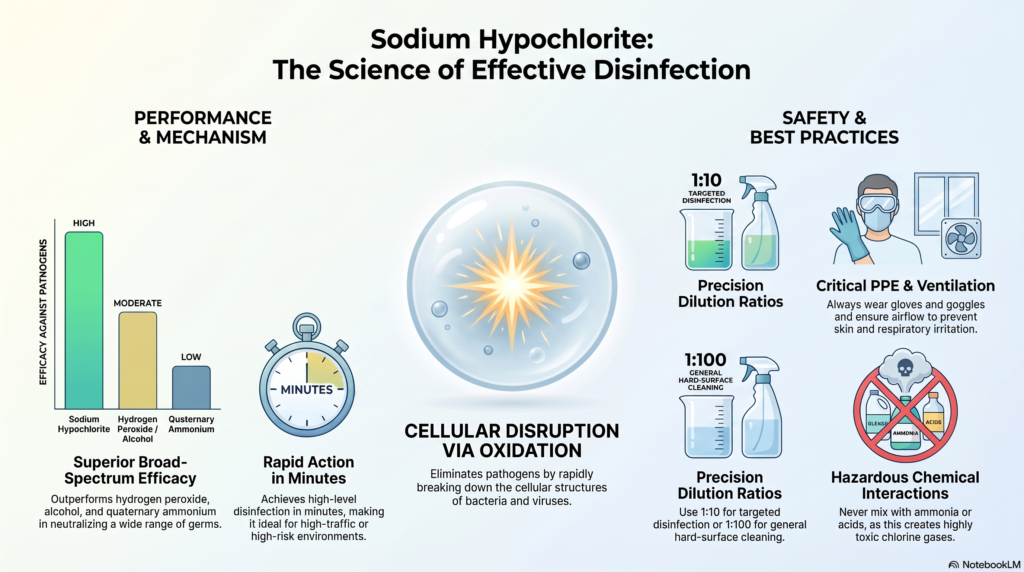
When you use sodium hypochlorite, you’re leveraging a potent disinfectant that effectively neutralizes harmful germs and pathogens in your environment. Sodium hypochlorite, the active ingredient in chlorine bleach, is routinely used in the laboratory to decontaminate surfaces and equipment or deactivate biological materials by inactivating vegetative bacteria, fungi, lipid and non-lipid viruses, and other liquid specimens. Bleach is very reactive and if it mixes with incompatible chemicals, it can produce high hazard by-products and toxic gases.
This chemical acts through oxidation, breaking down the cellular structures of viruses and bacteria, ensuring thorough germ elimination. Its efficacy is well-documented; studies demonstrate its ability to eradicate pathogens, making it indispensable in settings ranging from hospitals to households.
By incorporating sodium hypochlorite into your cleaning routine, you’re not just maintaining cleanliness—you’re actively contributing to public health.
The consistent use of this powerful disinfectant creates safer spaces, reducing the risk of infections and enhancing overall well-being.
In a world where germs constantly challenge our health, sodium hypochlorite stands as a formidable ally in the fight against disease.
Real-World Uses of Sodium Hypochlorite Cleaners
Cleaning products containing sodium hypochlorite find extensive use across various sectors due to their powerful disinfecting properties. In healthcare, they’re critical for sterilizing surfaces and equipment, ensuring patient safety. In food processing, they eliminate pathogens, maintaining hygiene standards. Additionally, in industrial settings, sodium hypochlorite is employed for water treatment and as a bleaching agent.
| Sector | Real World Applications | Industrial Usage |
| Healthcare | Surface and equipment sterilization | Infection control |
| Food Processing | Pathogen elimination | Hygiene maintenance |
| Water Treatment | Disinfection of drinking water | Wastewater treatment |
These applications highlight sodium hypochlorite’s versatility and effectiveness, making it an indispensable tool in your cleaning arsenal.
Top 5 Benefits of Sodium Hypochlorite Cleaners for Effective Disinfection
Five key benefits make sodium hypochlorite cleaners stand out for effective disinfection. Sodium hypochlorite, commonly referred to as bleach, is a chemical compound with the formula NaOCl. Sodium hypochlorite solutions are made by reacting chlorine (gas or liquid) with a dilute sodium hydroxide solution in continuous or batch method. These two reactants are the major co-products from most chlor-alkali cell rooms. It is commonly available in strengths of 3 to 20 wt. % sodium hypochlorite and is shipped in a variety of methods such as rail tank car, cargo tank (truck), and other smaller containers.
First, their broad-spectrum efficacy targets bacteria and viruses, guaranteeing a thorough clean.
Second, sodium hypochlorite applications are versatile, suitable for various surfaces, from countertops to medical facilities.
Third, they work quickly, often in just minutes, enabling rapid disinfection in high-traffic areas.
Fourth, sodium hypochlorite cleaners are cost-effective compared to many disinfectant alternatives, providing powerful results without breaking the bank.
Finally, their easily adjustable concentrations allow tailored solutions for specific disinfection needs, enhancing effectiveness.
Safety Precautions When Using Sodium Hypochlorite Cleaners
While sodium hypochlorite cleaners are highly effective for disinfection, safety precautions are essential to prevent potential hazards.
Always wear personal protective equipment (PPE) such as gloves, goggles, and masks to shield yourself from splashes and vapors. Guarantee proper ventilation in the area to minimize inhalation risks.
Never mix sodium hypochlorite with other chemicals, especially ammonia, as this can produce toxic gases.
In case of contact with skin or eyes, rinse immediately with plenty of water and seek emergency first aid if necessary.
Familiarize yourself with the Material Safety Data Sheet (MSDS) for specific handling instructions.
HOW SODIUM HYPOCHLORITE STACKS UP AGAINST OTHER POPULAR DISINFECTANTS
When I evaluate cleaning chemicals from a regulatory and toxicity standpoint, sodium hypochlorite always presents a fascinating study in dosage and application. There’s often a misconception in home cleaning that “more chemical equals better results,” leading people to use overly concentrated solutions or misuse heavy industrial-strength products. From a chemical safety perspective, this is where most risks arise. High concentrations increase indoor volatile emissions, cause respiratory irritation, and heighten the risk of severe accidental reactions if cross-contaminated with acids or ammonia.
In toxicology, we evaluate compounds based on observable outcomes rather than theoretical panic. Sodium hypochlorite is a potent skin and lung irritant in high doses, but it is not classified as a carcinogen because sound scientific evidence simply doesn’t support that classification. When properly diluted such as a 1:10 ratio for targeted disinfection or 1:100 for general hard-surface cleaning it balances rapid pathogen inactivation with manageable toxicity profiles.
Additionally, modern green processing innovations, like combining lower hypochlorite concentrations with ultrasonic activation in food sanitization, show how smart engineering can cut chemical use by over 60% while maintaining stellar hygiene standards. Smart chemistry is always about using the absolute minimum concentration necessary to achieve safety.
When comparing sodium hypochlorite to other popular disinfectants, you’ll want to evaluate its effectiveness against various pathogens. Bleach is referred to as a product used to brighten, disinfect, clean or remove stains. Bleach is also known as sodium hypochlorite that is used as a common product across all industries both commercially and domestically to clean. Our bleach is 12.5% which means it is very strong when fighting against bacteria. The powerful strength is used for cleaning, removing stubborn stains and more. Effective for cleaning white as it brightens as well as nappies, and as a general household product.
You’ll also need to weigh safety risks and how they stack up against the benefits.
Finally, examining the cost and value of sodium hypochlorite can help you make an informed choice for your disinfecting needs.
Effectiveness Against Pathogens
Sodium hypochlorite is widely recognized for its powerful disinfecting properties, particularly when it comes to combating pathogens. Its efficacy against bacteria and viruses often surpasses other popular disinfectants, making it a go-to choice for those serious about infection control. When evaluating disinfectant efficacy, consider the following comparison:
| Disinfectant | Efficacy Against Pathogens |
| Sodium Hypochlorite | High |
| Hydrogen Peroxide | Moderate |
| Quaternary Ammonium | Low |
| Alcohol | Moderate |
While some pathogens exhibit resistance to certain disinfectants, sodium hypochlorite maintains a robust track record. However, a hydrogen peroxide disinfectant is another effective option for broad-spectrum surface sanitation, depending on the cleaning application. Its rapid action against a wide range of microorganisms makes it a powerful ally in the fight against infection, ensuring you achieve ideal results in sanitizing your environment.
Safety Considerations and Risks
Understanding the effectiveness of sodium hypochlorite against pathogens is just part of the equation; safety considerations are equally important when choosing a disinfectant.
While sodium hypochlorite is potent, it carries certain exposure risks that you must consider:
- Inhalation Hazards: Fumes can irritate respiratory systems, especially in poorly ventilated areas.
- Skin and Eye Contact: Direct exposure can cause burns; protective gear is essential.
- Proper Storage: Store in a cool, dry place away from incompatible substances to prevent hazardous reactions.
Cost Comparison and Value
Choosing the right disinfectant involves more than just evaluating its effectiveness; it also requires a careful look at cost and value.
Sodium hypochlorite stands out in budget comparisons against other popular disinfectants. Its concentration allows for significant dilution, which enhances cost effectiveness without sacrificing efficacy.
While some alternatives may have higher upfront costs,they often lack the broad-spectrum activity that sodium hypochlorite offers, whereas a benzalkonium chloride cleaner may be preferred for certain hard-surface disinfection applications. Furthermore, sodium hypochlorite’s rapid action against bacteria and viruses can lead to reduced labor costs and time savings in cleaning.
When you consider overall value, it becomes clear that sodium hypochlorite isn’t only budget-friendly but also a powerhouse in maintaining hygiene standards.
Ultimately, its affordability and effectiveness make it a wise choice for any cleaning regimen.
Best Practices for Effective Use of Sodium Hypochlorite Solutions
When using sodium hypochlorite solutions, implementing best practices guarantees maximum effectiveness and safety.
To achieve ideal results, consider these essential strategies:
- Dilution Ratios: Always follow recommended dilution ratios, typically 1:10 for disinfection. This guarantees the solution is effective against bacteria and viruses without compromising safety.
- Application Techniques: Use spray bottles or mop systems for even coverage, allowing the solution to sit for at least 10 minutes before rinsing. This maximizes disinfection.
- Protective Gear: Wear gloves and eye protection to shield yourself from potential irritation. Safety is paramount when handling chemicals.
RELATED STUDIES ABOUT SODIUM HYPOCHLORITE CLEANER
To summarize, sodium hypochlorite solutions serve as superb sanitizers, swiftly slaying stubborn germs and safeguarding your surroundings. Their proven potency makes them a popular pick for disinfection in diverse domains. However, remember to prioritize safety and follow best practices for maximum efficacy. By understanding and utilizing these powerful cleaners responsibly, you can contribute to a cleaner, healthier environment for yourself and those around you. Embrace the benefits of sodium hypochlorite and enjoy peace of mind!
Effects of multi-frequency ultrasonic assisted sodium hypochlorite on the cleaning effect and quality of fresh-cut scallion stems
This study evaluated the efficacy of multi-frequency, ultrasound-assisted sodium hypochlorite (NaClO) as an alternative cleaning method for fresh-cut scallion stems (FCS). The research aimed to improve food safety and quality while addressing concerns related to high water consumption and the chemical by-products associated with traditional high-concentration chlorine disinfection.
Key Findings
- Optimal Cleaning Parameters: The most effective cleaning performance was achieved using a sweep frequency (SF) ultrasound combination of (20±2) + (28±2) kHz with a sample-to-water ratio of 1:4.
- Enhanced Microbial Control: The ultrasound-assisted process significantly improved cleanliness and inhibited microbial growth. Specifically, the total number of bacteria decreased by 2.2 ± 0.078 log CFU/g, and Escherichia coli decreased by 1.94 ± 0.057 log CFU/g.
- Resource Efficiency: This optimized approach allowed for a notable reduction of 68% in NaClO concentration and conserved 19.99% more water compared to traditional FCS cleaning methods.
- Quality Retention: The treatment maintained product quality, showing no significant difference in ascorbic acid (AA) retention, color, or texture (firmness) compared to traditional cleaning. Additionally, the content of allicin increased by 52.5% under the ultrasound-assisted cleaning treatment.
- Storage Benefits: Scallion stems treated with this method exhibited lower respiration rates (RR) and reduced weight loss compared to those treated with traditional 250 ppm NaClO cleaning, indicating a potential for extended shelf life.
Conclusion
Ultrasound-assisted NaClO cleaning is a promising, efficient approach for the processing of fresh-cut vegetables. It effectively reduces surface microorganisms and improves storage quality while successfully lowering both chemical and water consumption, offering significant benefits to the post-harvest sector.
| REFERENCE: Yulan Qu, Lina Guo, Chen Hong, Yuming Wan, Jamila Tuly, Haile Ma, Effects of multi-frequency ultrasonic assisted sodium hypochlorite on the cleaning effect and quality of fresh-cut scallion stems, Ultrasonics Sonochemistry, Volume 100, 2023, 106613, ISSN 1350-4177, https://doi.org/10.1016/j.ultsonch.2023.106613. (https://www.sciencedirect.com/science/article/pii/S1350417723003255) |
The combination of non-electrolytic hypochlorite water and ultrasonic treatment on the cleaning and preservation of baby cabbage
This study evaluated the synergistic effects of immersing baby cabbage in non-electrolytic hypochlorite water (NEHW, 50 mg/L, pH 5.8) combined with ultrasonic treatment (US, 32 kHz) to enhance microbial safety and postharvest quality during cold storage at 4 °C.
Key Findings
- Microbial Inactivation: The combination of NEHW and US treatment was the most effective method for controlling microbial populations. Compared to the control group, this treatment significantly reduced the total viable count (TVC) by 1.965 lg CFU/g and yeast and mold counts by 1.545 lg CFU/g by the 12th day of storage.
- Quality Maintenance: The compound treatment effectively maintained the quality of the baby cabbage during storage. Specifically, it:
- Slowed the increase of weight loss rates and relative conductivity, which indicates reduced cell damage and decay.
- Inhibited the loss of essential nutrients, including Vitamin C (VC), total phenols, and soluble sugars.
- Inhibited the accumulation of nitrates and nitrites.
- Sensory Freshness: The NEHW combined with ultrasonic treatment significantly improved the sensory freshness and overall commodity value of the baby cabbage compared to other treatment groups.
Conclusion
The results suggest that a synergistic treatment of NEHW immersion and ultrasonic processing is a safe, effective, and cost-efficient method for postharvest preservation. This combined approach successfully inhibits microbial activity and maintains nutritional and sensory quality, thereby effectively extending the shelf life of baby cabbage.
| REFERENCE: Jun Lei, Hongrui Ren, Yujie Li, Tongjiao Wu, Jianxiong Hao, The combination of non-electrolytic hypochlorite water and ultrasonic treatment on the cleaning and preservation of baby cabbage, LWT, Volume 205, 2024, 116528, ISSN 0023-6438, https://doi.org/10.1016/j.lwt.2024.116528. (https://www.sciencedirect.com/science/article/pii/S0023643824008077) |
Postoperative Pain Evaluation in Endodontic Treatment
This study aimed to evaluate the impact of different sodium hypochlorite (NaOCl) concentrations (5.25% and 8.25%) and various irrigation activation methods (none, sonic, and ultrasonic) on postoperative pain following single-visit root canal treatment in mandibular premolars with symptomatic irreversible pulpitis.
Study Design
- Participants: 120 individuals with symptomatic irreversible pulpitis in single-rooted mandibular premolars were randomly assigned to six groups (n=20 per group).
- Groups:
- Group 1: 5.25% NaOCl, no activation.
- Group 2: 8.25% NaOCl, no activation.
- Group 3: 5.25% NaOCl, sonic activation.
- Group 4: 5.25% NaOCl, ultrasonic activation.
- Group 5: 8.25% NaOCl, sonic activation.
- Group 6: 8.25% NaOCl, ultrasonic activation.
- Assessment: Postoperative pain was recorded using the Visual Analogue Scale (VAS) at 24, 48, and 72 hours post-treatment.
Key Findings
- Activation Methods: Postoperative pain was consistently higher in groups utilizing ultrasonic activation compared to groups with no activation or sonic activation.
- Concentration Impact: There was no significant difference in postoperative pain between 8.25% and 5.25% NaOCl concentrations when using either no activation or sonic activation.
- Pain Progression: Pain scores decreased across all six groups over the 24-, 48-, and 72-hour intervals.
- Medication Usage: Patients in Group 6 (8.25% NaOCl with ultrasonic activation) required significantly more medication for pain relief compared to all other groups.
Conclusion
The study concludes that ultrasonic activation of NaOCl is associated with higher postoperative pain, regardless of whether 5.25% or 8.25% concentration is used. Conversely, no significant difference in pain was observed between the two NaOCl concentrations when paired with no activation or sonic activation methods.
| REFERENCE: Kabir Bulchandani, Shahina Parvez, Lalit Kumar Likhyani, Manoj Kumar Agarwal, Rohit Kumar Khatri, Deepak Goel, Evaluation of postoperative pain in patients using 8.25 % sodium hypochlorite compared with 5.25 % sodium hypochlorite using sonic and ultrasonic activation methods after single visit root canal treatment: an in-vivo study, Journal of Oral Biology and Craniofacial Research, Volume 16, Issue 1, 2026, Pages 101-105, ISSN 2212-4268, https://doi.org/10.1016/j.jobcr.2025.11.004. (https://www.sciencedirect.com/science/article/pii/S2212426825002751) |
CONCLUSION
Wrapping up a deep dive into sodium hypochlorite always brings me back to the core philosophy of my work: balancing high-performance sanitization with long-term environmental and personal health. In a ideal world, every household and commercial facility could rely entirely on gentle, plant-derived cleaners for every situation. But practical science reminds us that different cleaning challenges require different chemical tools.
Everyday dust, grease, and light soils rarely demand a heavy-duty antimicrobial agent, and overusing disinfectants for routine cleaning is neither necessary nor environmentally optimal. However, when high-risk pathogens, surface contamination, or public health safeguards are on the line, sodium hypochlorite delivers unmatched, rapid-acting efficacy at a very low cost.
By respecting its chemical strength, adhering strictly to proper dilution guidelines, wearing basic protective gear, and ensuring good room ventilation, you can harness its powerful disinfecting properties without compromising safety. True sustainability isn’t about eliminating powerful chemicals entirely; it’s about applying sound scientific principles, minimizing unnecessary chemical loads, and using the right formulation at the right time.