
Over the last two decades overseeing maintenance operations across healthcare facilities, public school systems, and industrial sites, I’ve seen hundreds of commercial cleaners come and go. Marketing claims often paint a picture of effortless, instant sanitization, but in institutional chemistry, results come down to basic molecular behavior and application discipline. Early in my career while managing a regional hospital contract, we faced persistent challenges with rapid surface recontamination on high-touch fixtures.
Switching blindly between commercial sprays did little until we evaluated the core active ingredients driving microbial kill rates. That was when quaternary ammonium compounds, specifically Benzalkonium Chloride (BAC), proved their worth in our daily sanitation workflows. Unlike standard volatile alcohol blends that evaporate rapidly without leaving much defense behind, BAC-based formulations provide a predictable balance of immediate cell disruption and residual surface stability.
Understanding how these chemical mechanisms function isn’t just an academic exercise for lab technicians, it is a practical requirement for facility managers, janitorial crews, and homeowners who want to maintain genuinely hygienic spaces without unnecessarily degrading their physical assets over time.
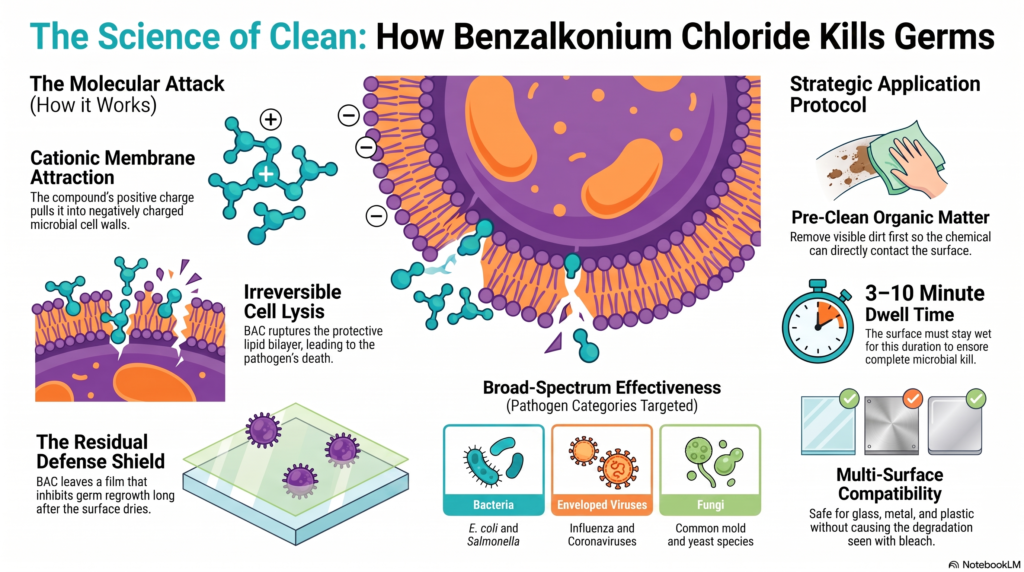
Benzalkonium chloride cleaner formulas kill germs effectively by disrupting microbial cell membranes. This disruption leads to cell lysis and inactivation of various pathogens, including bacteria and viruses. The cationic nature of these compounds enhances their penetration into surfaces, ensuring a thorough clean. Additionally, they adhere to surfaces, providing ongoing antimicrobial action that minimizes recontamination. Understanding how these cleaners work can further inform your cleaning choices for healthier environments.
KEY TAKEAWAYS
- Benzalkonium chloride disrupts microbial cell membranes, leading to cell lysis and subsequent death of bacteria, viruses, and fungi.
- It effectively neutralizes a wide range of pathogens, such as E. coli, Salmonella, influenza, and coronaviruses.
- The cationic nature of benzalkonium chloride enhances surface penetration, improving cleaning performance and germicidal action.
- Residual activity allows ongoing protection against recontamination, maintaining lower microbial load on treated surfaces over time.
- Proper application and adherence to safety guidelines optimize the effectiveness of benzalkonium chloride cleaner formulas.
WHAT IS BENZALKONIUM CHLORIDE AND WHY SHOULD YOU CARE?
Benzalkonium chloride, a quaternary ammonium compound, serves as a potent disinfectant and preservative widely used in various cleaning products. Benzalkonium Chloride (BKC) is part of a family of cationic surfactants known as Quaternary Ammonium Compounds, often shortened to Quats. Quats are common ingredients found in disinfectant products due to their broad antimicrobial activity. By adsorbing onto the cytoplasmic membrane of microbes, Quats damage the structural integrity of cell membranes. This enables them to lead gram-positive and gram-negative bacteria and lipophilic (enveloped) viruses to their death.
Its unique chemical properties include a cationic structure that allows it to disrupt microbial cell membranes effectively, rendering bacteria, viruses, and fungi inactive.
You should care about this compound because it not only enhances the efficacy of cleaning solutions but also offers significant health benefits.
By reducing microbial load on surfaces, it lowers the risk of infections, particularly in high-touch environments.
Additionally, its residual activity guarantees ongoing protection against recontamination.
Understanding these aspects empowers you to make informed choices regarding cleaning products, ultimately fostering a healthier living or working environment.
Embrace the power and knowledge that benzalkonium chloride provides.
Why Choose Benzalkonium Chloride?
When selecting a cleaner, you need to take into account the effectiveness and safety of its ingredients.
Benzalkonium chloride offers robust germicidal properties that guarantee thorough disinfection while being safe for various surfaces.
This makes it a practical choice for maintaining cleanliness in diverse environments.
Effective Germicidal Properties
Choosing a cleaner with effective germicidal properties is vital for maintaining a safe and hygienic environment.
Benzalkonium chloride excels in this area due to its robust germicidal mechanisms. As the active ingredient, it disrupts microbial cell membranes, leading to cell lysis and death, which dramatically enhances disinfectant efficacy. It disrupts microbial cell membranes, leading to cell lysis and death, which dramatically enhances disinfectant efficacy. This action is particularly effective against a wide range of pathogens, including bacteria and viruses, making it a powerful tool for infection control.
Safe For Various Surfaces
Opting for benzalkonium chloride cleaners guarantees compatibility with a wide variety of surfaces, making them an ideal choice for both residential and commercial environments.
Their surface compatibility allows you to maintain hygiene without damaging materials.
Consider these advantages:
- Versatile Use: Effective on hard, non-porous surfaces like glass, metal, and plastic.
- Multi-Surface Application: Safe for use in kitchens, bathrooms, and high-touch areas, enhancing overall sanitation.
- Reduced Risk of Damage: Formulated to minimize surface degradation, allowing for longevity.
With benzalkonium chloride, you leverage a powerful germicidal agent that delivers reliable performance across multiple surfaces, making it a practical companion to using dishwasher detergent without alcohol ethoxylates as part of a comprehensive cleaning routine.
Make the smart choice for a cleaner, safer environment without compromising on effectiveness or surface integrity.
How Does Benzalkonium Chloride Clean Surfaces?
Although many cleaning agents exist, benzalkonium chloride stands out for its effectiveness in sanitizing surfaces. Its high cleaning efficacy stems from its unique surface interaction properties. BENZALKONIUM CHLORIDE (ben zal KOE nee um klor ide) prevents skin infection. It is often used to clean and disinfect the skin after an injury or before a procedure. It works by killing or preventing the growth of bacteria on the skin.
When applied, benzalkonium chloride forms a layer that disrupts microbial membranes, leading to the destabilization of harmful pathogens. This active compound adheres to surfaces, ensuring prolonged antimicrobial action that continues to inhibit microbial growth even after the initial application.
The cationic nature of benzalkonium chloride allows it to bind effectively to various materials, enhancing its surface penetration and overall cleaning performance.
THE SPECTRUM OF GERMS TARGETED BY BENZALKONIUM CHLORIDE CLEANERS
If twenty years in institutional facility management have taught me anything, it’s that even the most sophisticated chemical formulation will fail if your team ignores proper contact time and preparation. I can’t tell you how often I’ve walked onto a job site and watched technicians spray a BAC-based disinfectant and immediately wipe it dry two seconds later. That is essentially just expensive dusting.
Benzalkonium chloride relies on a cationic charge to pull itself into microbial cell walls, and that physical membrane lysis takes actual dwell time typically anywhere from three to ten minutes depending on the targeted pathogen load and concentration. Furthermore, surface compatibility is where long-term budgeting meets chemical discipline.
While harsh oxidizing agents like high-concentration sodium hypochlorite can pit stainless steel, strip protective floor finishes, and degrade plastic housing over continuous use, properly formulated quats offer exceptional material safety. In high-traffic environments like classrooms or outpatient facilities where surfaces undergo multiple cleaning passes daily, preserving surface integrity while ensuring broad-spectrum microbicidal activity is essential. Respect the chemistry, follow dilution ratios precisely, and let the product sit long enough to do the heavy lifting for you.
When considering the effectiveness of benzalkonium chloride cleaners, it’s crucial to understand the broad spectrum of germs they target. These cleaners are engineered to combat a diverse array of pathogens, enhancing your cleaning efficacy considerably.
- Bacteria: They effectively neutralize various strains, including E. coli and Salmonella.
- Viruses: They’re proficient against enveloped viruses, such as influenza and coronaviruses.
- Fungi: They also tackle common mold and yeast species, ensuring surface safety.
The germ diversity targeted by benzalkonium chloride underscores its potency in disinfection. By utilizing these cleaners, you harness a powerful tool against harmful microorganisms, ensuring a healthier environment.
Their formulation allows for rapid action, making them indispensable in both residential and commercial settings.
Safety Considerations When Using Benzalkonium Chloride
Safety is paramount when using benzalkonium chloride cleaners, especially given their potency in disinfecting surfaces.
To harness their effectiveness without compromising safety, adhere to strict safety precautions. Always wear gloves and eye protection to minimize contact with your skin and eyes. Ascertain your workspace is well-ventilated, as inhalation of fumes can cause irritation.
Follow user guidelines meticulously; this includes diluting the product as specified and avoiding mixing with other chemicals, which can create hazardous reactions, especially if you have a cocamidopropyl betaine allergy or sensitivity to certain cleaning ingredients.
Store the cleaner in a secure location, out of reach of children and pets, to prevent accidental exposure.
How to Use Benzalkonium Chloride Cleaners Effectively
Proper usage of benzalkonium chloride cleaners considerably enhances their disinfecting effectiveness. Benzalkonium chloride is one of the most widely applied disinfectant ingredients today. From household sprays to hospital cleaning products, it plays a quiet but important role in protecting surfaces from harmful microbes. Many people, however, are unsure about its properties, safe dosage, and the right way to use it at home. This guide aims to answer those questions in a clear and practical way.
To optimize your results, focus on the following application techniques and cleaning frequency:
- Confirm surfaces are pre-cleaned to remove organic matter.
- Apply the cleaner evenly, allowing adequate contact time for maximum germ kill.
- Repeat cleaning regularly, particularly in high-touch areas, to maintain a sanitized environment.
Lasting Protection From Recontamination
To achieve lasting protection from recontamination, it’s essential to understand the mechanisms behind benzalkonium chloride (BAC) disinfectants. BAC not only disrupts microbial cell membranes, effectively neutralizing pathogens, but it also leaves behind protective coatings that can mitigate recontamination risks.
These residual effects extend the disinfectant’s efficacy, ensuring surfaces remain inhospitable to germs long after the initial application. By strategically employing BAC formulations, you can create an environment that markedly reduces the likelihood of germ resurgence.
It’s crucial to assess the surfaces you’re treating, as the durability of these protective coatings can vary. Regular evaluations and reapplications based on usage frequency and environmental conditions will enhance your defense against recontamination, empowering you to maintain superior hygiene standards.
RELATED STUDIES ABOUT BENZALKONIUM CHLORIDE CLEANER
In a world where germs seem to multiply faster than we can clean, using a Benzalkonium Chloride cleaner might feel like an uphill battle. Ironically, while you fight the invisible enemy, you’re armed with a powerful ally that not only eliminates a broad spectrum of pathogens but also leaves surfaces ready for action against recontamination. So, the next time you wipe down a surface, remember: you’re not just cleaning; you’re engaging in a strategic battle—one wipe at a time.
Toxicological assessment of benzalkonium chloride using planaria mobility: A comparison of manual and digital tracking methods
This study evaluates the toxicological effects of benzalkonium chloride (BAC)—a common antimicrobial excipient and environmental pollutant—on the locomotion of the planarian Schmidtea mediterranea. By comparing traditional manual assessment methods with digital video-tracking software, the research aims to refine toxicological testing protocols in alignment with the 3Rs (Reduction, Refinement, and Replacement) principle.
Key Findings
- Methodological Comparison:
- The traditional manual method, which relies on counting gridline crossings, proved subjective and limited by human interpretation, leading to potential observer bias and oversimplification of movement data.
- The Lolitrack video-tracking software provided a more robust, objective, and precise method for quantifying locomotion by measuring distance moved and activity percentage.
- Toxicological Effects of BAC:
- Both methods consistently identified a concentration-dependent reduction in planarian locomotor activity as BAC levels increased (tested range: 5–1000 mu g/mL).
- While manual analysis suggested a transient stimulatory effect at low concentrations, digital tracking indicated a more consistent, concentration-dependent decline in activity, highlighting the digital method’s superior reliability.
- Mechanism of Action: The study attributes the observed inhibition of motility to BAC’s action as a cationic surfactant, which disrupts lipid bilayers, impairs osmoregulatory and neuromuscular function, and disturbs ion channel activity in the organism.
Conclusion
The study demonstrates that planaria are a sensitive and effective invertebrate model for assessing sublethal environmental toxicity. The researchers conclude that video-tracking software like Lolitrack is preferable to manual methods, as it enables high-throughput, objective, and reproducible behavioral analysis. This methodological refinement advances the use of planaria as a bridge model between invertebrate and vertebrate systems in ecotoxicological and neurotoxicological research.
| REFERENCE: Manel M. Habel, Adrian C. Williams, Vitaliy V. Khutoryanskiy, Toxicological assessment of benzalkonium chloride using planaria mobility: A comparison of manual and digital tracking methods, Environmental Toxicology and Pharmacology, Volume 120, 2025, 104850, ISSN 1382-6689, https://doi.org/10.1016/j.etap.2025.104850. (https://www.sciencedirect.com/science/article/pii/S138266892500225X) |
Therapeutic effects of Ghrita Manda Ashchyotana on tear film stability, corneal integrity, and IL-6 expression in a benzalkonium chloride-induced murine dry eye model
This study evaluates the therapeutic potential of Ghrita Manda Ashchyotana (a clear, supernatant layer of ghee, also known as the scum of ghee) in managing dry eye disease (DE), a condition characterized by tear film instability and chronic inflammation. The research was conducted using a benzalkonium chloride (BAC)-induced murine dry eye model, comparing the Ayurvedic treatment against preservative-free eye drops (positive control) and saline-treated groups.
Key Findings
- Clinical Improvement: Ghrita Manda Ashchyotana significantly improved Tear Film Break-Up Time (TFBUT) and reduced fluorescein staining scores in the trial group compared to the negative control ($p < 0.001$).
- Anti-Inflammatory Mechanism: A notable reduction in the expression of the inflammatory marker Interleukin-6 (IL-6) was observed in the trial group compared to the positive control group, suggesting that Ghrita Manda effectively mitigates sterile inflammation on the ocular surface.
- Tissue Preservation: Histopathological analysis (H&E staining) revealed that the topical instillation of Ghrita Manda preserved corneal epithelial integrity and prevented the hyperplasia observed in untreated dry eye models.
- Compositional Analysis: GC-MS analysis of Ghrita Manda identified high concentrations of fatty acids, including n-hexadecanoic acid, oleic acid, and linoleic acid, which contribute to anti-inflammatory, wound-healing, and lubricating properties that aid in replenishing the tear film lipid layer.
- Safety: Quality control and microbial profiling confirmed the stability and safety of the preparation, which remained within permissible microbial limits throughout the storage period.
Conclusion
Ghrita Manda Ashchyotana demonstrates therapeutic efficacy for dry eye disease by providing lubrication, protecting corneal integrity, and reducing ocular surface inflammation. These findings validate Ayurvedic principles for managing vata pitta derangements and offer a promising, natural, preservative-free alternative to conventional eye drops that often contain cytotoxic preservatives like BAC.
| REFERENCE: Ramya Shruthi Janardhanan, Sivabalaji Kundrinmani, Ashwini Belludi Nagaraj, Therapeutic effects of Ghrita Manda Ashchyotana on tear film stability, corneal integrity, and IL-6 expression in a benzalkonium chloride-induced murine dry eye model, Journal of Ayurveda and Integrative Medicine, Volume 17, Issue 3, 2026, 101354, ISSN 0975-9476, https://doi.org/10.1016/j.jaim.2026.101354. (https://www.sciencedirect.com/science/article/pii/S0975947626000380) |
Benzalkonium chloride induces hematopoietic stem cell reduction and immunotoxicity in zebrafish larvae
This study explores the formulation and evaluation of a novel isotonic sports drink using Ajwa date (Phoenix dactylifera L.) pulp as a natural alternative to synthetic ingredients in sports nutrition.
Key Findings
- Formulation: Three formulations were created using different ratios of Ajwa date pulp to deionized water: ASD1 (20%), ASD2 (25%), and ASD3 (30%).
- Sensory Acceptability: ASD2 (25% pulp) was identified as the most promising formulation, achieving the highest overall sensory acceptability score of 8.2/9.
- Physicochemical and Functional Properties:
- ASD2 maintained an osmolality of $297 3.17$ mOsm/kg, which is ideal for rapid hydration during physical activity.
- The drink provided 34.01 0.47 kcal/100 g of energy without the addition of artificial sugars, relying instead on the natural glucose and fructose present in the date pulp.
- It exhibited significant antioxidant capacity, with phenolic content ranging between 2.5 and 3.0 g/kg gallic acid equivalent.
- Storage and Safety: The ASD2 formulation demonstrated excellent physicochemical and microbiological stability over a 90-day storage period at 7 2^C, with minimal microbial counts and no detected coliforms or salmonella.
Conclusion
The Ajwa date-based isotonic sports drink (ASD2) serves as a successful, health-conscious alternative to traditional, synthetic sports beverages. It effectively meets the physiological requirements for hydration and energy replenishment in athletes while offering additional health benefits through its natural bioactive compounds. This research supports the potential for commercializing natural, plant-based sports nutrition products.
| REFERENCE: Junquan Zeng, Si Dong, Chao Chen, Yongliang Zheng, Yuhua Zuo, Yuxin Liu, Ting Ding, Fasheng Liu, Qinyuan Shen, Yunyun Du, Xiaoping Wang, Wenguo Xie, Chenjun Zhou, Huiqiang Lu, Benzalkonium chloride induces hematopoietic stem cell reduction and immunotoxicity in zebrafish larvae, Ecotoxicology and Environmental Safety, Volume 284, 2024, 116902, ISSN 0147-6513, https://doi.org/10.1016/j.ecoenv.2024.116902. (https://www.sciencedirect.com/science/article/pii/S0147651324009783) |
CONCLUSION
Looking back across my career, I always tell the young technicians I mentor that effective sanitation isn’t about applying the strongest chemical you can find; it’s about establishing consistency, discipline, and understanding the science behind your tools. Benzalkonium chloride has remained a workhorse in institutional hygiene for decades precisely because it delivers reliable, broad-spectrum germicidal protection while remaining gentle enough on everyday materials to prevent premature surface degradation.
As clean technology evolves and scientific studies continue to evaluate active ingredients under rigorous laboratory conditions, the core principle remains unchanged: successful infection control relies on smart product selection combined with methodical execution.
Whether you are managing environmental services for a multi-story medical building or simply keeping high-touch areas safe in your own home, leveraging the residual defense of BAC cleaner formulas gives you a practical edge against cross-contamination. Take the time to understand your chemical ingredients, adhere strictly to manufacturer guidelines, and build cleaning routines grounded in proven field practices.