
When I first started auditing functional beverage formulations nearly a decade ago, I noticed a recurring theme in consumer marketing: sports drinks were routinely presented as either a magical performance elixir or an unnecessary, sugar-laden luxury. The reality, as is usually the case in chemistry, lies somewhere in between.
From an analytical standpoint, electrolytes aren’t exotic performance boosters they are fundamental chemical salts. When dissolved in water, compounds like sodium chloride or potassium phosphate dissociate into charged ions ($Na+, K+, Cl-). These ions transform standard water into an electrically conductive medium that allows your central nervous system to communicate with your muscle fibers. Without this bioelectrical conductivity, your body simply cannot execute fluid transfer or muscle contractions efficiently during sustained physical exertion.
In my lab work reviewing batch testing and regulatory compliance, I frequently see consumers misunderstand why these specific ratios matter. People often ask whether plain tap water is enough, and for a light 20-minute walk, it absolutely is. But when you are sweating continuously, drinking pure water without replenishing lost ions can actually dilute your internal mineral concentration, leading to hyponatremia or severe cramping. Understanding the underlying chemistry behind electrolyte formulations takes the guesswork out of hydration, helping you choose beverages based on biological necessity rather than aggressive label claims.
Electrolytes in sports drinks play a crucial role in supporting your athletic performance and recovery. They help regulate hydration, maintain muscle function, and balance fluids in your body during high-intensity workouts. For instance, sodium prevents cramping, while potassium aids muscle contractions. Replenishing these electrolytes post-exercise enhances recovery, reduces fatigue, and prepares you for your next performance. Understanding how to choose the right sports drink can make all the difference in optimizing your training results.
KEY TAKEAWAYS
- Electrolytes regulate nerve function and muscle contractions, essential for maintaining peak athletic performance during exercise.
- Sodium helps retain fluid and prevents cramping, supporting muscle contraction and recovery when combined with carbohydrates.
- Potassium is crucial for preventing muscle cramps and fatigue, enhancing endurance and recovery through proper fluid balance.
- Magnesium aids in reducing muscle tension and cramping, boosts energy production, and promotes better sleep for effective recovery.
- Timely replenishment of electrolytes post-exercise enhances hydration, speeds recovery, and prepares the body for subsequent workouts, reducing dehydration risks.
UNDERSTANDING ELECTROLYTES AND THEIR ROLE IN HYDRATION
When you engage in physical activity, your body loses electrolytes through sweat, making it vital to understand their role in hydration. Maintaining electrolyte balance is essential for peak performance and recovery.
Electrolytes like sodium, potassium, and magnesium help regulate nerve function, muscle contractions, and fluid balance. Without them, you risk dehydration, cramping, and decreased endurance.
To develop effective hydration strategies, consider incorporating electrolyte-rich foods and beverages into your routine. Drinking water alone may not suffice; adding a sports drink or active pharmaceutical ingredient electrolyte supplement can enhance your performance.
Monitor your body’s signals—thirst, fatigue, and concentration—to adjust your intake accordingly. By mastering these strategies, you’ll maximize your athletic potential and guarantee your body stays primed for peak performance.
Key Electrolytes in Sports Drinks
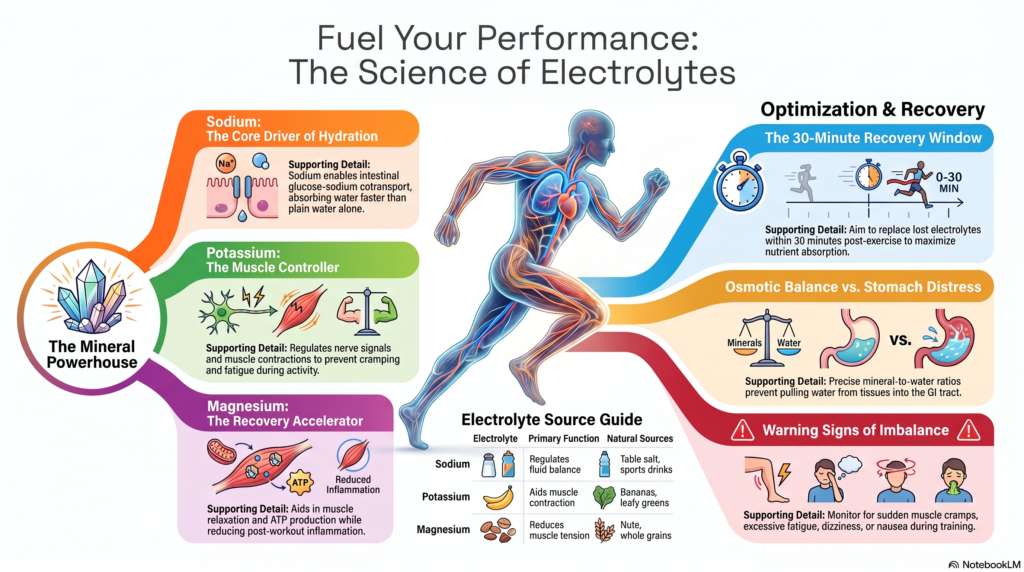
When you’re sweating it out during exercise, key electrolytes like sodium, potassium, and magnesium play important roles in keeping you hydrated and your muscles functioning at their best.
Sodium helps retain fluid in your body, while potassium is essential for muscle contractions.
Magnesium contributes to recovery, making these electrolytes essential for your performance and overall health.
Sodium’s Role In Hydration
Although many athletes focus on fluid intake during activities, sodium plays an important role in maintaining hydration. It helps regulate sodium absorption and guarantees a proper sodium balance in the body. When you sweat, you lose not only water but also sodium, which is crucial for retaining fluids and preventing dehydration. Consuming sodium-rich sports drinks replenishes what you lose and supports peak performance.
| Benefit | Sodium’s Role | Practical Tips |
| Hydration | Maintains fluid balance | Choose drinks with sodium |
| Muscle Function | Aids in contraction | Monitor sweat loss |
| Electrolyte Balance | Prevents cramping | Replenish during activity |
| Recovery | Speeds up recovery | Combine with carbs |
Incorporating sodium into your hydration strategy is key for peak performance.
Potassium For Muscle Function
Potassium is an essential electrolyte that plays an important role in muscle function during athletic activities. It helps regulate muscle contractions and nerve signals, critical for peak performance.
When you exercise, potassium levels can drop, leading to muscle cramps and fatigue. To maintain ideal performance, it’s imperative to consume adequate potassium sources, such as bananas, sweet potatoes, and spinach.
The potassium benefits extend beyond immediate performance; they also support recovery by aiding in fluid balance and reducing muscle soreness. Including potassium-rich foods or sports drinks with electrolytes can help replenish what you lose during intense workouts.
Prioritizing potassium guarantees you’re not just performing, but recovering effectively, keeping you strong and ready for your next challenge.
Magnesium’s Impact On Recovery
Maintaining ideal levels of magnesium is just as important for recovery after intense physical activity. This essential mineral offers numerous magnesium benefits that can enhance your recovery strategies.
Here are four key impacts of magnesium:
- Muscle Relaxation: It helps reduce muscle cramps and tension.
- Energy Production: Magnesium plays an essential role in ATP production, fueling your recovery.
- Inflammation Reduction: It aids in lowering inflammatory markers, speeding up healing.
- Sleep Quality: Good magnesium levels improve sleep, which is critical for recovery.
Incorporating magnesium-rich foods or sports drinks featuring magnesium in functional beverages into your regimen guarantees you harness these benefits.
How Electrolytes Improve Muscle Function and Performance
When you exercise, your body loses essential electrolytes through sweat, which can greatly impact muscle function and performance. Electrolytes are essential minerals that help bring balance to your body. Your cells use electrolytes to conduct electrical charges that keep your internal systems running at peak efficiency.
Electrolytes like sodium, potassium, and calcium are essential for proper muscle contraction. An electrolyte deficiency can lead to muscle cramps, weakness, and a decline in overall performance.
By replenishing these minerals with sports drinks, you support ideal muscle function, ensuring that your muscles contract efficiently and effectively. This is significant whether you’re lifting heavy or sprinting.
Maintaining your electrolyte balance not only enhances your power output but also reduces the risk of fatigue. To achieve peak performance, make sure to hydrate with electrolyte-rich beverages, especially during intense workouts.
Your muscles will thank you, and you’ll feel the difference in your training.
HOW ELECTROLYTES BOOST YOUR ENDURANCE
In food safety and chemical analysis, we evaluate additives not just by their presence, but by their osmotic behavior and ionic bioavailability. It’s easy to look at a nutrition panel, see “sodium” or “potassium,” and assume all formulations behave identically in the stomach, but beverage stability and absorption dynamics are delicate sciences.
Take sodium, for example. In commercial sports drinks, sodium isn’t added just for flavor or basic fluid retention; it operates as the core driver of intestinal glucose-sodium cotransport. This mechanism allows your body to absorb water and carbohydrates significantly faster than plain water can move across the gut wall. However, formulate a drink with too high a mineral concentration (hypertonic solution), and you risk pulling water out of your tissues and into the GI tract, causing acute stomach distress. Keep it too low (hypotonic), and you lose the rapid rehydration advantage.
Similarly, potassium and magnesium play critical roles in modulating cellular membrane potential and ATP conversion, but balancing them in liquid shelf-stable forms is a major engineering hurdle. Magnesium salts, in particular, can alter flavor profiles or precipitate out of solution over time if pH levels aren’t precisely controlled. When you consume a well-engineered electrolyte drink, you are benefiting from a carefully calibrated ratio designed to maintain cellular osmolality under stress. Recognizing these chemical interactions helps athletes avoid under-dosing during prolonged training or over-relying on poorly balanced commercial products.
Electrolytes play an essential role in regulating your hydration, which directly impacts your endurance during exercise. Daily electrolyte and fluid losses occur naturally throughTrusted Source sweat and other waste products. However, certain activities or situations, such as heavy exercise or bouts of diarrhea or vomiting, can increaseTrusted Source the amount of electrolytes you lose and may warrant adding an electrolyte drink to your routine.
By maintaining the balance of fluids in your body, they help prevent dehydration and enhance muscle function.
This means you can perform longer and more effectively, allowing you to push your limits while staying energized.
Hydration Regulation Mechanism
Proper hydration is essential for peak athletic performance, as it directly influences your endurance during intense physical activity.
Understanding hydration mechanisms helps you maintain ideal electrolyte balance, which is vital for sustaining energy levels. Here are four key aspects to take into account:
- Fluid Absorption: Electrolytes enhance your body’s ability to absorb water efficiently.
- Osmotic Regulation: They help regulate fluid movement in and out of cells, maintaining cellular integrity.
- Temperature Control: Proper electrolyte balance aids in thermoregulation, preventing overheating during strenuous workouts.
- Thirst Regulation: Electrolytes signal your brain when to hydrate, ensuring you drink enough fluids.
Muscle Function and Performance
Maintaining an ideal electrolyte balance directly influences muscle function and performance during physical activity. When you’re low on electrolytes, muscle cramps can strike, hindering your endurance and causing frustrating performance plateaus. Electrolytes like sodium, potassium, and magnesium play critical roles in muscle contraction and recovery.
| Electrolyte | Function | Sources |
| Sodium | Regulates fluid balance | Table salt, sports drinks |
| Potassium | Muscle contraction | Bananas, leafy greens |
| Magnesium | Reduces cramps | Nuts, whole grains |
| Calcium | Muscle function | Dairy, fortified foods |
| Chloride | Fluid balance | Table salt, seaweed |
Identifying and Addressing Electrolyte Imbalance
When you engage in intense physical activity, it’s essential to recognize the signs of electrolyte imbalance, as these imbalances can considerably impact your performance and overall health.
An electrolyte deficiency can hinder your abilities, so stay vigilant. Here are key signs to watch for:
- Muscle cramps: Sudden, involuntary contractions may signal low sodium or potassium.
- Fatigue: Excessive tiredness can indicate dehydration and electrolyte loss.
- Dizziness: Feeling lightheaded might mean you’re not properly hydrated.
- Nausea: Gastrointestinal distress can arise from an imbalance.
To combat these issues, implement effective hydration strategies by regularly consuming electrolyte-rich drinks, including vitamin c in juice drinks, before, during, and after workouts.
This proactive approach helps maintain peak performance and overall well-being.
How Replenishing Electrolytes Aids Recovery
Replenishing electrolytes is essential for your recovery after intense exercise, as these important minerals help restore balance in your body and support various physiological functions.
Effective recovery strategies emphasize the importance of electrolyte timing; consuming sports drinks immediately after your workout can greatly enhance your recovery process.
By replenishing sodium, potassium, and magnesium, you help reduce muscle cramps and fatigue while promoting hydration and nutrient absorption. This not only speeds up recovery but also prepares you for your next workout.
Aim to replace lost electrolytes within 30 minutes post-exercise to maximize benefits.
Integrating electrolyte-rich drinks into your routine empowers you to recover faster and perform better, keeping you at the top of your game.
Choosing the Best Sports Drink for Your Needs
Selecting the right sports drink can considerably impact your performance and recovery, especially if you know what to look for. Here are four key factors to take into account:
- Flavor Preferences: Choose a flavor you enjoy; it’ll make hydration more appealing during workouts.
- Sugar Content: Opt for drinks with appropriate sugar levels that align with your energy needs without causing crashes.
- Calorie Considerations: Be mindful of calories to guarantee you’re not overconsuming, especially if weight management is a goal.
- Ingredient Transparency: Look for brands that clearly list their ingredients, fostering trust and confidence in what you’re consuming.
Examining brand reputation and conducting price comparisons can also help you find the best option for your hydration needs and performance goals. Sports drinks are advertised to replenish glucose, fluids, and electrolytes (sodium, potassium, magnesium, calcium) lost during strenuous exercise as well as to enhance endurance. Some brands also contain B vitamins associated with increased energy (not to be confused with energy drinks, which are a different product entirely). Sports drinks contain carbohydrate in the form of sugar (e.g., glucose, high-fructose corn syrup, sucrose) or contain no sugar and are flavored instead with low-calorie sweeteners. The specific amount of sugar and electrolytes in sports drinks is intended to allow for quick hydration and absorption.
RELATED STUDIES ABOUT ELECTROLYTES IN SPORTS DRINKS
Incorporating electrolytes into your hydration routine can greatly enhance your athletic performance and recovery. Research shows that even a 2% decrease in body weight from dehydration can impair performance, making electrolyte balance essential. By choosing the right sports drink, you can guarantee ideal muscle function and endurance. Remember, replenishing electrolytes not only helps you recover faster but also keeps you energized for your next workout. Stay informed and hydrated to maximize your potential on the field or court.
Analysis of the consumption of soft drinks, energy drinks, and sports drinks among adolescents in the Principality of Asturias (BREDA Project)
This cross-sectional study investigated the prevalence and consumption patterns of soft drinks, energy drinks, and sports drinks among 1,250 adolescents (aged 13–18 years) in the Principality of Asturias, Spain, during early 2025. The research also explored the association between these consumption habits and physical activity levels.
Key Findings
- High Prevalence of Consumption: The study found widespread intake of sugar-sweetened beverages:
- Soft drinks: 57.7%
- Sports drinks: 27.2%
- Energy drinks: 11.8%
- Context and Timing: Consumption habits varied by the type of beverage and age group:
- Soft and energy drinks were primarily consumed during leisure time.
- Sports drinks were mainly consumed during or after physical activity.
- Demographic Differences: Regular energy drink consumption was more prevalent among older students (bachillerato), whereas sports drink consumption (both occasional and regular) was more frequent among younger students (ESO).
- Association with Physical Activity: A significant positive association was identified between physical activity levels and the consumption of sports drinks ($P < .001$). Notably, 54.5% of students preferred water during exercise, and 87.6% reported never consuming energy drinks while active, suggesting a base awareness of healthier options.
Conclusion
The widespread consumption of sugar-sweetened beverages among adolescents in Asturias—particularly during leisure and physical activity—indicates a normalization of these drinks within this population. The authors emphasize an urgent need for targeted nutrition literacy strategies to raise awareness regarding the long-term health risks associated with these beverages. Future interventions should focus on empowering adolescents to make informed, healthy choices and potentially involve youth-centered participatory designs to effectively promote healthier lifestyle habits.
| REFERENCE: Judit Cachero-Rodríguez, María del Mar Fernández-Álvarez, Lucia Fernández-Arce, Carla Carrizo-Rodríguez, Cristina Fernández-Rodríguez, Rubén Martin-Payo, Analysis of the consumption of soft drinks, energy drinks, and sports drinks among adolescents in the Principality of Asturias (BREDA Project), Anales de Pediatría (English Edition), Volume 104, Issue 3, 2026, 504139, ISSN 2341-2879, https://doi.org/10.1016/j.anpede.2026.504139. (https://www.sciencedirect.com/science/article/pii/S2341287926000463) |
Development, characterization and stability of a novel sport drink based on thermal water, apple juice and hibiscus
This study explores the development of an innovative isotonic sports beverage (ID) that utilizes thermal water (TW)—typically underutilized in food applications—as a primary source of natural electrolytes. By combining thermal water with natural apple juice (as a carbohydrate source) and hibiscus aqueous extract (as a natural colorant and bioactive source), researchers aimed to surpass traditional formulations that rely on artificial flavors, synthetic dyes, and added minerals.
Key Findings
- Mineral Content: The formulated drink, utilizing thermal water from Chaves, Portugal, naturally provides essential minerals such as sodium (34.99 mg/100 mL) and potassium (73.20 mg/100 mL). This allows for the production of an isotonic drink without the need for exogenous mineral fortification.
- Nutritional and Bioactive Profile: The novel beverage is rich in phenolic compounds, particularly chlorogenic acid ($2.75 \pm 0.10$ mg/100 mL), and possesses high antioxidant activity (472.72 µmol Trolox eq/100 mL). The vibrant red color is naturally derived from hibiscus anthocyanins, such as delphinidin 3-O-sambubioside and cyanidin 3-O-sambubioside.
- Stability: The beverage demonstrated excellent microbiological stability over a 45-day storage period at both 4 °C and 25 °C. While anthocyanin content and redness (a* color parameter) degraded over time—particularly at 25 °C—the overall color change remained within perceptible limits for consumers.
- Sensory Appeal: By replacing artificial additives with natural ingredients like hibiscus and apple juice, the beverage aligns with growing consumer demand for “clean-label,” all-natural products.
Conclusion
The study confirms the feasibility of using thermal water as a foundational ingredient for isotonic sports beverages, offering a sustainable and innovative approach that eliminates the need for synthetic additives. This model successfully combines attractive sensory characteristics with potential health benefits and could serve as a blueprint for other regions rich in thermal spring resources globally.
| REFERENCE: Maroua Fatma Radhouane, Tayse F.F. da Silveira, Jessica Ribeiro, Paula Rodrigues, Rafaela Guimarães, Ricardo Calhelha, Filipa Mandim, Ichrak Charfi, Isabel C.F.R. Ferreira, Maria José Alves, Lillian Barros, Sandrina A. Heleno, Development, characterization and stability of a novel sport drink based on thermal water, apple juice and hibiscus, Food Chemistry Advances, Volume 5, 2024, 100823, ISSN 2772-753X, https://doi.org/10.1016/j.focha.2024.100823. (https://www.sciencedirect.com/science/article/pii/S2772753X24002181) |
Natural alternatives in sports nutrition: Formulation and quality evaluation of an isotonic sports drink using dates of Ajwa variety (Phoenix dactylifera L.)
This study explores the formulation and evaluation of a novel isotonic sports drink using pulp from Ajwa dates (Phoenix dactylifera L.) as a natural alternative to synthetic, chemically-flavored sports beverages.
Key Findings
- Optimal Formulation: Three formulations were tested (ASD1: 20% pulp, ASD2: 25% pulp, and ASD3: 30% pulp). The ASD2 (25% pulp) formulation was selected as the most promising, achieving the highest sensory score (8.2/9 in overall acceptability).
- Physicochemical Suitability: ASD2 maintained an osmolality of 297 \pm 3.17mOsm/kg over 90 days, which falls within the recommended range (270–330 mOsm/kg) for rapid rehydration and absorption. The beverage had an optimal pH of 4.62 \pm 0.12 and provided 34.01 \pm 0.47 kcal/100 g of energy.
- Nutritional and Bioactive Profile:
- The drink successfully replaced artificial sugars with natural date sugars (glucose, sucrose, and fructose).
- It provided significant levels of essential minerals, specifically potassium (930 \pm 3.28 mg/L) and sodium (269 \pm 1.76 mg/L), which are critical for electrolyte balance during exercise.
- The product retained high antioxidant capacity, with total phenolic content ranging between 2.5 and 3.0 g/kg gallic acid equivalent.
- Microbiological Safety: Throughout a 90-day storage study, the formulation remained microbiologically safe, with no detected coliforms, salmonella, or molds.
- Market Potential: The Ajwa date-based sports drink compares favorably to commercial brands like Gatorade® and Powerade® in potassium content and energy profile, offering a “clean-label” alternative free from synthetic dyes and artificial flavors.
Conclusion
The ASD2 formulation provides a functional, stable, and highly palatable natural sports drink. By harnessing the bioactive and electrolyte-rich profile of Ajwa dates, this research offers a sustainable, plant-based innovation for the sports nutrition industry, meeting the growing consumer demand for minimally processed, health-conscious products.
| REFERENCE: Md. Shahidullah Kayshar, Juwel Rana, Md. Shoaib Arifin, Amirul Islam, Md. Mahfuzur Rob, Zannatul Ferdoush, Md. Anisur Rahman Mazumder, Md. Fahad Jubayer, Natural alternatives in sports nutrition: Formulation and quality evaluation of an isotonic sports drink using dates of Ajwa variety (Phoenix dactylifera L.), Applied Food Research, Volume 4, Issue 2, 2024, 100618, ISSN 2772-5022, https://doi.org/10.1016/j.afres.2024.100618. (https://www.sciencedirect.com/science/article/pii/S2772502224002282) |
CONCLUSION
As someone whose daily work revolves around evaluating safety thresholds, active ingredient stability, and label accuracy, my overarching goal is to strip away the industry hype and restore consumer trust through clear, evidence-based education. The functional beverage market is flooded with bright dyes, proprietary blends, and aggressive claims, making it difficult for the average person to discern what their body actually needs.
The data from both clinical settings and recent food science literature tells a clear story: electrolytes are vital tools for recovery and sustained athletic output, but their utility depends entirely on context, dosage, and individual demand. You don’t need a heavy-sodium isotonic beverage for every trip to the gym, just as you shouldn’t rely solely on plain water during a three-hour endurance run in hot weather. Whether you opt for a standard commercial sports drink, a natural alternative like coconut water or date-based formulations, or a simple powder mix, what matters most is matching the mineral profile to your actual fluid losses.
Empowering yourself with a basic understanding of how these chemical salts function allows you to make smart, cost-effective decisions for your health. Hydration shouldn’t be about following trends or buying into catchy slogans; it’s about giving your body the exact biochemical support it requires to perform, recover, and stay in balance.