

Having spent over a decade working at the intersection of veterinary pharmacology and equine care, I’ve seen firsthand how crucial effective pain management is to a horse’s long-term health and spirit. Early in my career, managing chronic pain or post-surgical inflammation meant relying heavily on broad-spectrum, non-selective NSAIDs like phenylbutazone (‘bute’) or flunixin meglumine. While these traditional drugs certainly have their place and get the job done, they often came with a heavy cost to the animal’s digestive system gastrointestinal ulcers, right dorsal colitis, and renal toxicity were constant worries during long-term management.
That’s why the development and clinical refinement of second-generation COX-2 selective inhibitors, like firocoxib, represent such a significant turning point in equine medicine. From both a scientific and practical perspective, firocoxib offers a targeted mechanism that directly addresses inflammation where it hurts without indiscriminately shutting down the protective baseline functions of the GI tract and kidneys.
Whether I’m consulting on performance horses suffering from joint stiffness or helping owners navigate the long-term management of equine osteoarthritis, understanding how this active ingredient operates allows us to craft therapeutic protocols that prioritize both performance and long-term well-being.
Firocoxib is a COX-2 selective NSAID specifically designed for horses, prioritizing pain relief and inflammation control while minimizing gastrointestinal side effects common with traditional NSAIDs. It effectively inhibits the COX-2 enzyme, allowing for lower, once-daily dosing that simplifies care. While it has a favorable safety profile, monitoring is essential to manage potential side effects. Understanding its proper usage and benefits can enhance your horse’s quality of life, guiding you through the complexities of administration and vigilance.
KEY TAKEAWAYS
- Firocoxib is a COX-2 selective NSAID specifically formulated for horses, providing effective pain relief and reducing inflammation.
- Its selectivity minimizes gastrointestinal side effects compared to traditional non-selective NSAIDs, enhancing equine health.
- The recommended dosage is 0.1 mg/kg body weight, given once daily, allowing for simplified administration.
- Monitoring horse conditions, including mobility and behavior, is essential to evaluate the effectiveness and safety of firocoxib treatment.
- Regular veterinary consultations and detailed recordkeeping help identify any adverse reactions and ensure optimal management of treatment.
WHAT IS FIROCOXIB AND HOW DOES IT WORK?
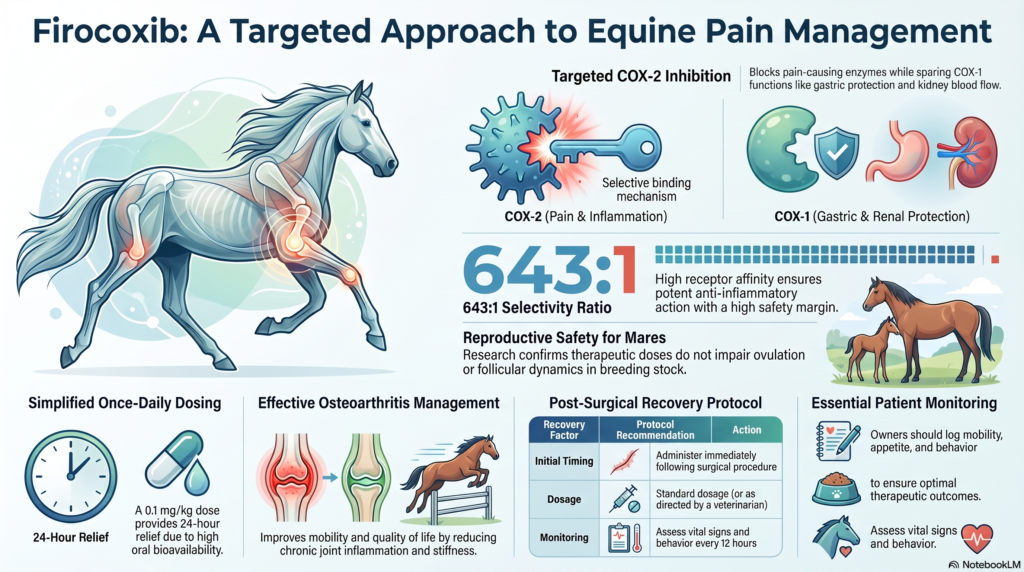
Firocoxib is a non-steroidal anti-inflammatory drug (NSAID) specifically designed for horses, working by selectively inhibiting the cyclooxygenase-2 (COX-2) enzyme. EQUIOXX selectively blocks the COX-2 isoenzyme which is the form that generates the prostaglandins mostly responsible for pain and inflammation. Yet it spares cyclooxygenase 1-isoenzyme (COX-1), which helps maintain normal body functions such as coagulation, gastric mucosal protection and blood flow to the kidneys.
This targeted firocoxib mechanism allows for effective pain relief and inflammation control while minimizing gastrointestinal side effects often associated with non-selective NSAIDs.
By inhibiting COX-2, firocoxib disrupts the production of prostaglandins that mediate pain and inflammation, providing a potent analgesic effect. As the active ingredient, firocoxib delivers targeted anti-inflammatory action while helping minimize gastrointestinal side effects associated with non-selective NSAIDs.
This selective inhibition is essential for maintaining equine health, especially in performance horses requiring peak physical condition.
You’ll appreciate how firocoxib’s precise action not only alleviates discomfort but also promotes recovery, allowing your horse to perform at its best.
Understanding this mechanism empowers you to make informed decisions regarding equine health management.
How Does Firocoxib Compare to Other NSAIDs?
When considering firocoxib for horses, it’s essential to evaluate its efficacy compared to traditional NSAIDs. Equioxx is often considered to be the preferred NSAID in the treatment of fever and pain in sick foals because there are fewer side effects compared to other NSAIDs. Equioxx® is typically well tolerated in horses and is an option for long-term pain relief when used as directed by your veterinarian.
You’ll also want to assess its side effects and overall safety profile, as these factors play a significant role in treatment decisions.
Understanding these comparisons will help you make informed choices for your horse’s pain management.
Efficacy Compared To Traditional NSAIDs
While traditional NSAIDs like phenylbutazone and flunixin meglumine have been staples in equine pain management, recent studies reveal that firocoxib offers distinct advantages. Non-steroidal anti-inflammatory drugs, or NSAIDs, are a type of medication administered to horses for various conditions. Veterinarians typically prescribe NSAIDs for soft tissue and musculoskeletal injuries, as well as for abdominal inflammation and pain.
Its COX-2 selectivity translates to effective pain relief with reduced gastrointestinal side effects, which is essential for maintaining equine health.
When considering firocoxib dosage, it’s often administered at a lower frequency compared to traditional NSAIDs, enhancing compliance and convenience.
This targeted action minimizes unwanted side effects while still delivering potent anti-inflammatory benefits. While veterinary medications serve different purposes, treatments such as fenbendazole for dogs are commonly used to manage parasitic infections, whereas firocoxib is specifically formulated to control pain and inflammation in horses.
As you evaluate treatment options for your horse, firocoxib stands out as a powerful alternative, offering a balance of efficacy and safety that may surpass conventional NSAIDs in specific cases.
Make informed decisions to optimize your horse’s performance and well-being.
Side Effects And Safety Profile
Although many non-steroidal anti-inflammatory drugs (NSAIDs) are effective in managing pain in horses, their side effects can vary considerably.
Firocoxib, as a COX-2 selective NSAID, presents a favorable safety profile compared to traditional NSAIDs. It’s vital to engage in diligent monitoring of side effects, as gastrointestinal issues and renal impairment can occur, albeit less frequently than with non-selective options.
When evaluating safety, consider individual horse health factors, including age and pre-existing conditions. This tailored approach guarantees ideal use of firocoxib while minimizing potential adverse effects.
By understanding these dynamics, you empower yourself to make informed decisions that enhance your horse’s well-being while effectively managing pain.
Firocoxib stands out for its targeted action, offering a strategic advantage in equine analgesia.
Benefits of Using Firocoxib for Horses
Firocoxib offers significant advantages for managing pain and inflammation in horses, particularly in cases of osteoarthritis and soft tissue injuries.
As a COX-2 selective inhibitor, it targets the inflammatory pathways responsible for pain without compromising gastrointestinal integrity, unlike traditional NSAIDs. This mechanism provides effective pain relief, enhancing your horse’s mobility and overall quality of life.
Firocoxib’s prolonged action allows for once-daily dosing, simplifying your administration routine and ensuring consistent equine health management.
In addition, its safety profile enables you to use it with confidence, minimizing the risk of adverse effects.
When prioritizing your horse’s wellbeing, choosing Firocoxib can empower you to optimize their performance and recovery, fostering a proactive approach to equine health.

BEST CONDITIONS FOR ADMINISTERING FIROCOXIB TO HORSES
In clinical practice and pharmacology research, the true value of a medication lies not just in its mechanism on paper, but in its daily practicality and safety profile under real-world conditions. What I find particularly compelling about firocoxib is its unique pharmacokinetic profile. With a high oral bioavailability exceeding 80% and a long terminal half-life of roughly two days, it allows for a simplified, once-daily dosing regimen of 0.1 mg/kg. Anyone who has managed a busy barn or tried administering daily treatments to an anxious horse knows that once-daily compliance is a major win for stress reduction for both the animal and the caregiver.
Furthermore, from a reproductive safety standpoint, firocoxib provides peace of mind that older generations of NSAIDs simply couldn’t. Recent clinical research shows that even at supratherapeutic doses during periovulatory periods, firocoxib does not disrupt follicular dynamics or ovulation in mares.
This means we can manage joint pain and systemic inflammation in breeding stock without worrying about compromising reproductive performance. That said, targeted safety doesn’t mean zero risk; monitoring hydration, kidney markers, and subtle behavioral shifts remains essential to ensuring the best outcomes.
When considering firocoxib for your horse, administering it post-surgery can greatly aid in pain management.
Additionally, this medication is effective for alleviating symptoms associated with osteoarthritis.
Understanding these ideal conditions will enhance your horse’s recovery and overall well-being.
Pain Management After Surgery
Administering Firocoxib effectively for pain management after surgery requires careful consideration of specific conditions to optimize its benefits. Proper pain assessment is essential during the post-surgical recovery phase. You should monitor your horse’s important signs and behavior to evaluate pain levels accurately. Administer Firocoxib based on the recommended dosage and schedule to maintain effective pain control.
| Condition | Recommendation |
| Timing of Administration | Immediately after surgery |
| Dosage | Per veterinarian’s advice |
| Monitoring Frequency | Every 12 hours |
| Duration of Treatment | As prescribed |
| Signs of Pain to Watch For | Restlessness, sweating |
These steps will guarantee a more comfortable recovery, promoting healing and overall well-being.
Osteoarthritis Symptom Relief
To effectively relieve osteoarthritis symptoms in horses, it’s vital to recognize the best conditions for administering Firocoxib.
Ideal osteoarthritis management hinges on several factors:
- Dosage: Administer the correct dosage based on the horse’s weight and severity of symptoms.
- Timing: Give Firocoxib during inflammation spikes to enhance its efficacy.
- Environment: Guarantee a comfortable, stress-free environment to promote joint health.
- Diet: Incorporate joint-supporting nutrients to complement Firocoxib’s effects.
When utilized under these conditions, Firocoxib can greatly reduce pain and improve mobility in horses suffering from osteoarthritis.
Monitoring your horse’s response and adjusting the treatment plan accordingly is vital for achieving ideal joint health and enhancing their quality of life.
Firocoxib Dosage for Horses
Understanding the appropriate firocoxib dosage for horses is essential for effective pain management and inflammation control.
The firocoxib administration guidelines recommend an initial dosage of 0.1 mg/kg body weight, administered once daily. However, individual responses may vary, necessitating firocoxib dosage adjustments.
Monitor your horse’s condition closely to determine if a higher or lower dose is required, particularly in cases of chronic pain or specific health considerations.
Always consult your veterinarian before making any changes to guarantee ideal outcomes.
Accurate dosing not only enhances therapeutic efficacy but also minimizes potential risks.
Adhering to these protocols empowers you to achieve superior results in managing your horse’s health and well-being.
What Are the Side Effects of Firocoxib?
While firocoxib is effective for managing pain and inflammation in horses, it’s important to be aware of potential side effects that can arise from its use.
Understanding these effects can help you make informed decisions regarding firocoxib interactions and firocoxib alternatives.
Key side effects include:
- Gastrointestinal upset, such as colic or diarrhea
- Kidney dysfunction, particularly in dehydrated horses
- Liver enzyme elevations, indicating potential liver stress
- Allergic reactions, which may manifest as hives or swelling
Being vigilant about these side effects guarantees you can act swiftly if adverse reactions occur.
Always consult with your veterinarian to weigh the benefits against potential risks and explore viable alternatives if necessary. Keep in mind that medications have species-specific uses, and treatments such as fenbendazole for cats are intended for parasite control rather than pain and inflammation management in horses.
Your horse’s health and performance depend on it.
How Can You Monitor Your Horse While Using Firocoxib?
How can you effectively monitor your horse during firocoxib treatment?
Start by closely observing mobility. Note any changes in gait, stiffness, or reluctance to move, as these can indicate how well the medication is working.
Assess your horse’s overall behavior; increased restlessness or signs of discomfort may warrant further evaluation.
Regularly check essential signs, including heart rate and temperature, to identify any adverse reactions early.
Maintain a detailed log of your observations, documenting both positive and negative changes.
Incorporating routine veterinary consultations can enhance your monitoring efforts, ensuring any complications are addressed promptly.

RELATED STUDIES ABOUT FIROCOXIB FOR HORSES
In summary, firocoxib stands out as a reliable cox-2 selective NSAID for horses, offering targeted pain relief and inflammation control. When you weigh its benefits against other options, firocoxib often proves to be the go-to choice for various equine conditions. By monitoring your horse’s response and adhering to proper dosage guidelines, you can guarantee optimal results. Remember, keeping your horse comfortable is just as important as a knight’s armor in battle—essential for peak performance and wellbeing.
Synopsis of the pharmacokinetics, pharmacodynamics, applications, and safety of firocoxib in horses
Firocoxib (FX) is a second-generation coxib that functions as a highly selective COX-2 inhibitor in horses. By sparing COX-1, Executive FX offers a potentially safer alternative to traditional non-selective NSAIDs, which are associated with risks such as gastric mucosal irritation and renal impairment.
Clinical Applications and Licensing
- Approval: FX is licensed for treating musculoskeletal pain and lameness associated with osteoarthritis (OA) in horses over one year of age.
- Formulations: It is available as an injectable formulation for intravenous (IV) administration ($0.09\text{ mg/kg}$ for five days) and as an oral paste formulation ($0.1\text{ mg/kg}$ for 14 days).
- Loading Dose: Due to its long elimination half-life, a single $0.3\text{ mg/kg}$ loading dose is recommended to establish steady-state concentrations within 24 hours, making it suitable for acute pain management.
Pharmacokinetics and Pharmacodynamics
- Absorption and Distribution: FX is well-absorbed in horses, with an oral bioavailability typically exceeding 80%. It has a volume of distribution of approximately $2\text{ L/kg}$ and exhibits high plasma protein binding (~97%).
- Metabolism and Elimination: The drug undergoes hepatic biotransformation (primarily via dealkylation) and is slowly eliminated, with a terminal half-life of approximately two days. Excretion is predominantly renal.
- Selectivity: With a COX-1/COX-2 $IC_{50}$ ratio of 643, FX demonstrates high selectivity for COX-2. Its $EC_{50}$ of $27\text{ ng/mL}$ indicates it has the highest affinity for its receptor compared to other commonly used equine NSAIDs.
- Neonatal Differences: Pharmacokinetics in foals differ significantly from adults, characterized by faster clearance and a shorter terminal half-life.
Safety and Regulatory Considerations
- Safety Profile: When administered at recommended doses, FX is well-tolerated and demonstrates a high safety margin. Unlike non-selective NSAIDs, it is not associated with gastric ulceration following prolonged administration.
- Regulatory Status: The use of FX in performance horses is regulated to ensure compliance with threshold concentrations for drug testing.
- Drug Interactions: Co-administration with other NSAIDs or corticosteroids is not recommended, as it may impair the benefits of COX-2 selectivity and increase the risk of adverse effects.
| REFERENCE: Charbel Fadel, Mario Giorgi, Synopsis of the pharmacokinetics, pharmacodynamics, applications, and safety of firocoxib in horses, Veterinary and Animal Science, Volume 19, 2023, 100286, ISSN 2451-943X, https://doi.org/10.1016/j.vas.2023.100286. (https://www.sciencedirect.com/science/article/pii/S2451943X23000030) |
Periovulatory administration of therapeutic and supratherapeutic doses of firocoxib does not impair induced ovulation or follicular dynamics in mares treated with a GnRH analogue
This study evaluated whether the administration of therapeutic and supratherapeutic doses of firocoxib during the periovulatory period affects ovulation or follicular dynamics in mares.
Study Overview
- Objective: To determine if firocoxib—a selective COX-2 inhibitor—impairs the ovulation process or preovulatory follicular development when administered to mares induced to ovulate with a GnRH analogue.
- Methodology: Seventy cycling mares were randomly assigned to one of three groups:
- Firocoxib at 0.1 mg/kg (therapeutic dose).
- Firocoxib at 0.3 mg/kg (supratherapeutic dose).
- An untreated control group.
- Protocol: Treatments were administered intravenously on Day 0 (day of GnRH induction) and Day 1. Ovarian structures were monitored via transrectal ultrasonography from Day 0 through Day 4.
Key Findings
- Ovulation Integrity: All mares in all groups ovulated within 72 hours of induction. No instances of ovulatory failure or hemorrhagic anovulatory follicles were reported.
- Follicular Dynamics: There were no significant differences among the groups regarding dominant follicle diameter or the rate of follicular growth between Day 0 and Day 1.
- Safety Conclusion: Periovulatory administration of firocoxib, even at doses higher than the therapeutic recommendation, did not impair induced ovulation or follicular development.
Clinical Implications
Unlike non-selective NSAIDs—which have been shown to potentially block ovulation in mares—the high selectivity of firocoxib for the COX-2 enzyme appears to preserve essential physiological functions, such as ovulation. These findings suggest that firocoxib can be safely used during periovulatory reproductive management protocols in mares without negatively impacting ovulatory timing or follicular health.
| REFERENCE: L.G. Faria, B.M. Zutter, C.P. Freitas-Dell’Aqua, B.L. Camillo, O.S. Ávila-Júnior, F.S. Bassetti, L.C. Marcolino, M.A. Alvarenga, Periovulatory administration of therapeutic and supratherapeutic doses of firocoxib does not impair induced ovulation or follicular dynamics in mares treated with a GnRH analogue, Journal of Equine Veterinary Science, Volume 161, 2026, 105878, ISSN 0737-0806, https://doi.org/10.1016/j.jevs.2026.105878. (https://www.sciencedirect.com/science/article/pii/S0737080626001140) |
Effects of Flunixin Meglumine, Firocoxib, and Meloxicam in Equines After Castration
This study evaluated and compared the clinical efficacy and safety of three nonsteroidal anti-inflammatory drugs (NSAIDs)—flunixin meglumine (FM), firocoxib (FX), and meloxicam (MX)—in controlling pain and inflammation following open castration in horses.
Study Overview
- Objective: To compare the efficacy of FM, FX, and MX in managing postoperative pain and inflammation in horses undergoing open castration.
- Methodology: Thirty healthy stallions were randomly divided into three groups ($n=10$ per group) and treated intravenously once daily for 5 days post-surgery with one of the following:
- Group I (GI): Flunixin meglumine (1.1 mg/kg).
- Group II (GII): Firocoxib (0.1 mg/kg).
- Group III (GIII): Meloxicam (0.6 mg/kg).
- Evaluations: Researchers assessed clinical, behavioral, and hematological parameters, along with peritoneal fluid (PF) analysis, before surgery and at 1, 2, 3, 5, and 7 days post-castration.
Key Findings
- Pain and Inflammation Control: All three drugs were found to be effective in controlling pain; none of the study animals required analgesic rescue.
- Clinical Observations: Horses in the FX and MX groups exhibited higher incidences of pelvic limb rigidity and significant prepuce edema compared to the FM group. Tachycardia was observed in the FX and MX groups, and hyperthermia was noted specifically in the MX group.
- Laboratory Results: All groups showed increases in leukocytes, neutrophils, monocytes, and fibrinogen levels following surgery, consistent with the expected inflammatory response to surgical trauma.
- Peritoneal Fluid: Surgery triggered an abdominal inflammatory process in all groups, evidenced by changes in the color and turbidity of the peritoneal fluid and increased protein concentration. While PF markers fluctuated, the FM group showed a faster return to normal color compared to the FX and MX groups.
Conclusions
The study concluded that while FM, FX, and MX are equally effective at controlling pain and inflammation after castration, flunixin meglumine (FM) provided more advantageous results regarding the control of local edema and body temperature.
| REFERENCE: Francielli Pereira Gobbi, Paula Alessandra Di Filippo, Luciana de Macêdo Mello, Gabriela Bravim Lemos, Carla Braga Martins, Antônio Peixoto Albernaz, Celia Raquel Quirino, Effects of Flunixin Meglumine, Firocoxib, and Meloxicam in Equines After Castration, Journal of Equine Veterinary Science, Volume 94, 2020, 103229, ISSN 0737-0806, https://doi.org/10.1016/j.jevs.2020.103229. (https://www.sciencedirect.com/science/article/pii/S0737080620303208) |
CONCLUSION
Ultimately, our goal in equine pharmacology is to give horses the highest quality of life possible while supporting their physical demands whether they are competing at a high level, recovering from routine surgery, or simply enjoying their retirement years in the pasture.
Firocoxib isn’t a magical cure-all, but it is one of the most sophisticated tools we currently have in our analgesic arsenal, bridging the gap between potent anti-inflammatory relief and gastrointestinal safety. When using firocoxib, I always remind horse owners and equine professionals that scientific precision must go hand in hand with diligent observation.
Keep detailed logs of your horse’s mobility, appetite, and attitude, and maintain an open line of communication with your veterinarian. By pairing sound clinical science with attentive, daily husbandry, we can use advanced ingredients like firocoxib to keep our horses comfortable, sound, and thriving for years to come.