
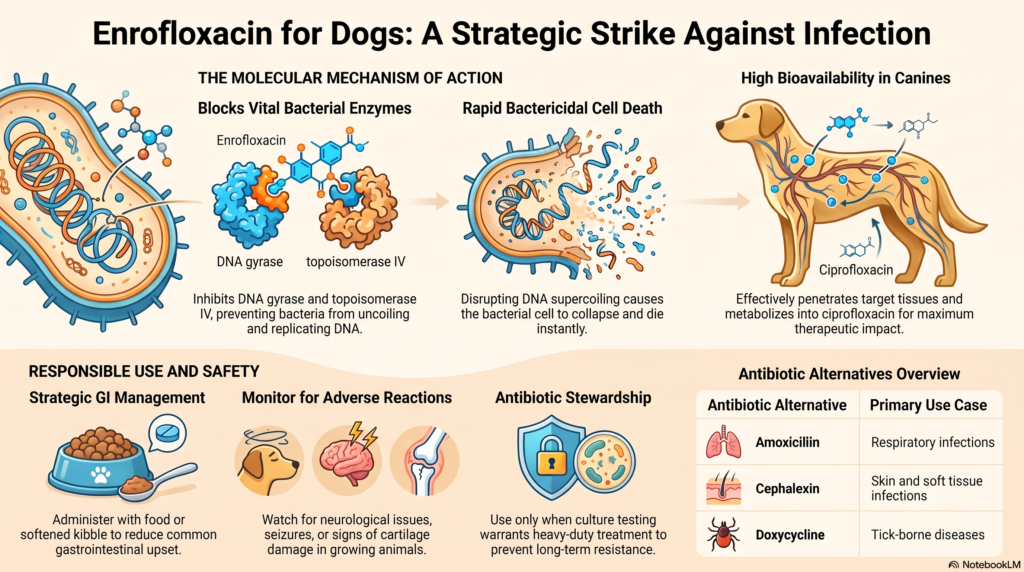
When evaluating active pharmaceutical ingredients for canine therapy, enrofloxacin stands out as a core antimicrobial agent in modern veterinary practice. From my research perspective in animal science and clinical consulting, the true clinical value of a fluoroquinolone isn’t just that it kills bacteria, it’s how efficiently it penetrates target tissues and disrupts bacterial replication at the cellular level. Enrofloxacin acts as a bactericidal power tool by directly inhibiting bacterial DNA gyrase and topoisomerase IV, two enzymes absolutely vital for uncoiling and replicating bacterial DNA.
When you block these enzymes, supercoiling fails, replication halts instantly, and the cell collapses. However, translating raw pharmacological mechanics into real-world outcomes requires careful oversight. Pet owners often hear “antibiotic” and assume all treatments work similarly, but fluoroquinolones occupy a specific, heavy-duty tier in antimicrobial stewardship.
Understanding its precise mechanism gives us the perspective needed to use it responsibly rather than relying on it as a broad safety net for every minor issue. As we dive into how this active ingredient functions in dogs, it is essential to look closely at both its pharmacological strengths and the practical considerations necessary to protect long-term animal health.
Enrofloxacin is a fluoroquinolone antibiotic that works by inhibiting bacterial DNA synthesis. It targets DNA gyrase and topoisomerase IV, essential for bacterial replication, disrupting the DNA supercoiling necessary for their growth. This leads to impaired replication and ultimately bacterial cell death. By doing so, it enhances your dog’s immune response against infections. To understand potential risks and alternatives, you might want to explore further insights.
KEY TAKEAWAYS
- Enrofloxacin is a fluoroquinolone that inhibits bacterial DNA gyrase and topoisomerase IV, critical for bacterial replication.
- It disrupts DNA supercoiling, leading to impaired bacterial replication and cell death.
- The broad-spectrum activity of enrofloxacin targets various pathogens, enhancing treatment efficacy.
- It allows the dog’s immune system to regain control over infections through effective bacterial suppression.
- Enrofloxacin minimizes the risk of resistance while maximizing therapeutic effectiveness in canine infections.
ENROFLOXACIN: COMMON USES IN DOGS
Enrofloxacin is commonly used in dogs to treat a variety of bacterial infections, particularly those affecting the urinary tract, skin, and respiratory system. Its use in dogs and cats to treat certain infections and its use in small mammals, birds, and reptiles is “off label” or “extra label”. Many drugs are commonly prescribed for off-label use in veterinary medicine. In these instances, follow your veterinarian’s directions and cautions very carefully, as their directions may be significantly different from those on the label.
Its effectiveness stems from its ability to inhibit bacterial DNA gyrase and topoisomerase IV, essential enzymes for bacterial replication. This action makes it a formidable choice against pathogens like E. coli and Staphylococcus spp., ensuring rapid recovery and enhancing canine health.
You’ll appreciate its broad-spectrum activity, which translates to a lower risk of treatment failure and the need for additional antibiotics.
Administering enrofloxacin effectively requires adherence to prescribed dosages and duration, as misuse can lead to resistance.
This potent antimicrobial agent empowers you to safeguard your dog’s well-being while tackling stubborn infections head-on.
What Is Enrofloxacin and How Does It Work?
This veterinary medication belongs to the fluoroquinolone class of antibiotics and is designed specifically for canine use. Enrofloxacin provides significant benefits for treating bacterial infections in dogs, including:
- Rapid action against various pathogens.
- Broad-spectrum efficacy, targeting multiple bacteria.
- Enhanced bioavailability, ensuring effective drug levels.
- Reduced treatment duration compared to other antibiotics.
However, it’s essential to be aware of potential Enrofloxacin resistance, which can arise from improper usage or overprescription.
This resistance can diminish the drug’s effectiveness, leading to persistent infections and treatment failures.
Understanding Enrofloxacin’s role and the importance of responsible use empowers you to make informed decisions for your dog’s health, ensuring they receive ideal care while minimizing the risk of resistance.
The Mechanism of Action: Inhibiting Bacterial DNA Synthesis
When bacteria invade a dog’s body, they rely on DNA synthesis for growth and reproduction, which is where enrofloxacin comes into play.
This fluoroquinolone antibiotic targets bacterial DNA gyrase, an essential enzyme required for DNA replication. As the active ingredient, enrofloxacin binds to these bacterial enzymes, preventing DNA replication and ultimately leading to bacterial cell death. By inhibiting DNA gyrase, enrofloxacin effectively disrupts the supercoiling process necessary for bacterial DNA to replicate.
Without this critical function, bacterial replication falters, leading to cell death. Enrofloxacin’s mechanism guarantees that harmful bacteria can’t proliferate, allowing your dog’s immune system to regain control.
This targeted approach not only minimizes the risk of resistance but also maximizes therapeutic efficacy, making enrofloxacin a powerful ally in treating bacterial infections.
Essentially, it’s a strategic strike against the pathogens threatening your dog’s health.
Enrofloxacin Dosage and Administration
Proper dosage and administration of enrofloxacin are vital to guarantee its effectiveness while minimizing potential side effects. Enrofloxacin is an antibiotic used to treat bacterial infections in dogs. Enrofloxacin works by preventing bacterial reproduction, causing the harmful bacteria to die. Antibiotics can be divided into classes based on their characteristics. Enrofloxacin belongs to a medication class known as fluoroquinolones. These antibiotics interfere with the DNA inside the bacteria, resulting in bacterial death.
To harness the full power of this antibiotic, adhere to these enrofloxacin administration guidelines:
- Consult a veterinarian for tailored enrofloxacin dosage recommendations based on your dog’s weight and health status.
- Administer with food to enhance absorption and reduce gastrointestinal upset.
- Follow the prescribed schedule—consistency is essential for ideal therapeutic outcomes.
- Monitor your dog closely for any changes in behavior or health, ensuring swift action if issues arise.
Understanding and implementing these guidelines empowers you to effectively combat bacterial infections in your dog, enhancing their health and well-being.
What Are the Risks and Side Effects of Enrofloxacin?
While enrofloxacin is an effective antibiotic for treating bacterial infections in dogs, it’s vital to be aware of its potential risks and side effects. Enrofloxacin is a fluoroquinolone antibiotic, which has proven to be highly effective against a wide range of bacterial types. This includes some of the more difficult to treat infections. Enrofloxacin prevents bacterial cells from replicating and rapidly causes cell death.
Common side effects include gastrointestinal upset, such as nausea or diarrhea, and neurological issues, like seizures or changes in behavior.
Risk factors that heighten the likelihood of adverse reactions involve pre-existing conditions, such as kidney or liver disease, and concurrent medications that may interact negatively.
You should monitor your dog closely during treatment, looking for signs of serious reactions, such as difficulty breathing or severe lethargy.
KEY FACTORS TO CONSIDER BEFORE ADMINISTERING ENROFLOXACIN
In clinical research and field practice, how a drug behaves on paper doesn’t always equal seamless administration at home. Enrofloxacin offers excellent bioavailability, but achieving therapeutic concentrations without upsetting a dog’s gastrointestinal tract requires careful planning. In practice, I often advise pet owners who struggle with GI upset to offer the medication with a small meal. If a dog is particularly nauseous or reluctant to take pills, simple home strategies like softening kibble in warm water for 10 to 15 minutes to enhance aroma, or mixing the dose with plain, boiled chicken and rice can make a massive difference in maintaining compliance without compromising digestion.
Beyond basic administration, we must address the broader picture of drug selection and sensitivity. Enrofloxacin metabolizes into ciprofloxacin within the body, making it significantly more bioavailable for dogs when administered orally compared to human-labeled ciprofloxacin.
However, because fluoroquinolones are concentration-dependent and carry potential risks such as cartilage damage in growing animals or neurotoxicity at higher doses they shouldn’t automatically be our first choice unless culture and sensitivity testing specifically warrants them. Responsible veterinary care means balancing the immediate need to eradicate stubborn pathogens with long-term stewardship to prevent resistance.
What should you consider before giving your dog enrofloxacin? Ensuring your dog’s health is paramount, so take these key factors into account:
- Veterinary Consultation: Always consult your veterinarian before starting enrofloxacin to confirm it’s appropriate for your dog’s condition.
- Health History: Evaluate your dog’s medical history; certain conditions may increase risks.
- Safety Precautions: Be aware of potential side effects, such as gastrointestinal upset or neurological issues, and monitor your dog closely.
- Dosage Accuracy: Follow the prescribed dosage precisely; improper dosing can lead to ineffective treatment or adverse reactions.
Alternatives to Enrofloxacin for Treating Canine Infections
When considering alternatives to enrofloxacin for treating canine infections, it’s crucial to evaluate other antibiotic options that may be effective.
Additionally, you should explore natural remedies that could support your dog’s recovery.
Understanding these alternatives allows for informed decisions that align with your dog’s specific health needs.
Alternative Antibiotics Overview
As veterinarians increasingly recognize the need for effective alternatives to enrofloxacin, several antibiotics have emerged as viable options for treating canine infections.
These alternatives can help combat the growing issue of antibiotic resistance while maintaining efficacy.
Consider these significant alternatives:
- Amoxicillin – Broad-spectrum activity, often used for respiratory infections.
- Cephalexin – Effective against skin and soft tissue infections.
- Clindamycin – Primarily targets anaerobic bacteria, suitable for dental infections.
- Doxycycline – A natural antibiotic option, effective against tick-borne diseases.
Each of these antibiotics offers unique benefits, enabling you to tailor treatment to your dog’s specific needs. It’s also important to recognize that medications such as fenbendazole for cats are intended for treating parasitic infections and are not substitutes for antibiotics used to manage bacterial infections in dogs.
Understanding these alternatives is essential for responsible antibiotic stewardship and ensuring your canine companion receives ideal care.
Natural Remedies Consideration
While conventional antibiotics like enrofloxacin play a vital role in treating canine infections, exploring natural remedies can also offer effective alternatives.
Herbal treatments, such as turmeric and oregano oil, possess antimicrobial properties that may combat bacterial infections. These natural agents can enhance your dog’s immune response while minimizing adverse effects associated with synthetic drugs.
Additionally, home remedies like apple cider vinegar and coconut oil can serve as supportive therapies, promoting overall health and well-being.
However, it’s essential to consult with a veterinarian before implementing these alternatives to guarantee safety and efficacy. Similarly, medications such as firocoxib for horses are prescribed for managing pain and inflammation in equine patients and are not appropriate alternatives for treating bacterial infections in dogs. Relying solely on natural remedies without professional guidance may lead to inadequate treatment or complications.
Empower your decision-making by integrating both conventional and natural approaches for peak canine health.
RELATED STUDIES ABOUT ENROFLOXACIN FOR DOGS
In conclusion, while enrofloxacin offers a powerful solution against bacterial infections in dogs, it’s essential to weigh the benefits against potential risks. As you consider its use, remember that the stakes are high; the wrong decision could lead to unforeseen consequences. Stay informed and vigilant about your dog’s health, as the path to recovery can be fraught with challenges. Will you choose the right treatment for your loyal companion, or will uncertainty lead you astray?
Assessment of seasonality in antimicrobial susceptibility testing and resistance of urinary Escherichia coli from dogs and cats in the United States (2019 – 2022)
This study analyzed the seasonality of antimicrobial susceptibility testing (AST) and antimicrobial resistance (AMR) in urinary Escherichia coli isolates from dogs and cats in the United States between January 2019 and December 2022.
Key Findings
- Study Scope: The analysis included 344,862 urinary E. coli isolates, with 74.2% originating from dogs and 25.8% from cats.
- AST Trends:
- An increasing trend in the frequency of AST was observed for both species throughout the study period.
- A distinct seasonal pattern in AST was identified, with testing peaking during the summer months (June, July, and August) and reaching its lowest frequency in February and April.
- When adjusted for pet population, the marine climatic zone recorded the highest AST rate, while the hot-humid and mixed-humid zones had the lowest.
- AMR Patterns:
- No seasonal pattern in AMR was detected at either the national or regional levels.
- Amoxicillin exhibited the highest resistance rates for both dogs (27.9%) and cats (28.4%).
- While resistance rates significantly declined for all tested drugs in dogs, significant declines in cats were observed only for cefovecin, marbofloxacin, and enrofloxacin.
- AMR rates varied significantly by climatic zone, with the hot-humid zone showing the highest resistance rates for the antimicrobials tested.
Conclusion
The observed seasonality in AST suggests that urinary tract infections (UTIs) in dogs and cats may follow predictable seasonal patterns, potentially linked to environmental factors. However, the study found no evidence of a corresponding seasonal pattern in AMR. The significant regional variability in resistance, particularly in hot-humid zones, warrants further investigation into multifactorial drivers, including prescribing practices, socioeconomic factors, and veterinary care access.
| REFERENCE: Rasaq A. Ojasanya, J. Scott Weese, Kurtis E. Sobkowich, Anne Deckert, Donald Szlosek, Andy Plum, Theresa M. Bernardo, Zvonimir Poljak, Assessment of seasonality in antimicrobial susceptibility testing and resistance of urinary Escherichia coli from dogs and cats in the United States (2019 – 2022), Preventive Veterinary Medicine, Volume 245, 2025, 106684, ISSN 0167-5877, https://doi.org/10.1016/j.prevetmed.2025.106684. (https://www.sciencedirect.com/science/article/pii/S0167587725002697) |
Emphysematous cystitis in dogs and cats: A scoping review
This scoping review identified and analyzed 28 studies to characterize the risk factors, clinical presentation, management, and outcomes of emphysematous cystitis in dogs and cats.
Key Findings
- Study Population: The review included 109 cases: 101 (93%) dogs and 8 (7.4%) cats. The median age was 8.5 years.
- Clinical Presentation:
- Marked variability in clinical signs was reported. Gross hematuria was the most common clinical abnormality, reported in over 50% of cases.
- Only 23% of cases presented with signs of lower urinary tract disease (LUTD) when hematuria was excluded.
- 81% of cases presented with at least one sign of gross hematuria, abdominal pain, or LUTD.
- Diagnosis and Pathogens:
- Imaging revealed gas accumulation in the bladder wall (37%), the lumen (23%), or both (38%).
- Escherichia coli was the most frequently identified pathogen, found in 68% of cases.
- While diabetes mellitus is considered a risk factor, it was diagnosed in only 25% of the combined study population.
- Management and Outcomes:
- Treatment regimens were highly variable and not clearly described, with no controlled trials identified to support evidence-based guidance.
- When reported, treatment durations ranged from 18 to 35 days (median 30 days).
- Among cases with reported outcomes, 79% (46/58) recovered after initial treatment, while 19% (11/58) died or were euthanized (often due to comorbidities).
Conclusion
Current evidence for managing emphysematous cystitis is limited to observational studies and case reports, highlighting significant evidence gaps regarding optimal treatment duration and antimicrobial selection. The findings underscore that while emphysematous cystitis is uncommon, it should be considered in patients presenting with vague clinical signs or gross hematuria.
| REFERENCE: J.Scott Weese, Heather E. Weese, Emphysematous cystitis in dogs and cats: A scoping review, The Veterinary Journal, 2026, 106723, ISSN 1090-0233, https://doi.org/10.1016/j.tvjl.2026.106723. (https://www.sciencedirect.com/science/article/pii/S1090023326001796) |
Genotypic diversity and genotype–phenotype concordance of antimicrobial resistance in methicillin-resistant staphylococci from dogs and cats
This study investigated the genotypic diversity, clinical associations, and genotype-phenotype concordance of methicillin-resistant staphylococci (MRS) in clinical isolates from dogs and cats in Thailand between 2020 and 2021.
Key Findings
- Study Population: Out of 50 analyzed cases with complete clinical data, 47 isolates were confirmed as MRS (40 from dogs, 7 from cats). The most prevalent species identified was methicillin-resistant Staphylococcus pseudintermedius (MRSP) at 61.7%, followed by S. aureus (14.9%) and S. coagulans (14.9%).
- Genotypic Diversity:
- High diversity was observed in MRSP, which exhibited 20 different sequence types (STs), including seven novel STs (ST2622–ST2628) identified for the first time.
- MRSP-ST496 and ST1386 were reported in Thailand for the first time, suggesting a polyclonal shift in the MRSP population.
- Most MRS isolates were multidrug-resistant (MDR), with all strains harboring blaZ and fluoroquinolone resistance mutations (gyrA, grlA), excluding single strains of S. ureilyticus and S. warneri.
- Genotype-Phenotype Concordance:
- The overall concordance between genotypic and phenotypic antimicrobial resistance was 93.19%.
- Concordance was highest for penicillin and erythromycin (100%), followed by clindamycin, enrofloxacin, and marbofloxacin (97.87%).
- Discordance was primarily due to phenotypic susceptibility despite the presence of resistance genes (major error).
- Clinical Associations:
- Skin infections were the most common site for MRS (42.55%).
- Certain clones, such as MRSP-ST1386 and ST433, were isolated from multiple infection sites.
- No correlation was found between the frequency of virulence genes and clinical improvement.
Conclusion
Whole genome sequencing (WGS) proved to be a powerful tool for monitoring MRS genotypic diversity and resistance profiles in veterinary medicine. While high concordance between genotypes and phenotypes was observed, the study notes that discordance for some drugs poses a potential risk of clinical error. The authors highlight the need for improved species-specific resistance databases and larger sample sizes to monitor clonal shifts and the dissemination of resistance and virulence factors.
| REFERENCE: Jeerawat Soonthornsit, Nuvee Prapasarakul, Kittitat Lugsomya, Nae Tanpradit, Sukanya Apiratwarrasakul, Nathita Phumthanakorn, Genotypic diversity and genotype–phenotype concordance of antimicrobial resistance in methicillin-resistant staphylococci from dogs and cats, Veterinary and Animal Science, Volume 33, 2026, 100722, ISSN 2451-943X, https://doi.org/10.1016/j.vas.2026.100722. (https://www.sciencedirect.com/science/article/pii/S2451943X26001523) |
CONCLUSION
Looking at the full clinical picture, enrofloxacin remains an invaluable asset in veterinary medicine, but it demands respect and precise application. Navigating canine bacterial infections isn’t about finding a single miracle drug; it’s about choosing the right tool for the specific pathogen while safeguarding the animal’s overall physiological stability. When we weigh the high efficacy of fluoroquinolones against potential side effects and the rising concern of antimicrobial resistance, the necessity of thorough diagnostic workups like bacterial cultures and MIC evaluations becomes crystal clear.
Whether you are managing a stubborn urinary tract infection or a deep-seated tissue infection, relying on evidence-based protocols ensures that treatments remain effective for years to come. Integrative approaches, tailored dosing schedules, and open communication with your veterinarian are what ultimately drive successful recovery.
By understanding the molecular mechanics and practical demands of active ingredients like enrofloxacin, veterinarians and pet owners can make confident, informed decisions that put animal welfare and long-term health front and center.