
When I first stepped into the world of pharmacology, my fascination was rooted in the intricate dance between chemical compounds and biological systems. As a veterinary pharmacologist, I often evaluate active ingredients not just by their clinical efficacy, but by how cleanly they balance therapeutic power with overall animal safety. Florfenicol is a prime example of synthetic chemical engineering that has revolutionized livestock medicine. Unlike its historical predecessor, chloramphenicol which posed severe safety concerns regarding aplastic anemia in humans, florfenicol underwent precise molecular modifications, replacing a structural hydroxyl group with a fluorine atom.
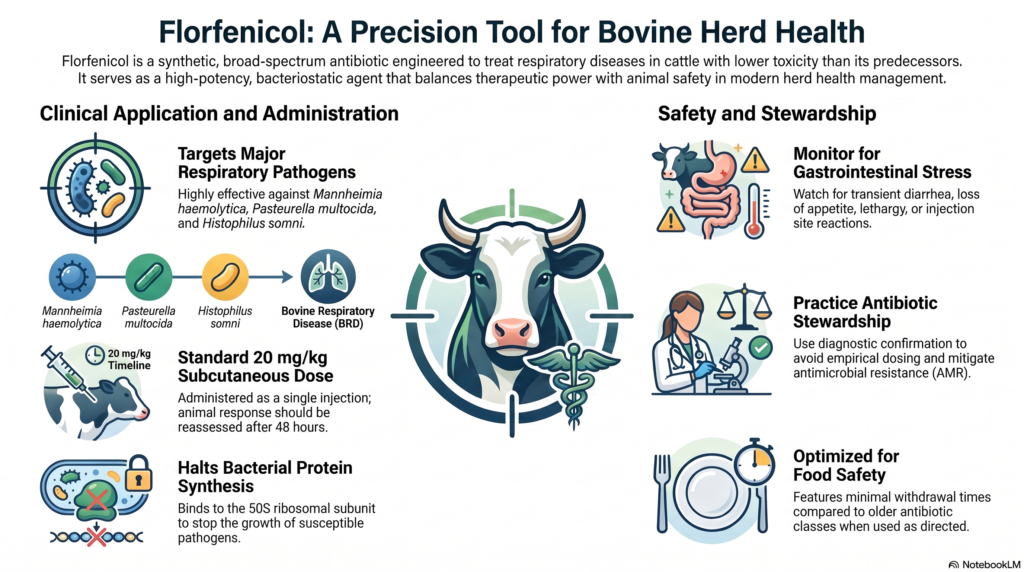
This subtle shift dramatically reduced toxicity while enhancing its broad-spectrum potency against tough agricultural pathogens like Mannheimia haemolytica and Pasteurella multocida. In herd health management, where bacterial outbreaks can devastate a population within days, having a target-driven, bacteriostatic agent that rapidly halts bacterial protein synthesis is invaluable.
However, viewing florfenicol purely as a “magic bullet” overlooks the crucial responsibility we hold as practitioners and producers. Effective herd care isn’t just about administering powerful therapeutics; it requires a deep understanding of pharmacokinetics, tissue distribution, and the delicate balance between clearing an infection and safeguarding overall animal welfare. Let’s explore how this active ingredient functions and how to utilize it responsibly.
Florfenicol is an essential antibiotic in cattle veterinary medicine, targeting key pathogens like Mannheimia haemolytica and Pasteurella multocida that cause respiratory diseases. By inhibiting bacterial protein synthesis, it promotes recovery and enhances herd productivity. Administering a single dose of 20 mg/kg body weight subcutaneously is standard, but monitoring for side effects, such as diarrhea and lethargy, is vital. Understanding its integration in herd health protocols can further improve overall outcomes. Explore more on this topic.
KEY TAKEAWAYS
- Florfenicol effectively treats respiratory infections in cattle caused by Mannheimia haemolytica, Pasteurella multocida, and Histophilus somni.
- The initial recommended dosage of Florfenicol is 20 mg/kg body weight, administered as a single subcutaneous injection.
- Monitoring animal response post-administration is crucial for potential dosage adjustments and reassessment of treatment efficacy.
- Common side effects include diarrhea, loss of appetite, and injection site reactions, requiring careful observation and timely intervention.
- Florfenicol promotes animal welfare and sustainable livestock practices by reducing antibiotic resistance and ensuring food safety compliance.
UNDERSTANDING FLORFENICOL: WHAT IT IS AND HOW IT WORKS
Florfenicol is a synthetic antibiotic that plays an essential role in veterinary medicine, particularly in treating bacterial infections in livestock and companion animals. Florfenicol is an antibiotic belonging to the Phenicol group. The bacteriostatic spectrum of Florfenicol is quite broad and similar to the antibacterial spectrum of Chloramphenicol, including Gram(-) and Gram(+) bacteria.
Its mechanism involves inhibiting bacterial protein synthesis by binding to the 50S ribosomal subunit, effectively halting the growth of susceptible pathogens. As the active ingredient, florfenicol delivers this targeted antibacterial action, helping control infections caused by susceptible bacteria in cattle. This precise action allows florfenicol to exhibit a broad antibiotic spectrum, targeting various Gram-positive and Gram-negative bacteria.
By understanding this mechanism, you can appreciate florfenicol’s efficacy in managing complex infections. Its unique properties distinguish it from other antibiotics, making it a powerful tool in veterinary therapeutics.
This strategic application not only enhances animal health but also supports the overall productivity of livestock operations, ensuring a sustainable approach to veterinary care.
Common Bacterial Infections Treated With Florfenicol in Cattle
When cattle develop bacterial infections, timely and effective treatment is essential for maintaining herd health and productivity.
Florfenicol effectively targets common bacterial strains such as Mannheimia haemolytica, Pasteurella multocida, and Histophilus somni. These pathogens are often responsible for respiratory diseases and can greatly impact growth and reproduction.
The treatment efficacy of florfenicol lies in its ability to inhibit protein synthesis, leading to bacterial cell death. While enrofloxacin for dogs is commonly prescribed to treat bacterial infections in canine patients, florfenicol is specifically formulated to address bacterial diseases affecting cattle, making each medication appropriate for its intended species. This antibiotic is particularly valuable in controlling outbreaks, ensuring that your herd remains healthy and productive.
Proper Administration and Dosage Guidelines for Florfenicol
When administering florfenicol, it’s essential to adhere to the recommended dosage guidelines to guarantee efficacy and minimize resistance. Florfenicol is a time-dependent, bacteriostatic acetamide antibiotic with a very broad spectrum of activity, including Gram-positive and Gram-negative aerobes, and anaerobes. Florfenicol is widely distributed throughout the body and crosses the blood-brain barrier. Elimination is through hepatic metabolism, and inactive metabolites are excreted in the urine. Florfenicol is a good choice of antibiotics for treatment of intracellular pathogens.
You’ll find that proper techniques for administration can greatly impact the drug’s absorption and overall effectiveness.
Understanding these factors will help you optimize treatment outcomes in your veterinary practice.
Recommended Dosage Guidelines
Administering the correct dosage of florfenicol is essential for its effectiveness in treating bacterial infections in veterinary patients.
You must consider specific conditions that may require dosage adjustments to optimize treatment outcomes. Adhering to these guidelines guarantees your herd’s health remains robust.
- Initiate treatment with a recommended dose of 20 mg/kg body weight.
- Administer florfenicol as a single subcutaneous injection.
- Monitor animal response to adjust dosage as clinically indicated.
- Reassess treatment after 48 hours; consider dosage adjustments if symptoms persist.
- Consult with a veterinary professional for individualized treatment plans based on specific conditions.
Administration Techniques Overview
Effective administration of florfenicol is essential for achieving ideal therapeutic outcomes. You must understand the various administration routes and dosage forms available.
Florfenicol can be delivered via intramuscular injection or subcutaneous injection, allowing for maximum absorption and bioavailability. When choosing a dosage form, consider the specific condition being treated and the animal’s weight; florfenicol typically comes in injectable solutions.
Adhere strictly to recommended dosage guidelines—typically 20 mg/kg body weight for a single dose or as prescribed by your veterinarian for ongoing therapy. Confirm that the injection site is clean and free from contaminants to prevent complications.
Monitoring the animal’s response post-administration is critical for evaluating efficacy and adjusting treatment plans as needed.
MANAGING FLORFENICOL SIDE EFFECTS
Looking at the pharmacokinetics of florfenicol, what stands out to me scientifically is its exceptional lipid solubility and widespread tissue distribution. It easily crosses biological membranes, allowing it to penetrate deep into lung tissue where respiratory pathogens thrive, as well as crossing the blood-brain barrier for central nervous system involvement. However, from a practical and pharmacological standpoint, managing its side-effect profile requires a vigilant, cautious approach. Because florfenicol is a broad-spectrum antibiotic, its introduction into the gastrointestinal tract even via parenteral routes like subcutaneous or intramuscular injections can disrupt the delicate microflora of ruminants.
This often manifests as transient diarrhea or a noticeable drop in feed intake. In my research and clinical observations, watching for early signs of lethargy or injection site reactions isn’t just routine paperwork; it is a critical diagnostic feedback loop. If an animal exhibits severe anorexia post-administration, its liver metabolism slows, which in turn alters the clearance rate of the drug and can inadvertently prolong residue depletion times. Furthermore, we must address the global elephant in the room: antimicrobial stewardship.
Over-reliance on empirical dosing without proper diagnostic confirmation or susceptibility testing accelerates resistance patterns, threatening the future efficacy of this vital active ingredient. Responsible usage means dosing strictly by weight, avoiding unnecessary repeated cycles, and closely monitoring therapeutic responses.
When using florfenicol, you should be aware of common side effects such as gastrointestinal disturbances and allergic reactions.
Understanding these potential reactions allows you to implement effective mitigation strategies, ensuring the well-being of your patients.
Close monitoring and timely intervention can greatly reduce the impact of these side effects.
Common Side Effects
Although florfenicol is a potent antibiotic used in veterinary medicine, it can lead to several common side effects that practitioners and pet owners should be aware of.
Monitoring for these adverse reactions is essential, especially since some may have long-term effects on animals.
- Diarrhea
- Loss of appetite
- Injection site reactions
- Lethargy
- Allergic responses
Recognizing these symptoms early can facilitate timely intervention.
You should remain vigilant and document any unusual behaviors or health changes in your cattle following treatment.
Understanding these potential side effects empowers you to make informed decisions about your herd’s health while ensuring the effective use of florfenicol in managing infections.
Mitigation Strategies
To effectively manage the side effects of florfenicol, implementing proactive mitigation strategies is essential.
Start by monitoring dosage and administration closely; improper use can lead to resistance management issues.
Consider integrating treatment alternatives, such as other antibiotic classes, to minimize reliance on florfenicol and reduce the risk of adverse reactions.
Regularly assess herd health to identify any emerging side effects early, allowing for timely intervention.
Educate your team on best practices in florfenicol use and potential side effects, ensuring everyone understands the importance of vigilance.
Additionally, maintain thorough records of treatments and responses to facilitate informed decision-making in future cases.
Key Advantages of Florfenicol for Cattle Health
Florfenicol offers several key advantages for cattle health, particularly in managing bacterial infections. Loncor® 300 (florfenicol) can be administered to beef and non-lactating dairy cattle via intramuscular or subcutaneous injection to treat bovine respiratory disease (BRD) or via subcutaneous injection to control BRD that is caused by Mannheimia haemolytica, Pasteurella multocida and Histophilus somni. It can also be used to treat foot rot.
Its effective formulation leads to significant health improvements in your herd, supporting robust advantage analysis for your veterinary protocols. While firocoxib for horses is commonly prescribed to manage pain and inflammation in equine patients, florfenicol is specifically used to treat bacterial infections in cattle, highlighting the importance of selecting medications based on the species and condition being treated.
- Broad-spectrum efficacy against various pathogens
- Rapid absorption and long-lasting action
- Reduced risk of antibiotic resistance development
- Minimal withdrawal time, ensuring compliance with market regulations
- Enhanced overall herd productivity and performance
Best Practices for Integrating Florfenicol Into Herd Health Protocols
When integrating Florfenicol into your herd health protocols, it’s essential to establish a systematic approach that guarantees effective implementation and monitoring.
Begin by conducting a thorough assessment of your herd’s health status, identifying specific conditions where Florfenicol can provide benefits.
Develop clear treatment guidelines, ensuring that dosages align with veterinary recommendations and regulations.
Regularly train your team on the proper administration techniques and monitor the outcomes of treatments to evaluate efficacy.
Document all interventions meticulously to facilitate data analysis and future decision-making.
Additionally, consider establishing a feedback loop with your veterinarian to refine your protocols continuously.
How Florfenicol Fits Into the Antibiotic Resistance Conversation
As concerns about antibiotic resistance grow, understanding how Florfenicol fits into this conversation is essential for maintaining effective treatment options in veterinary medicine.
Florfenicol represents a crucial component of antibiotic stewardship and resistance management strategies in cattle.
- Targets specific bacterial pathogens, reducing unnecessary antibiotic use.
- Demonstrates efficacy against resistant strains, promoting treatment success.
- Supports herd health without compromising future therapeutic options.
- Integrates into thorough management protocols for best health outcomes.
- Provides an alternative to traditional antibiotics, mitigating resistance development.
Emphasizing Florfenicol’s role not only safeguards animal welfare but also contributes to broader public health efforts.
RELATED STUDIES ABOUT FLORFENICOL ANTIBIOTIC CATTLE
Incorporating florfenicol into your herd health strategies can greatly enhance cattle well-being and productivity. By understanding its mechanisms, appropriate usage, and potential side effects, you can guarantee ideal outcomes for your livestock. Remember, though, that while florfenicol is a powerful tool, it’s essential to use it responsibly to combat antibiotic resistance. With the right approach, you can hit the ground running, guaranteeing a healthier herd and a more sustainable farming operation for the long haul.
Antibiotic use among beef cattle farmers in feedlots in Querétaro, Mexico Uso de antibióticos entre ganaderos de bovinos de carne en corral de engorda en Querétaro, México
This cross-sectional study investigated antibiotic use and management practices among 21 beef cattle farmers in feedlots within the municipality of Ezequiel Montes, Querétaro, Mexico, between April and May 2025. The study highlights the critical need for rational antibiotic use within the “One Health” framework to mitigate antimicrobial resistance (AMR).
Key Findings
- Study Demographics: All 21 surveyed farmers were male, with ages ranging from 23 to 66 years. Approximately 43% had only a basic level of formal education.
- Antibiotic Procurement and Usage:
- Although 90% of farmers consulted a veterinarian for purchasing decisions, all participants reported purchasing antibiotics without a prescription.
- The primary reasons for antibiotic use were to save/prolong animal life (85.7%).
- A total of 335 antibiotic vials from 20 different classes were inventoried across the feedlots. The most common active substances were enrofloxacin (20.3%), penicillin (13.7%), florfenicol (11.0%), and oxytetracycline (10.7%).
- All registered antibiotics in the inventory were categorized as “critically important” by the World Organisation for Animal Health (WOAH).
- Management Practices:
- Pneumonia was identified as the primary cause of morbidity and mortality.
- Only 19% of farmers had a formal protocol for antibiotic use, and 57% relied on staff trained by veterinarians—rather than veterinarians themselves—to administer injections.
- Approximately 66.6% of farmers disposed of empty antibiotic vials in the trash, posing a potential environmental risk.
- No presumptive diagnoses or antibiograms were described in the majority of clinical records.
Conclusion
The findings indicate a high prevalence of empirical antibiotic use, characterized by a lack of diagnostic testing, frequent over-the-counter purchases, and insufficient formal management protocols. The frequent use of critically important antibiotics in feedlot systems poses significant risks for AMR development and environmental contamination. The authors emphasize that stronger regulatory enforcement, mandatory veterinary prescriptions, and improved communication between human and veterinary sectors are essential to promote rational antibiotic use and public health safety.
| REFERENCE: José Alberto Castañeda-Ramos, Maria Elena Velazquez-Meza, Miguel Galarde-López, José Alfredo Carranza-Velázquez, Ángel Rosendo Pulido-Albores, Susana Flores-Villalva, Emilio Blando-Garay, Berta Alicia Carrillo-Quiroz, Celia Mercedes Alpuche-Aranda, Antibiotic use among beef cattle farmers in feedlots in Querétaro, Mexico, Revista Argentina de Microbiología, Volume 58, Issue 3, 2026, 100707, ISSN 0325-7541, https://doi.org/10.1016/j.ram.2026.100707. (https://www.sciencedirect.com/science/article/pii/S032575412600012X) |
In vivo pharmacokinetic and pharmacodynamic study and cutoff of florfenicol against Riemerella anatipestifer in ducks
This study evaluated the efficacy of florfenicol (FF) in treating Riemerella anatipestifer—a pathogen responsible for septicemia and infectious serositis in ducks—by establishing a systemic infection model and integrating pharmacokinetic (PK) and pharmacodynamic (PD) data.
Key Findings
- Study Model: A systemic infection model in 7-day-old shelducks was successfully established via intraperitoneal injection of R. anatipestifer.
- Pharmacokinetics:
- Following intramuscular (i.m.) injection, florfenicol was rapidly absorbed, reaching peak plasma concentrations (Cmax) in 0.5 hours.
- The elimination half-life (T1/2kel) was relatively short, recorded at 1.67 h in plasma, 2.2 h in lungs, and 1.62 h in the liver.
- Pharmacodynamics:
- Florfenicol exhibited a concentration-dependent bactericidal effect against R. anatipestifer.
- A single-dose regimen was insufficient to achieve a bactericidal effect. However, bactericidal effects in systemic tissues (heart, liver, spleen, lung, kidney, and brain) were achieved with doses of ge 20{ mg/kg} administered as two i.m. injections within 24 hours.
- The optimal PK/PD parameters for predicting antibacterial activity were AUC_{24h}/MIC and C_{max}/MIC. An AUC_{24h}/MIC of 58.56 h was required to achieve a 3{ Log}_{10}{ CFU/mL} reduction in bacterial counts.
- Cutoff and Dosage:
- The PK/PD cutoff (CO_PD) was determined to be 1 mu g/mL, confirming that wild-type R. anatipestifer strains with an MIC1mu g/mL can be effectively treated.
- For 90% of the 164 clinical isolates tested—many of which showed reduced susceptibility—the predicted dosage required to achieve clinical efficacy was 431 mg/kg over 24 hours, a level far exceeding current clinical recommendations.
Conclusion
While florfenicol remains effective against wild-type R. anatipestifer strains ($MIC mu g/mL), many clinical isolates show increased resistance, necessitating higher doses than those currently marketed. The study highlights that the existing dosing regimen (at 48-hour intervals) is suboptimal for ducks due to florfenicol’s rapid elimination in this species. The authors recommend conducting antimicrobial susceptibility tests before using florfenicol and suggest that the current clinical dosing regimens be optimized based on the identified PK/PD parameters.
| REFERENCE: Hui-Lin Zhang, Fa-Lei Li, Hui-Yang Chen, Ding-Mei Qin, Shu-Jun Sun, Meng-Meng Zhang, Huan-Zhong Ding, Yong Liu, In vivo pharmacokinetic and pharmacodynamic study and cutoff of florfenicol against Riemerella anatipestifer in ducks, Poultry Science, Volume 104, Issue 1, 2025, 104635, ISSN 0032-5791, https://doi.org/10.1016/j.psj.2024.104635. (https://www.sciencedirect.com/science/article/pii/S0032579124012136) |
Pharmacokinetics, tissue residue depletion, and withdrawal interval estimations of florfenicol in goats following repeated subcutaneous administrations
This study investigated the plasma pharmacokinetics and tissue residue depletion profiles of florfenicol and its primary metabolite, florfenicol amine, in goats following an extra-label subcutaneous dosage regimen of 40 mg/kg administered twice, 96 hours apart. The study aimed to establish scientifically based withdrawal intervals (WDIs) to ensure food safety.
Key Findings
- Study Design: Twenty-eight healthy goats were divided into three study groups to evaluate drug depletion in plasma, serum, and edible tissues (liver, kidney, muscle, and fat) over a 50-day period post-second dose.
- Pharmacokinetics:
- Following the second dose, the plasma half-life was 101.80 hours for florfenicol and 207.69 hours for florfenicol amine.
- The liver was identified as the target organ with the highest drug residue concentration and the longest depletion time compared to other tissues.
- Withdrawal Interval (WDI) Estimations:
- Estimated WDIs varied significantly based on the regulatory method used and the chosen operational tolerances (LODs, FDA/USDA tolerances, or EMA MRLs).
- Using the FDA tolerance limit method (with LODs as tolerances), the estimated WDIs for liver and kidney were 202 days and 101 days, respectively.
- Using the EMA maximum residue limit method (with LODs as tolerances), the estimated WDIs were 179 days for liver and 96 days for kidney.
- The terminal elimination half-life method yielded lower WDI estimates of 89 days for liver and 79 days for kidney.
- Insufficient data points above the lower limit of quantification (LLOQ) prevented WDI estimations for muscle and fat tissues.
Conclusion
The study characterizes the depletion profiles of florfenicol in goats and demonstrates that withdrawal intervals are highly dependent on the regulatory standard and statistical method applied. The longer depletion times observed in the liver highlight its importance as a critical tissue for food safety assessments. The authors recommend that veterinarians consider these conservative WDI estimates when using florfenicol in an extra-label manner to protect consumer health and prevent violative chemical residues. Future research incorporating physiologically based pharmacokinetic (PBPK) models is suggested to further refine these estimates across different dosage regimens.
| REFERENCE: Xue Wu, Zhoumeng Lin, Emily Toney, Maaike O. Clapham, Scott E. Wetzlich, Jennifer L. Davis, Qiran Chen, Lisa A. Tell, Pharmacokinetics, tissue residue depletion, and withdrawal interval estimations of florfenicol in goats following repeated subcutaneous administrations, Food and Chemical Toxicology, Volume 181, 2023, 114098, ISSN 0278-6915, https://doi.org/10.1016/j.fct.2023.114098. (https://www.sciencedirect.com/science/article/pii/S0278691523005008) |
CONCLUSION
Reflecting on the role of florfenicol in modern livestock medicine, I am continually reminded that effective pharmacology is equal parts rigorous science and practical responsibility. The data from recent field studies across feedlots globally highlights a pressing challenge: while florfenicol remains a cornerstone therapeutic against bovine respiratory disease, its widespread empirical use without precise veterinary oversight or antibiograms puts its longevity at risk.
When we skip diagnostic testing or neglect recommended withdrawal intervals, we do not just risk treatment failure in the short term; we endanger consumer trust, food safety compliance, and the global effort against antimicrobial resistance. Therapeutics should never serve as a substitute for robust biosecurity, adequate nutrition, low-stress handling, and targeted vaccination programs.
Instead, florfenicol should be viewed as a precision tool, a highly effective, science-backed intervention reserved for when preventative measures fall short. By pairing advanced pharmacological knowledge with conscientious, evidence-based management practices, we can protect our herds, preserve the efficacy of vital active ingredients, and ensure a higher standard of animal welfare for years to come.