

Having spent over a decade in environmental toxicology and regulatory strategy, I’ve sat across the table from policy committees, chemical manufacturers, and academic researchers globally. If there is one lesson my career in international chemical legislation has taught me, it is that comparative policy analysis is never just an abstract academic exercise. The operational differences between the U.S. Environmental Protection Agency (EPA) and the European Chemicals Agency (ECHA) dictate real-world outcomes: which products enter the market, how fast farmers gain access to protective tools, and how effectively we protect human health and ecological systems.
When you strip away the dense administrative jargon, regulatory science is deeply human. The divergent paths taken by the US and the EU stem from fundamentally different risk management philosophies. While the U.S. framework leans heavily on quantitative, risk-based cost-benefit balancing, the EU’s approach under Regulation (EC) No 1107/2009 is anchored in the Precautionary Principle essentially requiring comprehensive safety proof before a substance hits the shelves.
I often compare regulatory design to abstract painting: you must look beyond the immediate strokes to see the underlying composition. As we dive into how these two powerhouses evaluate pesticide active ingredients, my goal is to break down these complex policy mechanisms into clear, actionable insights for compliance professionals and policy analysts alike.
Pesticide active ingredient regulation varies considerably between the EPA in the U.S. and ECHA in the EU. The EPA employs a risk-based approach focused on existing data, while ECHA adopts a precautionary principle with extensive long-term studies and greater public participation. This leads to stricter classification and approval processes in the EU, impacting timelines and market access. Understanding these regulatory differences is essential for stakeholders wanting to navigate compliance effectively, and there’s much more to explore about these frameworks’ implications.
KEY TAKEAWAYS
- The EPA employs a decentralized regulatory approach balancing state and federal regulations for pesticide active ingredients.
- ECHA emphasizes centralized oversight under EU directives, prioritizing the precautionary principle in its evaluations.
- Risk assessments in the U.S. focus on existing data, while the EU integrates broader scientific studies and stakeholder input.
- The EU mandates extensive long-term studies for approval, contrasting with the U.S. risk-based approach and shorter timelines.
- Greater public participation in EU assessments enhances transparency compared to the more limited engagement seen in U.S. evaluations.
WHY PESTICIDE REGULATION MATTERS
Pesticide regulation matters because it directly impacts public health, environmental sustainability, and agricultural productivity. You must recognize that the pesticide impact extends beyond crop yields; it influences the very ecosystems we depend on.
Effective regulation guarantees that harmful substances don’t compromise environmental health, safeguarding water sources, soil quality, and biodiversity. When regulations are rigorous, they mitigate risks associated with pesticide exposure, protecting vulnerable populations from potential health hazards.
Moreover, robust regulatory frameworks enhance agricultural resilience, enabling farmers to optimize their practices without jeopardizing public welfare. Consequently, understanding and advocating for stringent pesticide regulations empowers you to influence policy, promote sustainable practices, and ultimately, safeguard both human and environmental health.
Your role in this dialogue is vital for shaping future agricultural landscapes.
Understanding the Regulatory Bodies: EPA vs. ECHA
When comparing the EPA and ECHA, you’ll notice significant differences in their regulatory frameworks. The EU Pesticides Database allows users to search for information on active substances used in plant protection products, Maximum Residue Levels (MRLs) in food products, and emergency authorisations of plant protection products in Member States.
Each agency approaches risk assessment processes uniquely, reflecting their respective priorities and methodologies.
Understanding these distinctions is essential for grasping how pesticide regulations are shaped and implemented.
Regulatory Framework Differences
Although both the U.S. and EU aim to protect human health and the environment, their regulatory frameworks for pesticide active ingredients reveal stark differences.
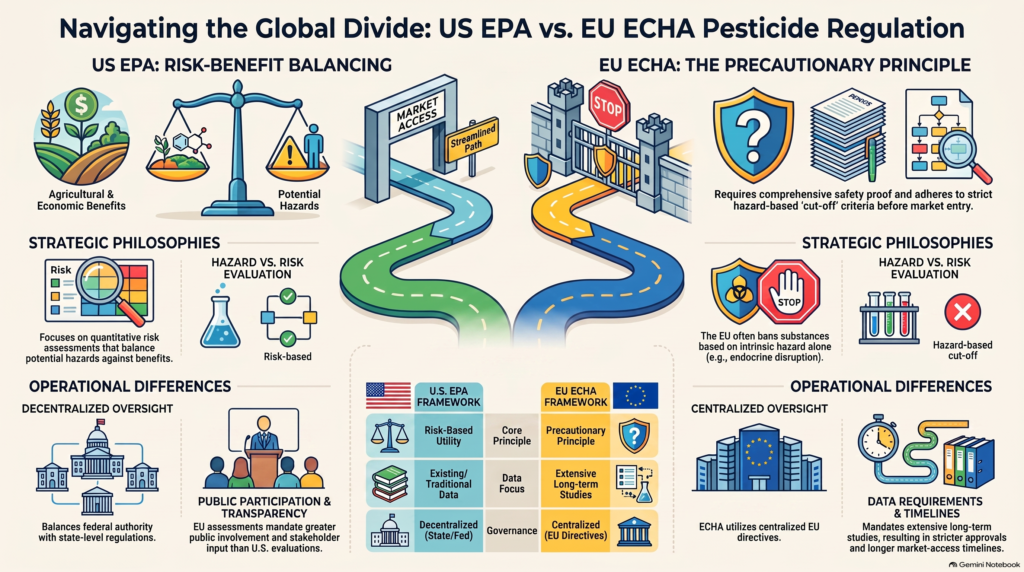
The EPA operates under a more decentralized approach, balancing state and federal regulations, while ECHA emphasizes centralized oversight under EU directives. This divergence creates regulatory harmonization challenges, complicating international standards comparisons.
You’ll find the EPA prioritizing risk-benefit analyses, whereas ECHA leans towards the precautionary principle, often resulting in stricter approvals.
These frameworks reflect broader philosophies in governance and public health, impacting global trade and compliance for pesticide manufacturers.
Understanding these regulatory nuances is essential for industry stakeholders seeking to navigate this complex landscape effectively.
Risk Assessment Processes
Understanding the risk assessment processes employed by the EPA and ECHA reveals significant differences in their methodologies and underlying philosophies.
The EPA’s risk evaluation typically emphasizes a more traditional approach, focusing on existing data to assess potential hazards and exposure levels, including historical substances such as endrin pesticide where relevant to regulatory reviews. In contrast, ECHA employs a more proactive stance, integrating a broader array of scientific studies and stakeholder input to enhance safety protocols.
This divergence impacts how each regulatory body prioritizes human health and environmental protection. While both organizations aim to mitigate risks, ECHA’s approach often results in stricter limits and thorough evaluations.
As you navigate these frameworks, recognizing these differences empowers you to make informed decisions regarding pesticide regulation and its implications for safety and compliance.
The Process of Evaluating Pesticide Active Ingredients
When evaluating pesticide active ingredients, you must understand the rigorous risk assessment methods employed by regulatory bodies.
In the EU, all pesticides sold or used must be registered first before they can be placed on the EU market. The most important pesticide regulation is the Regulation (EC) No 1107/2009 (also known as Plant Protection Products Regulation, PPP), which lays down both rules for the approval of active substances (including micro-organisms), safeners and synergists, and the authorization of plant protection product formulations. Other non-crop protection pesticide products such as pest control, preservatives and disinfectants are usually regulated by the EU Biocidal Products Regulation (BPR, Regulation (EU) No. 528/2012).
These methods determine the potential hazards and exposure levels associated with each ingredient.
The regulatory approval process then follows, ensuring that only safe and effective pesticides reach the market.
Risk Assessment Methods
Risk assessment methods are essential in evaluating pesticide active ingredients, ensuring they meet safety standards before reaching the market.
You need to grasp the intricacies of these evaluations, which involve:
- Risk assessment models to predict potential harm
- Exposure assessment to determine the likelihood of contact
- Toxicological studies to evaluate health effects
- Environmental impact analyses to gauge ecological risks
These elements work together to form a thorough understanding of the active ingredient’s safety profile.
By employing robust risk assessment models, you can make informed decisions that protect both human health and the environment.
The process demands precision and rigor, as even minor oversights can lead to significant consequences in regulatory compliance and public safety.

REGULATORY APPROVAL PROCESS
From my perspective as a regulatory scientist, nowhere is the friction between regulatory frameworks more pronounced than in the evaluation of endocrine-disrupting chemicals (EDCs) and specific systemic toxicities. In my work advising industry stakeholders on compliance harmonization, I frequently see companies stumble when trying to bridge the gap between U.S. hazard-versus-risk evaluations and the EU’s strict cut-off criteria.
For instance, recent research highlights how the EU’s joint ECHA-EFSA guidance strictly screens for EATS (estrogen, androgen, thyroid, and steroidogenic) modalities under Regulation (EU) 2018/605, often leading to non-approval based on intrinsic hazard alone. Conversely, studies examining EPA evaluations suggest that critical endpoints, such as developmental mammary gland toxicity or subtle hormonal disruptions, can sometimes be dismissed or overlooked due to traditional toxicological study designs prioritizing overt system toxicity over micro-level endocrine signals.
This fundamental mismatch creates immense practical challenges. A plant protection product or microbial biological control agent might clear U.S. registration with relative ease, only to face years of administrative friction or outright restriction under the European framework. Additionally, as global supply chains interconnect, these regulatory divides produce a troubling “double standard” in international trade, where active substances restricted or banned in Western markets remain in heavy use across developing agricultural sectors. Harmonizing these data requirements isn’t merely a matter of cutting administrative red tape; it is essential for establishing transparent, modern toxicity standards that protect ecosystems globally without stifling agricultural innovation.
The regulatory approval process for pesticide active ingredients is a multi-step evaluation designed to guarantee safety and efficacy before products reach the market.
First, you must submit detailed data on the pesticide formulation, including its chemistry, toxicology, and environmental impact. Each active ingredient is evaluated individually to determine its safety, efficacy, and compliance with regulatory requirements before approval. Regulatory bodies classify ingredients based on their potential risks, which influences their approval status.
You’ll engage in rigorous assessments, often requiring field trials and peer-reviewed studies. Transparency is essential; stakeholders need to understand ingredient classification and related risks to make informed decisions.
After evaluation, you can expect a thorough review from regulatory authorities, who may impose conditions or require additional data before granting approval.
This meticulous process guarantees only safe, effective products enter the agricultural landscape.
Differences in U.S. and EU Safety Assessments
While both the U.S. and EU implement safety assessments for pesticide active ingredients, notable differences exist in their approaches. You need to understand these distinctions to navigate the regulatory landscape effectively.
Here are key factors to take into account:
- Safety Standards: The U.S. often employs a risk-based approach, while the EU focuses on a precautionary principle.
- Ingredient Classification: The EU has stricter classification criteria, affecting the approval timeline for substances such as dieldrin pesticide, which are subject to rigorous evaluation and regulatory restrictions.
- Data Requirements: The EU mandates extensive long-term studies, contrasting with U.S. requirements.
- Public Participation: The EU encourages more public involvement in assessments compared to the U.S.
These differences shape how regulations evolve and influence market access, making it essential for you to stay informed.
How Risk Communication Works in Pesticide Regulation
Effective communication about pesticide risks is essential for ensuring public safety and confidence in regulatory processes.
To manage public perception, regulatory bodies like the EPA and EU must employ robust communication strategies that clearly articulate the risks associated with pesticide use. By providing transparent data and engaging in dialogue, you can mitigate fear and misinformation.
Tailoring messages to different audiences—farmers, consumers, and environmental groups—ensures that the information resonates and fosters trust. Utilizing multiple channels, including social media, public forums, and educational campaigns, enhances outreach effectiveness.
When stakeholders feel informed and involved, their perception shifts positively, leading to greater acceptance of pesticides that meet safety standards.
Ultimately, strategic risk communication transforms challenges into opportunities for regulatory alignment and public engagement.
Enforcement of Pesticide Regulations
Enforcement of pesticide regulations plays a critical role in maintaining public health and environmental integrity, as it guarantees compliance with established safety standards.
You need to understand the mechanisms behind regulatory enforcement:
- Oversight by federal and state agencies guarantees adherence to pesticide compliance.
- Regular inspections and audits assess pesticide use and application methods.
- Violations can lead to penalties, including fines and product bans.
- Collaboration between agencies fosters a unified approach to enforcement.
These actions not only protect human health but also safeguard ecosystems from harmful pesticide exposure.
What’s Next for Pesticide Regulation?
As the landscape of agriculture and environmental policy evolves, the future of pesticide regulation is poised for significant transformation. Microbial biological control agents (MBCA) are biopesticides based on living microbes. They have huge potential for the control of pests and diseases, but have trouble reaching the European Union (EU) market. According to several authors, this is caused by the regulatory regime, which is less supportive compared with that in the USA. The main objective of this paper is to present regulatory differences between the USA and the EU, and the resulting effects and developments of registration in both regions.
You’ll witness an increasing emphasis on future innovations that prioritize efficacy while minimizing environmental impact. Regulatory frameworks will likely adapt, embracing advanced technologies like biopesticides and precision agriculture to enhance safety and sustainability.
Moreover, global harmonization of pesticide standards is on the horizon, streamlining processes and fostering international cooperation. This shift will empower you and others in the agricultural sector to navigate compliance more efficiently across borders.
Ultimately, the convergence of innovation and harmonized regulations will create a new paradigm, enhancing both productivity and environmental stewardship while ensuring that pesticide use aligns with public health priorities.

RELATED STUDIES ABOUT PESTICIDE ACTIVE INGREDIENT REGULATION EPA EU
In summary, understanding pesticide regulation under the EPA and EU frameworks is vital for ensuring public health and environmental safety. Both systems endeavor to protect citizens, but their approaches and evaluations differ considerably. As regulatory standards evolve, staying informed about these changes is essential—after all, the future of agricultural safety and biodiversity hangs in the balance. By engaging with these frameworks, you contribute to a safer world, one tiny pesticide molecule at a time.
Endocrine-disrupting chemicals – pesticide regulatory issues from the EU perspective
This paper analyzes the current European Union (EU) regulatory framework concerning endocrine-disrupting chemicals (EDCs) found in plant protection products (PPPs). As EDCs pose significant health and environmental concerns, the EU has implemented specific criteria to identify these substances to protect citizens and ecosystems.
Current EU Regulatory Approach
- Active Substances: Approval for active substances in PPPs is governed by Regulation (EC) No 1107/2009. Since 2018, criteria established by Regulation (EU) 2018/605 determine if a substance is an endocrine disruptor, requiring proof of an adverse effect, an endocrine mode of action, and a causal link between the two.
- Identification Strategy: The joint ECHA-EFSA guidance document provides the technical framework for this identification, focusing on EATS (estrogen, androgen, thyroid, and steroidogenic) modalities. This process involves a weight-of-evidence analysis and utilizes the OECD Conceptual Framework for testing, which progresses from in vitro mechanisms to in vivo adverse effects.
- Safeners and Synergists: Historically lacking detailed data requirements, Commission Regulation (EU) 2024/1487 recently established standardized criteria for approving these substances, ensuring they undergo a rigorous review consistent with active substances.
- Co-formulants: These are increasingly scrutinized, with existing lists of “unacceptable” substances (e.g., those with CMR or ED properties) maintained under Regulation (EU) 2021/383. Evaluations increasingly incorporate data from other legal frameworks, such as REACH (chemicals) or SCCS (cosmetics).
Key Regulatory Issues and Challenges
- “One Substance, One Assessment”: The European Commission is moving toward this holistic approach to improve consistency, transparency, and efficiency across different chemical sectors.
- Testing and Methodological Gaps: A primary challenge remains the development and validation of non-animal testing methods, particularly for sensitive life stages and non-EATS modalities (e.g., thyroid signaling, insulin pathways).
- Mixture Effects: Current evaluations struggle to fully account for “cocktail effects”—the combined impact of multiple chemicals—and the potential for non-monotonic dose-response (NMDR) relationships, where low doses may exert unexpected effects.
- Policy Evolution: Driven by the European Green Deal and the Chemicals Strategy for Sustainability, EU policy is evolving to strengthen information requirements and accelerate the transition toward safer, more sustainable chemical alternatives.
Conclusion
The EU pesticide and biocide sectors are among the most advanced in terms of EDC-related regulation. However, significant challenges persist, including the need to address cumulative exposure and the long-term effects of EDCs on complex systems like the nervous and immune systems. Ongoing research and policy reviews aim to bridge these gaps, ensuring a comprehensive and consistent approach to protecting public health from endocrine disruption.
| REFERENCE: Monika Liszewska, Katarzyna Czaja, Wojciech Korcz, Radosław Lewiński, Paweł Struciński, Endocrine-disrupting chemicals – pesticide regulatory issues from the EU perspective, Regulatory Toxicology and Pharmacology, Volume 154, 2024, 105735, ISSN 0273-2300, https://doi.org/10.1016/j.yrtph.2024.105735. (https://www.sciencedirect.com/science/article/pii/S0273230024001764) |
US EPA’s regulatory pesticide evaluations need clearer guidelines for considering mammary gland tumors and other mammary gland effects
This study investigates whether U.S. Environmental Protection Agency (EPA) pesticide registration processes adequately assess risks to the mammary gland, including potential breast cancer links. By reviewing Reregistration Eligibility Decisions (REDs) and academic literature, the authors identified 35 pesticides associated with mammary gland tumors or altered mammary gland development.
Key Findings
- Dismissal of Mammary Tumors: Of the 28 pesticides reported to cause mammary tumors in rodent bioassays, the EPA cancer risk assessment process dismissed the tumors for 19 cases. Common reasons for dismissal included claims of “excessive toxicity” (where high-dose effects are ignored due to overall system toxicity), a lack of dose-response relationship, or the assertion that the mechanism of tumor formation is not relevant to humans.
- Neglect of Developmental Effects: For five pesticides known to alter mammary gland development—atrazine, chlorpyrifos, malathion, methoxychlor, and parathion—the implications for long-term breast cancer susceptibility or impaired lactation were not assessed in EPA registration documents.
- Mechanistic Evidence: Many of the 35 “mammary-active” pesticides exhibit biological activity in ToxCast high-throughput screening assays at concentrations below 1 µM. These include:
- Steroidogenesis: 17 pesticides altered the synthesis of estradiol (E_2), estrone (E_1), or progesterone (P_4) in H295R cells.
- Molecular Targets: 22 pesticides showed activity related to xenobiotic metabolism (CYPs), nuclear receptors, and cell cycle regulation, providing plausible biological mechanisms for mammary gland effects.
Regulatory Recommendations
The authors conclude that existing guideline toxicology studies required for pesticide registration are largely insensitive to endocrine-disrupting chemicals (EDCs) and developmental mammary gland effects. To improve breast cancer risk prevention, the study proposes the following:
- Clearer Guidelines: EPA assessment protocols should be modified to require sensitive mammary gland histology and hormone measurements.
- Re-evaluation: Potential cancer risks from several commonly used pesticides—specifically malathion, triclopyr, atrazine, propylene oxide, and 3-iodo-2-propynyl butylcarbamate (IPBC)—should be re-evaluated using contemporary knowledge of breast cancer biology.
- Holistic Assessment: Regulatory decisions should integrate in vitro mechanistic data (such as ToxCast results) to better interpret in vivo findings and identify potential EDCs that standard protocols might overlook.
| REFERENCE: Bethsaida Cardona, Ruthann A. Rudel, US EPA’s regulatory pesticide evaluations need clearer guidelines for considering mammary gland tumors and other mammary gland effects, Molecular and Cellular Endocrinology, Volume 518, 2020, 110927, ISSN 0303-7207, https://doi.org/10.1016/j.mce.2020.110927. (https://www.sciencedirect.com/science/article/pii/S0303720720302276) |
Toxicological profiling and health hazard characterization of pesticides widely used in Tanzania unmarked
This study provides a comprehensive toxicological assessment of pesticides utilized in smallholder agricultural systems in Tanzania, highlighting a significant public health and environmental crisis. Despite the importance of agriculture to the Tanzanian economy, the reliance on highly hazardous pesticides (HHPs)—many of which are banned or withdrawn in other regions—poses severe risks to human health and ecological stability.
Key Findings
- Widespread HHP Reliance: Over 150 active ingredients are currently used in Tanzania, including highly hazardous pesticides (HHPs) like lambda-cyhalothrin, glyphosate, chlorpyrifos, mancozeb, paraquat, and atrazine. Most pesticides sold belong to WHO Class II (highly toxic), with some classified as extremely toxic (Class I).
- Unsafe Handling and Disposal: While registration and labeling appear to be generally implemented, field-level practices are unsafe.
- Handling: Almost all farmers use manual knapsack sprayers, and a significant portion lack proper safety training or personal protective equipment (PPE).
- Disposal: Disposal methods are dangerous, with 36.6% of farmers discarding empty containers in nature and 26.1% resorting to open burning.
- Health and Environmental Impacts: Prolonged exposure to these pesticides is linked to chronic non-communicable diseases, including various cancers (e.g., non-Hodgkin lymphoma), neurological disorders (e.g., Parkinson’s disease), reproductive dysfunction, and endocrine disruption. Because these health issues are non-specific, their link to pesticide exposure often remains invisible, leading to underreporting and delayed treatment.
- Regulatory Dissonance: There is a critical gap between knowledge and practice. Tanzania continues to authorize pesticides such as chlorpyrifos, paraquat, atrazine, and carbendazim, which have been banned in the EU and other regions due to unacceptable risks. This situation effectively creates a double standard, exposing the Tanzanian population and environment to hazards deemed unacceptable elsewhere.
Conclusion and Recommendations
The study concludes that the combination of inherently hazardous chemicals, inadequate regulatory enforcement, and unsafe handling creates a “perfect storm” of pesticide exposure in Tanzania. To mitigate these risks, the authors provide the following recommendations:
- Regulatory Reform: Review currently registered pesticides against HHP criteria and phase out those banned in other jurisdictions.
- Promotion of Alternatives: Invest in and incentivize Integrated Pest Management (IPM) and agroecological practices to reduce chemical dependency.
- Safety and Training: Launch nationwide programs for safe handling and provide subsidies for necessary PPE.
- Monitoring and Surveillance: Establish a robust national system for monitoring pesticide residues in food, soil, and water, and designate pesticide exposure as a “Neglected Public Concern” to secure political commitment.
| REFERENCE: Jones A. Kapeleka, Aiwerasia Ngowi, Toxicological profiling and health hazard characterization of pesticides widely used in Tanzania unmarked, Toxicology Reports, Volume 16, 2026, 102269, ISSN 2214-7500, https://doi.org/10.1016/j.toxrep.2026.102269. (https://www.sciencedirect.com/science/article/pii/S2214750026000715) |
CONCLUSION
As we look toward the future of global chemical safety, it is obvious to me that the traditional siloed approach to active ingredient regulation is no longer viable. The rapid shift toward biopesticides, biological control agents, and precision agriculture requires regulatory bodies on both sides of the Atlantic to evolve faster than ever before. In my years facilitating regulatory alignment, I have consistently argued that true chemical safety requires a holistic, interdisciplinary perspective much like blending distinct colors on a canvas to create a cohesive work of art.
Achieving meaningful international harmonization does not mean stripping away the high safety standards of the EU’s Precautionary Principle, nor does it mean discarding the practical risk-based efficiency of the EPA. Instead, initiatives like the “One Substance, One Assessment” strategy represent a vital step forward in reducing redundant testing, advancing non-animal toxicity models, and incorporating modern toxicological endpoints such as mixture effects and low-dose endocrine impacts.
For industry professionals, regulatory scientists, and policymakers, staying ahead of this curve requires continuous learning and adaptive strategy. By understanding the core drivers behind EPA and EU frameworks today, we can better collaborate to build a safer, more sustainable, and scientifically unified global marketplace for tomorrow.