
Throughout my fifteen years researching soil health, nutrient cycles, and irrigation management, I’ve often seen agricultural discussions pivot sharply between chemical pest control and ecological preservation. From my perspective as a soil scientist, synthetic pyrethroids sit directly at this critical intersection. Originally modeled after natural compounds found in chrysanthemums, pyrethroids were designed to deliver targeted insect management while avoiding some of the long-term persistence issues associated with older pesticide chemistry. However, viewing them strictly as a “catch-all” shield for crops misses the nuanced reality of field agronomy.
In my work with precision farming technology, I always remind growers that chemical interventions do not exist in a vacuum; every drop applied interacts directly with the soil microbial community, local runoff pathways, and beneficial insect populations. When used thoughtfully within a structured management plan, pyrethroids provide rapid pest knockdown and essential yield security.
Yet, their true value is only realized when we treat them not as a primary crutch, but as a calibrated precision tool. As we explore the mechanisms, benefits, and environmental trade-offs of pyrethroid active ingredients, my goal is to help you look past basic eradication and consider how these inputs fit into a broader, sustainable agricultural system.
Pyrethroid active ingredients are essential in crop protection strategies due to their ability to effectively target pest populations. They disrupt insect nervous systems by targeting voltage-gated sodium channels, leading to rapid knockdowns and reduced crop damage. Their broad-spectrum activity simplifies pest management, while low toxicity guarantees environmental safety. By integrating pyrethroids into your pest management plans and considering application timing, you can enhance effectiveness and minimize resistance development. Continue exploring the innovative practices that optimize pyrethroid use.
KEY TAKEAWAYS
- Pyrethroid active ingredients target insect nervous systems, leading to rapid knockdown and paralysis of pests, enhancing crop protection efficiency.
- Their broad spectrum of activity simplifies pest management, allowing for effective control of multiple pest species with fewer applications.
- Residual activity from pyrethroids provides extended protection, reducing the frequency of applications and minimizing crop damage over time.
- Compatibility with integrated pest management strategies enables the combination of pyrethroids with biological control methods, promoting sustainable agriculture practices.
- Advanced formulations and application techniques optimize pyrethroid effectiveness while minimizing environmental impact and reducing the risk of pest resistance.
UNDERSTANDING PYRETHROIDS: ORIGINS AND ACTIVE INGREDIENTS
Although you may not realize it, pyrethroids are an essential class of insecticides derived from natural pyrethrins, which are extracted from chrysanthemum flowers. Their history dates back to the late 19th century, when scientists first identified the insecticidal properties of these compounds. A pyrethroid is an organic compound similar to the natural pyrethrins, which are produced by the flowers of pyrethrums (Chrysanthemum cinerariaefolium and C. coccineum). Pyrethroids are used as commercial and household insecticides.
Pyrethroids represent a synthetic evolution of these natural substances, designed to enhance efficacy and stability. You’ll encounter various active ingredient types within this class, including permethrin, cypermethrin, and deltamethrin, each engineered for specific pest control applications.
Understanding these distinctions is important for optimizing crop protection strategies. By leveraging the unique characteristics of each active ingredient, you can effectively combat diverse agricultural pests while minimizing environmental impact, ultimately securing a robust yield for your crops.
How Pyrethroids Work: Mechanisms Against Pests
When you apply pyrethroids to crops, you’re utilizing their ability to disrupt the normal functioning of insect nervous systems.
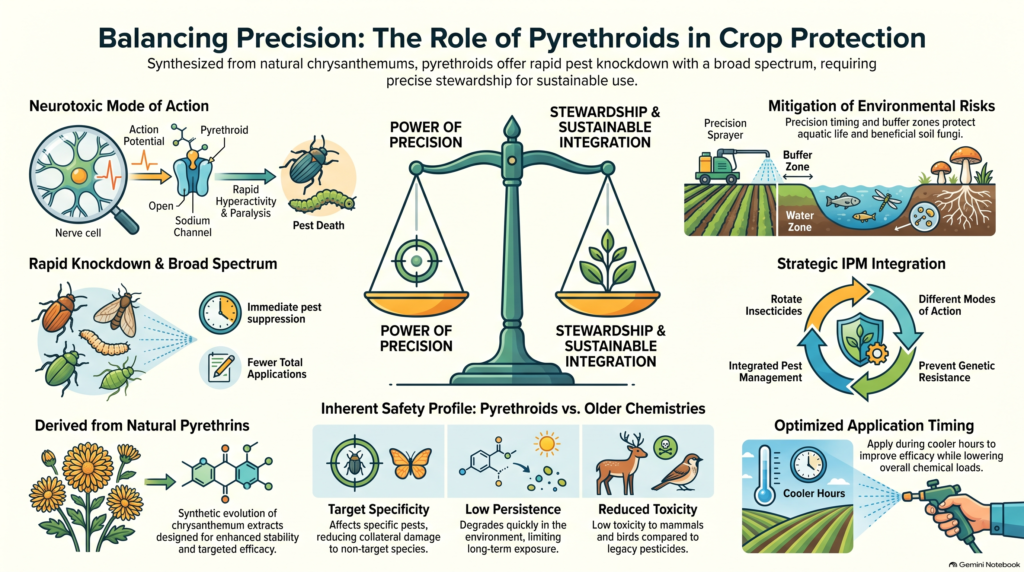
These compounds act primarily through insect neurotoxicity mechanisms, targeting voltage-gated sodium channels. By prolonging the opening of these channels, pyrethroids induce hyperactivity and eventual paralysis in pests, effectively eliminating them.
Different pyrethroid formulation types can enhance efficacy and persistence, ensuring ideal penetration and performance against a range of insects. The active ingredient in each formulation determines its effectiveness, residual activity, and suitability for specific pest control applications. You can choose between emulsifiable concentrates, wettable powders, or microencapsulated formulations, each offering distinct advantages for specific pest challenges.
Understanding these mechanisms allows you to strategically deploy pyrethroids, maximizing their impact while minimizing resistance development, thereby fortifying your crop protection strategy.
Five Key Benefits of Pyrethroids for Effective Crop Protection
When considering effective crop protection, you’ll find that pyrethroids offer significant advantages. The application of pyrethroids and carbamates represents an environmental risk and may exert adverse effects on beneficial microorganisms such as Trichoderma, which contribute to the biocontrol of several fungal phytopathogens. It was determined the influence of this insecticide on the release of enzymes such as chitinases, peroxidases, and endoglucanases by a consortium of selected Trichoderma strains grown in liquid culture medium).
Their enhanced pest control efficacy guarantees targeted action against a wide range of insects while maintaining environmental safety.
These benefits make pyrethroids an essential component in modern agricultural practices.
Enhanced Pest Control Efficacy
Pyrethroids offer five key benefits that greatly enhance pest control efficacy in crop protection. This active ingredient is a contact, broad-spectrum insecticide that belongs to a class of pesticides known as pyrethroids. Pyrethroids are synthetic versions of pyrethrins, which are extracted from chrysanthemum flowers. Permethrin disrupts the central nervous system of insects. Pests that come in contact with or feed on this active ingredient become paralyzed and die. To learn more, see the NPIC fact sheet for this active ingredient.
First, their rapid knockdown effect allows you to eliminate pests swiftly, minimizing crop damage.
Second, they exhibit a broad spectrum of activity, targeting various pests, which simplifies your pest management strategy.
Third, effective target pest identification enables you to optimize application techniques, ensuring precise delivery and maximum impact.
Fourth, their residual activity provides extended protection, reducing the frequency of applications needed.
Finally, pyrethroids are compatible with integrated pest management approaches, allowing you to combine them with biological control methods for enhanced effectiveness.
Environmental Safety Considerations
Although effective pest control is essential, environmental safety should never be overlooked in crop protection strategies. Pyrethroids are designed with ecological impact in mind, undergoing rigorous safety assessments to guarantee minimal harm to non-target species. Here are five key benefits:
| Benefit | Description |
| Target Specificity | Pyrethroids affect specific pests, reducing collateral damage. |
| Low Persistence | They degrade quickly, limiting long-term environmental exposure. |
| Reduced Toxicity | Low toxicity to mammals and birds minimizes health risks. |
Environmental Impacts of Pyrethroid Use
While their effectiveness in pest control is well-documented, the environmental impacts of pyrethroid use warrant careful consideration.
Pyrethroid degradation rates can vary considerably, leading to residue persistence that poses exposure risks to non-target organisms. Aquatic toxicity is a significant concern, as runoff can contaminate waterways, disrupting ecosystem balance and harming aquatic life.
Additionally, the impact on pollinator effects can’t be ignored; these critical species often suffer adverse effects, jeopardizing biodiversity and soil health.
Understanding these factors is essential for mitigating potential harm while utilizing pyrethroids. Similar discussions surrounding neonicotinoid active compounds agriculture impact have also emphasized the importance of balancing effective pest control with long-term environmental sustainability.
HOW TO INCORPORATE PYRETHROIDS IN INTEGRATED PEST MANAGEMENT?
When evaluating how pyrethroids perform in the field, we have to look closely at the balance between pest suppression and off-target risks. From a purely mechanical standpoint, targeting voltage-gated sodium channels in insect nervous systems offers undeniable efficiency. But as someone who studies long-term soil health and aquatic runoff, I know that high efficacy comes with real responsibilities.
For instance, recent research on aquatic organisms like freshwater molluscs and non-target species highlights how easily runoff can transport lipophilic compounds into surrounding waterways, where they can accumulate in aquatic food chains. Furthermore, we must account for beneficial soil biology; uncalibrated applications can disrupt beneficial fungal networks like Trichoderma, which play an active role in natural pathogen suppression. This is precisely why timing and application mechanics matter so much.
Over the years, whether I’m calibrating micro-irrigation systems or reviewing field trial data, I’ve seen that spray timing dictates success far more than simply increasing dosages. Applying pyrethroids during cooler hours or targeting specific pest life stages drastically improves efficiency while lowering overall chemical loads. When integrated alongside soil amendments, organic matter management, and crop rotations, pyrethroids become far more effective, helping us prevent metabolic or genetic resistance in key pests like aphids while safeguarding local ecosystem health.
To effectively incorporate pyrethroids into your Integrated Pest Management (IPM) strategy, you’ll need to focus on application timing and resistance management.
Strategically timing applications can enhance efficacy while reducing the likelihood of pest resistance.
Additionally, implementing resistance management practices will help maintain the effectiveness of pyrethroids in your pest control arsenal.
Application Timing Strategies
Effective application timing strategies for pyrethroids in Integrated Pest Management (IPM) are essential for optimizing pest control while minimizing environmental impact.
Understanding application windows is vital; targeting the correct life stages of pests enhances efficacy. You should monitor pest populations closely to determine the timing significance of your applications. Early intervention during critical pest development phases can suppress infestations and reduce the need for subsequent treatments.
Additionally, incorporating weather conditions into your timing strategy can improve pyrethroid performance, as temperature and humidity affect their potency.
By strategically scheduling applications, you strengthen your IPM framework, ensuring a balanced approach to pest management that maximizes crop protection while safeguarding ecological integrity.
Choose your timing wisely; it’s a powerful tool in your arsenal.
Resistance Management Practices
Incorporating pyrethroids into Integrated Pest Management (IPM) requires a robust resistance management strategy to guarantee their continued efficacy against target pests.
Start by implementing resistance monitoring protocols to identify and track pest populations that may develop resistance. This data-driven approach allows you to make informed decisions about when and how to apply pyrethroids effectively.
Combine pyrethroid use with alternative control methods, such as biological agents or cultural practices, to enhance sustainable practices and reduce reliance on any single mode of action.
Rotate different insecticides with varying modes of action to disrupt resistance development.
How to Apply Pyrethroids Effectively
Applying pyrethroids effectively requires careful attention to timing, dosage, and method. To maximize efficacy, choose ideal application techniques based on target pests and crop conditions.
Early morning or late evening applications often yield better results, as pest activity peaks during these times. Follow dosage recommendations closely; under-application can lead to resistance, while over-application risks crop damage and environmental harm.
Utilize calibrated equipment to guarantee even distribution, and consider weather conditions, as rain or wind can diminish effectiveness. Rotate pyrethroid use with other insecticides to combat resistance and maintain pest control.
Innovations in Pyrethroid Use: Trends and Alternatives
As the agricultural landscape evolves, innovations in pyrethroid use are reshaping pest management strategies and addressing environmental concerns.
You’ll find emerging formulations that enhance efficacy while minimizing ecological impact. These advanced products often incorporate nano-encapsulation or controlled-release technologies, allowing for targeted application and prolonged effectiveness.
By integrating sustainable practices, such as crop rotation and integrated pest management, you can optimize the benefits of pyrethroids while reducing dependence on chemical inputs. Research on fulvic acid agricultural benefits active compound also demonstrates how improving soil health and nutrient uptake can complement these sustainable crop protection strategies.
Additionally, the development of biopesticides as alternatives to traditional pyrethroids offers potential pathways for resilience against pest resistance.
Staying ahead of these trends not only strengthens your crop protection strategies but also positions you as a leader in sustainable agriculture, ultimately ensuring long-term productivity and environmental stewardship.

RELATED STUDIES ABOUT PYRETHROID PESTICIDE ACTIVE INGREDIENTS
Incorporating pyrethroids into your crop protection protocols can considerably safeguard your yields. Their potent pest-fighting properties provide precision and performance, making them essential in pest management. However, it’s vital to take into account their environmental effects and apply them judiciously. By blending best practices and innovative approaches, you can maximize the benefits of pyrethroids while minimizing potential pitfalls. Ultimately, a balanced strategy guarantees sustainable success, promoting both productivity and preservation in your agricultural endeavors.
Pyrethroids have become a barrier to the daily existence of molluscs (Review)
This review synthesizes current research regarding the environmental contamination and toxicological impacts of pyrethroid insecticides on freshwater molluscs. As the global population increases, the reliance on pyrethroids for pest control in agriculture, forestry, and public health has risen, leading to widespread contamination of aquatic ecosystems via rainwater runoff and sewage drainage.
Key Findings
- Environmental Persistence and Bioaccumulation: Pyrethroids are highly lipophilic and exhibit low water solubility, causing them to adsorb strongly to organic matter and sediments in aquatic bodies. This property leads to their accumulation in the fatty tissues of molluscs, posing significant long-term health risks even when environmental concentrations are low.
- Physiological and Cellular Impacts: Pyrethroids act as neurotoxins by interfering with voltage-gated sodium channels, preventing their closure and resulting in continuous nerve stimulation, paralysis, and death. Furthermore, exposure induces metabolic disruption by:
- Increasing the production of reactive oxygen species (ROS), which leads to oxidative stress, DNA damage, and protein carbonylation.
- Altering neurotransmitter actions and enzyme activities (e.g., inhibiting glycolytic enzymes and succinate dehydrogenase), which impairs mitochondrial function and energy production.
- Reducing the efficacy of cellular defense systems, such as the glutathione-S-transferase (GST) pathway and antioxidant enzymes (SOD, CAT).
- Behavioral and Ecological Consequences: Molluscs serve as crucial bioindicator species and secondary consumers in aquatic food webs. Pyrethroid exposure causes significant behavioral changes, including reduced feeding, impaired locomotion, disrupted reproduction, and altered predator avoidance, all of which contribute to population declines and ecosystem-level instability.
- Immunological Threat: Synthetic pyrethroids (e.g., cypermethrin, fenvalerate) are increasingly classified as immunotoxins. They disrupt the immunological defenses of molluscs—such as phagocytic activity and phenoloxidase activity—leaving them more susceptible to infections and other environmental stressors.
Conclusion and Recommendations
Pyrethroids represent a “nightmare” for aquatic molluscs due to their multifaceted toxicity, which impacts everything from basic cellular functions to community-level ecological dynamics. The authors emphasize that current research often neglects smaller water bodies (ponds and streams) in favor of larger rivers, leaving a gap in our understanding of these critical habitats.
To mitigate these risks, the study recommends:
- Promoting sustainable agricultural practices, such as Integrated Pest Management (IPM), crop rotation, and the use of biological control agents.
- Implementing active mitigation techniques like vegetated buffer strips and sediment check dams to reduce pesticide runoff.
- Conducting long-term, low-dose exposure studies across a wider variety of aquatic species to better understand the chronic impacts of pyrethroids on aquatic biodiversity and ecosystem resilience.
| REFERENCE: Raja Saha, Sangita Maiti Dutta, Pyrethroids have become a barrier to the daily existence of molluscs (Review), Journal of Hazardous Materials Letters, Volume 6, 2025, 100144, ISSN 2666-9110, https://doi.org/10.1016/j.hazl.2025.100144. (https://www.sciencedirect.com/science/article/pii/S2666911025000048) |
Pesticide residues in aquaculture salmon filet and feed: Quantitative and qualitative screening profiles of legacy and current-use pesticides using GC-EI-MS/MS and LC-ESI-IMS-QToF
This study evaluated the pesticide residue profiles in farmed Atlantic salmon (Salmo salar), their commercial feed, and feed ingredients in Norway. As aquaculture practices have shifted from marine-based to plant-based feed ingredients over the last two decades, this research sought to determine if this transition has altered the pesticide contamination profile in farmed salmon.
Methodology
The researchers employed two complementary analytical techniques:
- Quantitative GC-MS/MS: A targeted method identifying 43 analytes, focusing on legacy organochlorine pesticides, organophosphates, and pyrethroids.
- Qualitative LC-IMS-QTOF Screen: A broader presence/absence screen covering 215 analytes, providing insight into a wider range of current-use pesticides.
Key Findings
- Distinct Contamination Profiles: The study found differing pesticide burdens between the salmon filet and their feed.
- Salmon Filet: Dominated by legacy organochlorine pesticides, which are lipophilic and prone to bioaccumulation. The most prevalent compound was 4,4′-DDE.
- Fish Feed: Dominated by current-use organophosphate and pyrethroid pesticides. Notably, pirimiphos-methyl was detected in 100% of analyzed feed samples.
- Food Safety and Animal Health:
- Food Safety: No pesticide concentrations in salmon filet exceeded the default EU maximum residue limit (MRL) of 10~\mu g/kg.
- Animal Health: While food safety risks appear low, several pesticides (cypermethrin, deltamethrin, pirimiphos-methyl, and glyphosate) were detected in feed at levels exceeding the 10~\mu g/kg threshold, raising potential concerns for animal health, welfare, or production efficiency.
- Glyphosate: While glyphosate and its metabolite AMPA were frequently detected in fish feed, they were not found above the limit of quantitation (LOQ) in any salmon filet samples.
Conclusion
The transition to plant-based feed ingredients has significantly altered the pesticide profile in the aquaculture food chain, moving from persistent organochlorine legacy contaminants to current-use organophosphates and pyrethroids. While the current levels do not pose a direct food safety risk to human consumers, the frequent detection of current-use pesticides in feed suggests a need for ongoing monitoring to protect fish health and to better understand the long-term impacts of these residues on aquaculture productivity.
| REFERENCE: Carey E. Donald, Annette Bernhard, Marianne F. Hauglid, Annie Fürstenberg, Marc H.G. Berntssen, Anne-Katrine Lundebye, Veronika Sele, Pesticide residues in aquaculture salmon filet and feed: Quantitative and qualitative screening profiles of legacy and current-use pesticides using GC-EI-MS/MS and LC-ESI-IMS-QToF, Journal of Chromatography B, Volume 1269, 2026, 124864, ISSN 1570-0232, https://doi.org/10.1016/j.jchromb.2025.124864. (https://www.sciencedirect.com/science/article/pii/S1570023225004180) |
Molecular screening and dose-response assays provide insights into pyrethroid resistance in four agriculturally important aphid species
This study surveys multiple aphid populations across the UK to assess the prevalence of insecticide resistance and tolerance to pyrethroids, the primary insecticide class remaining for cereal aphid control following increased regulation of other chemical groups. The research focused on four key species: Sitobion avenae (grain aphid), Rhopalosiphum padi (bird cherry-oat aphid), Metapolophium dirhodum (rose-grain aphid), and Myzus persicae (peach-potato aphid).
Key Findings
- Species-Specific Resistance:
- M. persicae: Showed high levels of insecticide resistance, with 74% of sampled populations harboring at least one resistance mechanism. Genotyping confirmed the widespread presence of super-knockdown resistance (super-kdr) mutations (M918T and M918L) and Modified Acetylcholinesterase (MACE) resistance, particularly in populations sampled from rapeseed crops.
- S. avenae: Exhibited a low overall prevalence of knockdown resistance (kdr) (L1014F mutation), though geographical “hot spots” were identified in Eastern England.
- R. padi: While no genetic kdr or super-kdr resistance was found, the study identified reduced sensitivity (tolerance) in several populations—the first such report for this species in the UK.
- M. dirhodum: All tested populations remained highly sensitive to pyrethroids, with no evidence of emerging resistance.
- Resistance Mechanisms: Resistance in S. avenae and M. persicae is linked to target-site mutations in voltage-gated sodium channels (kdr/super-kdr), while the reduced sensitivity observed in R. padi appears to be metabolic rather than genetic.
- Fitness Costs: Resistance mutations often carry fitness costs, such as reduced reproductive output or increased susceptibility to natural enemies, which likely limits the proliferation of resistant clones like the S. avenae sa3 genotype to specific agricultural regions.
Conclusion and Management Implications
The study concludes that pyrethroid resistance is a common feature in M. persicae and is potentially emerging in R. padi populations within the UK. Although the effectiveness of chemical control remains high overall, the identification of reduced sensitivity and widespread resistance mechanisms underscores the vulnerability of current pest management programs. The authors emphasize that regular, routine surveys are essential to monitor resistance prevalence, inform farmers’ decision-making, and ensure the continued efficacy of remaining control methods. The high prevalence of resistance in M. persicae populations from rapeseed crops highlights an urgent need for the development and validation of non-chemical management alternatives in those systems.
| REFERENCE: Daniel J. Leybourne, Elinor Baird, Duncan Coston, Rory Jones, Nasamu Musa, Molecular screening and dose-response assays provide insights into pyrethroid resistance in four agriculturally important aphid species, Crop Protection, Volume 197, 2025, 107315, ISSN 0261-2194, https://doi.org/10.1016/j.cropro.2025.107315. (https://www.sciencedirect.com/science/article/pii/S0261219425002078) |
CONCLUSION
Ultimately, securing high crop yields while protecting the environmental baseline requires a move away from blanket chemical treatments toward a deeply integrated approach. Pyrethroids remain one of our most effective tools against yield-threatening pests, but their long-term viability rests squarely on stewardship. As recent studies across aquaculture feed chains and regional aphid populations demonstrate, pest resistance and chemical accumulation in non-target environments are continuous challenges that demand our active attention.
From my standpoint, sustainable agriculture isn’t about eliminating tools; it’s about utilizing technology, biological controls, and chemical inputs with complete clarity regarding their broader impacts. By pairing precise pyrethroid applications with active resistance monitoring, vegetated buffer zones, and soil-building practices, we can protect our crops without compromising soil vitality or surrounding aquatic ecosystems.
Whether you are managing broadacre crops or fine-tuning a regional IPM framework, success lies in strategic balance embracing innovation and data-driven field management to maintain both farm profitability and long-term land stewardship.