

Throughout my career as an agricultural chemist, I’ve often observed a persistent disconnect between theoretical soil chemistry and practical, on-the-ground sustainable farming. Early in my research, we relied heavily on synthetic inputs to push crop yield boundaries, but over the years, the long-term degradation of soil architecture and microbial life made it clear that we needed a more regenerative path forward.
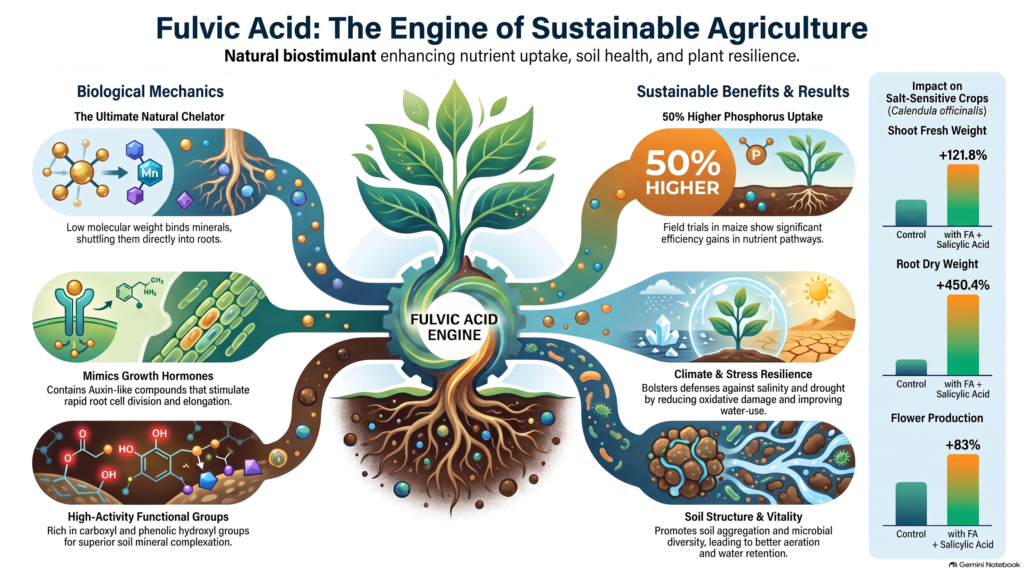
That is why the study of natural humic substances, particularly fulvic acid, has become one of the most compelling areas in modern agronomy. Unlike heavy organic fractions, fulvic acid possesses a lower molecular weight and rich functional groups, such as carboxyl and phenolic hydroxyl groups. These allow it to act as an exceptional natural chelator, unlocking tightly bound soil minerals and shuttling them directly into plant roots.
I’ve seen firsthand how incorporating these active compounds can transform exhausted soils into dynamic ecosystems without over-relying on synthetic fertilizers. For growers trying to balance economic viability with environmental stewardship, understanding the biochemical mechanics of fulvic acid isn’t just an academic exercise, it’s a practical imperative for the future of food production.
Fulvic acid plays an essential role in sustainable crop production by enhancing nutrient uptake, improving soil health, and increasing plant resilience to stress. This natural chelator increases nutrient mobility, stimulates root growth, and boosts microbial diversity, leading to better nutrient cycling and crop yields. Its ability to improve soil structure and water retention further supports healthy plant growth. Understanding these benefits can provide insights into optimizing your agricultural practices for sustainability and productivity.
KEY TAKEAWAYS
- Fulvic acid enhances nutrient mobility, improving plant absorption and reducing reliance on synthetic fertilizers in sustainable crop production.
- It boosts soil health by promoting microbial diversity, which is essential for effective nutrient cycling and disease resistance in crops.
- The compound improves soil structure, enhancing water retention and aeration, leading to better crop resilience against environmental stressors.
- Fulvic acid’s chelation of minerals transforms them into bioavailable forms, optimizing nutrient availability for plants and supporting enhanced growth rates.
- Integration of fulvic acid into farming practices aligns with eco-friendly approaches, promoting sustainable agricultural productivity and environmental stewardship.
UNDERSTANDING FULVIC ACID: WHAT IT IS AND HOW IT WORKS
While many may overlook fulvic acid as merely another soil component, understanding its complex role reveals its significance in sustainable crop production. The fulvic acid contains functional groups such as carboxyl group and phenolic hydroxyl group, which has strong complexation, chelation and surface adsorption ability, can reduce the loss of ammonium nitrogen, increase the moving distance of phosphorus in the soil, and inhibit the fixation of water-soluble phosphorus in the soil.
Fulvic acid, a key fraction of organic matter, plays a pivotal role in enhancing soil health and fertility. It acts as a natural chelator, binding essential nutrients and making them more bioavailable to plants. This organic compound facilitates the exchange of ions, promoting microbial activity and improving soil structure.
Additionally, fulvic acid enhances water retention, which is essential for maintaining ideal growth conditions. Its presence in the soil matrix not only supports nutrient cycling but also contributes to the resilience of agroecosystems.
How Fulvic Acid Enhances Nutrient Uptake for Plant Growth
As plants grow, their ability to absorb nutrients directly hinges on the presence of fulvic acid in the soil. This powerful compound enhances nutrient mobility, facilitating the movement of essential minerals to root systems.
By improving root development, fulvic acid considerably increases the surface area for nutrient absorption. It chelates minerals, transforming them into bioavailable forms that plants can readily uptake. As the active ingredient responsible for these effects, fulvic acid also stimulates microbial activity in the rhizosphere, further optimizing nutrient exchange.
Furthermore, fulvic acid stimulates microbial activity in the rhizosphere, further optimizing nutrient exchange. With a robust supply of nutrients, plants exhibit enhanced growth rates, increased yields, and overall resilience against stressors.
Integrating fulvic acid into your crop production strategy guarantees that your plants thrive, maximizing their potential for sustainable agricultural success.
How Fulvic Acid Benefits Soil Health
Fulvic acid greatly enhances soil health through improved nutrient availability, better soil structure, and increased microbial activity. Fulvic Acid contains an Auxin-like growth hormone that enhances cell division and elongation. Root cell division is magnified with obvious benefits for all root crops. Potatoes have proven particularly responsive to Fulvic Acid stimulation.
By facilitating the release and accessibility of essential nutrients, it helps create a more balanced nutrient profile for crops.
Additionally, the structural improvements in soil foster a thriving ecosystem, crucial for sustainable agricultural practices.
Enhanced Nutrient Availability
When soil health is prioritized in sustainable crop production, enhancing nutrient availability becomes essential for maximizing plant growth and yield.
Fulvic acid plays a pivotal role in this process by facilitating efficient nutrient cycling. It acts as a natural chelator, binding essential minerals and making them readily accessible to plants. This increased availability not only boosts immediate nutrient uptake but also enhances crop resilience against environmental stressors.
Research shows that crops treated with fulvic acid exhibit improved nutrient absorption, leading to stronger, healthier plants.
Improved Soil Structure
Improved soil structure is essential for enhancing water retention, aeration, and root development, all of which contribute to healthier crops.
Fulvic acid plays an important role in this process by promoting soil aggregation and reducing compaction. When you apply fulvic acid, it increases soil aeration, allowing air to circulate more freely, which is fundamental for ideal root penetration.
The organic matter from fulvic acid creates stable aggregates, improving pore space and facilitating better drainage. This enhanced structure not only supports robust root systems but also helps in the efficient uptake of nutrients and water.
Increased Microbial Activity
As soil health hinges on a diverse and active microbial community, the introduction of fulvic acid greatly boosts microbial activity, enhancing overall soil vigor.
This powerful compound stimulates the growth of beneficial microorganisms, increasing microbial diversity within the soil ecosystem. Enhanced microbial populations improve nutrient cycling, enabling plants to access essential minerals more efficiently.
Additionally, fulvic acid acts as a natural chelator, facilitating the mobilization of nutrients, which further supports microbial functions. This mechanism is also consistent with findings related to humic acid active ingredient agriculture, where enhanced nutrient cycling and soil productivity contribute to sustainable crop production.

HOW FULVIC ACID HELPS PLANTS HANDLE STRESS?
When evaluating field trials, what continuously strikes me about fulvic acid is its multi-faceted impact across both soil physical properties and plant cellular physiology. Beyond simply solubilizing phosphorus or stabilizing nitrogen, it actively influences cellular division and root elongation, mimicking vital plant growth hormones. In my own observations working with root crops like potatoes, the difference in root architecture, specifically lateral root density and surface area between treated and untreated plots is staggering.
This expanded root system serves as an insurance policy against abiotic stresses like seasonal drought or elevated soil salinity. Furthermore, we cannot ignore the crucial role fulvic acid plays in feeding and stimulating the rhizosphere’s microbial population. By providing a accessible carbon backbone, it fosters a diverse microbiome that accelerates organic nutrient cycling and enhances natural disease suppression.
Recent research co-applying fulvic acid with amino acids or organic biostimulants further proves that we can remediate challenging environments such as high-salinity or degraded soils while simultaneously improving harvest quality and crop resilience. It transforms passive soil into an active, responsive engine for growth.
Although environmental stressors like drought, salinity, and extreme temperatures pose considerable challenges to plant health, fulvic acid emerges as an essential ally in enhancing plant resilience. By improving stress tolerance, fulvic acid helps plants better withstand adverse conditions, boosting environmental resilience. It facilitates nutrient uptake, enhances root development, and stimulates physiological processes that mitigate stress effects.
| Mechanism | Impact on Stress Tolerance |
| Enhanced Nutrient Uptake | Increases availability of essential minerals |
| Stimulated Root Growth | Improves water and nutrient absorption |
| Antioxidant Properties | Reduces oxidative damage under stress |
| Improved Soil Structure | Enhances water retention and aeration |
Incorporating fulvic acid into your crop management strategy can greatly empower plants to thrive despite stressors.
Integrating Fulvic Acid Into Sustainable Farming Practices
Integrating fulvic acid into sustainable farming practices offers a promising approach to enhance soil health and crop productivity. This organic compound improves nutrient availability and microbial activity, essential for robust plant growth.
By utilizing fulvic acid applications, you can notably increase the efficiency of fertilizers, including high potassium fertilizers, reduce chemical runoff, and promote sustainable practices that align with environmental stewardship.
Studies indicate that applying fulvic acid can enhance soil structure and water retention, creating a more resilient ecosystem. As you adopt these practices, you’ll find that they not only bolster yields but also contribute to long-term soil fertility.
Embracing fulvic acid in your sustainable farming strategy positions you at the forefront of agricultural innovation, ensuring both profitability and ecological sustainability.
Real-World Examples of Fulvic Acid Improving Crop Yields
You’ll find that numerous studies highlight how fulvic acid enhances nutrient absorption in crops, leading to higher yields. Fulvic and humic acids belong to the large family of humic substances, which are produced by the slow decomposition of plant organic matter in soils, sediments, peats, and natural waters. They are naturally present in humus, the nutrient-rich topsoil layer, where they contribute to fertility and water retention.
Additionally, its role in increasing soil microbial activity contributes to improved soil health and fertility.
These real-world examples illustrate the practical benefits of integrating fulvic acid into your farming practices.
Enhanced Nutrient Absorption
As researchers continue to explore the benefits of fulvic acid in agriculture, numerous real-world examples demonstrate its capacity to enhance nutrient absorption and improve crop yields.
In field trials, crops treated with fulvic acid show considerably improved uptake efficiency, optimizing nutrient pathways that facilitate the translocation of essential elements.
For instance, studies indicate that maize treated with fulvic acid can absorb phosphorus up to 50% more effectively than untreated counterparts, leading to a remarkable yield increase.
Similarly, soybean crops display enhanced nitrogen absorption, directly correlating with improved growth rates and harvest quality.
These findings underscore the crucial role of fulvic acid in refining nutrient pathways, ultimately empowering farmers to achieve sustainable and profitable crop production.
Increased Soil Microbial Activity
While the benefits of fulvic acid extend beyond nutrient absorption, its impact on soil microbial activity greatly contributes to enhanced crop yields. By fostering microbial diversity, fulvic acid strengthens soil ecosystems, leading to improved nutrient cycling and disease resistance.
| Aspect | Effect of Fulvic Acid | Real-World Example |
| Microbial Diversity | Increased | Enhanced soil health |
| Nutrient Cycling | Optimized | Greater nutrient availability |
| Disease Resistance | Improved | Higher crop resilience |
Research shows that farms utilizing fulvic acid witnessed a notable increase in crop yields. This aligns with the understanding that a robust microbial community plays a pivotal role in sustaining agricultural productivity.
The Future of Fulvic Acid in Eco-Friendly Agriculture
How can fulvic acid revolutionize eco-friendly agriculture in the coming years? As research advances, fulvic acid’s role in enhancing nutrient uptake and soil health becomes increasingly crucial.
Future innovations will likely focus on integrating fulvic acid into biostimulant formulations, considerably improving crop resilience and yields under sustainable practices.
By optimizing soil microbial communities, fulvic acid can enhance nutrient cycling, reducing dependency on synthetic fertilizers. Furthermore, its capacity to chelate minerals guarantees efficient nutrient availability, fostering healthier plants and maximizing resource use.
As you adopt these practices, you’ll not only bolster your crop production but also contribute to a regenerative agricultural system. Embracing fulvic acid could redefine your approach to sustainable agriculture, positioning you at the forefront of eco-friendly farming solutions.

RELATED STUDIES ABOUT FULVIC ACID AGRICULTURAL BENEFITS ACTIVE COMPOUND
Incorporating fulvic acid into your sustainable farming practices can be like revealing a hidden treasure trove of benefits for both soil and crops. Its ability to enhance nutrient uptake, improve soil health, and bolster plant resilience under stress creates a fertile foundation for thriving ecosystems. As you weave fulvic acid into your agricultural strategies, envision a future where your fields flourish, echoing the liveliness of nature’s balance—a true proof of eco-friendly agriculture’s transformative power.
Seaweed extract and fulvic acid application affect the biomass performance, the essential oil yield and composition of Sicilian oregano grown in an organic agricultural system
The study aimed to evaluate how varying doses of Ascophyllum nodosum (AN) and fulvic acid (FA) impact the morphological and yield traits, essential oil quality, and secondary metabolite content (specifically total phenolic content, antioxidant activity, and rosmarinic acid) of oregano managed in an organic, low-input farming system.
Key Findings
- Yield Improvements: Foliar application of biostimulants positively influenced biomass production. Treated plants exhibited significant increases in both fresh and dry biomass yield compared to control plants, with the highest dry yields observed in the second year across all biostimulant treatments.
- Essential Oil Quality: The application of the lowest dose of fulvic acid (FA4) produced the highest EO content (up to 3.93% and 3.46%) and EO yields (73.3 and 97.4 kg ha⁻¹) over the two-year period. Additionally, this treatment increased thymol content by an average of 4%.
- Secondary Metabolites: A contrasting response was observed regarding chemical traits. Biostimulant application generally led to a reduction in total phenolic content (TPC), antioxidant activity (AA), and rosmarinic acid content (RAC) compared to the untreated control plants.
- Morphological Traits: Treatments, particularly higher doses of A. nodosum, led to increased plant height and chlorophyll content compared to control plants.
Conclusion
This study demonstrates that foliar application of low doses of seaweed extract and fulvic acid is a viable strategy for improving the biomass yield and essential oil production of organically grown oregano in rainfed, arid environments. While these biostimulants successfully enhance agronomic performance, they may modulate secondary metabolism, leading to a decrease in some antioxidant parameters. These findings offer a novel, sustainable management approach for organic oregano producers seeking to maximize output in challenging growing conditions.
| REFERENCE: Davide Farruggia, Giuseppe Di Miceli, Mario Licata, Giovanni Urso, Claudio Leto, Johannes Novak, Seaweed extract and fulvic acid application affect the biomass performance, the essential oil yield and composition of Sicilian oregano grown in an organic agricultural system, Industrial Crops and Products, Volume 222, Part 3, 2024, 119790, ISSN 0926-6690, https://doi.org/10.1016/j.indcrop.2024.119790. (https://www.sciencedirect.com/science/article/pii/S0926669024017679) |
Fulvic acid-amino acid organic fertilizer: Optimal co-application, sustainable remediation, and yield improvement strategies for aline-alkaline cotton fields in Xinjiang
This two-year field study investigated the synergistic effects of co-applying fulvic acid (FA) and amino acid (AA) organic fertilizers to improve soil conditions and cotton productivity in the saline-alkali environments of Xinjiang, China. Given the region’s challenges with soil compaction, salinity, and low fertility, the research aimed to establish a sustainable fertilization strategy.
Key Findings
- Soil Physicochemical Improvement: The combined application of FA and AA organic fertilizers significantly improved soil structure and fertility in the 0–40 cm layer. Specifically, the treatments increased soil water content (SMC), porosity (SP), microbial biomass carbon (MBC), and microbial biomass nitrogen (MBN), while simultaneously reducing bulk density (BD), soil salinity (SSC), and pH.
- Cotton Yield and Fiber Quality: Organic fertilizer application significantly boosted cotton productivity and fiber quality compared to the control. Seed cotton yield and fiber quality metrics (including length, tenacity, uniformity, and micronaire) generally increased with higher application rates of the organic amendments.
- Optimal Fertilization Strategy: Based on a comprehensive evaluation of soil quality (SQI), fiber quality (CQI), and economic profitability, the A3B2 treatment—consisting of 100 kg ha⁻¹ of fulvic acid and 750 kg ha⁻¹ of amino acids—was identified as the optimal fertilization strategy for these saline-alkali fields.
Conclusion
The study demonstrates that the co-application of fulvic acid and amino acid fertilizers serves as a highly effective, sustainable soil management practice for saline-alkali cotton production. By optimizing the nutrient supply and alleviating salt stress, this strategy not only improves cotton yield and fiber quality but also provides significant economic and environmental benefits, offering a replicable model for other saline-alkali agricultural regions.
| REFERENCE: Han Han, Jinhua Zhang, Qiang Meng, Qiang Xu, Yanjie Li, Ling Li, Hongguang Liu, Rui Cai, Ping Gong, Fulvic acid-amino acid organic fertilizer: Optimal co-application, sustainable remediation, and yield improvement strategies for aline-alkaline cotton fields in Xinjiang, Industrial Crops and Products, Volume 237, 2025, 121984, ISSN 0926-6690, https://doi.org/10.1016/j.indcrop.2025.121984. (https://www.sciencedirect.com/science/article/pii/S0926669025015304) |
Synergistic effects of fulvic acid and salicylic acid on mitigating salinity stress in Calendula officinalis: Physiological and biochemical responses
This study investigated the potential of fulvic acid (FA) and salicylic acid (SA) to mitigate salinity stress (EC 8.64 dS m⁻¹) in Calendula officinalis L. (pot marigold), a medicinal and ornamental crop highly sensitive to salt-induced damage. While both biostimulants are known individually for stress mitigation, this research provides the first comprehensive assessment of their synergistic co-application in a greenhouse environment.
Key Findings
- Synergistic Efficacy: The interaction between FA and SA was strongly synergistic. The treatment combining 3 g L⁻¹ of FA and 200 mg L⁻¹ of SA produced the most significant improvements in plant resilience and productivity.
- Reproductive and Growth Gains: This optimal combination led to substantial increases in key performance metrics compared to salt-stressed control plants:
- Flower Production: Increased flower number by 83%.
- Flower Longevity: Extended duration of blooms by 43%.
- Biomass: Enhanced shoot fresh weight by 121.8%, root fresh weight by 462.7%, shoot dry weight by 86.8%, and root dry weight by 450.4%.
- Physiological and Biochemical Resilience: The synergistic treatment significantly bolstered plant health by:
- Reducing electrolyte leakage (membrane damage) by 30.4% and increasing relative water content (RWC) by 65.6%.
- Improving photosynthetic efficiency, including a 57.3% increase in net photosynthesis and a 156.9% increase in water-use efficiency (WUE).
- Elevating pigment concentrations (total chlorophyll +134.8% and carotenoids +187.3%) and boosting antioxidant defenses (POD activity +183.3%) and osmolyte (proline) accumulation.
- Nutrient Homeostasis: The combined treatment improved nutrient uptake, specifically increasing nitrogen content by 34.8% and potassium content by 55.5%.
Conclusion
The study concludes that the co-application of fulvic acid and salicylic acid is a robust, sustainable strategy for cultivating Calendula officinalis in salt-affected environments. By integrating nutrient enhancement (via FA) with stress-signaling activation (via SA), this synergistic approach mitigates salinity-induced impairments and restores plant productivity, offering a promising solution for maintaining the economic and medicinal value of salt-sensitive crops.
| REFERENCE: Fatemeh JomehNezhad, Safoora Saadati, Vahid Reza Saffari, Synergistic effects of fulvic acid and salicylic acid on mitigating salinity stress in Calendula officinalis: Physiological and biochemical responses, Scientia Horticulturae, Volume 357, 2026, 114602, ISSN 0304-4238, https://doi.org/10.1016/j.scienta.2025.114602. (https://www.sciencedirect.com/science/article/pii/S0304423825006491) |
CONCLUSION
As we look toward the future of sustainable agriculture, biostimulants like fulvic acid represent a fundamental shift in how we approach crop protection and plant nutrition. We are moving away from the paradigm of simply treating symptoms with heavy inputs and moving toward optimizing the plant’s innate biological processes and soil health.
The growing body of peer-reviewed literature confirms what many sustainable farmers have observed in the field: integrated approaches using fulvic acid yield stronger crops, higher quality harvests, and healthier land over time. While no single active compound is a silver bullet for every agricultural challenge, incorporating fulvic acid into a broader management strategy gives growers a proven tool to increase nutrient use efficiency, mitigate environmental stress, and safeguard long-term productivity.
I encourage producers, agronomists, and researchers alike to look closely at these organic humic fractions. Embracing these nature-based solutions is not merely an eco-friendly option; it is the cornerstone of a resilient and sustainable agricultural system.