

Throughout my years of research and field consulting in sustainable agriculture, I’ve often seen growers hit a frustrating wall where pouring more synthetic inputs into depleted soil yields diminishing returns. Early in my career, during my time at the University of Wisconsin-Madison, we repeatedly observed how soil biology gets degraded when chemical dependency replaces long-term soil health management. That is precisely why humic acid active ingredients have become such a critical focus for modern integrated management.
Humic acid isn’t some quick-fix miracle chemical; it’s an organic macromolecular complex that fundamentally restores the structural and biological integrity of your soil. When you look at how it chelates essential nutrients, buffers soil pH, and stimulates microbial communities, you realize it acts as the vital bridge between soil chemistry and plant physiology.
In my work with agricultural technology startups, we consistently find that incorporating humic substances allows growers to optimize fertilizer efficiency rather than relying on heavy application rates. Whether you are managing broad-acre crops or intensive horticultural operations, shifting your perspective to feed the soil biology first changes everything. Humic acid provides the organic foundation needed to unlock tied-up nutrients, improve root zone dynamics, and build long-term agricultural resilience.
Humic acid actively improves soil fertility and crop yield by enhancing nutrient availability, boosting water retention, and stimulating microbial activity. It chelates essential nutrients, making them more accessible for plants, while improving soil structure for better aeration and moisture capture. Additionally, it fosters beneficial microbial populations that cycle nutrients efficiently. By incorporating humic acid into your soil management practices, you can create a fertile environment that greatly elevates crop productivity. Discover more about maximizing these benefits.
KEY TAKEAWAYS
- Humic acid enhances soil structure, improving aeration and moisture retention, which supports healthier root systems and crop growth.
- It chelates essential nutrients, preventing leaching and increasing their availability for plant uptake, boosting overall fertility.
- By fostering microbial activity, humic acid aids in nutrient cycling and disease resistance, contributing to robust crop health.
- Improved soil water retention reduces irrigation needs and mitigates drought effects, providing a reliable water source for crops.
- Regular application of humic acid can significantly increase crop yields and long-term soil fertility through enhanced nutrient profiles.
WHAT’S THE BIG DEAL ABOUT HUMIC ACID FOR SOIL?
While you may have heard of various soil amendments, humic acid stands out due to its multifaceted benefits for soil health. This organic compound enhances soil structure, promoting aeration and moisture retention, essential for robust plant growth.
Its ability to chelate essential nutrients means that humic acid effectively binds with minerals, preventing leaching and making them more accessible to crops. Additionally, it fosters microbial activity, creating a thriving ecosystem that supports nutrient cycling and disease resistance.
By improving soil porosity and facilitating root development, humic acid transforms your soil into a fertile ground for increased productivity.
For anyone serious about maximizing agricultural output, understanding and utilizing humic acid is a strategic move that can elevate soil health and guarantee long-term sustainability.
How Does Humic Acid Enhance Nutrient Availability?
Humic acid greatly enhances nutrient availability by improving nutrient retention in the soil, ensuring that essential elements remain accessible to plants. Humic acids, fulvic acids, humin, and their derivatives are gaining popularity in agriculture as fertilizer additives, soil conditioners, biostimulants, and agents for soil and crop protection and remediation. All of these substances belong to the family of humic substances (HS).
It also boosts microbial activity, which plays an essential role in breaking down organic matter and releasing nutrients.
Additionally, humic acid increases cation exchange capacity, allowing the soil to hold more positively charged nutrients for plant uptake.
Improved Nutrient Retention
When soil contains humic acid, it greatly enhances nutrient retention, making essential minerals more available for plant uptake.
This organic compound improves soil structure by increasing porosity and water-holding capacity, creating an ideal environment for nutrient cycling.
The complex molecular structure of humic acid binds with various nutrients, preventing leaching and ensuring they remain accessible to plants during critical growth phases.
By promoting a balanced nutrient profile in the soil, humic acid empowers you to maximize crop yield and health. As the active ingredient responsible for many of these beneficial effects, humic acid improves nutrient availability, supports soil biology, and enhances overall soil fertility.
Enhanced nutrient retention not only supports immediate plant needs but also contributes to long-term soil fertility, establishing a sustainable agricultural system.
Consequently, harnessing humic acid can elevate your farming practices to new heights of productivity and efficiency.
Enhanced Microbial Activity
By fostering enhanced microbial activity in the soil, humic acid plays an essential role in making nutrients more available to plants. This active ingredient stimulates microbial diversity, which is vital for healthy soil ecosystems.
A diverse microbial community enhances decomposition processes, breaking down organic matter and releasing essential nutrients in forms that plants can readily absorb. Additionally, increased microbial activity improves soil health by promoting beneficial interactions among organisms, leading to a more resilient soil environment.
Healthy soils, rich in microbial life, not only support nutrient cycling but also contribute to improved plant growth and vigor. By leveraging the power of humic acid, you can considerably enhance nutrient availability, ultimately driving superior crop yields and sustainable agricultural practices.
Increased Cation Exchange Capacity
A significant benefit of incorporating humic acid into soil is its ability to increase cation exchange capacity (CEC), which enhances nutrient availability for plants.
By improving soil structure, humic acid creates a more favorable environment for cation exchange, allowing essential nutrients like calcium, magnesium, and potassium to be more readily available.
This elevated CEC guarantees that your crops can access crucial minerals, leading to improved growth and yield.
Additionally, enhanced cation exchange promotes better retention of nutrients against leaching, especially in sandy soils, helping improve the efficiency of high potassium fertilizers and other essential plant nutrients.
When you leverage humic acid’s capacity to enhance CEC, you’re not just improving soil health; you’re empowering your crops to thrive, maximizing your investment in fertility and ultimately driving better agricultural outcomes.
How Humic Acid Improves Soil Water Retention
Humic acid considerably enhances soil water retention, acting like a sponge that captures and holds moisture. Humic acid is the primary active ingredient that is the starting point of a healthy, microbially active soil. A good soil is continuously releasing humic acid (or humins), depending on rain, water, soil temperature and other conditions.
By improving soil structure, it promotes ideal soil aeration, allowing roots to access both air and water efficiently.
When you incorporate humic acid into your soil management practices, you’ll notice a marked increase in moisture retention, which is critical for crop health and yield.
This powerful organic compound increases the soil’s ability to absorb and retain water, reducing the need for frequent irrigation.
Additionally, it helps mitigate the effects of drought, ensuring your crops have a reliable water source.
Ultimately, leveraging humic acid for water retention positions you for greater agricultural success and resilience in changing climatic conditions.

BOOSTING MICROBIAL ACTIVITY WITH HUMIC ACID
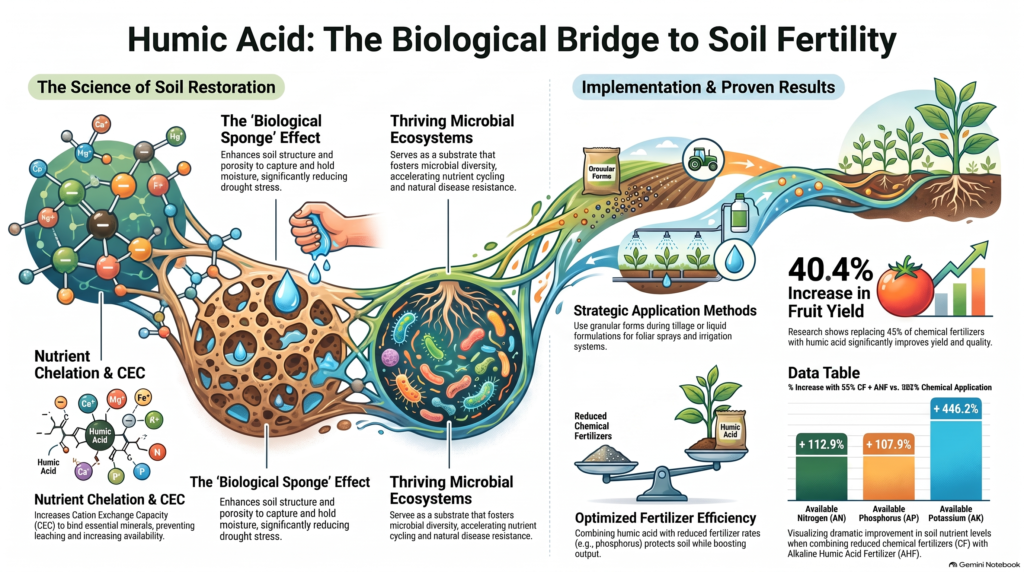
In the field, the theoretical mechanisms of humic acid translate into clear, measurable changes in plant vigor and stress tolerance. During drought-prone seasons, one of the most remarkable transformations I regularly observe is how humic acid alters soil water retention and root expansion. By improving soil aggregate structure and increasing Cation Exchange Capacity (CEC), humic substances act like a biological sponge, holding onto positively charged ions like potassium, calcium, and magnesium that would otherwise leach past the root zone.
From a pest and stress management standpoint, a plant backed by a robust, microbially active rhizosphere is infinitely more resilient against disease pressures and environmental shifts. When advising farm managers on integration, I always emphasize that timing and method matter just as much as product quality.
Combining liquid or granular humic acid with reduced rates of commercial fertilizers such as phosphorus or potassium blends drastically improves efficiency while protecting soil health. We see stronger root architecture, deeper soil penetration, and active nutrient cycling driven by thriving microbial populations. It’s not just about hitting high yield numbers for one harvest; it’s about rebuilding depleted soils so they remain productive and fertile for decades to come.
When you incorporate humic acid into your soil, you greatly enhance microbial activity, which is crucial for nutrient cycling and overall soil health. Humic acid is a natural organic macromolecular compound and a major component of humus. It is not a single acid, but rather a mixture composed of many complex molecules containing functional groups such as carboxyl and phenolic hydroxyl groups.
Humic acid serves as an organic substrate that fosters microbial diversity, promoting a more resilient soil ecosystem. This increased microbial activity improves the breakdown of organic matter, facilitating the release of essential nutrients that plants can readily absorb.
In addition, a diverse microbial community strengthens soil structure and enhances its ability to retain moisture, creating an ideal environment for plant growth.
As you boost microbial activity with humic acid, you empower the soil’s natural processes, leading to a more sustainable and productive agricultural system.
Embracing this approach elevates your soil health to new heights, ensuring long-term fertility.
Benefits of Humic Acid for Crop Yields
By enhancing soil fertility, humic acid directly contributes to improved crop yields, making it an essential component of modern agricultural practices.
This organic compound increases nutrient availability and facilitates better water retention, leading to optimized crop performance. When you apply humic acid, you’re enabling roots to absorb essential minerals more efficiently, which helps plants thrive even in suboptimal conditions.
Additionally, humic acid enhances microbial activity, further enriching the soil ecosystem, and boosting overall plant health. As a result, you can expect not only higher yields but also improved quality of produce.
How to Use Humic Acid in Agriculture
To effectively use humic acid in agriculture, you’ll need to understand the various application methods available, as well as the ideal timing and frequency for your specific crops.
Additionally, determining the appropriate dosage is essential for maximizing benefits while avoiding potential over-application.
Application Methods Overview
While understanding the benefits of humic acid is essential, knowing how to apply it effectively in agricultural settings is equally important.
You can enhance soil fertility through various application techniques tailored to specific product formulations. For granular forms, incorporate humic acid directly into the soil during tillage to maximize its interaction with soil particles.
Liquid formulations, on the other hand, can be applied via foliar sprays or irrigation systems, providing immediate absorption. Additionally, consider blending humic acid with fertilizersto boost nutrient efficiency, especially when using phosphorus fertilizers, as humic acid can help improve phosphorus availability and reduce nutrient loss in the soil.
Each method has distinct advantages, so evaluate your soil conditions and crop requirements to determine the best approach. By strategically applying humic acid, you can greatly enhance soil quality and optimize crop yields.
Timing and Frequency Guidelines
Timing and frequency play a significant role in maximizing the benefits of humic acid in agricultural practices.
To guarantee prime results, adhere to specific application schedules and make seasonal adjustments as needed.
- Apply humic acid during the early growth stages to enhance root development.
- Schedule follow-up applications at critical growth intervals to maintain nutrient availability.
- Adjust timing based on seasonal conditions, factoring in rainfall and temperature variations.
Dosage Recommendations for Crops
When applying humic acid in agriculture, understanding the appropriate dosage is essential for optimizing crop performance.
Generally, you should follow dosage guidelines that recommend 2 to 5 gallons per acre for conventional farming and 1 to 3 gallons per acre for organic practices. Adjustments may be necessary based on soil type, crop species, and specific growth stages.
For foliar applications, a concentration of 0.5% to 1% is effective, ensuring you mix it with water adequately.
Monitoring your crops’ response to humic acid is vital; this way, you can fine-tune the dosage for maximum impact.
Best Practices for Incorporating Humic Acid Into Soil Management
Incorporating humic acid into your soil management practices can greatly enhance soil fertility and structure, provided you follow a few best practices.
First, always choose high-quality humic acid products, as their effectiveness can vary.
Next, consider the timing of application; integrating humic acid during soil preparation or planting can yield ideal results.
Finally, monitor soil pH and moisture levels to guarantee the best uptake of humic acid.
- Use humic acid alongside other soil amendments for synergistic effects.
- Apply in conjunction with regular soil testing to adjust rates effectively.
- Implement a consistent application schedule to maintain soil health over time.

RELATED STUDIES ABOUT HUMIC ACID ACTIVE INGREDIENT AGRICULTURE
Incorporating humic acid into your soil management practices can greatly enhance fertility and crop yields. For instance, a farmer in California saw a 30% increase in tomato yields after applying humic acid to his fields, improving nutrient uptake and soil structure. By implementing best practices for humic acid use, you can effectively boost microbial activity and water retention, leading to healthier crops and more sustainable agricultural systems. Don’t miss the opportunity to elevate your soil health and productivity.
Enhancing passion fruit (Passiflora edulis f. flavicarpa Degener) agriculture with application of alkaline humic acid fertilizer and chemical fertilizer: A effective approach to soil and fruit quality optimization
This study addresses the agricultural challenges of continuous cropping and excessive chemical fertilizer (CF) application, which lead to soil nutrient depletion and acidification in passion fruit cultivation. The research evaluated the impact of combining alkaline humic acid fertilizer (AHF) with reduced chemical fertilizer rates to improve soil quality, yield, and fruit nutritional components.
Key Findings
- Soil Optimization: The application of 55% CF + AHF (a 45% reduction in CF supplemented with AHF) significantly improved soil nutrient levels compared to 100% CF treatment at the fruiting stage, specifically increasing available nitrogen (AN) by 112.9%, available phosphorus (AP) by 107.9%, and available potassium (AK) by 446.2%.
- Yield and Quality Improvements: This optimized treatment resulted in a 40.4% increase in fruit yield compared to the 100% CF control. Additionally, it enhanced key fruit quality parameters, including the sugar/acid ratio, vitamin C content, and total amino acid levels.
- Metabolomic Enrichment: Metabolomics analysis revealed that the 55% CF + AHF group was enriched in functional small molecules such as piceatannol, isoorientin, phytosphingosine, and flavor-related compounds. Conversely, higher application rates of chemical fertilizers were associated with reduced levels of functional oligopeptides.
Conclusion
The study concludes that the 55% CF + AHF treatment serves as a viable strategy for sustainable passion fruit cultivation. By replacing a significant portion of chemical fertilizer with alkaline humic acid fertilizer, growers can mitigate soil degradation caused by continuous cropping while simultaneously enhancing fruit yield and functional quality.
| REFERENCE: Qiong Fan, Junyan Yu, Jian Feng, Huiyu Wu, Yuanda Jiu, Xiaofang Wu, Qun Zhang, Zhi Xu, Zhenzhen Xu, Enhancing passion fruit (Passiflora edulis f. flavicarpa Degener) agriculture with application of alkaline humic acid fertilizer and chemical fertilizer: A effective approach to soil and fruit quality optimization, Environmental Technology & Innovation, Volume 39, 2025, 104214, ISSN 2352-1864, https://doi.org/10.1016/j.eti.2025.104214. (https://www.sciencedirect.com/science/article/pii/S2352186425002007) |
Transcriptome datasets of maize plant cultures treated with humic- and amino acids
This study provides comprehensive transcriptome datasets to facilitate the analysis of how plant conditioners—specifically humic acid and amino acid-based foliar fertilizers—influence gene expression in maize (Zea mays). As the agricultural sector increasingly seeks environmentally benign and sustainable alternatives to synthetic fertilizers, these data offer a resource for understanding the molecular mechanisms behind plant conditioning.
Key Data Overview
- Experimental Scope: Maize plants were subjected to five different treatments, including an untreated control, pure humic acid, and various combinations of humic acid with nitrogen, boron/sulfur, or amino acids. Leaf tissue samples were collected five days post-treatment for RNA-seq analysis.
- Methodology: Using the Illumina NovaSeq 6000 platform, the study generated raw, single-end sequencing reads (63 bp). These reads were pre-processed and used for de novo transcriptome assembly, resulting in a dataset comprising 2,279 total transcripts and 1,980 total genes.
- Data Availability: The researchers have made the data publicly accessible to support further scientific inquiry:
- NCBI Accession: PRJNA1141959 (Bioproject) and individual SRA datasets for each treatment (SRR30037655–SRR30037659).
- Supplementary Data: Annotated contigs and RNA-seq count tables are available via the Mendeley database (doi: 10.17632/dj9ppg9mt3.2).
Significance of the Datasets
The published data enables diverse research opportunities, including monitoring alterations in plant biochemical processes at the gene expression level and exploring how these fertilizers mitigate abiotic stress. By providing a detailed map of gene-level responses to natural conditioners, these datasets support the development of precision, sustainable, and eco-friendly agricultural practices.
| REFERENCE: Kincső Decsi, Mostafa Ahmed, Roquia Rizk, Donia Abdul-Hamid, Zsolt Vaszily, Zoltán Tóth, Transcriptome datasets of maize plant cultures treated with humic- and amino acids, Data in Brief, Volume 57, 2024, 110900, ISSN 2352-3409, https://doi.org/10.1016/j.dib.2024.110900. (https://www.sciencedirect.com/science/article/pii/S2352340924008631) |
Effects of cow manure and humic acid on Echinacea purpurea (L.) performance and essential oils accumulation under drought conditions
This study investigated how integrated fertilization strategies involving cow manure (CM) and humic acid (HA) influence the performance, productivity, and essential oil accumulation of coneflower (Echinacea purpurea) under drought stress conditions. Given the challenges semi-arid agroecosystems face with water scarcity and nutrient management, the research aimed to identify sustainable alternatives to chemical fertilizers (CF).
Key Findings
- Optimal Treatment: The application of 15 t/ha of cow manure combined with 1 kg/ha of humic acid (CMH 3:1) proved to be the most effective treatment. This specific combination resulted in the highest plant height, stem and leaf counts, flower production, aboveground biomass, and essential oil yield under drought conditions.
- Drought Tolerance: The CMH(3:1) and CMH(1:1) treatments maintained consistent stem and flower weights regardless of water status, whereas other treatments suffered significant reductions under drought. Notably, the CMH(3:1) treatment under drought outperformed chemical fertilizer (CF) under non-drought conditions in terms of aboveground biomass (34% higher) and essential oil yield (9% higher).
- Physiological Response: While drought stress generally increased proline content as an osmotic adjustment across all fertilizer treatments, the integrated manure-humic acid approach helped maintain higher photosynthetic pigment levels and relative water content (RWC). Specifically, manure application improved soil water retention, which mitigated drought impacts.
Conclusion
The study concludes that integrating humic acid with cow manure is a viable, eco-friendly alternative to mineral fertilizers for coneflower cultivation. This approach not only optimizes production under varying water availability but also addresses the soil degradation risks associated with excessive chemical fertilizer use. The CMH(3:1) ratio is recommended for achieving optimal growth and essential oil performance in water-limited environments.
| REFERENCE: Mojtaba Farhadian, Sina Fallah, Hans-Peter Kaul, Aliyeh Salehi, Effects of cow manure and humic acid on Echinacea purpurea (L.) performance and essential oils accumulation under drought conditions, Industrial Crops and Products, Volume 222, Part 3, 2024, 119826, ISSN 0926-6690, https://doi.org/10.1016/j.indcrop.2024.119826. (https://www.sciencedirect.com/science/article/pii/S092666902401803X) |
CONCLUSION
As we look toward the future of sustainable crop production, reducing reliance on pure synthetic inputs isn’t just an environmental preference, it’s an economic imperative for modern agriculture. The scientific literature and real-world trials repeatedly demonstrate that humic acid active ingredients offer a proven path to balancing soil health with peak crop performance.
Incorporating humic substances into your integrated soil management program provides a permanent uplift in nutrient retention, microbial activity, and overall soil structure. My core recommendation to growers and ag-tech teams is always to approach humic acid as a foundational investment rather than an optional add-on. Start by testing your baseline soil conditions, pair humic applications with balanced nutrient schedules, and give the soil biology time to respond.
When you work in harmony with natural organic processes, you don’t just achieve higher yields and better quality produce, you cultivate a resilient agricultural system capable of weathering climate variability and market demands. Building fertile, living soil takes intention, but leveraging the power of humic acid is easily one of the most effective strategies you can implement today.