
As a materials scientist with a focus on cosmetic delivery systems, I often see people treat retinol like a magic bullet while completely ignoring the physics of how it interacts with their skin barrier. We love to talk about what active ingredients do, but we rarely slow down to evaluate how they are delivered and absorbed. Early in my career, when I was first playing around with high-potency Vitamin A formulations, I made the classic mistake of assuming more active molecules meant faster, better results.
I quickly learned that overloading the stratum corneum with competing actives without considering their molecular weight, vehicle, or skin cell turnover mechanics is a fast track to inflammation and barrier dysfunction.
Good skin care isn’t about throwing every popular bottle on your vanity onto your face at once it’s about smart formulation and intentional layering. Retinol is undoubtedly one of the most thoroughly researched derivatives we have, but pairing it safely with other actives requires a respect for skin chemistry. If you’ve ever experienced severe peeling or stinging simply from applying a product too close to delicate areas, you know how delicate this balance can be. Let’s take a look at how to layer your routine strategically, so you can maximize results without stripping your skin.
To use retinol alongside other active ingredients safely, start with a patch test to assess your skin’s sensitivity. Pair vitamin C in the morning and retinol at night to reduce the risk of irritation. Incorporate hydrating agents like hyaluronic acid to maintain moisture. Avoid over-exfoliation by alternating exfoliating acids with retinol applications. Keep an eye on any signs of irritation, adjusting your routine as needed. Continue exploring strategies to balance your skincare regimen effectively.
Key Takeaways
- Always patch test new active ingredients before combining them with retinol to prevent adverse reactions.
- Use vitamin C in the morning and retinol at night to minimize irritation and enhance effectiveness.
- Gradually introduce new products to your routine to monitor skin reactions and avoid overwhelming your skin.
- Ensure adequate hydration by layering hyaluronic acid under retinol and using a moisturizer afterward to maintain skin health.
- Adjust frequency and concentrations of retinol based on signs of irritation, allowing skin to adapt gradually for optimal results.
WHAT YOU NEED TO KNOW ABOUT RETINOL AND ITS BENEFITS
When it comes to skincare, understanding retinol is essential because it’s one of the most researched and effective ingredients available. Retinol is a form of vitamin A with many uses in skin care. It’s used to treat acne and has anti-aging effects. You can buy retinol over the counter (without a prescription) or visit your healthcare provider to discuss how retinol might best fit into your skincare routine. Your provider may prescribe medications that contain higher concentrations of retinoids than you can get over the counter.
Retinol benefits include its ability to accelerate skin cell turnover, promoting skin rejuvenation and enhancing texture. It effectively reduces fine lines, wrinkles, and hyperpigmentation while improving overall radiance.
By stimulating collagen production, retinol strengthens your skin’s structure, making it more resilient. Incorporating retinol into your routine isn’t just about beauty; it’s a strategic move for long-term skin health.
However, it’s important to start slowly to minimize irritation. As you harness the power of retinol, you’ll notice significant improvements in your skin’s appearance and health, asserting your commitment to a transformative skincare regimen.
Embrace retinol to elevate your skincare game.
Why You Should Patch Test New Actives Before Combining
Before combining new active ingredients with retinol, it’s essential to patch test them first. “Retinoids is an umbrella term,” says Dr. Sugai. “Retinol, retinal, and retinyl fall under the category of over the counter retinoids.”All retinoids are Vitamin A derivatives that speed cell turnover. Over-the-counter retinoids undergo one or more conversions within the skin to become retinoic acid, which is the compound that creates the desired changes. Retinol undergoes two conversions, and retinal gets converted just once, making it the strongest OTC retinoid on the market.
This simple step helps you identify any adverse skin reactions early, preventing potential irritation.
Gradually introducing ingredients allows your skin to adjust and minimizes the risk of overwhelming it.
Importance Of Patch Testing
Patch testing is essential for anyone looking to incorporate new active ingredients into their skincare routine, especially retinol. This vital step helps you assess your skin’s sensitivity to new products before fully integrating them.
By applying a small amount of the active to a discreet area, you can identify potential reactions without risking widespread irritation. This is particularly important with potent ingredients like retinol, which can trigger redness or peeling in sensitive skin types.
Remember, understanding your skin’s unique response allows you to make informed decisions, ensuring a balanced regimen that maximizes benefits while minimizing adverse effects.
Prioritize patch testing to empower your skincare journey and maintain healthy, resilient skin.
Identifying Skin Reactions
Understanding how your skin reacts to new active ingredients is essential, especially when combining them with established products.
Before diving into a full regimen, patch testing helps you identify potential irritation triggers. When you introduce retinol or other actives, your skin’s sensitivity may fluctuate, leading to redness, peeling, or discomfort.
By applying a small amount of the new product on a discreet area, you can monitor your skin’s response over 24-48 hours. If irritation occurs, you can adjust your routine accordingly to prevent adverse reactions.
This proactive approach not only empowers you to make informed choices but also enhances your skin’s resilience, ensuring a smoother, more effective integration of potent ingredients into your skincare arsenal.
Gradual Ingredient Introduction
Introducing new active ingredients can greatly enhance your skincare routine, but doing so without caution can lead to unwanted reactions. To maximize ingredient tolerance and minimize adverse effects, practice a gradual increase in exposure.
Here’s why patch testing is essential:
- It identifies your skin’s unique reactions to new actives.
- You can monitor for irritation or sensitivity before full application.
- It helps you build a regimen that works harmoniously with your skin.
Start with one active at a time, applying it to a small area for several days. If your skin responds positively, gradually incorporate it into your routine.
This method guarantees that you’re not overwhelming your skin and allows for a more powerful, effective approach to skincare.
How to Pair Retinol and Vitamin C Without Irritation?
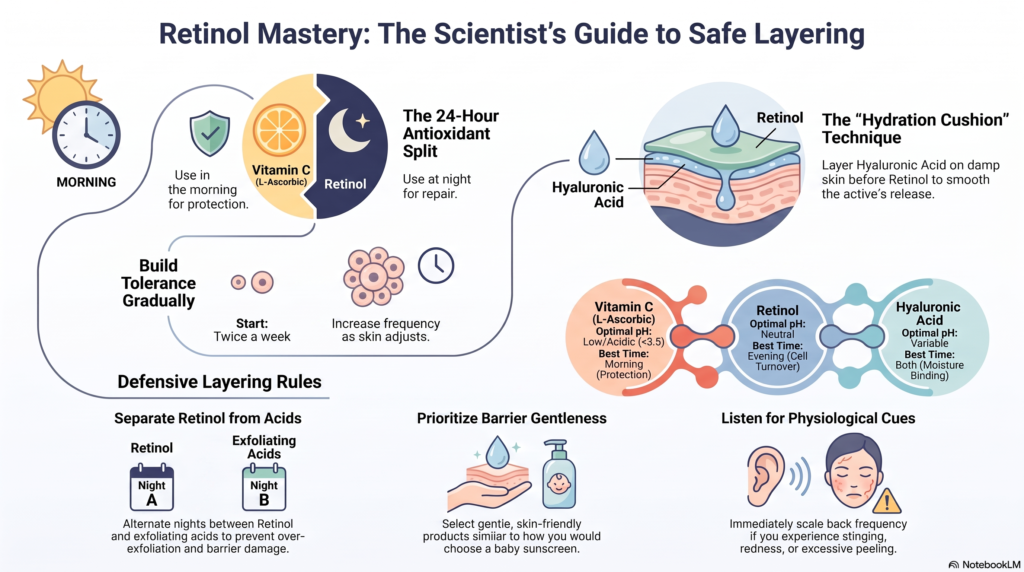
From a formulation standpoint, the way active ingredients interact on your skin comes down to molecular stability and delivery vehicles. A common mistake I see skincare enthusiasts make is trying to layer pure Vitamin C (L-ascorbic acid) directly with retinol in the same nighttime step. L-ascorbic acid requires a very low, acidic pH (typically under 3.5) to penetrate efficiently, whereas retinoid conversion functions much better in a higher, more neutral pH environment.
Throwing them together at once not only risks localized irritation especially around high-sensitivity zones like the corners of the mouth, but it can actually destabilize the active pharmaceutical ingredients you paid good money for.
My rule of thumb, both in the lab and in my own minimal skincare routine, is temporal separation: let antioxidants like Vitamin C protect your skin during daylight hours, and reserve your retinoids for night work when cell turnover and barrier repair naturally peak. Furthermore, don’t overlook basic hydration mechanics. Layering a water-binding agent like hyaluronic acid onto damp skin before applying your retinol acts like a molecular cushion, smoothing out the release curve of the active without compromising its efficacy. Smart formulation is always about workability, not brute force.
While retinol and vitamin C are both powerhouse ingredients for your skin, combining them can sometimes lead to irritation if not done correctly.
To guarantee peak retinol compatibility, consider using them at different times of the day. Apply vitamin C in the morning, allowing its antioxidant properties to protect your skin from environmental stressors. Reserve retinol for your nighttime routine, where it can work effectively without interference.
When selecting a vitamin C formulation, opt for a stable version, like sodium ascorbyl phosphate, which is less irritating and works well alongside active pharmaceutical ingredient formulations commonly used in evidence-based skincare routines.
Always patch-test new products and introduce them gradually. With this approach, you can enjoy the benefits of both ingredients without compromising your skin’s health.
BOOSTING HYDRATION WITH RETINOL AND HYALURONIC ACID
To enhance the effects of retinol and minimize dryness, incorporating hyaluronic acid into your skincare routine is a smart move.
This powerhouse combination not only amplifies the hydration benefits but also guarantees your skin remains supple and resilient.
Here are some hydration tips to maximize your results:
- Layer hyaluronic acid under your retinol for ideal moisture retention.
- Apply on damp skin** to boost absorption and enhance hydration levels.
- Use a moisturizer afterward to lock in the benefits and further combat dryness.
Avoiding Over-Exfoliation With Retinol and Acids
When using retinol and exfoliating acids together, it’s vital to avoid over-exfoliation, which can lead to irritation and compromised skin barriers. Both ingredients have potent effects on skin cell turnover, so understanding ingredient compatibility is important.
To minimize over-exfoliation risks, consider alternating their application days or employing a layered approach, allowing your skin to adapt. Start with lower concentrations of acids and gradually increase usage as your skin builds tolerance.
Always listen to your skin—if you notice redness or excessive dryness, it’s a sign to scale back. Similar to choosing a baby sunscreen for delicate skin, selecting gentle, skin-friendly products can help minimize the risk of irritation. Prioritizing a balanced routine guarantees you harness the benefits of both retinol and acids without damaging your skin, empowering you with a radiant and resilient complexion.
Building a Balanced Skincare Routine With Retinol
To build a balanced skincare routine with retinol, you’ll need to understand effective layering techniques and the best timing for your applications. Retinol is one of those skincare ingredients that seems to have a bit of mystery and magic around it but at its core, it’s simply a derivative of Vitamin A, a nutrient essential for healthy skin renewal.
Start by applying retinol after cleansing and before heavier creams to maximize its absorption and benefits.
Additionally, spacing your retinol use with other active ingredients guarantees you avoid irritation while maintaining your skin’s health.
Layering Techniques Explained
Understanding how to layer your skincare products effectively can make all the difference when incorporating retinol into your routine.
Mastering layering techniques enhances your product formulation, maximizing the benefits while minimizing irritation.
- Start with a gentle cleanser to prep your skin.
- Apply retinol on dry skin to prevent pilling and guarantee ideal absorption.
- Follow with a hydrating serum or moisturizer to lock in moisture and soothe your skin.
Timing Your Applications
While establishing a balanced skincare routine, timing your retinol applications is essential for achieving ideal results without overwhelming your skin.
Retinol is best applied in the evening, as this allows it to work overnight, minimizing UV exposure that can compromise its efficacy. During the day, follow with mineral sunscreen to help protect your skin, especially as retinol can increase sun sensitivity. Start with a low-frequency application—twice a week—and gradually increase as your skin adjusts. This approach prevents irritation while promoting tolerance.
Avoid using retinol in the morning, especially if you’re incorporating other actives like vitamin C or AHAs, as their combination can lead to sensitivity.
Recognizing Signs of Irritation and Adjusting Retinol Use?
Recognizing signs of irritation is essential for anyone using retinol, as it can help you maintain skin health and achieve desired results. Pay attention to your skin’s response and make necessary usage adjustments to prevent further irritation.
Common irritation signs include:
- Redness or inflammation
- Excessive dryness or peeling
- Stinging or burning sensations
If you notice these symptoms, consider reducing the frequency of application or switching to a lower concentration. Always prioritize your skin’s health over aggressive treatment.
Gradually reintroducing retinol can also help your skin acclimate without overwhelming it. By staying vigilant and responsive to irritation signs, you can harness the power of retinol effectively while minimizing discomfort.
RELATED STUDIES ON HOW TO USE RETINOL
Incorporating retinol into your skincare routine can feel like maneuvering through a maze, but with careful planning, you can reap its incredible benefits without the pitfalls of irritation. By understanding how to combine it with other active ingredients wisely, you’re not just enhancing your skin; you’re investing in your confidence. Remember, the path to healthy skin is not a sprint but a marathon—patience and awareness will guide you toward radiant results. Keep listening to your skin; it knows best.Retinol is best applied in the evening
Can you suggest a placement for this keyword “baby sunscreen”. It needs to blend in the existing content naturally. Bold the keyword on the suggested placement. Only show the placement of the keyword and not the entire article. Do not place it on headings or subheading. Do not also place it at the introduction and conclusion. Again the keyword is “baby sunscreen”
Inflammation Does Not Mediate Relationships between BMI/BMI-for-Age Z-Score and Retinol or Retinol-Binding Protein in Adult Women or Young Children without Underweight, Wasting, or Malaria: An Analysis of 24 Surveys
Background and Objective
- The primary goal of the study was to determine whether inflammation caused by overweight or obesity influences the interpretation of vitamin A (VA) biomarkers.
- Commonly used VA biomarkers, such as retinol and retinol-binding protein (RBP), are known to decrease during inflammatory conditions, such as acute infections.
- Because obesity is characterized by chronic, low-grade inflammation, the authors sought to understand if this adiposity-related inflammation also lowers circulating retinol and RBP, which could potentially complicate VA deficiency assessments in populations with high obesity rates.
Methodology
- The researchers conducted a cross-sectional analysis using data from 24 surveys within the Biomarkers Reflecting Inflammation and Nutritional Determinants of Anemia (BRINDA) project.
- The analytical sample included 16,771 non-pregnant adult women (aged 15-49 years) across 13 surveys and 24,707 preschool-aged children (aged 6-59 months) across 22 surveys.
- To isolate inflammation primarily related to weight status, the study specifically excluded individuals with underweight, wasting, or a positive malaria test result.
- The study utilized linear regression and structural equation modeling to assess the relationships and potential mediation among weight status (BMI or BMI-for-age z-score), inflammatory markers (C-reactive protein [CRP] and al-acid glycoprotein [AGP]), and VA biomarkers (retinol or RBP).
Key Findings: Adult Women
- BMI was positively associated with retinol or RBP concentrations in 5 of the 13 surveys evaluated.
- BMI was positively associated with the inflammatory markers CRP and/or AGP in 10 out of 13 surveys.
- The associations between inflammation markers and VA biomarkers were inconsistent in both direction and magnitude across the various women’s surveys.
- Inflammation partially mediated the relationship between BMI and retinol or RBP in only 3 of 13 surveys.
- Where mediation was present, the effects were inconsistent and extremely small in magnitude, representing less than a 1% change in biomarker concentration.
Key Findings: Young Children
- BMI-for-age z-score (BAZ) showed a positive association with retinol or RBP in 3 out of 22 surveys.
- BAZ was positively associated with CRP in only 1 survey, and showed no significant association with AGP in any of the surveys.
- Unlike the women’s group, inflammation biomarkers in children were consistently negatively associated with both retinol and RBP.
- Inflammation partially mediated the relationship between BAZ and retinol or RBP in only 1 of the 22 children’s surveys, and the significance was only marginal.
Conclusions and Recommendations
- The study concludes that inflammation associated with overweight or obesity does not significantly mediate the relationship between weight status and VA biomarkers.
- Consequently, obesity-related inflammation is unlikely to impact the assessment of population-level vitamin A status when measured via retinol or RBP.
- Current population assessment protocols do not require specialized statistical adjustments for adiposity-related inflammation.
- However, the consistent negative association between inflammation and VA biomarkers in children reinforces the recommendation that health programs must continue to measure inflammatory biomarkers (regardless of their underlying etiology) to accurately interpret vitamin A status in pediatric populations.
| REFERENCE: Jennie N Davis, Anne Williams, Charles D Arnold, Yaw Addo, Brietta M Oaks, James P Wirth, Parminder S Suchdev, Melissa F Young, Reina Engle-Stone, Inflammation Does Not Mediate Relationships between BMI/BMI-for-Age Z-Score and Retinol or Retinol-Binding Protein in Adult Women or Young Children without Underweight, Wasting, or Malaria: An Analysis of 24 Surveys, Current Developments in Nutrition, Volume 10, Issue 5, 2026, 107684, ISSN 2475-2991, https://doi.org/10.1016/j.cdnut.2026.107684. (https://www.sciencedirect.com/science/article/pii/S2475299126000491) |
Self-assembled nanoparticles from natural herbs alleviate osteoarthritis by targeting retinol metabolism and inhibiting chondrocyte ferroptosis
Overview and Objective Osteoarthritis (OA) is a leading degenerative joint disease with limited effective therapies capable of reversing structural cartilage damage. While traditional Chinese medicine—specifically the Shen-Sui-An-Kang (T-SSAK) decoction—shows clinical promise for OA, its application is hindered by poor water solubility and low bioavailability. This study investigates the isolation of self-assembled nanoparticles from the SSAK decoction (N-SSAK) and the development of an injectable hydrogel delivery system to improve targeted OA therapy.
Methodology and Innovation
- Nanoparticle Extraction: Researchers successfully isolated N-SSAK nanoparticles from the traditional decoction using gradient centrifugation and dialysis.
- Molecular Assembly: Molecular dynamics simulations revealed that these nanoparticles self-assemble primarily through hydrophobic interactions, supported by hydrogen bonding and stacking.
- Targeted Delivery System: To overcome the short joint retention time of direct injections, the team engineered HA-MIX@N-SSAK, a pH-responsive, injectable hyaluronic acid-based hydrogel loaded with the N-SSAK nanoparticles.
Key Findings
- Cartilage and Bone Protection: Both in vitro and in vivo (mouse model) testing demonstrated that N-SSAK effectively alleviated cartilage erosion, suppressed abnormal subchondral bone remodeling, and maintained cartilage matrix integrity.
- Symptom Relief: Treatment significantly reduced OA-associated joint pain sensitivity and restored normal gait and motor function in mice.
- Superior Hydrogel Performance: The HA-MIX@N-SSAK hydrogel outperformed standard N-SSAK oral administration by providing sustained, localized nanoparticle release in the joint cavity for up to 28 days.
Mechanisms of Action
- Regulating Retinol Metabolism: N-SSAK restored retinol metabolic balance by downregulating RBP4 and STRA6 expression and upregulating CYP26B1, effectively preventing the toxic accumulation of retinoic acid in chondrocytes.
- Inhibiting Ferroptosis: The nanoparticles protected cartilage cells from ferroptosis (iron-dependent lipid peroxidation) by restoring glutathione (GSH) levels, upregulating GPX4, and significantly reducing reactive oxygen species (ROS).
Conclusion
The study concludes that N-SSAK effectively delays the progression of osteoarthritis through the dual mechanisms of regulating retinol metabolism and inhibiting chondrocyte ferroptosis. The development of the HA-MIX@N-SSAK hydrogel system successfully bridges the gap between traditional herbal medicine and modern targeted drug delivery, offering a highly promising and translatable therapeutic strategy for clinical OA management.
| REFERENCE: Xuefeng Li, Yuhang Wang, Xucheng Wang, Wenzhe Chen, Ling Jin, Qinwen Ge, Jingyuan Wen, Pinger Wang, Wenhua Yuan, Yimin Yang, Luwei Xiao, Jiali Chen, Di Chen, Songfeng Hu, Hongting Jin, Self-assembled nanoparticles from natural herbs alleviate osteoarthritis by targeting retinol metabolism and inhibiting chondrocyte ferroptosis, Materials Today Bio, Volume 38, 2026, 103250, ISSN 2590-0064, https://doi.org/10.1016/j.mtbio.2026.103250. (https://www.sciencedirect.com/science/article/pii/S2590006426004941) |
Prenatal exposure to indoor VOCs impairs synaptic plasticity and cognitive function in mouse offspring via retinol metabolism disorder
Overview and Objective
- The study investigates the neurodevelopmental threats posed by prenatal exposure to realistic indoor volatile organic compounds (VOCs).
- Specifically, the researchers utilized a mouse model to determine how gestational exposure to a VOC mixture from commercially available “formaldehyde-free” paint affects synaptic maturation and cognitive function in postnatal offspring.
Methodology
- Pregnant C57BL/6J mice were exposed daily to either filtered laboratory air (control group at 0.15±0.01 ppm) or a paint-derived VOC mixture (exposed group at 0.68±0.06 ppm).
- The exposures lasted for 3 hours per day throughout the 21-day gestational period.
- Offspring were evaluated postnatally (days 14 through 35) using behavioral assessments, histopathological examinations, and transcriptomic sequencing of brain tissues.
Key Findings: VOC Composition and Physical Growth
- Complex Emissions: Despite being labeled “formaldehyde-free,” the paint emitted a complex mixture of 65 distinct VOCs. The emissions were predominantly composed of aromatics and alkenes (representing roughly 60% of the composition), alongside alkanes, halocarbons, and oxygenated VOCs.
- Physical Viability: Prenatal exposure to this VOC mixture did not significantly alter the offspring’s body weight, brain weight, or brain-to-body ratio. This indicates that the VOCs targeted neurobehavioral domains without causing overt systemic toxicity or gross growth impairments.
Key Findings: Cognitive and Neurological Impacts
- Cognitive Deficits: VOC-exposed offspring demonstrated distinct cognitive impairments. Behavioral tests revealed reduced spontaneous locomotor exploration, compromised recognition memory, and significant deficits in spatial learning and memory.
- Progressive Neurodegeneration: Histopathological analyses of the brain showed abnormal neuronal morphology, including cell shrinkage and nuclear condensation, leading to progressive neurodegeneration in the cortex and hippocampus.
- Synaptic Impairment: The exposed offspring suffered from reduced dendritic complexity and a decrease in dendritic spine density. Furthermore, there was a remarkable reduction in the expression of key synaptic proteins (PSD-95 and synaptophysin), indicating compromised synaptic formation and plasticity.
Mechanisms of Action
- Transcriptomic Disruption: RNA sequencing of the offspring’s brains revealed an escalating dysregulation of gene expression, with a strong downregulation of genes associated with neurodevelopment and synaptic transmission.
- Retinol Metabolism Disorder: The study identified the persistent downregulation of the retinol metabolism pathway as a central molecular mechanism for the observed neurotoxicity.
- Protein and Gene Suppression: VOC exposure caused a marked downregulation of Aldh1a2 (the crucial enzyme for retinoic acid synthesis) and Crabp2 (a binding protein essential for retinoic acid transport and signaling) at both the mRNA and protein levels.
Conclusions and Implications
- Prenatal exposure to realistic indoor VOC mixtures disrupts fetal brain development, leading to long-term synaptic and cognitive impairments via retinol metabolism disorder.
- These findings directly challenge the assumed safety of “eco-friendly” or “low-VOC” building materials in real-world, cumulative exposure scenarios.
- The study underscores the critical need to minimize maternal exposure to indoor air pollutants during pregnancy and highlights retinoid pathways as a potential target for neuroprotective interventions.
| REFERENCE: Jing Sun, Xin Zhou, Changjian Xiao, Zhuoyan Li, Caifang Xu, Xiji Qin, Jieru Lu, Yurong Wu, Jinping Cheng, Sun Chen, Jianyuan Zhao, Kun Sun, Prenatal exposure to indoor VOCs impairs synaptic plasticity and cognitive function in mouse offspring via retinol metabolism disorder, Journal of Hazardous Materials, Volume 501, 2026, 140688, ISSN 0304-3894, https://doi.org/10.1016/j.jhazmat.2025.140688. (https://www.sciencedirect.com/science/article/pii/S0304389425036088) |
CONCLUSION
When we strip away all the marketing hype surrounding active ingredients, effective skincare comes back to a foundational truth: respect the skin barrier. Throughout my years studying surfactant systems and encapsulation technologies, I’ve consistently seen that gentle, sustained delivery beats aggressive layering every single time.
Retinol is a phenomenal tool for cellular renewal, but it should never be treated as a test of endurance for your skin. If you start noticing micro-tears, flaking, or burning, your skin isn’t “purging” in a healthy way; it’s telling you that its barrier lipids are compromised. Skincare should never feel like a high-risk guessing game.
By taking a thoughtful, minimalist approach, spacing out your potent actives, prioritizing hydration, protecting your skin daily, and listening to subtle physiological cues, you allow these brilliant ingredients to do their job properly. Remember, building a resilient, radiant complexion is a long-term ritual rooted in smart science, not an overnight sprint. Keep your routine simple, stay consistent, and let the chemistry work for you.