
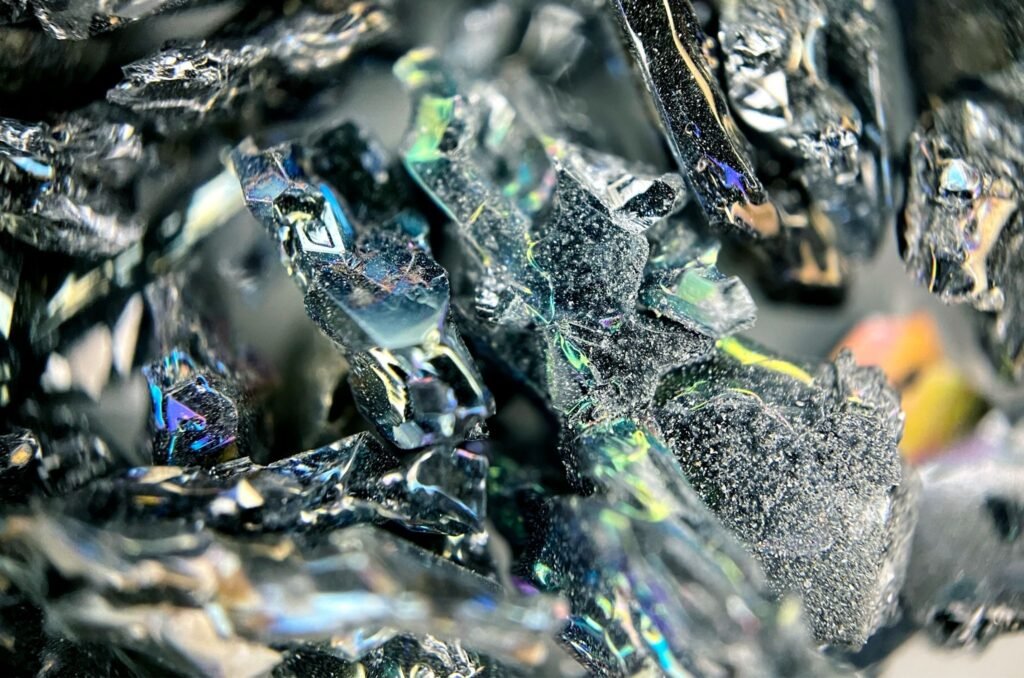
Throughout my research on metal powder characterization and alloy composition both during my doctoral studies at Tsinghua and in subsequent industrial additive manufacturing applications, I have consistently seen engineers treat the 10.5% chromium threshold as a routine checkbox in alloy specifications. However, viewing chromium as merely a baseline requirement overlooks the subtle, active physics occurring at the atomic level.
In practical manufacturing environments, achieving a resilient passive oxide film involves balancing elemental kinetics under thermal stress. When evaluating materials for high-performance components whether forged traditionally or printed layer-by-layer via laser powder bed fusion the structural stability provided by chromium relies heavily on precise composition control.
Small variations in chromium ratios drastically change carbide formation pathways, matrix strengthening mechanisms, and local oxidation behavior. Understanding this relationship requires viewing chromium not as a static ingredient, but as a dynamic stabilizing element that dictates how an alloy withstands mechanical degradation and corrosive environments over long operational lifespans.
Chromium is essential in stainless steel, increasing its strength and durability considerably. By forming a protective oxide layer, it prevents rusting and enhances corrosion resistance. Chromium improves tensile and fatigue strength, allowing stainless steel to endure higher loads and harsh environments. Ideal chromium levels range from 10.5% to over 25%, each providing varying benefits. Understanding these properties can help you appreciate how chromium-boosted stainless steel performs better in everyday applications and specialized industries.
KEY TAKEAWAYS
- Chromium enhances tensile strength, allowing stainless steel to withstand higher loads and improve fatigue resistance under cyclic loading conditions.
- The protective chromium oxide layer prevents corrosion, ensuring the longevity and reliability of stainless steel in harsh environments.
- Increased chromium concentration improves mechanical properties, resulting in superior durability and stress resistance for demanding applications.
- Chromium stabilizes the microstructure during welding, reducing distortion and enhancing ductility for robust, reliable welds.
- Industry standards ensure that chromium-enhanced stainless steel meets specific requirements for strength and durability across various applications.
WHAT IS STAINLESS STEEL AND WHY IS CHROMIUM IMPORTANT?
Stainless steel is an alloy primarily composed of iron, carbon, and a minimum of 10.5% chromium, which plays an essential role in its properties. The addition of chromium enhances the alloy’s strength, corrosion resistance, and aesthetic appeal, making it indispensable in various stainless steel applications. Stainless steel is an alloy of iron that contains at least 10.5% chromium, which gives it its characteristic resistance to corrosion. The composition of stainless steel varies depending on the grade, with each variant offering a unique combination of properties. Stainless steel can be divided into several categories, including austenitic, martensitic, and ferritic types, with each type containing specific proportions of alloying elements.
You’ll find stainless steel utilized in industries ranging from automotive to construction, where durability is paramount. The chromium benefits extend beyond mere appearance; it forms a passive layer that protects the underlying metal, ensuring longevity and reliability.
With its ability to withstand harsh environments, stainless steel proves a superior choice for demanding applications. Understanding the significance of chromium in this alloy empowers you to make informed decisions for your projects, optimizing performance and sustainability.
The chromium used in stainless steel is typically produced through Electrolytic Refining, a purification process that helps achieve the high metal purity needed to deliver consistent corrosion resistance, strength, and long-term durability in stainless steel alloys.
How Does Chromium Keep Stainless Steel From Rusting?
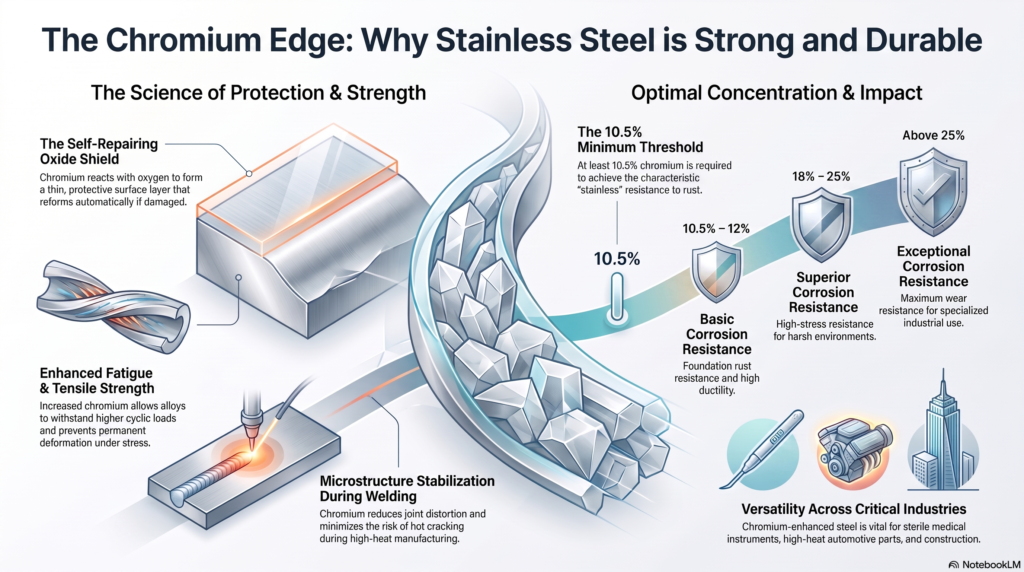
When exposed to moisture and oxygen, metals typically corrode, but chromium alters this outcome for stainless steel. The chromium properties create a thin, protective layer of chromium oxide on the surface, effectively shielding the underlying metal from environmental factors that cause rust.
This oxide layer is self-repairing; if damaged, it quickly reforms in the presence of oxygen, ensuring long-term protection. Consequently, stainless steel requires minimal maintenance, as this corrosion resistance greatly reduces the need for frequent protective coatings or treatments.
In stainless steel, chromium serves as the active ingredient responsible for forming the protective oxide layer that shields the metal from corrosion, helping maintain its strength, durability, and long-term performance in demanding environments.
By incorporating chromium into the alloy, you enhance both the durability and lifespan of stainless steel products, ensuring they remain resilient even in harsh conditions.
Understanding these mechanisms is essential for anyone involved in stainless steel maintenance and application.
Strengthening Stainless Steel: The Role of Chromium
When you consider the role of chromium in stainless steel, you’ll find it essential for enhancing both corrosion resistance and mechanical properties. The composition of stainless steel advantages many applications where strength, corrosion resistance, and surface quality are key. But what exactly is it that leads stainless steel to provide the protection and aesthetic appeal we’ve come to expect? It’s helpful to think about stainless steel as any steel alloy that contains at least 10.5% Chromium. The composition of stainless steel may also include Carbon, Silicon, Manganese, Phosphorus, Sulfur, Nickel, Molybdenum, and Titanium. Each of these alloying elements boost particular metal qualities. With many different stainless steel grades and various formats including stainless steel sheet and stainless steel plate, the manifold compositions of stainless steel result in an expansive list of possibilities.
Its presence not only strengthens the material but also affects its weldability, making it a critical element in various applications.
Understanding these aspects will help you appreciate how chromium contributes to overall performance and durability in stainless steel.
Chromium’s Corrosion Resistance
Chromium plays a pivotal role in enhancing the corrosion resistance of stainless steel, making it an essential alloying element. By incorporating chromium, you activate several critical mechanisms that combat corrosion and guarantee longevity.
These mechanisms include:
- Formation of Protective Layers**: Chromium reacts with oxygen to create a thin, passive film on the surface, shielding the steel beneath.
- Resistance to Pitting**: The presence of chromium considerably reduces susceptibility to localized corrosion.
- Enhanced Stress Corrosion Cracking Resistance: Chromium mitigates the effects of tensile stress in corrosive environments.
- Improved General Corrosion Resistance: Elevated chromium levels foster overall durability, allowing stainless steel to withstand aggressive corrosive media.
With these attributes, chromium fortifies stainless steel against various corrosion mechanisms, assuring its reliability in demanding applications.
Enhancing Mechanical Properties
The incorporation of chromium in stainless steel not only enhances corrosion resistance but also greatly improves its mechanical properties.
By increasing the chromium content, you notably boost stress resistance, allowing the material to withstand higher loads without permanent deformation. This enhancement is essential in applications where strength is paramount.
Additionally, chromium contributes to improved fatigue strength, which is critical for components subjected to cyclic loading. As a result, stainless steel exhibits greater durability and reliability over time, especially in harsh environments.
When you prioritize chromium in stainless steel compositions, you’re not just investing in corrosion resistance; you’re fortifying the mechanical integrity of your materials, ensuring they perform at their best under demanding conditions.
Impact on Weldability
Although you might think of chromium primarily for its role in enhancing corrosion resistance, it also plays an essential part in the weldability of stainless steel.
Understanding chromium’s impact helps you address various weldability challenges, ensuring ideal results with sophisticated welding techniques.
- Improved Heat Resistance**: Chromium stabilizes the microstructure during welding, reducing distortion.
- Reduced Risk of Cracking: Higher chromium content minimizes the likelihood of hot cracking in weld joints.
- Enhanced Ductility: Chromium contributes to better ductility, making the material easier to manipulate during welding.
- Increased Strength: The alloying element elevates the overall strength, allowing for robust and reliable welds.
OPTIMAL CHROMIUM LEVELS FOR SUPERIOR DURABILITY
In practical industrial metallurgy, the impact of chromium extends far beyond standard surface passivation. When working with high-carbon, high-chromium tool steels or specialized metal powders, controlling chromium behavior during thermal processing presents significant engineering challenges. Minor fluctuations in overall composition can alter carbide evolution. For instance, variations in cobalt or tungsten content alter the dissolution kinetics of M23C6 versus M7C3 carbides during austenitization. This directly impacts matrix chromium saturation, altering both achievable peak hardness and localized corrosion resistance.
Furthermore, when evaluating stainless steel alloys in high-temperature or reactive environments such as solid oxide fuel cell supports or jet engine manifolds chromium behavior becomes a key focus. While chromium diffusion forms essential protective Cr2O3 scales, uncontrolled element migration across interfaces can lead to local matrix depletion, phase degradation, or unintended interactions with adjacent catalyst layers.
In additive manufacturing and advanced coating technologies, optimizing chromium concentrations requires balancing mechanical strength and crack mitigation against potential microstructural embrittlement. Managing these trade-offs ensures consistent performance across demanding industrial environments.
To achieve superior durability in stainless steel, you need to understand the ideal chromium concentration range, which typically lies between 10.5% and 30%.
This specific range greatly enhances corrosion resistance, ensuring longevity in various environments.
Ideal Chromium Concentration Range
Ideal chromium concentrations in stainless steel typically range from 10.5% to 30%, with specific levels depending on the intended application and desired properties.
Understanding this range is essential for optimizing performance.
- 10.5% – 12%: Basic corrosion resistance and ductility.
- 12% – 18%: Enhanced strength and moderate corrosion resistance, ideal for general applications.
- 18% – 25%: Superior mechanical properties and resistance to oxidation, suited for harsh environments.
- Above 25%: Extremely high resistance to corrosion and wear, often used in specialized industrial applications.
Impact on Corrosion Resistance
When evaluating the impact of chromium levels on corrosion resistance, it’s clear that higher concentrations greatly enhance durability in stainless steel. Chromium plays an essential role in forming protective layers that inhibit corrosion mechanisms, ensuring long-lasting performance in harsh environments. Ideal chromium levels, typically between 10% and 30%, create a robust barrier against oxidizing agents, markedly reducing corrosion rates.
| Chromium Level (%) | Corrosion Resistance Rating | Protective Layer Formation |
| 10-15 | Moderate | Initial protective layers |
| 16-25 | High | Enhanced, stable layers |
| 26-30 | Superior | Exceptional corrosion barriers |
Everyday Uses of Chromium-Enhanced Stainless Steel
Because of its remarkable corrosion resistance and durability, chromium-enhanced stainless steel is essential to various everyday applications.
You’ll find it in multiple sectors, demonstrating its versatility and strength. Here are four key uses:
- Kitchen Appliances: From refrigerators to dishwashers, its resilience guarantees long-lasting performance and aesthetic appeal.
- Industrial Equipment: In manufacturing settings, it withstands harsh environments, making it ideal for tools and machinery.
- Medical Instruments: Sterilization and hygiene are vital; chromium-enhanced stainless steel meets these demands effectively.
- Cutlery and Cookware: Its balance of sharpness and resistance to rust makes it the preferred material for high-quality knives and pots.
In each case, chromium’s role is pivotal in enhancing performance and longevity. Industrial facilities involved in the gold cyanidation process also benefit from chromium-enhanced stainless steel, as its corrosion resistance helps extend the service life of tanks, pipes, and processing equipment.
Performance Benefits of Chromium in Everyday Stainless Steel Applications
Chromium considerably enhances the performance of stainless steel, making it a critical component in everyday applications. Its ability to improve corrosion resistance and tensile strength sets a benchmark in industry standards. When you examine performance comparisons, you’ll notice that chromium-rich stainless steel outperforms its counterparts, especially in harsh environments. This advantage translates into longer service life and reduced maintenance costs, ultimately driving efficiency and productivity.
| Application | Performance Benefit | Industry Standard |
| Kitchen Utensils | Enhanced corrosion resistance | ASTM A240 |
| Automotive Parts | Increased tensile strength | SAE J403 |
| Construction Steel | Superior durability under stress | ASTM A992 |
| Medical Devices | Biocompatibility and longevity | ISO 13485 |
Future of Stainless Steel: Innovations in Chromium Alloys
As industries continue to demand enhanced performance from materials, innovations in chromium alloys are shaping the future of stainless steel. These advancements focus on elevating strength, corrosion resistance, and overall functionality. Stainless steel is an iron-based alloy that contains chromium, making it resistant to rust and corrosion. Alternatively, it is known as inox (an abbreviation of the French term inoxydable, meaning non-oxidizable), corrosion-resistant steel (CRES), Nirosta (an abbreviation of the German term nichtrostender Stahl) or rustless steel. Stainless steel’s resistance to corrosion comes from its chromium content of 10.5% or more, which forms a passive film that protects the material and can self-heal when exposed to oxygen.: 3 It can be further alloyed with elements like molybdenum, carbon, nickel and nitrogen to enhance specific properties for various applications.
By leveraging chromium innovations, manufacturers can refine their products for extreme environments and demanding applications.
Key areas of focus include:
- High-performance alloys: Formulations that maximize chromium content for superior strength.
- Corrosion-resistant coatings: Enhancements that deliver longevity and reliability in harsh conditions.
- Lightweight composites: Integrating chromium alloys with other materials to achieve reduced weight without sacrificing durability.
- Smart alloys: Developing alloys that adapt to environmental changes, ensuring peak performance.
These alloy advancements will redefine the capabilities of stainless steel, positioning it as a leader in various industrial sectors.
RELATED STUDIES ABOUT CHROMIUM IN STAINLESS STEEL COMPOSITION
To summarize, chromium acts like a sturdy shield, enhancing the strength and durability of stainless steel. Its corrosion-resistant properties and ability to strengthen the metal guarantee that everyday applications remain reliable and long-lasting. As innovations in chromium alloys continue to emerge, the future of stainless steel looks promising, paving the way for even greater performance. Embracing these advancements will certainly lead to more resilient materials, making our world stronger, one alloy at a time.
Effect of composition fluctuations on the microstructural evolution and properties in the high carbon high chromium stainless tool steel
This study investigated the impact of subtle compositional differences on the microstructural evolution, hardness, and corrosion resistance of two powder metallurgical (PM) stainless tool steels, 18C6W and 19C5W, during the austenitization process. While these steels are similar in composition, they possess minor variations in Carbon (C), Tungsten (W), and Cobalt (Co) content, which lead to significant differences in material behavior.
Key Findings
- Carbide Population Differences: The subtle composition fluctuations significantly alter the types of carbides present. 18C6W retains M_{7}C_{3}, M_{23}C_{6}, and VC carbides, whereas 19C5W contains only M_{7}C_{3} and VC, with M_{23}C_{6} being absent due to its lower equilibrium dissolution temperature in the latter alloy (1005^C vs. 1051^C in 18C6W).
- Hardness Evolution: Carbide dissolution kinetics are critical for matrix strengthening. 18C6W achieves peak hardness earlier due to the ready dissolution of its M_{23}C_{6} carbides, reaching 65.66 HRC at 1075^C after 60 minutes. Conversely, 19C5W, dominated by more refractory M_{7}C_{3} carbides, requires higher temperatures (1110^C) to achieve a comparable peak hardness of 64.03 HRC.
- Corrosion Resistance: 18C6W exhibits superior corrosion resistance compared to 19C5W under short-duration or low-temperature heat treatment conditions. This is attributed to higher initial carbide content and lower matrix Chromium (Cr) concentration in 19C5W, which requires longer soaking times or higher temperatures to release enough Cr into the matrix to re-establish a passive film.
Conclusions and Recommendations
The study concludes that even negligible compositional fluctuations can critically alter the carbide evolution path and the resulting mechanical and corrosion properties of high-performance PM tool steels. The findings demonstrate that 19C5W is more thermodynamically sensitive and requires optimized, higher-energy heat treatment schedules compared to 18C6W to achieve desired performance. These results provide a quantitative theoretical foundation for optimizing austenitization parameters, enabling manufacturers to compensate for batch-to-batch compositional variations and ensure consistent industrial performance.
| REFERENCE: Wu, Dong Wu, Qinyi Zhang, Juncheng Ren, Yu Li, Shun Xu, Ruiling Huang, Yaojun Lin, Wei Liu, Effect of composition fluctuations on the microstructural evolution and properties in the high carbon high chromium stainless tool steel, Journal of Materials Research and Technology, Volume 41, 2026, Pages 1591-1603, ISSN 2238-7854, https://doi.org/10.1016/j.jmrt.2026.01.062. (https://www.sciencedirect.com/science/article/pii/S223878542600061X) |
Comparative evaluation of microstructure and electrochemical, high-temperature corrosion rates of titanium- and aluminum-modified black chromium coatings on AISI 304 stainless steel
This study investigated the microstructural, electrochemical, and high-temperature corrosion resistance of black chromium coatings modified with titanium (TiOy) or aluminum (AlOz) oxides, applied to AISI 304 stainless steel via electrodeposition. The research aimed to develop improved protective coatings for industrial applications, particularly for components in nuclear power plants (such as WWER reactors) where stainless steel is susceptible to pitting and intergranular corrosion.
Key Findings
- Surface Morphology & Crack Reduction: Modification with titanium or aluminum oxides significantly altered the coating structure. Conventional black chromium coatings exhibit a crack-like structure; however, modification with AlOz and TiOy reduced both the quantity and width of these cracks. Coatings modified with AlOz were nearly crack-free.
- Enhanced Corrosion Resistance: Potentiodynamic polarization and electrochemical impedance spectroscopy (EIS) demonstrated that modified coatings significantly improve resistance to pitting corrosion compared to uncoated steel. The Cr CrOx AlOz coating exhibited the highest protective properties, with a passive current density 6–7.5 times lower than uncoated steel after 5 days of exposure in a 6 wt% NaCl solution.
- Crystallinity & Barrier Properties: XRD analysis revealed that the modified coatings are crystalline. AlOz -modified coatings demonstrated a higher degree of crystallinity and larger crystallites (~9.39 nm), which facilitates dense atomic packing and improves barrier properties against corrosive agents like chloride ions .
- High-Temperature Performance: Corrosion tests in a water vapor environment up to 800^C showed that all coatings provide protection, with the mass gain of coated samples being significantly lower than that of uncoated steel. At 800C, the mass gain for uncoated steel was 220.0 mg dm-2, while samples coated with Cr CrOx AlOz showed a mass gain of only 8.83mgdm^-2.
Conclusions and Recommendations
The study concludes that modifying black chromium coatings with titanium or aluminum oxides is a highly effective strategy for enhancing the corrosion and high-temperature oxidation resistance of AISI 304 stainless steel. The aluminum oxide modification is superior to the titanium oxide modification, primarily due to its ability to form a denser, crack-free, and highly crystalline protective layer. While protective properties decrease at temperatures above $900^C due to shedding, these modified coatings significantly extend the operational life of steel structures in aggressive environments.
| REFERENCE: Viktoriia Shtefan, Nadiia Kanunnikova, Valeriy Zuyok, Comparative evaluation of microstructure and electrochemical, high-temperature corrosion rates of titanium- and aluminum-modified black chromium coatings on AISI 304 stainless steel, Surface and Coatings Technology, Volume 497, 2025, 131706, ISSN 0257-8972, https://doi.org/10.1016/j.surfcoat.2024.131706. (https://www.sciencedirect.com/science/article/pii/S0257897224013380) |
Chromium-diffusion-induced degradation in metal-supported solid oxide fuel cells with porous stainless-steel supports
This study investigates the long-term degradation mechanisms of metal-supported solid oxide fuel cells (MS-SOFCs) utilizing porous stainless-steel (21Cr alloy) supports. Given the susceptibility of these materials to high-temperature oxidation in humidified hydrogen atmospheres, researchers conducted an 8400-hour durability test to correlate microstructural changes with cell performance.
Key Findings
- Durability Performance: Over 8400 hours of operation at 600^C, the cell exhibited a degradation rate of 5.2%/1000h. While performance declined, no delamination or pore blockage was observed, suggesting the overall structural integrity of the cell was maintained.
- Anode Degradation Mechanisms:
- Breakaway Oxidation: Fine stainless-steel alloy particles within the anode bonding layer experienced severe oxidation. Chromium (Cr) diffused from these particles into the ScYSZ (scandia-stabilized zirconia) phase, leading to Cr depletion in the alloy and the formation of low-conductivity iron/chromium oxides .
- Ni Catalyst Poisoning: Cr and Fe diffused from the bonding layer into the Ni catalyst particles in the anode. This Cr-Ni interaction is believed to suppress hydrogen oxidation activity, directly contributing to increased polarization resistance .
- Oxide Scale & Resistance: Using deep learning-based volumetric segmentation (3D U-Net), the researchers quantified the growth of Cr_2O_3 scale. Although oxidation increased the ohmic resistance, the study concluded that the contribution of the porous metal support oxidation to the overall area-specific resistance (ASR) remained minimal (7.3 m Omega cm^2) even after 8400 hours.
Conclusions and Recommendations
The study identifies the dominant degradation factors as:
- Activity loss due to Cr poisoning of the Ni anode catalyst.
- Increased electrical resistance resulting from Cr_2O_3 accumulation at the anode/metal support interface.
- Breakaway oxidation of fine stainless-steel particles under highly humidified conditions.
Future Mitigation Strategies:
To improve the long-term durability of MS-SOFCs, the researchers suggest optimizing the pre-oxidation process to create a more effective protective barrier and increasing the particle size of the stainless-steel support to provide a larger Cr reservoir. Furthermore, avoiding the placement of fine alloy particles near the anode backbone interface—or replacing them with electronically conductive perovskite oxides—could mitigate Cr diffusion and extend the operational lifetime of these systems .
| REFERENCE: Yohei Miura, Satoshi Takemiya, Yuuki Shibata, Yuki Cho, Kosuke Hara, Takeshi Shiomi, Gen Inoue, Prabhakar Singh, Shunsuke Taniguchi, Kazunari Sasaki, Chromium-diffusion-induced degradation in metal-supported solid oxide fuel cells with porous stainless-steel supports, Journal of Power Sources, Volume 678, 2026, 240130, ISSN 0378-7753, https://doi.org/10.1016/j.jpowsour.2026.240130. (https://www.sciencedirect.com/science/article/pii/S0378775326008803) |
CONCLUSION
As industrial sectors push materials toward higher thermal limits and harsher operational environments, optimizing chromium alloys remains an active field of research in metallurgy and additive manufacturing. Standard specifications like ASTM A240 or ISO 13485 establish necessary baselines, but future advancements rely on precise compositional design and processing innovations. Emerging techniques such as oxide dispersion modification in electrodeposited coatings or tailored particle size distributions in metal powder synthesis allow us to minimize micro-cracking, suppress localized pitting, and control oxidation rates at extreme temperatures.
Refining pre-oxidation protocols and controlling grain-level diffusion pathways are critical strategies for mitigating long-term structural degradation in high-stress applications. Modern manufacturing demands materials that adapt dynamically to mechanical fatigue and environmental hazards.
By understanding the relationship between alloy chemistry, heat treatment parameters, and microstructural evolution, metallurgists can continue to develop stainless steel formulations that deliver long-term reliability across industrial, aerospace, and energy infrastructure.