
As a technology researcher working at the intersection of computational chemistry and battery informatics, I often view energy storage not merely as a mechanical component of modern hardware, but as a complex chemical ecosystem governed by atomic-scale interactions. When we talk about lithium-ion batteries powering everything from our daily handheld devices to grid-scale energy storage, the true hero and often the primary bottleneck is the active material selected for the electrodes.
Throughout my research, I’ve found that many people view batteries as simple black boxes that store electricity. In reality, every charge and discharge cycle is a physical journey where lithium ions shuttle across crystal lattices, deforming structures and transferring charge. Selecting active materials like Lithium Cobalt Oxide versus Lithium Iron Phosphate isn’t just an engineering compromise; it’s a fundamental decision that dictates how fast ions diffuse, how much heat is generated, and how resilient the structure remains over thousands of cycles.
By applying computational modeling and data-driven analysis to these compounds, we can look beyond traditional trial-and-error chemistry. Understanding the intrinsic properties of these active ingredients allows us to predict degradation mechanisms before a single cell is built, paving the way for safer, higher-density energy storage systems designed for real-world demands.
Active materials in lithium-ion batteries are essential for determining their performance and efficiency. Their unique electrochemical properties directly influence energy density, charge rates, and longevity. For instance, lithium cobalt oxide offers higher energy density, while lithium iron phosphate is preferred for safety and longer life. The choice of active material affects ion diffusion and thermal stability, which in turn impacts overall battery performance. Discover more about how selecting the right active materials can enhance your battery’s capabilities.
KEY TAKEAWAYS
- Active materials like lithium cobalt oxide and lithium iron phosphate have distinct electrochemical properties that influence battery capacity and energy density.
- Higher energy density from specific active materials enhances overall battery performance and range, making them crucial for application efficiency.
- Charge rates are affected by the conductivity and ion diffusion capabilities of active materials, impacting the speed of lithium ion transfer.
- Cycle life, influenced by active material properties, determines a battery’s longevity and efficiency through factors like charge rates and operating temperatures.
- Innovations in active materials, such as sustainable sourcing and advanced coatings, are vital for improving lithium-ion battery efficiency and performance metrics.
THE ROLE OF ACTIVE MATERIALS IN LITHIUM-ION BATTERIES
Active materials are essential components in lithium-ion batteries, as they directly influence the cell’s performance and efficiency.
You must understand the different active material types, such as lithium cobalt oxide, lithium iron phosphate, and lithium nickel manganese cobalt oxide. Each material serves as the active ingredient responsible for storing and releasing lithium ions during charging and discharging, directly influencing battery capacity, efficiency, and overall performance. Each type exhibits unique electrochemical properties that affect capacity, cycle life, and thermal stability.
When conducting a performance comparison, you’ll notice that lithium iron phosphate offers enhanced safety and longevity, while lithium cobalt oxide provides higher energy density.
By choosing the right active material, you can optimize battery performance for specific applications, ensuring you meet power demands effectively.
A thorough analysis of these materials will empower you to make informed decisions about battery design and application.
Understanding Energy Density in Battery Performance
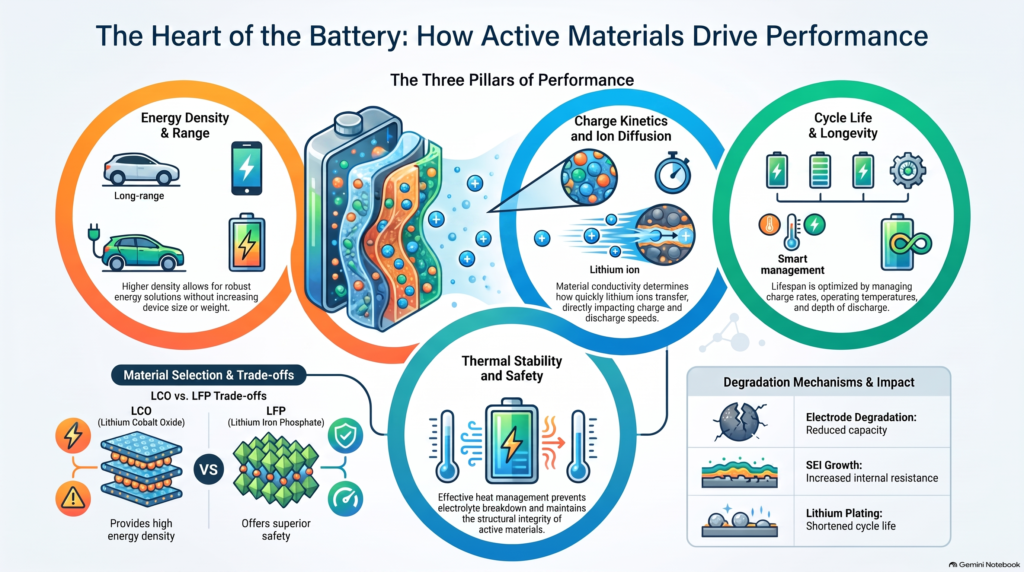
Energy density plays a fundamental role in determining the performance of lithium-ion batteries, as it quantifies the amount of energy stored per unit mass or volume.
Higher energy density directly correlates with improved performance metrics, allowing devices to operate longer and more efficiently. When you optimize energy density, you enhance not just the range but also the overall power output of your battery systems.
It’s vital to understand that energy density is influenced by the selection of active materials, which dictate how effectively energy is stored and released.
As you focus on maximizing energy density, you’re fundamentally pushing the boundaries of performance, enabling applications that require robust energy solutions without compromising on weight or size.
Why Active Materials Influence Charge Rates?
While the choice of active materials greatly impacts charge rates, understanding their electrochemical properties is essential for optimizing battery performance. Active materials in battery production are the chemical substances involved in the electrochemical reactions within the battery, and they work by absorbing ions during charging and releasing them during discharge. Think of them as the heart of the battery—the part that actually stores the energy.
The performance hinges on charge kinetics, which dictate how quickly ions can move through the electrolyte and into the active materials. Materials with high conductivity and favorable ion diffusion characteristics enhance the transfer of lithium ions, facilitating faster charge and discharge cycles.
For instance, lithium iron phosphate exhibits slower charge kinetics compared to nickel-cobalt-aluminum oxide, leading to longer charge times. Consequently, selecting active materials with superior ion diffusion capabilities not only accelerates charge rates but also maximizes overall efficiency.
How Longevity and Stability Impact Lithium-Ion Battery Life
Understanding how longevity and stability affect lithium-ion battery life is essential for optimizing performance. The lithium-ion (Li-ion) battery is the predominant commercial form of rechargeable battery, widely used in portable electronics and electrified transportation. The rechargeable battery was invented in 1859 with a lead-acid chemistry that is still used in car batteries that start internal combustion engines, while the research underpinning the Li-ion battery was published in the 1970s and the first commercial Li-ion cell was made available in 1991. In 2019, John B. Goodenough, M. Stanley Whittingham, and Akira Yoshino received the Nobel Prize in Chemistry for their contributions to the development of the modern Li-ion battery.
You’ll need to evaluate factors like battery cycle life, which determines how many charge-discharge cycles a battery can endure before significant capacity loss occurs.
Additionally, reviewing thermal stability and degradation mechanisms will reveal how environmental conditions and internal chemical processes impact overall battery efficiency.
Battery Cycle Life
Battery cycle life plays a crucial role in determining the overall performance and longevity of lithium-ion batteries. Cathode active materials (CAM) are typically composed of metal oxides. The most common cathode materials used in lithium-ion batteries include lithium cobalt oxide (LiCoO2), lithium manganese oxide (LiMn2O4), lithium iron phosphate (LiFePO4 or LFP), and lithium nickel manganese cobalt oxide (LiNiMnCoO2 or NMC). Each of these materials offers varying levels of energy density, thermal stability, and cost-effectiveness.
You need to understand that each charge and discharge cycle influences the battery’s capacity retention and efficiency. High cycle performance is essential for applications demanding reliability and endurance.
To achieve lifespan optimization, you must consider factors such as charge rates, depth of discharge, and operating temperatures. These elements directly impact the degradation mechanisms within the battery, influencing its cycle life.
By implementing strategies to enhance these parameters, you can greatly extend the battery’s operational lifespan, ensuring that it meets your power requirements for a longer duration.
Ultimately, a focus on cycle life translates into more effective and durable energy solutions.
THERMAL STABILITY EFFECTS
From a computational chemistry perspective, examining how active materials dictate charge rates, energy density, and thermal stability reveals why granular material science is so critical. In the laboratory, when analyzing transport kinetics, we observe that ion diffusion isn’t uniform across different crystal structures. High-performance cathodes like NMC offer impressive energy density, but they require precise thermal management to prevent solid-electrolyte interphase (SEI) growth and material fatigue under heavy loads. On the other hand, LFP’s olivine structure provides exceptional structural stability and longevity, though at the cost of lower nominal voltage and reduced ionic conductivity.
What excites me most in recent data-driven models is our growing ability to simulate solid-state diffusivity D(c) and volume fraction alterations directly. Rather than relying solely on lengthy empirical testing like traditional GITT measurements, advanced computational tools allow us to infer parameters faster and model exact degradation pathways like lithium plating or mechanical cracking under thermal stress.
Furthermore, as we integrate nanostructured coatings, silicon anodes, and advanced additives into active material frameworks, we aren’t just incrementalizing efficiency, we are actively rewiring the trade-offs between charge speed, safety, and lifespan. Bridging these physics-based models with computational informatics gives us the exact leverage needed to design robust battery architectures tailored for demanding applications.
Cycle life isn’t the only factor influencing the performance of lithium-ion batteries; thermal stability greatly impacts longevity and operational safety.
When operating at high temperatures, batteries face accelerated thermal degradation, which compromises their efficiency and reduces lifespan. Effective heat management is essential to maintain ideal operating conditions, as excessive heat can lead to electrolyte breakdown and loss of active material integrity.
You’ll want to take into account thermal stability as a key design criterion when selecting materials or configuring battery systems. By ensuring robust thermal management strategies are in place, you not only enhance battery performance but also greatly extend its life.
Ultimately, prioritizing thermal stability is critical for achieving the reliability and power density that modern applications demand.
Degradation Mechanisms Explained
While various factors contribute to the degradation of lithium-ion batteries, the mechanisms underlying longevity and stability play a critical role in determining their overall performance. Understanding degradation pathways is essential for optimizing battery life. Material fatigue, resulting from repeated charge-discharge cycles, leads to structural changes in electrodes and electrolytes, ultimately diminishing capacity.
| Degradation Mechanism | Impact on Battery Life |
| Electrode Degradation | Reduced capacity |
| SEI Growth | Increased internal resistance |
| Lithium Plating | Shortened cycle life |
Which Active Materials Power Lithium-Ion Batteries?
The performance of lithium-ion batteries heavily relies on the selection of active materials used in their construction.
You’ll find that cathode materials like lithium cobalt oxide and lithium iron phosphate directly influence energy density and thermal stability. Anode materials, commonly graphite or silicon, affect charge/discharge rates and cycle life.
Evaluating material composition is essential for optimizing performance metrics such as capacity and longevity. Considerations around material sourcing are significant, as they impact both cost analysis and environmental impact. Although battery materials differ from pharmaceutical lithium, understanding lithium side effects in medical applications highlights the importance of handling lithium-containing compounds responsibly throughout their lifecycle. Efficient recycling methods for these active materials can enhance sustainability, reducing waste and reliance on raw materials.
Efficient recycling methods for these active materials can enhance sustainability, reducing waste and reliance on raw materials.
Ultimately, your choice in active materials not only determines performance but also shapes the economic and ecological footprint of battery technology.
Innovating Active Materials for Better Battery Efficiency
As researchers push the boundaries of battery technology, innovating active materials becomes essential for enhancing lithium-ion battery efficiency.
By focusing on sustainable sourcing, you’ll find that composite materials can greatly improve performance metrics. Integrating advanced coatings with nanostructured electrodes leads to superior charge and discharge rates, optimizing energy density.
In addition, electrolyte innovations play a vital role in reducing internal resistance, thereby increasing overall efficiency. Implementing effective recycling strategies contributes not only to sustainability but also offers cost-effective solutions for raw material supply.
Future Trends in Active Materials for Lithium-Ion Batteries
Looking ahead, emerging trends in active materials for lithium-ion batteries promise to revolutionize energy storage capabilities.
You’ll see a significant shift towards sustainable materials that enhance performance while minimizing environmental impact. Innovations like silicon anodes and high-capacity cathodes are on the rise, offering greater energy density and efficiency. In advanced electric vehicle and energy storage systems, samarium cobalt magnets are also used in high-performance motors, complementing lithium-ion battery technologies with reliable magnetic performance under demanding conditions. Additionally, advancements in recycling technologies are essential, enabling the recovery of critical materials from spent batteries, thereby promoting a circular economy.
Additionally, advancements in recycling technologies are essential, enabling the recovery of critical materials from spent batteries, thereby promoting a circular economy. This not only reduces raw material dependency but also lowers production costs.
As these trends gain momentum, expect lithium-ion batteries to evolve, delivering higher power output and longevity, aligning with global sustainability goals while meeting the increasing demand for efficient energy storage solutions.

RELATED STUDIES ABOUT LITHIUM-ION BATTERY ACTIVE MATERIALS
In conclusion, active materials are the heartbeat of lithium-ion batteries, driving energy density, influencing charge rates, and determining longevity. By innovating these materials, you can enhance performance, boost efficiency, and extend battery life. As we look to the future, exploring advanced compositions and structures will be essential. Embracing these developments means revealing the potential for cleaner energy solutions and powering the next generation of technology. The path forward is clear: prioritize active materials for superior battery performance.
Direct-ink writing printed cathodes based on different active materials for lithium-ion batteries
This study investigates the influence of graphene nanosheets (GNSs) as a reinforcing nanofiller in Sn-Bi solder alloys to enhance their reliability under severe thermal conditions. As the electronics industry shifts toward low-temperature assembly—particularly for miniaturized components—Sn-Bi alloys have become essential; however, their mechanical reliability under prolonged thermal stress remains a critical engineering challenge.
Key Research Findings
- Microstructural Refinement: The addition of GNSs promotes the refinement of the primary \beta-Sn phase through heterogeneous nucleation, which helps manage the alloy’s microstructure.
- Optimal Concentration: The research identifies an optimal GNS concentration of approximately 0.05 wt% to 0.1 wt%.
- Samples with 0.05% GNS demonstrated the most significant refinement of the \beta-Sn phase.
- Additions exceeding 0.3 wt% lead to GNS agglomeration, causing microstructural heterogeneity and reduced reinforcement efficiency.
- Intermetallic Compound (IMC) Control: GNSs act as effective diffusion barriers at the solder/copper interface.
- At 0.05 wt% GNS, the thickness of the interfacial IMC layer was reduced by more than 40% post-reflow and 34% after thermal cycling.
- Mechanical Properties:
- The addition of GNSs enhances the elastic modulus of the solder joints.
- Post-reflow, a 0.1 wt% GNS addition resulted in a 16% increase in the modulus of elasticity.
- Following thermal cycling, samples with 0.3 wt% GNS showed a 50% increase in the modulus of elasticity compared to the unreinforced alloy, indicating superior resistance to elastic deformation.
Core Mechanisms
The study highlights that GNSs function through a combination of mechanisms:
- Heterogeneous Nucleation: GNSs provide sites for the primary \beta-Sn phase to nucleate, resulting in smaller, more refined grains.
- Diffusion Barrier Effect: Due to their compact covalent structure and high surface area, GNSs increase the effective diffusion path and restrict the migration of Sn and Cu atoms, effectively retarding the growth of the Cu_{6}Sn_{5} IMC layer.
- Morphological Modification: GNSs help fragment and disrupt the continuous, brittle Bi-rich lamellar networks typically found in Sn-Bi alloys, improving the spatial homogeneity of the microstructure.
Conclusion
Incorporating a small percentage of graphene nanosheets (optimally < 0.1 wt%) into Sn-Bi solder alloys significantly improves microstructural stability, restricts undesirable IMC layer growth, and enhances mechanical stiffness under thermal cycling. These improvements offer a viable pathway for increasing the reliability of next-generation, low-temperature electronic packaging.
| REFERENCE: Rafael S. Pinto, Francisco Macedo, Maria M. Silva, Carlos M. Costa, Senentxu Lanceros-Mendez, Renato Gonçalves, Direct-ink writing printed cathodes based on different active materials for lithium-ion batteries, Journal of Power Sources, Volume 684, 2026, 240442, ISSN 0378-7753, https://doi.org/10.1016/j.jpowsour.2026.240442. (https://www.sciencedirect.com/science/article/pii/S0378775326011924) |
Bridging data-driven and physics-based models for lithium-ion battery state analysis and future performance assessment via active material volume fraction
This study investigates the effect of incorporating graphene nanosheets (GNSs) as a reinforcing nanofiller into Sn-Bi solder alloys to improve their performance and reliability under severe thermal conditions. As miniaturized electronic devices become increasingly prevalent, particularly within industries like those in the Manaus Industrial Pole, optimizing low-temperature solder materials for thermal stability is essential.
Key Findings
- Microstructural Refinement: The addition of GNSs promotes the refinement of the primary \beta-Sn phase, with the 0.05 wt% GNS composition showing the most significant refinement in the post-thermal cycling condition.
- Control of Intermetallic Compound (IMC) Growth: GNSs serve as a diffusion barrier, significantly restricting the growth of the IMC layer between the solder and copper substrate.
- Post-reflow, the 0.05 wt% GNS sample exhibited a reduction of more than 40% in IMC layer thickness compared to the pure alloy.
- Post-thermal cycling, the 0.05 wt% sample maintained a 34% reduction in IMC thickness compared to the unreinforced alloy.
- Mechanical Properties: The study observed improvements in elastic modulus, indicating enhanced microstructural stability under thermal stress.
- In post-reflow samples with 0.1 wt% GNS, there was a 16% increase in the modulus of elasticity.
- After thermal cycling, samples with 0.3 wt% GNS demonstrated a 50% increase in the modulus of elasticity compared to the unreinforced alloy.
- Concentration Limits: The study found that GNS contents exceeding 0.3 wt% lead to nanoparticle agglomeration, which creates microstructural heterogeneity, reduces the diffusion-blocking efficiency, and results in a loss of overall performance.
Experimental Methodology
- Synthesis: Sn-Bi-xGNS alloys were prepared with concentrations ranging from 0.0 to 0.5 wt% GNS relative to the pure solder alloy.
- Processing: The solder alloys were applied to copper substrates and subjected to a standardized reflow process with a peak temperature of 245 °C.
- Thermal Cycling: The solder joints were exposed to 1000 thermal cycles (totaling 500 hours) between -40 °C and 85 °C, following the IPC-9701A standard.
- Evaluation: The microstructures and IMC layers were characterized via optical microscopy and microsectioning, while mechanical properties were evaluated using nanoindentation.
Conclusion
The incorporation of low concentrations of GNSs (optimally between 0.05 wt% and 0.1 wt%) is an effective strategy to refine the microstructure, control detrimental IMC growth, and improve the mechanical stiffness of Sn-Bi solder alloys. These findings provide a practical framework for enhancing the reliability of low-temperature solder joints in advanced electronic packaging.
| REFERENCE: Andrés Bernabeu-Santisteban, Alejandro Clemente, Bernhard C. Geiger, Franz M. Rohrhofer, Francisco Díaz-González, Lluís Trilla, Bridging data-driven and physics-based models for lithium-ion battery state analysis and future performance assessment via active material volume fraction, Energy and AI, Volume 24, 2026, 100749, ISSN 2666-5468, https://doi.org/10.1016/j.egyai.2026.100749. (https://www.sciencedirect.com/science/article/pii/S2666546826000753) |
A fast and accurate method for inferring solid-state diffusivity in lithium-ion battery active materials
This study introduces a novel methodology called Inference from a Consistent Model (ICM) to determine the concentration-dependent solid-state diffusivity D(c) of lithium-ion battery active materials.
Limitations of Classical Approaches
The current industry standard for inferring D(c) involves the Galvanostatic Intermittent Titration Technique (GITT) combined with the Sand equation. This approach suffers from several drawbacks:
- Time-Consuming: The process can span weeks due to mandatory lengthy rest periods (typically 1–3 hours) required to ensure uniform concentration before each pulse.
- Modeling Inconsistency: The Sand equation is derived for a semi-infinite slab, which contradicts the actual spherical geometry of active material particles used in predictive models like the Doyle-Fuller-Newman (DFN) and Single Particle Model (SPM).
- Reduced Accuracy: The slab approximation becomes increasingly inaccurate as pulse durations increase, leading to significant errors in diffusivity estimates.
The ICM Methodology
The ICM framework prioritizes consistency by using the same physical model for both parameter inference and device prediction.
- Core Principle: The method solves a spherically-symmetric, nonlinear diffusion model for a known surface lithium flux and minimizes the residual sum of squares between the predicted and measured cell voltage to infer D(c).
- Versatility: Unlike the GITT/Sand approach, ICM is not tethered to specific pulse-relax current profiles. It can be applied to any current excitation, provided the experimental conditions comply with the underlying model assumptions (e.g., negligible kinetic overpotentials).
Key Findings and Advantages
The study demonstrates the effectiveness of ICM using both synthetic data and experimental data from an LG M50 cell:
- Improved Accuracy: ICM yields objectively more accurate diffusivity estimates compared to the classical GITT method.
- Efficiency: ICM allows for a five-fold reduction in data collection time. Robust inference was achieved using faster-to-measure galvanostatic data instead of lengthy GITT sequences.
- Generalizability: The inferred parameters show superior predictive performance across different operating conditions, validating the method’s reliability for practical battery modeling.
- Extensibility: While demonstrated here on a single-particle diffusion model, the ICM philosophy is systematic and can be extended to incorporate complex factors like electrolyte transport limitations or, for phase-separating materials, multi-phase thermodynamic models.
| REFERENCE: A. Emir Gümrükçüoğlu, James Burridge, Kieran O’Regan, Emma Kendrick, Jamie M. Foster, A fast and accurate method for inferring solid-state diffusivity in lithium-ion battery active materials, Journal of Energy Storage, Volume 153, Part B, 2026, 120831, ISSN 2352-152X, https://doi.org/10.1016/j.est.2026.120831. (https://www.sciencedirect.com/science/article/pii/S2352152X26004950) |
CONCLUSION
Ultimately, the trajectory of next-generation energy storage depends entirely on our mastery over battery active materials. Reflecting on the rapid evolution of material science from early empirical formulations to today’s high-throughput computational discovery, it is clear that active materials are the single most determining factor in building a sustainable, electrified future. As we push toward higher energy demands in electric mobility and renewable integration, relying on legacy material combinations will no longer suffice. We must continue refining cathode and anode chemistry, optimizing particle geometries, and adopting closed-loop recycling practices to ensure material availability without compounding environmental impacts.
In my own work mentoring young scientists and exploring AI-driven discovery in materials science, I always emphasize that every breakthrough in battery longevity or fast-charging capability starts at the molecular level. By combining rigorous computational physics with innovative chemical synthesis, we can break through the current performance plateaus.
Prioritizing the research, characterization, and sustainable manufacturing of active materials will not only unlock cleaner energy technologies but will fundamentally transform how we power our world for generations to come.