

When people ask me what gets me most excited as a dietitian with a background in nutritional biochemistry, my answer usually isn’t exotic supplements or restrictive fad diets. It is the quiet, complex chemistry happening right on our dinner plates.
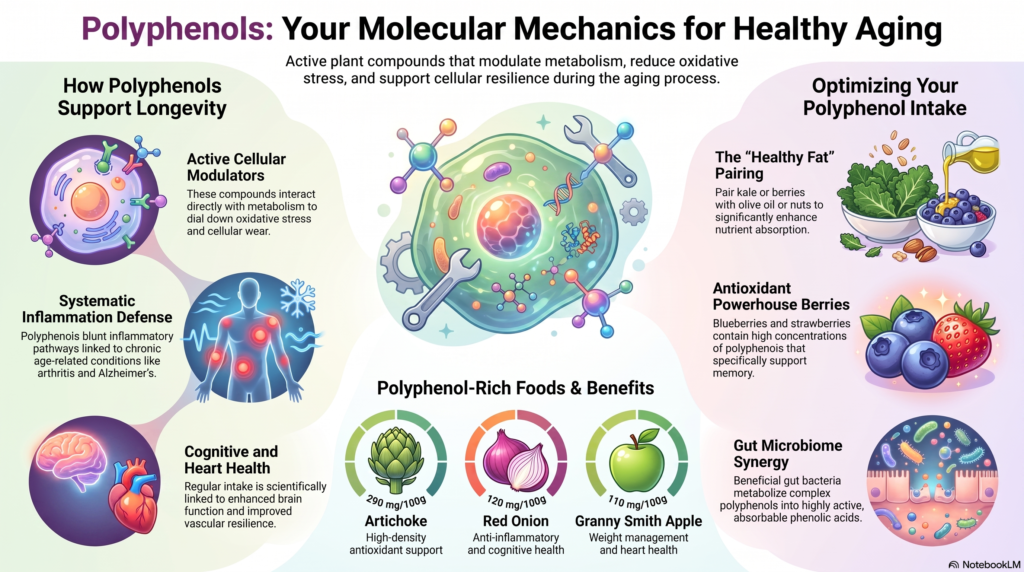
Polyphenols are a prime example of why I love this field. We often hear the buzzword “antioxidants,” but looking at polyphenols through a biochemical lens reveals something far more fascinating: these aren’t just arbitrary plant nutrients; they are active cellular modulators. Every time you eat a handful of blueberries or sip a cup of green tea, you are introducing compounds like flavonoids, phenolic acids, and stilbenes that interact directly with your metabolism. They act like molecular mechanics, dialing down oxidative stress, blunting systemic inflammation pathways, and supporting vascular function as we age.
In my own kitchen, especially when experimenting with South Asian-inspired dishes rich in vibrant spices and whole plant foods, I’m constantly looking at how simple ingredients work together. Healthy aging isn’t about halting the clock; it’s about giving your body the bioavailable tools it needs to maintain cellular resilience. Getting these nutrients from whole foods rather than isolate supplements ensures you get the full natural matrix of the plant. Let’s explore how these natural active ingredients work at the cellular level and how you can easily make them a seamless, delicious part of your daily life.
To boost healthy aging, incorporate polyphenol-rich foods into your diet. Focus on berries, especially blueberries and strawberries, apples, kale, and red onions. Enjoy green and black teas as health-boosting beverages, and consider spices like turmeric and cinnamon for added benefits. Pair these foods with healthy fats, like olive oil, to enhance absorption. By making these dietary choices, you can support your longevity and overall well-being. Discover more ways to optimize your nutrition for better health!
KEY TAKEAWAYS
- Berries, especially blueberries and strawberries, are high in polyphenols and support cognitive function and reduce inflammation.
- Apples, particularly Granny Smith, contribute to heart health and can aid in weight management.
- Leafy greens like kale and spinach, as well as red onions, are rich in polyphenols and enhance gut health.
- Green and black teas are excellent sources of antioxidants that support heart health and overall wellness.
- Combining polyphenol-rich foods with healthy fats, probiotics, and vitamin C maximizes their health benefits and absorption.
UNDERSTANDING POLYPHENOLS AND THEIR ROLE IN HEALTHY AGING
As you explore the world of nutrition, you’ll find that polyphenols play an essential role in promoting healthy aging. Polyphenols are micronutrients that naturally occur in plants. They’re included in many supplements, though they’re also easy to get in your diet from foods like fruits, vegetables, teas, and spices.
These powerful compounds, found in various foods, can be categorized into several polyphenol types, including flavonoids, phenolic acids, and stilbenes.
Research shows that they offer significant aging benefits, such as reducing oxidative stress and inflammation, both linked to age-related diseases. While polyphenols are naturally occurring compounds rather than an active pharmaceutical ingredient, they have been widely studied for their potential to support long-term health. By neutralizing free radicals, polyphenols support cellular health and longevity. By neutralizing free radicals, polyphenols support cellular health and longevity.
Additionally, they enhance cognitive function and improve cardiovascular health, which are vital as you age.
Incorporating polyphenol-rich foods into your diet can empower you to take control of your health. Embrace the benefits of these natural compounds and reveal your potential for a vibrant, healthier future.
How to Easily Add Polyphenols to Your Diet
To easily incorporate polyphenols into your diet, focus on making simple swaps and additions to your meals. Polyphenols are compounds that we get through certain plant-based foods. They’re packed with antioxidants and potential health benefits. It’s thought that polyphenols can improve or help treat digestion issues, weight management difficulties, diabetes, neurodegenerative disease, and cardiovascular diseases.
Start by choosing dark chocolate over milk chocolate for your daily snacks; just a small amount can boost your polyphenol intake considerably.
Incorporate berries like blueberries and strawberries into your breakfast or smoothies—these fruits are packed with antioxidants.
Opt for green tea instead of coffee, as it’s rich in catechins.
You can also experiment with simple recipes by adding spices like cinnamon and turmeric to your dishes.
Finally, consider using olive oil for cooking or salad dressings, as it’s another excellent source of polyphenols.
These small changes can powerfully enhance your health and promote healthy aging.
Top Fruits High in Polyphenols for a Vibrant Diet
If you’re looking to enhance your diet with polyphenols, fruits like berries and apples should be at the top of your list.
Berries are known as antioxidant powerhouses, packed with compounds that can support your health.
Meanwhile, apples offer a daily health boost with their rich polyphenol content, making them an easy addition to your routine.
Berries: Antioxidant Powerhouses
Berries aren’t just delicious; they’re packed with polyphenols that can considerably boost your health. Among the numerous berry varieties, blueberries, blackberries, and strawberries stand out for their high antioxidant benefits.
These vibrant fruits help combat oxidative stress, which is vital for fighting aging and chronic diseases. Studies show that the polyphenols in berries can enhance cognitive function and reduce inflammation, empowering you to feel your best.
Incorporating these powerhouses into your diet can elevate your overall wellness, making every meal a step towards longevity. So, whether you enjoy them fresh, in smoothies, or as a topping, harness the potential of berries to enhance your vibrant lifestyle and support your health goals.
Apples: Daily Health Boost
While you might already enjoy apples as a convenient snack, their rich polyphenol content offers a daily health boost you won’t want to overlook. Different apple varieties, such as Granny Smith and Fuji, pack various health benefits that enhance your well-being. Regular consumption can improve heart health, reduce inflammation, and support cognitive function.
| Apple Variety | Polyphenol Content (mg/100g) | Key Health Benefit |
| Granny Smith | 110 | Weight management |
| Fuji | 98 | Antioxidant protection |
| Honeycrisp | 90 | Improved gut health |
| Gala | 85 | Reduced cholesterol levels |
| Braeburn | 82 | Enhanced immune function |
Incorporate these vibrant fruits into your diet for a powerful health boost!

WHICH VEGGIES PACK THE MOST POLYPHENOLS?
From a nutritional biochemistry perspective, simply eating foods rich in polyphenols is only half the battle the real magic lies in bioaccessibility and metabolic absorption. Polyphenols often exist in complex matrices within plant cell walls, and our digestive enzymes need a little help extracting and utilizing them effectively. This is where formulation and smart food pairing come into play, something I love experimenting with in my daily cooking. Take lipid-soluble polyphenol compounds: when you pair polyphenol-rich items like kale, spinach, or dark berries with healthy dietary fats such as a drizzle of extra virgin olive oil, crushed walnuts, or seed mixes you significantly enhance their micellarization and absorption in the gut.
Furthermore, we cannot ignore the critical role of our gut microbiome. Many high-molecular-weight polyphenols aren’t absorbed in the small intestine at all; instead, they travel down to the colon where beneficial gut bacteria metabolize them into smaller, highly active phenolic acids that enter circulation. Pairing your polyphenol intake with gut-supportive elements like vitamin C, fermented foods, or targeted probiotics creates a symbiotic environment where nutrient utilization thrives.
In my practice, I always tell clients that cooking isn’t just about taste it’s functional chemistry. Whether you’re blooming spice polyphenols in warm oil or pairing berries with healthy fats, thoughtful preparation transforms good nutrition into optimized metabolic health.
When it comes to vegetables, some pack a powerful punch of polyphenols that can benefit your health. Polyphenols are also anti-inflammatory. Anyone who’s ever stubbed their toe knows a bit about inflammation — that’s the swelling and pain that signals your body going into “repair mode.” But inflammation can happen even when you’re not sick or injured. When your body sends out inflammatory cells when they’re not needed, it can lead to chronic conditions, like arthritis and Alzheimer’s disease. A diet rich in polyphenols can help keep your inflammation response in check.
You’ll find that options like kale, spinach, and red onions aren’t only nutritious but also rich in these beneficial compounds.
Incorporating these veggies into your diet can help enhance your overall wellness.
Top Polyphenol-Rich Vegetables
If you’re looking to boost your diet with polyphenols, certain vegetables stand out for their impressive content. Incorporating a variety of these nutrient-dense veggies can elevate your meals and enhance your health goals. Here are some top polyphenol-rich vegetable varieties:
| Vegetable | Polyphenol Content (mg/100g) | Cooking Methods |
| Spinach | 100 | Steamed, sautéed |
| Red Onion | 120 | Raw, grilled |
| Artichoke | 290 | Boiled, roasted |
Experiment with different cooking methods to maximize their benefits while keeping your meals exciting. By adding these power-packed vegetables to your diet, you’ll not only enjoy delicious flavors but also harness the potential of polyphenols for ideal health.
Benefits of Vegetable Polyphenols
Incorporating polyphenol-rich vegetables into your diet offers numerous health benefits, thanks to their antioxidant properties and potential to combat inflammation.
These powerful compounds can protect your cells from oxidative stress, reducing the risk of chronic diseases like heart disease and cancer. While acidic amino acids serve different biological functions than polyphenols, both contribute to important processes that support overall cellular health and normal body function. Vegetable sources like kale, red onions, and spinach are particularly high in polyphenols, enhancing your overall health profile.
Vegetable sources like kale, red onions, and spinach are particularly high in polyphenols, enhancing your overall health profile.
Studies show that regular consumption of these veggies can boost cognitive function and support healthy aging.
Additionally, they may improve gut health by promoting beneficial bacteria.
By prioritizing these nutrient-dense vegetables, you empower yourself to harness their health benefits, ultimately leading to a more vibrant, energetic life.
Embrace these potent foods and take charge of your well-being.
Health-Boosting Polyphenol Beverages
Beverages rich in polyphenols offer a delicious way to boost your health while satisfying your taste buds. Among the most potent options are various tea varieties, such as green and black tea, which are loaded with antioxidants that combat oxidative stress.
These teas not only refresh but also support heart health and cognitive function. Additionally, consider incorporating antioxidant juices made from berries, pomegranates, and grapes, which deliver a concentrated dose of polyphenols.
These beverages can help reduce inflammation and improve overall well-being. By choosing polyphenol-rich drinks, you’re not just quenching your thirst; you’re actively investing in your health and longevity.
Embrace these powerful beverages to elevate your wellness journey.
Polyphenol-Packed Spices and Herbs for Flavor and Health
Spices and herbs not only elevate the flavor of your meals but also pack a powerful punch of polyphenols that can enhance your health. Incorporating spice varieties like turmeric, cinnamon, and cloves can boost your antioxidant intake, providing significant spice benefits.
Turmeric, for instance, contains curcumin, known for its anti-inflammatory properties. Cinnamon offers not just a warm flavor but also compounds that may help regulate blood sugar levels.
When it comes to herb varieties, consider rosemary and oregano; they’re rich in polyphenols that support brain health and bolster your immune system.
Effective Strategies to Enhance Polyphenol Absorption
While you may enjoy foods rich in polyphenols, your body’s ability to absorb these antioxidants can greatly influence their health benefits.
To maximize absorption, consider polyphenol pairing; combining polyphenol-rich foods with healthy fats, like olive oil or avocado, can enhance bioavailability. For instance, pairing dark chocolate with nuts not only boosts flavor but also improves absorption.
Additionally, certain absorption enhancers, such as probiotics and vitamin C, can considerably increase the efficacy of polyphenols. For individuals exploring probiotics for men as part of a balanced wellness routine, combining them with polyphenol-rich foods may further support gut health and nutrient utilization. Consuming these alongside your polyphenol sources can empower your body to harness their full potential. Consuming these alongside your polyphenol sources can empower your body to harness their full potential.
RELATED STUDIES ABOUT POLYPHENOLS RICH FOODS LIST
Incorporating polyphenol-rich foods into your diet isn’t just a trend; it’s a science-backed approach to healthy aging. Research shows that these natural compounds can help reduce inflammation and oxidative stress, promoting overall well-being. By making simple changes—like adding berries to your breakfast or sipping on green tea—you can harness the power of polyphenols. So, why not give your health a boost and embrace these vibrant, nutrient-packed foods today? Your future self will thank you!
Expansion of an Australian food composition database to estimate polyphenol intakes
Overview
Research indicates that higher dietary intake of polyphenols—naturally occurring plant compounds including flavonoids and phenolic acids—is associated with a reduced risk of several adverse health outcomes. Despite this, accurately estimating polyphenol intake in epidemiological studies remains difficult due to methodological heterogeneity and the lack of comprehensive, localized food composition databases. This study addressed this gap by expanding an existing Australian food composition database to include polyphenol content data.
Objective
The primary objective of the study was to develop and implement a comprehensive polyphenol database tailored to the Australian food supply to facilitate more accurate estimation of polyphenol intake in research and population health studies.
Methodology
- Database Development: The research team expanded the existing Australian food composition database by integrating standardized polyphenol content data.
- Methodological Framework: The database was designed to harmonize with existing dietary assessment tools, specifically focusing on identifying and quantifying flavonoids and phenolic acids across common Australian food items.
- Focus Areas: The database categorization includes various subclasses of polyphenols, providing a structured approach for researchers to map dietary intake to specific chemical profiles.
Key Implications
- Enhanced Estimation: By providing specific data on the polyphenol content of foods commonly consumed in Australia, this database significantly reduces the reliance on foreign databases, which often do not accurately reflect the local food supply.
- Standardized Research: This expansion provides a critical resource for researchers to perform standardized dietary assessments, thereby mitigating the methodological heterogeneity that has previously hindered the comparability of epidemiological studies.
- Public Health Application: The availability of this database will improve the ability of public health practitioners and nutritionists to study the relationship between polyphenol intake and health outcomes within the Australian population, ultimately supporting better-informed dietary guidelines.
Conclusion
The expansion of the Australian food composition database to include comprehensive polyphenol content data marks a significant advancement in nutritional epidemiology. By providing a more accurate and localized tool for estimating polyphenol intake, this study facilitates more robust research into the long-term health benefits of polyphenol-rich diets and supports the development of targeted public health strategies.
| REFERENCE: Elizabeth Gamage, Rebecca Orr, Deb Junyi Zhang, Melissa M. Lane, Katherine Kent, Felice N. Jacka, Mojtaba Lotfaliany, Wolfgang Marx, Expansion of an Australian food composition database to estimate polyphenol intakes, Journal of Food Composition and Analysis, Volume 153, 2026, 109083, ISSN 0889-1575, https://doi.org/10.1016/j.jfca.2026.109083. (https://www.sciencedirect.com/science/article/pii/S0889157526002267) |
Attenuation of inorganic arsenic exposure-induced cognitive impairments by polyphenols-rich fraction of wild Rubus ellipticus berries via reshaping gut microbiota and reduction of oxidative stress-lead neuro-intestinal inflammation
Overview
Chronic exposure to inorganic arsenic [iAs(III)] is a significant environmental health threat, linked to cognitive impairments and neurodegeneration through mechanisms involving oxidative stress, neuroinflammation, and gut microbiota dysbiosis. This study evaluated the potential of a polyphenol-rich extract from the wild Himalayan berry Rubus ellipticus (yellow Himalayan raspberry) to mitigate these effects in a murine model.
Methodology
- Extraction: Researchers used ultrasonication-assisted extraction (UAE), optimized via response surface methodology (RSM), to obtain a polyphenol-rich extract.
- Chemical Profile: The extract was characterized using UHPLC and LC-MS, revealing high concentrations of flavonoids (e.g., dihydrokaempferol), phenolic acids, and proanthocyanidins.
- In Vivo Model: Male Swiss albino mice were exposed to inorganic arsenic (1.85 ppm) for 12 weeks, with simultaneous oral supplementation of R. ellipticus berry extract (doses ranging from 50 to 200 mg/kg).
- Assessments: Cognitive performance was measured via the Morris water maze and passive avoidance tests. Researchers also evaluated oxidative stress markers, neurotransmitter levels (serotonin and dopamine), neuroinflammatory markers, intestinal permeability, and gut microbiota composition.
Key Findings
- Cognitive Protection: Supplementation with R. ellipticus extract significantly improved spatial learning and memory in arsenic-exposed mice, as evidenced by better performance in the Morris water maze.
- Neurochemical Restoration: The extract mitigated arsenic-induced disruptions in neurotransmitters, specifically improving dopamine levels and serotonin synthesis in the brain.
- Anti-Inflammatory and Antioxidant Effects: The treatment reduced arsenic-induced neuroinflammation (downregulating NF-kB and NLRP3) and oxidative stress in the brain (restoring SOD and glutathione levels).
- Gut-Brain Axis Modulation: Arsenic exposure caused intestinal damage, including increased ileal permeability, shortened villi, and gut dysbiosis (e.g., reduction in beneficial SCFAs like acetate and butyrate). The berry extract successfully preserved gut barrier integrity, normalized SCFA levels, and reshaped the gut microbiota by increasing beneficial microbial populations (e.g., Eubacterium, Prevotella, Fecalibacterium).
Conclusion
This study provides the first evidence that a polyphenol-rich fraction of Rubus ellipticus berries can effectively protect against arsenic-induced cognitive impairments. The protective mechanism appears to involve a multifaceted approach: mitigating systemic oxidative stress, reducing neuroinflammation, and restoring gut-brain axis homeostasis by preventing gut barrier dysfunction and microbiota dysbiosis. These results highlight R. ellipticus as a promising functional food for dietary intervention against environmental neurotoxicity.
| REFERENCE: Vandana, Shweta Gupta, Rajni Sharma, Ashutosh Pandey, Mahendra Bishnoi, Rakesh Rawal, Dhirendra Pratap Singh, Santasabuj Das, Attenuation of inorganic arsenic exposure-induced cognitive impairments by polyphenols-rich fraction of wild Rubus ellipticus berries via reshaping gut microbiota and reduction of oxidative stress-lead neuro-intestinal inflammation, Journal of Hazardous Materials Advances, Volume 22, 2026, 101219, ISSN 2772-4166, https://doi.org/10.1016/j.hazadv.2026.101219. (https://www.sciencedirect.com/science/article/pii/S2772416626002184) |
Neuroprotective effects of polyphenol-rich extracts obtained from agricultural by-products in an induced cognitive decline model of zebrafish larvae and in human neurons
Overview
Neurodegenerative disorders—such as Alzheimer’s, Parkinson’s, and Huntington’s diseases—are increasingly linked to chronic neuroinflammation and oxidative stress. Agricultural by-products are a sustainable, underutilized reservoir of polyphenols, which possess well-documented antioxidant and anti-inflammatory properties. This study investigated the neuroprotective efficacy of four polyphenol-rich extracts derived from agricultural residues using sustainable subcritical water extraction (SWE).
Methodology
The researchers evaluated extracts from four sources:
- Red onion peels (ROPE)
- Olive pruning (OPE)
- Vineyard pruning (VPE)
- Chicory leaves (CLE)
These extracts were tested in two distinct models of neurodegeneration:
- In Vitro: D-galactose (D-gal)-induced senescence in human neuroblastoma (SH-SY5Y) cells.
- In Vivo: Aluminium chloride ($AlCl_3$)-induced cognitive decline in zebrafish larvae.
Key Findings
- Anti-Inflammatory Activity: All four extracts exhibited significant anti-inflammatory properties in SH-SY5Y cells, effectively reducing the mRNA expression of key pro-inflammatory markers, such as IL-1β and IL-8.
- Behavioral Recovery in Zebrafish:
- ROPE and VPE: Treatment with $100~\mu g/mL$ of these extracts successfully restored sensorimotor patterns disrupted by $AlCl_3$ in the Dark-Light-Dark (DLD) test.
- ROPE Efficacy: Red onion peel extract (ROPE) demonstrated the most comprehensive neuroprotective profile. Beyond restoring locomotor patterns, it rescued basal startle responses and significantly enhanced habituation indexes—a marker of improved cognitive learning—surpassing the performance of healthy control larvae.
- Sustainability: The study confirms that sustainable extraction methods like subcritical water extraction are effective for isolating bioactive polyphenols, supporting both circular economy principles and the development of natural therapeutic interventions.
Conclusion
Polyphenol-rich extracts from agricultural by-products, particularly red onion peels (ROPE), show significant promise as neuroprotective and cognitive-enhancing agents. Their ability to modulate inflammatory pathways and restore normal cognitive behavior in experimental models positions them as sustainable, natural candidates for slowing or preventing neurodegenerative processes. Further validation in mammalian models and clinical studies is recommended to confirm these translational benefits.
| REFERENCE: Ángela Castillo-Moral, Job Tchoumtchoua, Kevin Leonard, Josep M. Del Bas, Nàdia Ortega, Xavier Escoté, Joan Teichenné, Neuroprotective effects of polyphenol-rich extracts obtained from agricultural by-products in an induced cognitive decline model of zebrafish larvae and in human neurons, Biomedicine & Pharmacotherapy, Volume 193, 2025, 118776, ISSN 0753-3322, https://doi.org/10.1016/j.biopha.2025.118776. (https://www.sciencedirect.com/science/article/pii/S0753332225009709) |
CONCLUSION
As we pull all these science-backed threads together, the overarching message becomes clear: nourishing your body for healthy aging doesn’t require complicated overhauls it thrives on intentional, daily food choices. The beauty of polyphenols is that they showcase how deeply food communicates with our genetics and cellular pathways. From the anthocyanins in morning berries to the rich catechins in an afternoon green tea or the curcumin blooming in a warm curry, these compounds actively defend our bodies against premature cellular wear and tear.
In my own life, adopting a mindful approach to nutrition has never been about perfection or rigid rules. It’s about cultivating joy around real, nutrient-dense foods while honoring the physiological science that keeps us vibrant. When you understand how processing, pairing, and gut health influence nutrient synergy, managing your long-term health feels far less overwhelming and much more empowering.
I hope this guide demystifies the science behind these natural active ingredients and inspires you to bring more colorful, polyphenol-rich foods into your kitchen. Start small add a spice here, swap a beverage there, pair your veggies with a healthy fat and let chemistry do the rest. Here’s to eating with purpose, protecting your cellular health, and enjoying every delicious bite along the way!