

Over my past decade of investigating how toxic compounds circulate through our soil and aquatic systems, I have continually come back to one humbling realization: nature often holds the most elegant answers to our most complex chemical mistakes. Throughout my career in environmental chemistry, I have witnessed the heavy, lasting toll that industrial runoff, agricultural chemicals, and heavy metal deposition place on fragile natural habitats. Traditional chemical and physical cleanup methods, while sometimes necessary in acute crises, often feel like trying to cure a fever with a sledgehammer; they are invasive, energy-intensive, and frequently leave behind secondary waste or stripped soil that takes decades to recover.
Bioremediation represents a fundamental paradigm shift that has always deeply inspired my research. Rather than fighting against ecological systems, we are learning to partner with indigenous microorganisms, fungi, and specialized plants to perform delicate, microscopic chemical surgery.
These microscopic powerhouses possess metabolic pathways capable of systematically dismantling persistent pollutants into harmless byproducts. When we approach environmental cleanup through this biological lens, we stop viewing contaminated land purely as a toxic burden and start seeing it as an ecosystem waiting for the right microbial key to unlock its natural recovery potential.
Bioremediation compounds and microbes play an essential role in sustainable environmental cleanup by breaking down pollutants into less harmful substances. Microbes utilize metabolic pathways to convert hazardous materials, while bioremediation strategies like bioaugmentation and phytoremediation enhance the efficacy of these processes. This method not only restores ecosystems but also promotes soil fertility and minimizes environmental disruption. Understanding the complexities of these interactions can lead to more effective cleanup approaches and better ecological outcomes.
KEY TAKEAWAYS
- Bioremediation utilizes microorganisms to effectively break down pollutants, promoting sustainable environmental cleanup with minimal disruption to ecosystems.
- Microbial metabolism transforms harmful substances into less toxic forms, playing a crucial role in restoring contaminated environments.
- Strategies like bioaugmentation and biostimulation enhance microbial activity, improving the efficiency of pollutant degradation during cleanup efforts.
- The selection of appropriate microbial strains and compounds is essential for optimizing bioremediation based on the specific types of pollutants present.
- Continuous evaluation of ecological impacts ensures that bioremediation efforts lead to sustainable outcomes that restore balance in affected ecosystems.
HOW BIOREMEDIATION CLEANS UP OUR ENVIRONMENT
Bioremediation effectively cleans up our environment by utilizing microorganisms to break down pollutants in soil, water, and air. This process offers numerous bioremediation benefits, including cost-effectiveness and minimal environmental disruption.
By harnessing the natural capabilities of microbes, you facilitate ecosystem restoration, allowing damaged habitats to recover more efficiently than traditional methods. The targeted application of bioremediation not only accelerates the degradation of hazardous substances but also enhances soil fertility and water quality.
As you engage with this powerful solution, consider its potential to transform contaminated sites into thriving ecosystems. Understanding these dynamics positions you to make informed decisions that can lead to sustainable environmental practices, ultimately securing a healthier planet for future generations.
Embrace bioremediation as a strategic tool in your environmental initiatives. The growing rate of urbanization and industrialization has led to an increase in several types of pollution caused by the release of toxic chemicals to the environment. This is usually perpetuated by the manufacturing industry (e.g. detergent and dye), agricultural sectors (e.g. fertilizers and pesticides), mining industry (e.g. cyanide and sulphuric acid) and construction companies (e.g. cement and metals). These pollutants have adverse effects on the health of plants, animals, and humans. They also lead to the destruction of the microbial population in both aquatic and the terrestrial regions, and hence, have necessitated the need for remediation. Although different remediation methods, such as the physical and chemical methods, have been adopted for years, however, the drawbacks and challenges associated with them have promoted the use of an alternative which is bioremediation.
Bioremediation involves using biological agents such as plants and microbes to remove or lessen the effects of environmental pollutants. Of the two, microbes are more utilized primarily because of their rapid growth and ability to be easily manipulated, thus enhancing their function as agents of bioremediation. Different groups of bacteria, fungi and algae have been employed to clean up various environmental pollutants. This review discusses the types, mechanisms, and factors affecting microbial bioremediation. It also recommends possible steps that could be taken to promote the use of microbes as bioremediation agents.
Bioremediation Processes Explained
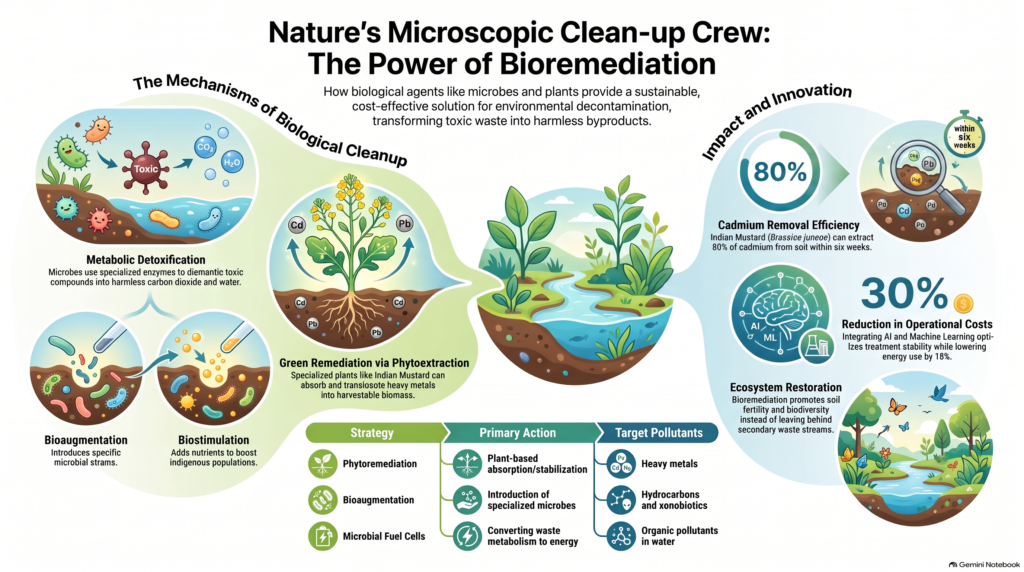
Understanding the various processes involved in bioremediation is essential for effective environmental cleanup. Bioremediation techniques leverage the capabilities of microorganisms to degrade contaminants in soil and water. Bioremediation is a natural process that uses living organisms—primarily microbes, fungi, and plants—to clean up contaminated environments. This innovative approach leverages the power of biology to break down or neutralize pollutants, transforming harmful substances into less toxic or harmless products.
These processes include biodegradation, where microbes break down harmful substances into less toxic forms, and bioaugmentation, which introduces specific microbial strains to enhance degradation efficiency.
Phytoremediation, another technique, utilizes plants to absorb pollutants, showcasing the importance of microbial diversity in optimizing these processes.
Each technique has its advantages and is selected based on specific environmental conditions and pollutant types. The choice of microbial strains and treatment compounds depends on the active ingredient responsible for breaking down specific contaminants and enhancing the overall efficiency of the bioremediation process.
The Role of Microbes in Environmental Cleanup
Microbes play an essential role in the bioremediation process through their metabolic mechanisms, enabling the biodegradation of various pollutants. Bioremediation is an environmentally friendly waste management technology that utilizes naturally occurring organisms, such as plants, microorganisms, and enzymes, to clean contaminated environments. This process effectively degrades toxic organic and inorganic compounds into harmless products, making it a cost-effective alternative to traditional remediation methods. Bioremediation can occur in situ, at the contaminated site, or ex situ, where contaminated materials are treated in controlled facilities. Approaches include fertilizing sites to promote natural biodegradation and employing bioreactors to optimize decomposition conditions.
Understanding how these microorganisms interact synergistically can enhance the effectiveness of environmental cleanup efforts.
Microbial Metabolism Mechanisms
While various strategies exist for environmental cleanup, the mechanisms of microbial metabolism play an essential role in breaking down pollutants. Microbes utilize specific metabolic pathways to convert harmful substances into less toxic forms.
These pathways often involve the use of electron donors, which serve as energy sources, facilitating the reduction of contaminants. For instance, certain bacteria can oxidize organic compounds, thereby transforming them into harmless byproducts. This process not only mitigates pollution but also supports the natural biogeochemical cycles.
Biodegradation of Pollutants
Biodegradation of pollutants hinges on the remarkable capabilities of microbial communities, which play a pivotal role in the breakdown of hazardous substances. Various pollutant types, including hydrocarbons and heavy metals, are susceptible to degradation through specific microbial enzymes.
These enzymes facilitate distinct degradation pathways, effectively reducing environmental toxicity. You’ll find that the effectiveness of bioremediation depends on understanding compound interactions and optimizing conditions for microbial activity.
By enhancing these interactions, you can minimize contaminant persistence and promote the rapid detoxification of polluted sites. Additionally, considering ecological impacts is vital; successful microbial interventions not only clean up contaminants but also restore ecosystem balance.
This interplay underscores the power of microbes in achieving sustainable environmental cleanup.
Synergistic Microbial Interactions
In the intricate web of environmental cleanup, synergistic microbial interactions often amplify the effectiveness of bioremediation efforts.
These interactions, characterized by mutualistic relationships, enable diverse microbial communities to enhance pollutant degradation through cooperative metabolism. By working together, microbes can break down complex contaminants more efficiently than isolated strains.
- Imagine a world where toxic waste no longer threatens ecosystems.
- Picture the revival of polluted waters, teeming with life once more.
- Envision communities united in the fight against environmental degradation.
Harnessing the power of these synergistic relationships not only accelerates cleanup processes but also paves the way for sustainable solutions.
Embracing this microbial teamwork is essential for achieving impactful environmental remediation.
DIFFERENT BIOREMEDIATION STRATEGIES AND THEIR ENVIRONMENTAL APPLICATIONS
In my own laboratory work and field observations, watching a bioaugmentation or biostimulation project unfold is nothing short of fascinating. When you examine a soil sample burdened with complex hydrocarbons or heavy metals under a microscope, it can look utterly lifeless. But once you introduce the right microbial strains or optimize environmental parameters like pH and nutrient balance, you witness an incredible biological cascade. Microbial communities do not work in isolation; they establish intricate, synergistic networks where one organism’s metabolic waste becomes another’s energy source, collectively converting toxic xenobiotics into simple carbon dioxide, water, or inert minerals.
However, translating these biological mechanisms from controlled lab conditions to real-world environments is where our greatest research challenges lie. Soil conditions fluctuate, temperatures shift, and indigenous microbial competition can be fierce. I often remind my students and colleagues that bioremediation is not a magic wand or a one-size-fits-all solution.
It demands rigorous monitoring, a deep understanding of local biochemistry, and patience. By combining strategic bioaugmentation with advanced environmental modeling and even emerging tools like machine learning we are finally learning how to give these beneficial microbes the precise support they need to thrive under unpredictable field conditions.
As you explore the various bioremediation strategies, it becomes clear that these methods can markedly enhance environmental cleanup efforts. Two prominent strategies include phytoremediation techniques and the use of microbial fuel cells, each offering unique advantages. These approaches can also be integrated with ozone treatment in water purification to improve contaminant removal, creating more comprehensive and sustainable environmental remediation systems.
| Bioremediation Strategy | Environmental Application |
| Phytoremediation | Utilizing plants to absorb pollutants from soil and water |
| Microbial Fuel Cells | Harnessing microbial metabolism to convert waste into energy |
| Biostimulation | Enhancing microbial activity with nutrients to degrade contaminants |
| Bioaugmentation | Introducing specific microbes to target pollutants effectively |
Inspiring Success Stories of Bioremediation in Action
Numerous compelling examples illustrate how bioremediation has effectively addressed environmental challenges across various settings.
These success stories serve as real-world examples of how innovative strategies can restore ecosystems and promote sustainability. You’ll find inspiration in:
- The restoration of the Hudson River, where engineered microbes broke down polychlorinated biphenyls (PCBs) effectively.
- The transformation of contaminated soils in the Gulf Coast post-oil spill, showcasing the power of microbial communities in degrading hydrocarbons.
- The revitalization of abandoned industrial sites, demonstrating how bioremediation can turn liability into opportunity, fostering community engagement and economic growth.
These cases reveal not just environmental recovery, but a profound shift towards a sustainable future, showcasing the potential of bioremediation as a powerful tool in your ecological arsenal.
What Challenges Do Bioremediation Strategies Face?
Bioremediation strategies encounter significant challenges, particularly due to limited microbial diversity and varying environmental conditions.
When microbial populations lack the necessary diversity, their effectiveness in breaking down pollutants diminishes.
Additionally, fluctuations in environmental conditions can hinder microbial activity, complicating the bioremediation process.
Limited Microbial Diversity
While many bioremediation strategies show promise in addressing environmental contamination, they often encounter significant challenges due to limited microbial diversity. A narrow range of microbes can impede the process, reducing microbial resilience and jeopardizing ecosystem stability.
When you rely on a handful of species, you risk diminishing the effectiveness of bioremediation efforts.
- You face the threat of ineffective remediation.
- Vital microbial functions may be lost, compromising recovery.
- The overall health of the ecosystem could deteriorate.
To overcome these obstacles, enhancing microbial diversity is essential. By fostering a broader microbial community, you can improve resilience and adaptability, ultimately leading to more successful and sustainable environmental cleanup efforts.
Environmental Conditions Variability
Environmental conditions can vary greatly across sites, posing significant challenges to bioremediation strategies. Climate change exacerbates these variations, leading to unpredictable temperature fluctuations and moisture levels that can hinder microbial activity.
Soil composition influences nutrient availability and pH variations, which are critical for optimizing bioremediation processes. Different pollutant types require tailored microbial responses; consequently, the ecological impact of these variables can’t be overstated. For instance, a contamination site with high acidity may support fewer effective microbes than one with neutral pH.
As you develop bioremediation strategies, recognizing and adapting to these environmental challenges is essential for achieving sustainable cleanup outcomes. Effective solutions depend on your ability to navigate and manipulate these fluctuating conditions.
How to Overcome Bioremediation Challenges for Future Success?
To successfully navigate the challenges of bioremediation, you need to focus on several key strategies. Embracing the use of novel compounds can greatly enhance the efficacy of your remediation efforts. Exploring research on algae bioactive substances environment can provide additional natural compounds and microbial interactions that strengthen bioremediation strategies for sustainable environmental restoration.
Additionally, fostering community engagement guarantees local support and input, which can streamline project implementation.
- Harness cutting-edge technologies to optimize microbial performance.
- Cultivate partnerships with local organizations for collaborative solutions.
- Educate stakeholders on the benefits of bioremediation to build trust.

RELATED STUDIES ABOUT BIOREMEDIATION COMPOUNDS AND MICROBES
In conclusion, bioremediation stands as an essential tool for sustainable environmental cleanup, harnessing the power of microbes and innovative compounds. Just like a superhero swooping in to save the day, these natural processes can mitigate pollution effectively. However, challenges remain, and addressing them is imperative for future success. By investing in research and development, we can enhance bioremediation strategies, ensuring a cleaner, healthier planet for generations to come.
Harnessing microbes and plants for bioremediation of heavy metal contaminants: Current paradigms and future perspectives
This study presents a detailed overview of the environmental and public health risks associated with heavy metal pollution and critically examines bioremediation—utilizing microorganisms and plants—as a sustainable, eco-friendly, and cost-effective alternative to conventional physical and chemical cleanup practices.
The Challenge of Heavy Metal Contamination
Rapid industrialization, population growth, and resource depletion have accelerated heavy metal pollution from mining, agricultural runoff, fossil fuel combustion, and industrial discharges.
- Environmental Persistence: Metals like lead (Pb), cadmium (Cd), mercury (Hg), chromium (Cr), and arsenic (As) do not degrade naturally, leading to long-term soil, sediment, and water contamination.
- Ecosystem Impacts: Accumulated heavy metals disrupt essential plant functions like photosynthesis and nutrient uptake, leading to stunted growth. In aquatic systems, they settle in sediments and travel through the food web, resulting in biodiversity loss and food chain destabilization.
- Human Health Risks: Exposure through contaminated crops, groundwater, and seafood causes severe pathologies in humans, including organ damage, neurological disorders, and carcinogenicity.
- Limitations of Traditional Cleanup: Conventional techniques (e.g., chemical precipitation, physical filtration) are financially burdensome, structurally complex, and often produce hazardous secondary waste streams.
Mechanisms of Bioremediation Strategies
Bioremediation processes harness natural biological activities to extract, sequester, or transform toxic metals into less bioavailable forms.
1. Microbial Bioremediation (Mycoremediation & Bacterial Detoxification)
Microorganisms rely on diverse metabolism-dependent and metabolism-independent mechanisms to handle heavy metal toxicity:
- Biosorption & Bioaccumulation: Active or passive physical-chemical binding of metal ions to fungal or bacterial cell walls and extracellular polymeric substances (EPS). For instance, Aspergillus niger has demonstrated up to a 97% lead removal efficiency from water via cell wall sequestration.
- Biotransformation & Reduction: Altering the oxidation state of metals via cellular metabolic pathways to reduce toxicity. A notable paradigm includes Bacillus subtilis, which reduces highly toxic hexavalent chromium (Cr(VI)) into less toxic trivalent chromium (Cr(III)).
- Methylation & Bioleaching: Converting metals into volatile, gaseous forms or secreting low-molecular-weight organic acids that safely dissolve or precipitate contaminants.
2. Phytoremediation (Green Remediation)
Plants naturally mitigate contaminants through structural and metabolic adaptations:
- Phytoextraction: Absorbing heavy metals through root systems and translocating them into harvestable, above-ground biomass. Brassica juncea (Indian mustard) serves as a prominent example, achieving an 80% cadmium extraction rate over six weeks.
- Phytostabilization: Using root exudates to alter rhizosphere pH, immobilizing heavy metals within the soil matrix to prevent leaching into adjacent groundwater.
- Rhizofiltration & Phytovolatilization: Utilizing extensive root biomass to absorb and precipitate toxins from polluted water bodies, or transpiring volatile metal forms safely into the atmosphere.
Field Limitations and Emerging Hybrid Paradigms
Despite its clear ecological advantages, standalone biological remediation faces operational roadblocks in real-world contexts:
- Constraints: Remediation efficiency declines in the field due to uneven metal bioavailability, toxic co-contaminants, high salinity, and extreme soil pH. Additionally, hyperaccumulating plants frequently exhibit low biomass and slow growth rates, prolonging cleanup timelines.
- Synergistic Plant-Microbe Combinations: Introducing metal-tolerant bacteria alongside resilient plants accelerates remediation. Microbes synthesize siderophores and phytohormones that enhance plant growth while modifying soil conditions to maximize root metal uptake.
- Engineered & Bio-electrochemical Systems: Advanced approaches look toward Bio-electrochemical Systems (BES), such as Microbial Fuel Cells (MFCs), which drive electron transfer from metal-reducing bacteria to electrodes to speed up metal precipitation. Furthermore, genetic tools like CRISPR-Cas9 are paving the way for specialized, site-specific synthetic microbial consortia with heightened defense and sequestration modules.
Conclusion
The study concludes that integrating microbial and plant-based systems offers a transformative paradigm for environmental restoration. Moving forward, shifting from laboratory success to large-scale deployment requires structured framework selection, cost-benefit economic modeling, supportive regulatory guidelines, and long-term ecological monitoring to ensure safety and food chain integrity.
| REFERENCE: Anjuman Ayub, Atif Khurshid Wani, Suhaib Mohd Malik, Mehvish Ayub, Chirag Chopra, Reena Singh, Tabarak Malik, Harnessing microbes and plants for bioremediation of heavy metal contaminants: Current paradigms and future perspectives, Environmental Challenges, Volume 20, 2025, 101220, ISSN 2667-0100, https://doi.org/10.1016/j.envc.2025.101220. (https://www.sciencedirect.com/science/article/pii/S2667010025001398) |
Microbial bioremediation for sustainable development
Bioremediation leverages the natural metabolic capabilities of microorganisms—including bacteria, fungi, and increasingly, extremophilic archaea—to detoxify, transform, or eliminate environmental pollutants, offering a sustainable, cost-effective alternative to traditional, energy-intensive physicochemical remediation methods.
Core Principles and Mechanisms
Bioremediation aims to restore environments to pre-pollution conditions by converting harmful contaminants into harmless end products like carbon dioxide (CO2), water (H2O), and inorganic compounds. The process relies on diverse microbial mechanisms:
- Cellular Interactions: Microbes interact with pollutants through biosorption (passive binding to cell walls or extracellular polymeric substances [EPS]) and bioaccumulation (active uptake and intracellular sequestration).
- Enzymatic Pathways: Microbes employ specific enzymes, such as oxygenases, reductases, laccases, and peroxidases, to modify the chemical structure of xenobiotics, making them less toxic or more biodegradable.
- Genetic Regulation: Specialized operons, such as the mer operon for mercury and the ars operon for arsenic, enable microorganisms to survive in and detoxify contaminated surroundings.
Strategies and Classification
Bioremediation techniques are categorized based on their application site, microbial intervention, and oxygen requirements:
- Application Site:
- In-situ: Treats contaminants directly at the source, minimizing environmental disturbance and costs. Techniques include bioventing and biosparging.
- Ex-situ: Involves excavating soil or pumping groundwater for treatment in controlled environments like bioreactors or biopiles.
- Intervention Strategy:
- Biostimulation: Modifying the environment (e.g., adding nutrients like nitrogen/phosphorus or oxygen) to boost the activity of indigenous microbes.
- Bioaugmentation: Introducing specialized exogenous microbial strains (wild-type or genetically engineered) to degrade specific pollutants.
- Natural Attenuation (Intrinsic Bioremediation): Passive monitoring of natural, unassisted degradation by native microbial communities.
- Oxygen Requirements: Techniques are tailored for aerobic degradation (using oxygen, ideal for hydrocarbons) or anaerobic degradation (using electron acceptors like nitrate or sulfate, effective for highly chlorinated compounds).
Emerging Trends and Future Directions
The field is advancing through three key frontiers:
- Extremophilic Archaea: Archaea adapted to extreme conditions (e.g., thermophiles, halophiles, acidophiles) offer the potential to remediate pollutants in environments where traditional microbes cannot survive.
- Synthetic Biology & GEMs: Genetic engineering (e.g., CRISPR-Cas9) is being used to design Genetically Engineered Microorganisms (GEMs) with enhanced degradation pathways, increased stress tolerance, and built-in biosafety mechanisms.
- Microbial Consortia Engineering: Moving beyond single-strain remediation, researchers are designing complex microbial communities that leverage “division of labor,” metabolic complementarity, and syntrophic interactions to increase the robustness and efficiency of pollutant degradation.
Challenges and Conclusion
While bioremediation is sustainable and environmentally benign, it faces significant field-scale challenges, including slow degradation rates, sensitivity to fluctuating environmental variables (temperature, pH, nutrient availability), and difficulties in extrapolating laboratory results to unpredictable field conditions. Future success depends on multidisciplinary approaches, including AI-based process optimization, “One Health” integration, and the transition toward a circular bioeconomy, where waste streams are converted into valuable products like biofuels or bioplastics.
| REFERENCE: Rana Raheema, Sabaa Hadi, Ameer Dirwal, Microbial bioremediation for sustainable development, The Microbe, Volume 11, 2026, 100699, ISSN 2950-1946, https://doi.org/10.1016/j.microb.2026.100699. (https://www.sciencedirect.com/science/article/pii/S2950194626000452) |
Harnessing artificial intelligence and machine learning for next-generation bioremediation
This review evaluates the integration of Artificial Intelligence (AI) and Machine Learning (ML) to enhance microbial and enzyme-based bioremediation of contaminants in water and wastewater ecosystems. As healthcare, laboratory, and pharmaceutical waste increase, traditional remediation methods often struggle to effectively degrade complex, toxic pollutants.
Key Findings
- Technological Integration: AI/ML approaches provide robust analytical models for predictive modeling, real-time monitoring, and process optimization. These systems improve operational efficiency, treatment stability, and cost-effectiveness.
- Performance Improvements: AI-driven approaches can reduce operational costs by up to ~30% and energy use by ~15%. Furthermore, data-driven models assist in risk assessment and can help tailor remediation strategies to specific contaminants.
- Microbial Efficacy: Diverse microorganisms—including bacteria, fungi, microalgae, and engineered consortia—effectively degrade organic compounds, heavy metals, dyes, and pharmaceuticals.
- Synergistic Strategies: Non-combinable strategies, such as enzyme immobilization, engineered bioreactors, co-cultivation, chemical pretreatments, and phytoremediation, continue to enhance degradation efficiency alongside AI/ML integration.
Research Outcomes (2018–2025)
A systematic review of 180 studies demonstrates significant advancements in water quality parameters:
- Parameter Reductions: Measurable improvements in BOD, COD, TDS, nitrates, phosphates, and heavy metals (Mg, Ca, Zn).
- Targeted Contaminants: High removal efficiencies for hydrocarbons, dyes, and pharmaceutical residues.
- Predictive Accuracy: Advanced models like Artificial Neural Networks (ANN) have achieved high predictive accuracy (R^2 values up to 0.999) in various environmental applications.
Challenges and Future Directions
Despite the potential of AI/ML-enabled bioremediation, several critical gaps remain:
- Implementation Barriers: There is a pressing need for large-scale validation, synergistic method optimization, and field-level implementation to address emerging contaminants.
- Data and Complexity: The effectiveness of these technologies is often limited by the quality of input data, computational complexity, and the need for standardized microbial-chemical databases.
- Practicality: Many current findings are limited to lab-scale settings, and there is a disconnect between high-accuracy computational models and the heterogeneous realities of field-level environmental remediation.
The review concludes that while AI-assisted bioremediation represents a paradigm shift toward intelligent, adaptive, and sustainable waste management, future research must focus on establishing hybrid experimental-simulation ecosystems to bridge the gap between computational intelligence and biological reality.
| REFERENCE: Praburaman Loganathan, Harnessing artificial intelligence and machine learning for next-generation bioremediation, Chemical Engineering Journal Advances, Volume 25, 2026, 101052, ISSN 2666-8211, https://doi.org/10.1016/j.ceja.2026.101052. (https://www.sciencedirect.com/science/article/pii/S2666821126000219) |
CONCLUSION
Looking toward the future of environmental science, I am profoundly optimistic about where bioremediation is heading. As industrialization continues to pressure our global water supply and arable land, relying on outdated, high-emission cleanup techniques is simply no longer sustainable. The biological tools we have at our disposal today from hyperaccumulating plants and extremophilic archaea to bio-electrochemical systems show us that ecological restoration can be both scientifically rigorous and deeply harmonious with the natural world.
True environmental stewardship requires us to bridge the gap between academic research and community action. Science communication has always been a core passion of mine because policy changes and cleanup initiatives only succeed when the public understands the incredible potential beneath their feet.
When communities realize that local bacteria and plant root networks can safely clean up a abandoned industrial site or polluted waterway, environmental advocacy transforms from an abstract concept into an active, hopeful movement. By investing in sustainable biological research, refining field-scale applications, and engaging local stakeholders, we can rehabilitate damaged ecosystems and safeguard our planet’s vital natural resources for the generations that follow.