

Having spent years working alongside industrial chemists and ingredient suppliers in the beverage industry, I’ve watched the functional drink sector explode and collagen-infused RTDs (ready-to-drink) are undoubtedly leading the charge. But whenever I see a flashy new collagen drink hitting retail shelves, I naturally look past the glowing marketing claims and head straight for the active ingredient panel.
The truth is, once you cross into your mid-to-late 20s, your body’s natural collagen production takes a steady decline. That loss isn’t just cosmetic; it impacts everything from skin elasticity to joint mobility, muscle recovery, and tissue repair. Consumers are right to seek out solutions, but from a beverage development standpoint, not all collagen formulations are created equal. Drinking a beverage packed with intact, native collagen proteins won’t give you the results you’re hoping for because the natural molecular structure is simply too massive for effective gastrointestinal absorption.
To actually see tangible benefits whether that’s reduced morning joint stiffness, improved skin hydration, or better post-workout recovery the formula must rely on low-molecular-weight collagen peptides that your body can efficiently process. Understanding the active chemistry inside the bottle is the only way to separate true functional innovation from clever beverage marketing.
Collagen drinks are packed with benefits for your skin, joints, and hair. They enhance skin hydration and elasticity while promoting joint mobility and bone health. The active ingredients, like collagen peptides and vitamin C, work together to improve your overall well-being. Type I collagen aids skin health, while Type II focuses on joints. By incorporating these drinks into your routine, you can support your beauty and health goals. Discover what to look for to make the best choice for you!
KEY TAKEAWAYS
- Collagen drinks enhance skin hydration and elasticity, promoting a youthful appearance and potentially reducing wrinkles over time.
- Regular consumption supports joint health by improving mobility and reducing pain, making it beneficial for those with arthritis.
- Collagen peptides, particularly Type I and Type II, target skin and joint health, respectively, providing tailored benefits based on their composition.
- Synergistic ingredients like vitamin C and amino acids enhance collagen absorption and effectiveness, maximizing health benefits.
- The rising popularity of collagen drinks reflects a consumer shift toward preventive health and wellness, supported by scientific research on their efficacy.
WHAT IS COLLAGEN AND WHY IS IT IMPORTANT FOR HEALTH?
Collagen, often referred to as the body’s structural protein, plays an essential role in maintaining your skin, joints, and overall health. Collagen is the most abundantTrusted Source protein in your body. It’s the main component of connective tissues that make up several body parts, including tendons, ligaments, skin, and muscles. It has many important functions, including providing your skin with structure and strengthening your bones.
It’s the backbone of your connective tissues, providing strength and elasticity. To sustain ideal collagen synthesis, you need to take into account your collagen sources. These include bone broth, fish, chicken, and plant-based options like soy and spirulina.
As you age, your body’s natural collagen production declines, which can lead to wrinkles and joint discomfort. By incorporating rich collagen sources into your diet or evaluating supplements, you can enhance your body’s collagen levels.
This proactive approach not only fortifies your skin’s appearance but also supports joint mobility, empowering you to stay active and vibrant.
Prioritize collagen for a robust, healthy life.
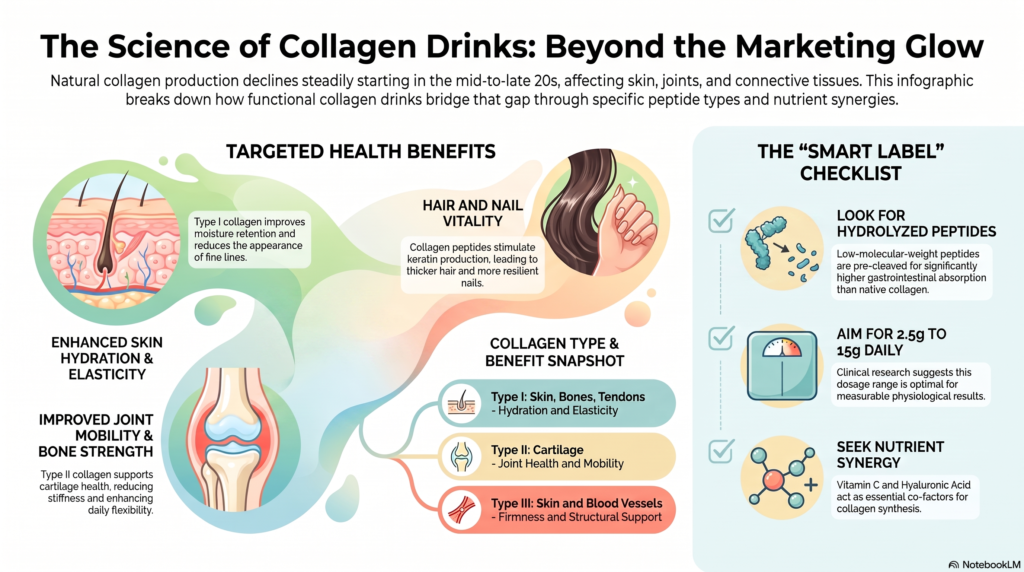
Enhancing Skin Health and Elasticity With Collagen Drinks
If you’re looking to enhance your skin’s hydration and elasticity, collagen drinks might be your new go-to. Collagen is the most abundant protein in your body. It accounts for about 30% of your body’s total protein. Collagen is the primary building block of your body’s skin, muscles, bones, tendons and ligaments, and other connective tissues. It’s also found in your organs, blood vessels and intestinal lining.
These drinks not only promote skin hydration but also boost your body’s natural collagen production.
Promoting Skin Hydration
When it comes to maintaining youthful and radiant skin, hydration plays an essential role.
Collagen drinks can be a powerful addition to your hydration methods, effectively enhancing skin moisture. These beverages often contain hyaluronic acid, known for its ability to retain moisture and boost skin elasticity.
By incorporating collagen drinks into your routine, you’re not just hydrating; you’re also supporting your skin’s overall health. Studies show that regular consumption can lead to improved skin texture and a reduction in dryness.
So, if you want to elevate your skincare game, consider how these drinks can hydrate from within, giving you that luminous glow.
Boosting Collagen Production
While your body naturally produces collagen, factors like aging and environmental stress can diminish its levels, impacting skin health and elasticity.
By incorporating collagen drinks into your routine, you can effectively boost collagen synthesis. These drinks often contain powerful amino acids and peptides that directly support your body’s ability to produce collagen.
Additionally, complementing these beverages with dietary sources rich in vitamin C, zinc, and copper can enhance your collagen production even further. Unlike an active pharmaceutical ingredient, collagen peptides work by supplying the building blocks your body needs to naturally support collagen synthesis rather than directly treating a medical condition. Research shows that these nutrients play a vital role in the collagen synthesis process.
Collagen Drinks for Joint and Bone Health
As you seek to enhance your joint and bone health, collagen drinks may offer a promising solution. Collagen is a group of proteins. They make up about one-third of the protein in your body and provide the structure for tissues like cartilage, skin and tendons.
These powerful beverages can greatly improve joint mobility and provide essential support for your bones.
Here are three key collagen benefits that make these drinks worth considering:
- Reduced Pain: Regular consumption may alleviate joint pain, making movement easier and more enjoyable.
- Enhanced Flexibility: Collagen improves the elasticity of cartilage, which can lead to better joint mobility and overall function.
- Bone Strength: Collagen drinks help maintain bone density, reducing the risk of fractures and supporting your skeletal structure.
Incorporating collagen drinks into your routine can empower you to achieve greater joint and bone health, allowing you to stay active and vibrant as you age.
Collagen’s Role in Hair and Nail Growth
Collagen plays an essential role in maintaining the health and energy of your hair and nails. As a crucial protein, it supports hair strength by promoting follicle health and encouraging growth.
Studies show that collagen peptides can stimulate the production of keratin, the protein that forms your hair, resulting in thicker and more vibrant strands. Similarly, collagen contributes to nail resilience, reducing brittleness and breakage.
When you include collagen drinks in your diet, you’re not just hydrating; you’re actively nourishing your hair and nails from within. This powerful protein helps fortify your beauty arsenal, ensuring your hair looks fuller and your nails are strong.
Embrace collagen for a robust approach to enhancing your natural beauty.

ESSENTIAL INGREDIENTS TO LOOK FOR IN COLLAGEN DRINKS
When formulating functional beverages, one of the biggest chemical hurdles we face is bioavailability versus palatability. A common myth circulating in online discussions is that drinking hydrolyzed collagen is no different than eating standard protein, claiming stomach acids digest it all identically anyway. While it’s true that your digestive tract breaks down proteins into amino acid building blocks, the enzymatic hydrolysis process used in quality collagen drinks pre-cleaves those long amino acid chains into specific, highly absorbable di-peptides and tri-peptides.
From an industrial chemistry perspective, these smaller peptides survive digestion far more effectively to signal cellular synthesis in connective tissues. However, raw marine or bovine collagen hydrolysates carry distinct off-notes often bitter, earthy, or fishy that can destroy a drink’s flavor profile. That is where formulators have to get creative with ingredient synergy.
Pairing hydrolyzed peptides with natural bioactives like ascorbic acid (Vitamin C), hyaluronic acid, or anthocyanin-rich fruit extracts doesn’t just mask unwanted flavors; it actively enhances collagen cross-linking and cellular uptake. When balanced properly with non-caloric natural sweeteners like stevia or monk fruit, you get a stable, refreshing beverage that delivers targeted bioactive benefits without loading your system with unnecessary refined sugars.
When choosing collagen drinks, it’s vital to pay attention to the types of collagen peptides included, as they can influence your body’s ability to absorb and utilize the nutrients.
Additionally, look for ingredient synergies that enhance absorption, while being mindful of flavoring agents and sweeteners that can affect overall health.
Types Of Collagen Peptides
While exploring the world of collagen drinks, it’s important to understand the types of collagen peptides that can greatly impact your health.
Different collagen types come from various peptide sources, and knowing them can make a big difference in your wellness journey. Here are three significant types of collagen peptides to look for:
- Type I: Found primarily in skin, bones, and tendons, this type supports skin elasticity and hydration.
- Type II: Mainly located in cartilage, it’s critical for joint health and mobility.
- Type III: Often found alongside Type I, it promotes skin firmness and helps maintain the structure of blood vessels.
Choosing the right collagen peptides guarantees you’re harnessing their full potential for improved health and vigor.
Nutrient Synergy And Absorption
Understanding the types of collagen peptides is just the beginning; the effectiveness of collagen drinks also hinges on the nutrients that enhance their absorption and synergy.
Look for ingredients like vitamin C, which boosts collagen synthesis and improves absorption efficiency. Amino acids, particularly glycine and proline, play an important role in nutrient interaction, maximizing the benefits of collagen peptides.
Additionally, hyaluronic acid can help retain moisture, further supporting skin health. When these nutrients work together, they create a powerful formula that elevates your body’s capacity to utilize collagen.
Flavoring Agents And Sweeteners
Flavoring agents and sweeteners play an essential role in making collagen drinks enjoyable and palatable, ensuring you’re more likely to incorporate them into your daily routine.
When choosing a collagen drink, consider these key ingredients:
- Natural flavors: Look for drinks that use natural flavors derived from fruits or herbs, which enhance taste without compromising health benefits.
- Sugar alternatives: Opt for drinks sweetened with sugar alternatives like stevia or monk fruit, which provide sweetness without the empty calories.
- Functional additives: Some drinks include ingredients like electrolytes or vitamins, boosting both flavor and nutritional value. This can be especially beneficial after exercise or during hot weather when you may be low on electrolytes, helping support hydration alongside your collagen routine.
How to Choose the Right Collagen Drink?
How do you find the perfect collagen drink for your needs? Start by identifying the collagen types that align with your health goals. For skin health, look for hydrolyzed collagen type I, while type II is ideal for joint support.
Next, check the dosage guidelines; most studies suggest 2.5 to 15 grams per day, depending on your objectives. Consider the source of collagen as well—marine, bovine, or plant-based options each offer unique benefits.
Don’t overlook additional ingredients; vitamins C and E, for instance, can enhance collagen absorption. If you enjoy pairing your wellness routine with beverages, L-Theanine in tea may also complement a balanced lifestyle by promoting relaxation without affecting the benefits of collagen supplementation. Finally, read reviews and consult with health professionals to guarantee you’re making an informed choice.
With the right collagen drink, you’ll be empowered to support your body’s vitality and resilience.
What Does the Research Say About Collagen Drinks?
What can the latest research tell us about the effectiveness of collagen drinks? Collagen research indicates these beverages may provide significant health benefits. Here’s what you should know:
- Skin Health: Studies show improved skin elasticity and hydration levels after regular collagen drink consumption.
- Joint Support: Collagen may reduce joint pain and enhance mobility, offering relief for those with arthritis or joint issues.
- Muscle Mass: Some research suggests that collagen drinks can aid in maintaining muscle mass, especially when combined with resistance training.
Incorporating collagen drinks into your routine could be a powerful step toward enhancing your overall wellness.
With solid backing from the scientific community, it’s clear that these drinks are more than just a trend; they’re a strategic addition to your health regimen.

RELATED STUDIES ABOUT COLLAGEN DRINKS BENEFITS
Incorporating collagen drinks into your daily routine can be a game-changer for your skin, joints, and hair. While you might opt for a sugary snack that provides a quick energy boost, consider the long-term benefits of nourishing your body with collagen. Research shows that these drinks not only enhance beauty but also support overall health. So, why not sip on something that not only tastes good but also fortifies your body from the inside out?
Anthocyanin-rich functional drinks enriched with hyaluronic acid (HA) and hydrolysed marine collagen: Physicochemical, antioxidant, and toxicity evaluation
This study evaluated the formulation of anthocyanin-rich drinks (A-RDs) enriched with hyaluronic acid (HA) and varying concentrations of hydrolysed marine collagen (HMC) ranging from 0% to 5%. The research assessed the drinks’ physicochemical properties, antioxidant and anti-tyrosinase activities, sensory acceptability, chemical composition, collagen bioavailability, and acute oral toxicity.
Key Research Findings
- Physicochemical & Bioactive Enhancements: Increasing HMC concentration resulted in higher turbidity, total soluble solids (TSS), and increased mineral (calcium and magnesium), protein, fiber, and ash content. Additionally, higher HMC levels correlated with improved antioxidant (DPPH-FRSA) and anti-tyrosinase activities.
- Sensory Acceptability: While no significant differences were observed across all sensory attributes, the formulation containing 2.5% HMC received the highest overall acceptability score, second only to the control (0% HMC).
- Bioavailability: The inclusion of 2.5% HMC significantly enhanced the total collagen content, in vitro collagen levels, and overall collagen bioavailability compared to the control.
- Safety Profile: An acute oral toxicity study conducted in Rattus norvegicus (Sprague-Dawley strain) demonstrated that a single oral dose of 2000 mg/kg of the HMC-enriched anthocyanin-rich drink resulted in no mortality, no clinical signs of toxicity, and no physical abnormalities over a 14-day observation period. The LD50 value is estimated to be greater than 2000 mg/kg.
Conclusion
The study concludes that incorporating 2.5% hydrolysed marine collagen into anthocyanin-rich drinks significantly improves their physicochemical, functional, and nutritional properties—specifically enhancing antioxidant capacity and collagen bioavailability—while maintaining consumer acceptance and demonstrating a non-toxic safety profile at the tested dose.
| REFERENCE: Deia Tawalbeh, Nur Fatieha Ismail, Soon Yong Ing, Nur Abir Dzulkifli, Mohd Hafiz Mail, Nur Hasnieza Mohd Rosli, Faisalina Ahmad Fisol, Norizah Mhd. Sarbon, Anthocyanin-rich functional drinks enriched with hyaluronic acid (HA) and hydrolysed marine collagen: Physicochemical, antioxidant, and toxicity evaluation, Future Foods, Volume 13, 2026, 100917, ISSN 2666-8335, https://doi.org/10.1016/j.fufo.2026.100917. (https://www.sciencedirect.com/science/article/pii/S2666833526000195) |
Collagen as a sustainable multifunctional protein: Sources, extraction strategies, applications, and future perspectives in food, cosmetic, and biomedical fields
This review provides a comprehensive overview of collagen, a primary structural protein in animals, emphasizing its structural diversity, sustainable sources, advanced extraction techniques, and multifaceted applications across the food, cosmetic, and biomedical industries.
Key Insights
- Structural Diversity & Sources: Collagen consists of a characteristic triple-helix structure with over 28 identified types. While traditionally sourced from bovine and porcine tissues, there is a significant shift toward sustainable utilization of seafood processing by-products and microbial-based recombinant systems.
- Extraction & Valorization: Extraction protocols involve pretreatment (chemical or biological) to remove non-collagenous components, followed by extraction (acid, enzymatic, or assisted technologies) and recovery (salt precipitation, dialysis, or ultrafiltration). Emerging methods like microwave- and ultrasound-assisted extraction are enhancing yield, purity, and sustainability.
- Multifunctional Applications:
- Food Industry: Collagen and its derivatives (gelatin and peptides) are utilized to improve texture, water-holding capacity, and stability in meat products, dairy items, and beverages, while also serving as functional ingredients in edible films and coatings.
- Cosmetic Industry: Due to its ability to improve skin hydration, elasticity, and firmness, collagen is widely incorporated into anti-aging creams, serums, and nutricosmetic supplements.
- Biomedical Field: Collagen’s biocompatibility and biodegradability make it a cornerstone material for wound dressings, tissue engineering scaffolds, drug delivery systems, and regenerative medicine.
- Sustainability & Future Perspectives: The valorization of animal and seafood processing waste not only reduces environmental pollution but also provides a cost-effective, sustainable supply of collagen. Future research is focused on optimizing recombinant production, exploring novel collagen variants, and conducting controlled clinical trials to further expand its industrial and therapeutic potential.
| REFERENCE: Sameh A. Korma, Ashiq Hussain, Abdul Rehman, Farzana Siddique, Nabeela Zulfiqar, Madiha Komal, Nida Firdous, Mohamed A. Fahmy, Tuba Esatbeyoglu, Taha Mehany, Collagen as a sustainable multifunctional protein: Sources, extraction strategies, applications, and future perspectives in food, cosmetic, and biomedical fields, Applied Food Research, 2026, 102151, ISSN 2772-5022, https://doi.org/10.1016/j.afres.2026.102151. (https://www.sciencedirect.com/science/article/pii/S2772502226004919) |
Collagen and its derivatives in the food industry: A review of sources, extraction, functional properties, and applications
Collagen is a versatile and abundant food biopolymer, accounting for approximately 30% of total animal protein mass, and is increasingly utilized in the food industry for its structural adaptability, texturization, water retention, and emulsification properties. This review provides a comprehensive synthesis of contemporary developments regarding collagen sources, processing strategies, and emerging food applications.
Key Findings
- Diverse Sources: The review categorizes collagen origins into bovine (the most abundant, ~45% of supply), porcine, poultry, marine (fish skin, scales, and jellyfish), and emerging recombinant or insect-based platforms. While mammalian sources offer superior thermal stability and gel strength, marine collagen is highly valued for its religious acceptability, sustainability, and unique solubility properties.
- Sustainable Extraction: Research highlights a shift toward environmentally sustainable extraction methodologies, such as enzymatic processes, ultrasound-assisted techniques, and the use of Natural Deep Eutectic Solvents (NADES). These methods aim to improve yield and purity while reducing chemical and energy intensity.
- Functional Applications:
- Texturization & Nutraceuticals: Collagen is widely used for texturizing meat products and plant-based analogs, while hydrolyzed collagen peptides are integrated into functional beverages and powders for their digestibility and health benefits.
- Active & Smart Packaging: The development of collagen-based edible films and coatings—often enriched with antimicrobial or antioxidant agents—offers a biodegradable alternative to synthetic polymers. The review further highlights “smart” packaging systems that utilize pH-sensitive or redox-responsive pigments to detect spoilage in real-time.
- Current Challenges: Despite its potential, the broader adoption of collagen in the food sector is constrained by several factors, including:
- Standardization: Variability in amino acid composition and functional behavior across mixed by-product streams complicates industry standardization.
- Economic & Safety Barriers: High production costs for recombinant collagen, inadequate allergenicity data (especially for marine and recombinant forms), and a lack of consistent life-cycle assessment (LCA) data hinder industrial-scale circularity.
- Regulatory Complexity: Safety requirements differ significantly depending on whether collagen is used as a food ingredient, a supplement, an edible coating, or a food-contact packaging material.
Conclusion
Collagen remains a high-potential multifunctional material for safe and sustainable food systems. The authors emphasize that moving forward, the industry must prioritize standardized characterization, application-specific regulatory validation, and rigorous safety assessments—particularly regarding allergenicity and migration—to fully realize collagen’s role in the future of functional and circular food development.
| REFERENCE: Palanivendhan Murugadoss, Ajay Kumar Karna, Naveen Kumar Rajendran, Shivendu Saxena, Yuvaraja Naik, Trapty Agarwal, Aseel Smerat, Ravikumar Jayabal, K. Kamakshi Priya, Collagen and its derivatives in the food industry: A review of sources, extraction, functional properties, and applications, Results in Chemistry, Volume 27, 2026, 103500, ISSN 2211-7156, https://doi.org/10.1016/j.rechem.2026.103500. (https://www.sciencedirect.com/science/article/pii/S2211715626004741) |
CONCLUSION
As someone who spends weekends experimenting with home carbonation profiles and hiking local trails, I appreciate wellness routines that fit naturally into an active lifestyle without feeling like a chore. The latest clinical data and food science research confirm that collagen drinks are far more than a fleeting functional beverage trend they represent a genuine shift toward proactive, preventive nutrition.
What excites me most as an ingredient sourcing strategist is where the industry is heading next. We are seeing a major, necessary transition toward eco-friendly marine collagen upcycled from fish processing by-products, as well as advanced enzymatic extraction methods that maximize purity without harsh chemical processing. Research consistently shows that a well-formulated, 2.5-gram to 10-gram daily dose of hydrolyzed marine or bovine peptides can make a measurable difference in joint flexibility, skin resilience, and overall vitality.
The key for any consumer is to stay curious and check the label carefully: target products utilizing low-molecular-weight peptides, look for essential co-factors like Vitamin C that drive natural synthesis, and choose brands committed to clean, transparent sourcing. When science and smart formulation meet, a daily functional drink becomes a powerful tool for long-term health.