

Throughout my work in medication review programs and health education, if there is one active pharmaceutical ingredient (API) I see continuously mentioned, it’s amoxicillin. For decades, it has served as a primary workhorse in modern medicine. Yet, despite how common it is, I frequently talk to patients who aren’t quite sure what it actually does inside their bodies. There is often a blur of confusion regarding when an antibiotic is necessary versus when a body is simply fighting off a routine seasonal virus.
I remember consulting with a patient during a community outreach event who was convinced that taking leftover amoxicillin from a prior illness would cure her severe seasonal cold. Scenarios like that highlight why science communication and medication literacy are so vital.
Amoxicillin is a remarkable, life-saving molecule, but its power lies entirely in using it for the right target. My goal in breaking down this active ingredient isn’t just to give you a pharmacology lesson it’s to give you practical knowledge so you can feel confident, safe, and informed every time you or a loved one receives an antibiotic prescription. Let’s look closer at how this familiar drug actually works to keep us healthy.
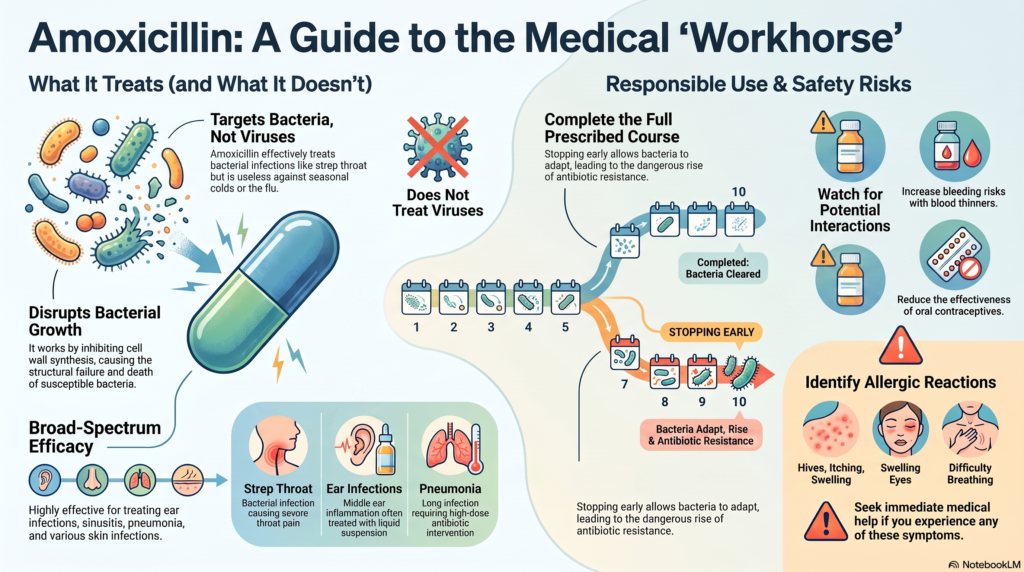
Amoxicillin is an antibiotic that targets bacterial infections by disrupting bacterial growth and reproduction. It’s commonly used to treat conditions like strep throat, ear infections, sinusitis, pneumonia, and skin infections. By inhibiting bacterial cell wall synthesis, it effectively combats a variety of bacteria. While it’s generally well-tolerated, be aware of potential side effects and the importance of completing your prescribed course. Continue to explore its benefits, risks, and responsible usage to maximize effectiveness.
Key Takeaways
- Amoxicillin is an antibiotic effective against bacterial infections such as strep throat, ear infections, and pneumonia.
- It works by inhibiting bacterial cell wall synthesis, disrupting growth and leading to bacterial death.
- Common side effects include nausea, vomiting, diarrhea, and possible allergic reactions like hives or rash.
- Strict adherence to the prescribed dosage is crucial to prevent antibiotic resistance and ensure effective treatment.
- Alternatives to Amoxicillin include other antibiotics like azithromycin, and consultation with healthcare professionals is essential for appropriate treatment options.
WHAT Is Amoxicillin and How Does It Work?
Amoxicillin is a widely used antibiotic that belongs to the penicillin group, designed to combat bacterial infections. Its mechanism involves inhibiting bacterial cell wall synthesis, effectively disrupting the structural integrity of bacteria.
By targeting the penicillin-binding proteins, amoxicillin halts the growth and replication of susceptible bacteria, leading to cell lysis. As the active pharmaceutical ingredient, amoxicillin is responsible for the antibiotic’s ability to interfere with bacterial cell wall synthesis and eliminate susceptible bacteria. However, the emergence of bacterial resistance poses a significant challenge to its efficacy.
Some bacteria produce beta-lactamase enzymes that can deactivate amoxicillin, undermining its therapeutic potential. Understanding these dynamics is essential for optimizing treatment strategies and mitigating resistance.
As you navigate the complexities of antibiotic use, staying informed about how amoxicillin works and the threat of resistance empowers you to make better healthcare decisions.
Common Infections Treated With Amoxicillin
In treating various bacterial infections, amoxicillin proves to be highly effective against a range of ailments. You’ll find it commonly prescribed for conditions like strep throat and ear infections. By understanding these specific applications, you gain insight into its utility in combating bacterial threats.
| Infection Type | Description |
| Strep Throat | A bacterial infection causing throat pain. |
| Ear Infections | Infections in the middle ear, causing pain. |
| Sinusitis | Inflammation of the sinuses with infection. |
| Pneumonia | Infection in the lungs, leading to cough. |
| Skin Infections | Bacterial infections affecting the skin. |
Amoxicillin stands out for its effectiveness, offering you a powerful option in the fight against these common bacterial infections.
Benefits of Using Amoxicillin for Bacterial Infections
When considering treatment options for bacterial infections, the benefits of using amoxicillin become evident. AMOXICILLIN (a mox i SIL in) treats infections caused by bacteria. It belongs to a group of medications called penicillin antibiotics. It will not treat colds, the flu, or infections caused by viruses.
This antibiotic is known for its effectiveness in combating various bacterial pathogens while offering several advantages:
- Broad-spectrum efficacy: Targets a wide range of bacteria, making it versatile for different infections.
- Rapid action: Typically starts working quickly, alleviating symptoms and promoting recovery.
- Well-tolerated: Most patients experience few side effects, enhancing adherence to treatment.
- Convenient dosing: Available in various forms, allowing for flexible administration tailored to individual needs.
What Are the Risks of Taking Amoxicillin?
When taking amoxicillin, you should be aware of potential risks, including common side effects like nausea or diarrhea.
Allergic reactions can also occur, and it’s essential to monitor for any unusual symptoms. Amoxicillin is used to treat bacterial infections in many different parts of the body (ear, lungs, nose, sinus, skin, urinary tract). It is also used with other medicines (eg, clarithromycin, lansoprazole) to treat H. pylori infection and duodenal ulcers.
Additionally, drug interactions with other medications can pose significant health hazards, so consult your healthcare provider before starting treatment.
Common Side Effects
Although many people tolerate amoxicillin well, it’s important to be aware of its potential side effects. Understanding these risks can empower you to make informed decisions about your health.
- Nausea or vomiting
- Diarrhea
- Rash or skin reactions
- Headaches
These side effects can occur regardless of amoxicillin dosage or amoxicillin administration method.
While most side effects are mild and temporary, some may be more severe. It’s essential to monitor your body’s response after taking amoxicillin.
Should you experience persistent or severe symptoms, consult your healthcare provider promptly.
With the right knowledge, you can navigate your treatment effectively and minimize risks associated with this antibiotic.

ALLERGIC REACTIONS CONCERNS
When we evaluate any medication in pharmacy practice, we always talk about the risk-to-benefit ratio. Amoxicillin is celebrated for its broad-spectrum efficacy and relative safety, but no active ingredient is completely without potential side effects or interaction risks. In my experience reviewing patient medication lists, some of the most avoidable complications happen simply because people aren’t aware of how different drugs interact such as taking over-the-counter remedies alongside prescription therapy without double-checking the active ingredients.
Beyond individual side effects like stomach upset or mild allergic reactions, there’s a broader safety issue we must address: antimicrobial stewardship. When antibiotics are overused or stopped halfway through a regimen, bacteria adapt. Recent public health research even highlights how shifts in prescribing habits and laboratory reporting policies can directly impact community-wide infection rates and antibiotic resistance.
As patients, taking your full prescribed dose at evenly spaced intervals isn’t just a routine instruction it’s an essential action that ensures the drug completely eradicates the target bacteria while protecting your long-term health. Empowering yourself with this knowledge ensures you get the full therapeutic benefit while keeping unnecessary risks at bay.
How can you identify an allergic reaction to amoxicillin?
You’ll want to be vigilant for allergic symptoms such as hives, rash, itching, swelling, or difficulty breathing. These reactions can manifest within hours or days of taking the medication.
If you notice any of these signs, it’s essential to seek immediate medical attention. Your healthcare provider may recommend treatment options like antihistamines or corticosteroids to alleviate symptoms. In some cases, an antihistamine such as a cetirizine hydrochloride tablet may be recommended by a healthcare professional to help relieve mild allergy symptoms, depending on your individual condition. In severe cases, an epinephrine injection might be necessary.
Knowing your allergy history is important; if you’ve had similar reactions to penicillin or cephalosporins, discuss this with your doctor before starting amoxicillin.
Awareness of these risks empowers you to make informed choices about your health.
Drug Interactions Risks
While amoxicillin is effective for treating various infections, it’s vital to be aware of potential drug interactions that can impact its efficacy and safety.
Understanding these interactions is significant for your medication safety. Here are key points to keep in mind:
- Anticoagulants: Amoxicillin may enhance the effects of blood thinners, increasing bleeding risks.
- Methotrexate: Concurrent use can elevate methotrexate levels, heightening toxicity.
- Oral Contraceptives: Amoxicillin might diminish the effectiveness of hormonal contraceptives. If you’re also taking over-the-counter cold and flu medications, reviewing the dayquil active ingredients can help you identify overlapping medications and avoid potential interactions.
- Probenecid: This medication can increase amoxicillin levels, altering its therapeutic effects.
How to Use Amoxicillin the Right Way
Using amoxicillin correctly is crucial for guaranteeing its effectiveness in treating bacterial infections. Amoxicillin comes as a capsule, a tablet, a chewable tablet, and as a suspension (liquid) to take by mouth. It is taken every 8 or 12 hours. Amoxicillin may be taken with food to prevent stomach upset. The length of your treatment depends on the type of infection that you have. Take amoxicillin at around the same times every day.
First, follow the prescribed amoxicillin dosage strictly; taking too little may not clear the infection, while too much can lead to adverse effects. Typically, it’s important to administer the medication at evenly spaced intervals to maintain consistent levels in your bloodstream.
This means adhering to specific amoxicillin timing, whether it’s every eight or twelve hours, as directed by your healthcare provider. Don’t skip doses, and if you miss one, take it as soon as you remember unless it’s nearly time for your next dose.
Always complete the full course, even if you start feeling better, to prevent antibiotic resistance and guarantee the infection is fully resolved.
Alternatives to Amoxicillin: What to Consider?
When considering alternatives to amoxicillin, it’s vital to evaluate the specific bacterial infection being treated and the patient’s medical history. Understanding your options empowers you to make informed choices.
Here are some alternatives worth exploring:
- Alternative antibiotics: Options like azithromycin or clindamycin may be effective based on the infection type.
- Natural remedies: Herbal solutions, such as garlic or echinacea, can offer supportive benefits but should be approached cautiously.
- Probiotics: These can help restore gut health, especially after antibiotic use, minimizing side effects.
- Lifestyle changes: Diet and hydration can enhance immune function, potentially reducing infection severity.
Each alternative has its own efficacy, so consulting a healthcare professional is essential for tailored advice.
Key Guidelines for Responsible Antibiotic Use
As you navigate the complexities of antibiotic use, adhering to key guidelines is essential to confirm effectiveness and prevent resistance. You must engage in responsible prescribing and prioritize patient education. Ascertain that you only prescribe antibiotics when absolutely necessary, and stress the importance of completing the full course to minimize resistance.
| Action | Importance | Potential Consequence |
| Educate patients | Increases adherence | Reduces effectiveness |
| Avoid unnecessary use | Preserves antibiotic efficacy | Promotes resistance |
| Monitor side effects | Guarantees safety | Avoids complications |
| Follow guidelines | Maintains public health | Protects treatment options |

RELATED STUDIES ABOUT WHAT IS AMOXICILLIN USED FOR
In conclusion, amoxicillin stands as an essential ally in the battle against bacterial infections, wielding its power with precision. However, like a double-edged sword, it carries risks that warrant caution. By understanding its uses, benefits, and alternatives, you can navigate the antibiotic landscape wisely. Embrace responsible usage to guarantee this potent medication remains effective for generations to come, safeguarding not just your health, but the delicate balance of our shared microbial world.
Amoxicillin bone penetration in patients with medication-related osteonecrosis of the jaw: a preliminary study
Overview and Objective
Medication-related osteonecrosis of the jaw (MRONJ) is a severe complication primarily seen in patients receiving antiresorptive treatments, such as denosumab or bisphosphonates. Because MRONJ is associated with altered bone perfusion and impaired drug delivery, this preliminary study aimed to evaluate and compare amoxicillin exposure in both plasma and bone tissue between MRONJ patients and a control group undergoing oral surgery.
Methodology
- The prospective observational study enrolled 27 patients between 2022 and 2024 who were treated with bisphosphonates or denosumab.
- The participants were stratified into 12 cases (patients with MRONJ) and 15 controls.
- Researchers measured amoxicillin concentrations in blood plasma and jaw-bone specimens collected during surgery.
- To account for varying antibiotic regimens, the measured drug concentrations were normalized (adjusted) based on the specific administered dose.
Key Findings
- Patient Comparability: The cases and controls were comparable in terms of baseline characteristics, including age, sex, body mass index, hematochemical parameters, and duration of antibiotic therapy.
- Systemic Exposure: Median dose-adjusted plasma concentrations of amoxicillin were similar across both groups, with cases at 3.8 [2.8-4.5] mg/L/g and controls at 4.0 [3.0-4.8] mg/L/g (p=0.533).
- Local Bone Exposure: Despite similar systemic levels, dose-adjusted bone concentrations of amoxicillin were significantly lower in MRONJ cases (0.9 [0.2-3.1] ng/mg/g) compared to the controls (15.5 [8.7-17.9] ng/mg/g), representing a highly significant 10-fold reduction (P=0.004).
- Bone-to-Plasma Ratio: There was a non-significant trend toward lower bone-to-plasma drug concentration ratios in MRONJ patients compared to controls (49% vs 298%, p=0.133).
Conclusion
The study demonstrates that while systemic plasma exposure to amoxicillin remains similar, actual bone concentrations of the antibiotic are significantly reduced in patients with MRONJ. This local impairment in drug delivery is likely related to the poor vascularization and tissue necrosis characteristic of MRONJ lesions. Ultimately, these findings provide a pharmacokinetic rationale for the frequently reported reduced efficacy of beta-lactam antibiotics in this clinical setting and highlight the need for personalized antibiotic strategies in MRONJ management.
| REFERENCE: Jessica Cusato, Alessandra Manca, Virginia Moscone, Miriam Antonucci, Francesco Chiara, Jacopo Mula, Dario Cattaneo, Lorenzo Bianchi, Paolo Arduino, Antonio D’Avolio, Francesco Erovigni, Amoxicillin bone penetration in patients with medication-related osteonecrosis of the jaw: a preliminary study, International Journal of Antimicrobial Agents, 2026, 107866, ISSN 0924-8579, https://doi.org/10.1016/j.ijantimicag.2026.107866. (https://www.sciencedirect.com/science/article/pii/S0924857926001548) |
Cessation of amoxicillin-clavulanate selective reporting and association with antibiotic prescribing and Clostridioides difficile infection in Ontario, Canada, 2017-2024: an ecological study
Overview
The study investigates the public health effects of ceasing “selective reporting” for amoxicillin-clavulanate, a broad-spectrum antibiotic known to carry a high risk of Clostridioides difficile infection (CDI). Selective reporting is an antimicrobial stewardship strategy that suppresses susceptibility results for broader-spectrum drugs when a narrower-spectrum alternative (like amoxicillin) is effective. This research examines whether a sudden transition to routine amoxicillin-clavulanate reporting in Ontario, Canada, led to increased prescribing rates and subsequent community-associated CDI (CA-CDI).
Methodology
- The research was structured as an ecological longitudinal study utilizing monthly aggregated data for Ontario residents from January 2017 to June 2024.
- The study compared a pre-intervention period (January 2017 to November 2021) against a post-intervention period (December 2021 to June 2024).
- Researchers analyzed the monthly percentage of amoxicillin-clavulanate susceptibility reporting specifically among amoxicillin-susceptible Escherichia coli and Proteus mirabilis urinary isolates.
- These reporting trends were then correlated with monthly outpatient antibiotic prescribing rates and the incidence of CA-CDI.
Key Findings
- Reporting Surge: Laboratory susceptibility reporting for amoxicillin-clavulanate skyrocketed from a mean of 4.1% during the pre-intervention period to 56.7% in the post-intervention period.
- Increased Prescribing: Following this shift in reporting, overall amoxicillin-clavulanate prescribing increased by 29% (Incidence Rate Ratio [IRR] of 1.29), while the prescribing of comparator antibiotics remained stable or decreased.
- Prescribing Shift: When compared directly to narrower-spectrum amoxicillin, the prescribing of amoxicillin-clavulanate increased by 36% (IRR, 1.36).
- Excess Infections: The transition away from selective reporting was associated with an estimated 459 excess cases of CA-CDI between December 2021 and June 2024.
Conclusion
The cessation of selective reporting for amoxicillin-clavulanate among susceptible urinary isolates is temporally associated with a significant increase in the prescribing of this broad-spectrum antibiotic and a higher incidence of CA-CDI. These findings underscore the critical role that microbiology laboratory reporting policies play in influencing clinician prescribing behaviors and downstream patient outcomes.
| REFERENCE: Michelle K. Wong, Nick Daneman, Bradley J. Langford, Valerie Leung, Kevin L. Schwartz, Huda Almohri, Lee W. Goneau, Kevin A. Brown, Cessation of amoxicillin-clavulanate selective reporting and association with antibiotic prescribing and Clostridioides difficile infection in Ontario, Canada, 2017-2024: an ecological study, Clinical Microbiology and Infection, 2026,, ISSN 1198-743X, https://doi.org/10.1016/j.cmi.2026.04.015. (https://www.sciencedirect.com/science/article/pii/S1198743X26001990) |
Can amoxicillin be detected in the aquatic environment? A critical assessment
Background and Objectives
Amoxicillin is a heavily consumed broad-spectrum $\beta$-lactam antibiotic utilized in both human and veterinary medicine. Because 60-80% of an administered dose is excreted unmetabolized via urine within hours, its potential contamination of aquatic systems poses significant ecological and public health risks, including the promotion of antimicrobial resistance. Recognizing these threats, the European Union included amoxicillin in environmental monitoring Watch Lists in 2018 and 2020. However, existing scientific literature presents highly contradictory data regarding its environmental presence, with reports ranging from complete non-detection to exceedingly high concentrations.
Analytical Challenges and Study Methodology
The conflicting reports largely stem from amoxicillin’s high polarity, which causes poor retention on conventional liquid chromatography columns and leads to substantial analytical errors during detection and quantification. To resolve these discrepancies and provide realistic expectations for environmental monitoring, researchers conducted a comprehensive assessment of amoxicillin’s stability in surface water, influent wastewater, and effluent wastewater. The study tracked degradation patterns in water samples spiked with 5 and $50~\mu g/L$ of the antibiotic under both dark and natural sunlight conditions. The parent compound was quantified using liquid chromatography-tandem mass spectrometry (LC-MS/MS), while transformation products were identified via high-resolution mass spectrometry (LC-HRMS).
Key Findings
- Rapid Degradation in Wastewater: In influent wastewater kept in dark conditions, amoxicillin degraded extremely rapidly. Less than 20% of the initial concentration remained after just 6 hours, and less than 5% remained after 24 hours.
- Pronounced Photodegradation: Under natural sunlight exposure, both effluent wastewater and surface water exhibited significant photodegradation. Less than 30% of the antibiotic remained after 48 hours, and it became completely undetectable by 96 hours.
- Identification of Transformation Products: The analysis successfully identified amoxicillin penicilloic acid as the primary transformation product resulting from this degradation process.
Conclusions and Recommendations
The research conclusively demonstrates that the detection of intact, unmetabolized amoxicillin in authentic environmental water samples is highly unlikely due to its inherent instability and rapid degradation. Consequently, high amoxicillin concentrations reported in previous literature should be interpreted with extreme caution, as they are likely the result of analytical inaccuracies. For reliable environmental monitoring and risk assessment moving forward, efforts should shift toward tracking its primary degradation product, amoxicillin penicilloic acid, which serves as a far more accurate and persistent indicator of aquatic contamination.
| REFERENCE: Félix Hernández, Ana María Botero-Coy, Lubertus Bijlsma, David Fabregat-Safont, Can amoxicillin be detected in the aquatic environment? A critical assessment, Environment International, Volume 211, 2026, 110258, ISSN 0160-4120, https://doi.org/10.1016/j.envint.2026.110258. (https://www.sciencedirect.com/science/article/pii/S0160412026002163) |
CONCLUSION
At its core, I believe pharmacy is just as much about service and health equity as it is about chemical structure and cellular biology. Understanding what goes into your body shouldn’t require a science degree; clear, accessible information is a fundamental right for every patient. Amoxicillin remains one of our most effective, reliable tools against bacterial infections, but its continued success relies heavily on how responsibly we use it today.
From an environmental standpoint, emerging studies show us that pharmaceuticals interact with our ecosystems long after they leave the bottle, reminding us of the interconnected nature of human health and our environment. Whether you are managing an acute middle ear infection, helping a child take their liquid suspension, or simply trying to read a prescription label with greater clarity, remember that you are an active partner in your healthcare journey.
Never hesitate to ask your pharmacist or physician questions about your prescriptions, potential side effects, or necessary precautions. When we approach medicine with curiosity instead of fear, we take meaningful steps toward a healthier, more literate community.