
When consumers look at ingredient lists or nutritional panels, words like “acidic” can often trigger unnecessary anxiety people naturally associate acidity with stomach upset, chemical synthetic additives, or corrosive properties. But from a food science perspective, acidic amino acids like aspartic acid and glutamic acid are some of the most fascinating and beneficial natural building blocks in our food supply.
As someone who spends their days evaluating food safety data and formulation mechanics, I always remind people that chemical structures dictate behavior, not fear-driven headlines. What makes these specific amino acids “acidic” is simply the presence of an extra carboxyl group on their side chains. At normal physiological pH, that extra carboxyl group loses a proton, leaving the molecule with a net negative charge.
Far from being dangerous, this unique negative charge is precisely what allows aspartic acid and glutamic acid to perform critical biochemical functions from acting as key neurotransmitters in your central nervous system to forming the structural backbone of proteins in whole foods. Understanding the real chemistry of what you eat empowers you to make choices based on facts rather than marketing buzzwords. Let’s break down what these compounds actually do inside your body and how they show up on your plate.
Acidic amino acids, like aspartic acid and glutamic acid, play essential roles in protein synthesis, neurotransmitter regulation, and energy production. They support mood and cognitive performance by enhancing neuronal communication and can even aid in muscle recovery for athletes. You’ll find these vital amino acids in foods such as eggs, fish, dairy, and legumes. By optimizing your intake, you can enjoy various health benefits. Discover more about how to effectively incorporate them into your diet.
KEY TAKEAWAYS
- Acidic amino acids, primarily aspartic acid and glutamic acid, are vital for protein structure and function in the body.
- They play essential roles in neurotransmission, influencing mood, cognitive function, and synaptic plasticity.
- Food sources rich in acidic amino acids include eggs, fish, lean meats, dairy products, lentils, beans, and quinoa.
- These amino acids support muscle recovery and growth, enhance physical performance, and promote metabolic health.
- Supplementing with acidic amino acids around workouts can optimize recovery and nutrient utilization for active individuals.
WHAT ARE ACIDIC AMINO ACIDS AND THEIR ROLE IN THE BODY?
Acidic amino acids, essential components of proteins, play a fundamental role in various physiological processes within the body. These amino acids, primarily aspartic acid and glutamic acid, are essential for maintaining ideal body functions.
They participate in neurotransmission, influencing mood and cognitive performance. By facilitating the synthesis of neurotransmitters, they enhance communication between nerve cells, empowering your mental agility.
Additionally, acidic amino acids contribute to energy production and metabolic processes, ensuring your body operates efficiently. Their capacity to regulate pH levels also supports muscle function and overall homeostasis.
Including foods rich in these amino acids, such as meat, fish, and legumes, can greatly bolster your health, allowing you to harness the full potential of your body’s capabilities.
What Sets Aspartic Acid Apart From Glutamic Acid?
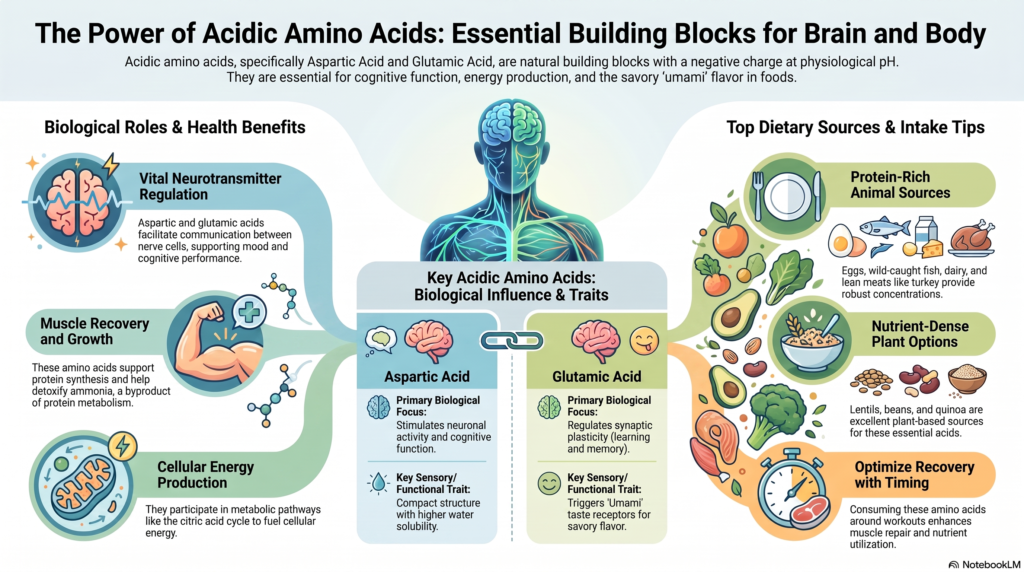
Aspartic acid and glutamic acid, while both acidic amino acids, differ in their chemical structures and biological roles. Amino acids are the building blocks of proteins, and their side chains—or R groups—determine how they behave in different environments. Among the 20 standard amino acids, a small but important group is negatively charged amino acids which carries a negative charge at physiological pH, influencing everything from protein structure to biochemical interactions.
You’ll find that aspartic acid contains one less carbon atom than glutamic acid, influencing how each amino acid functions in cellular processes.
Understanding these distinctions can help you appreciate their unique contributions to health and metabolism.
Chemical Structure Differences
Understanding the chemical structures of amino acids reveals important distinctions between aspartic acid and glutamic acid. Aspartic acid has a shorter side chain containing one carboxyl group, while glutamic acid features an additional methylene group, giving it two carboxyl groups.
This difference in structure affects their chemical bonding and molecular polarity. Aspartic acid’s configuration makes it a more compact molecule with a lower molecular weight, enhancing its solubility in water.
In contrast, glutamic acid’s extended structure increases its polarity, greatly influencing its interactions within proteins. These structural variations not only impact each amino acid’s function but also their role in metabolic pathways.
Biological Functions Comparison
While both aspartic acid and glutamic acid play essential roles in metabolism and neurotransmission, their distinct biological functions set them apart.
Aspartic acid, classified as an acidic amino acid, primarily acts as a neurotransmitter stimulating neuronal activity, enhancing cognitive functions.
In contrast, glutamic acid, another acidic amino acid, serves as a key excitatory neurotransmitter, regulating synaptic plasticity vital for learning and memory.
While both share similar acidic properties, aspartic acid’s involvement in energy production distinguishes it, as it participates in the urea cycle and nucleotide synthesis.
Understanding these differences not only highlights their unique contributions to brain health but also emphasizes the broader implications of amino acid classification in nutritional science and therapeutic strategies.
How Acidic Amino Acids Support Protein Building
In my work consulting with food manufacturers, I frequently analyze how individual ingredients interact in complex biological systems. When you examine aspartic acid and glutamic acid side-by-side, the structural difference seems tiny; glutamic acid just has one additional methylene (CH2) carbon in its chain compared to aspartic acid. However, in food chemistry and human physiology, minor structural variations completely transform a compound’s behavior. Take glutamic acid, for instance.
Because of its extended side chain and higher polarity, its free form (glutamate) triggers the umami taste receptors on our human tongue. It is the exact molecular reason why aged cheeses, ripe tomatoes, and fermented soy sauces taste deeply savory and satisfying. In modern manufacturing and clean-label product development, harnessing these naturally occurring acidic amino acids allows us to enhance food flavor naturally without over-relying on excess sodium or artificial flavor enhancers.
Beyond taste, these structural traits dictate how the body absorbs nitrogen, fuels cellular energy through the citric acid cycle, and synthesizes critical neurochemicals like GABA. When you look past the clinical jargon, you realize that these two organic acids are foundational to both the sensory quality of our food and the metabolic efficiency of our bodies.
Acidic amino acids, such as aspartic acid and glutamic acid, play an essential role in protein synthesis by serving as building blocks that facilitate the formation of proteins crucial for various bodily functions.
Their involvement in amino acid metabolism enhances the efficiency of this process. Here’s how they support protein building:
- Nitrogen Source: They provide nitrogen, essential for forming amino groups in amino acids, critical for synthesizing proteins.
- Energy Production: They participate in metabolic pathways, supplying energy that fuels protein synthesis.
- Regulatory Role: They help regulate gene expression related to protein synthesis, ensuring that the right proteins are produced when needed. Unlike an active pharmaceutical ingredient, acidic amino acids are naturally occurring nutrients that support normal biological processes and overall health.
HOW ACIDIC AMINO ACIDS INFLUENCE NEUROTRANSMISSION?
Acidic amino acids play a vital role in synthesizing neurotransmitters, which are essential for effective communication between neurons. The basic structure of amino acids includes an α-carbon atom bonded to both an amino group (-NH₂) and a carboxyl group (-COOH), along with a hydrogen atom (H) and a distinct side chain known as the R group. Each amino acid derives its distinct characteristics from its side chain, which affects its charge as well as its polarity and reactivity. The amino group (-NH₂) alongside the carboxyl group (-COOH) is responsible for naming amino acids. The term “amino” denotes the amino group, and “acid” denotes the carboxyl group, which has the ability to release a proton (H⁺), showing acidic behavior. Unique properties arise from the different side chains (R groups) present in the 20 standard amino acids. Some side chains demonstrate hydrophobic properties, whereas others exhibit hydrophilic characteristics. Proteins require amino acids for their assembly because they perform functions within almost every cellular process. Proteins function as biochemical reaction catalysts while also forming tissue structures and serving as signaling molecules for cellular communication. Knowledge about individual amino acid properties allows us to comprehend protein folding into active three-dimensional forms and their interactions with different molecules. Such knowledge proves essential for both the progress of biochemistry studies and the creation of novel therapeutic strategies against diseases.
By influencing neurotransmitter levels, these amino acids directly impact mood regulation and emotional well-being.
Understanding this relationship can help you appreciate the importance of dietary sources rich in acidic amino acids for ideal brain function.
Role in Neurotransmitter Synthesis
Although neurotransmitter synthesis involves various amino acids, acidic amino acids like aspartate and glutamate play essential roles in this process.
They’re critical in maintaining neurotransmitter balance and facilitating communication between neurons. Here’s how they contribute:
- Precursor Role: Aspartate and glutamate serve as precursors for the synthesis of key neurotransmitters, directly influencing brain signaling.
- Excitatory Neurotransmission: These amino acids are primary excitatory neurotransmitters, enhancing neuronal activation and promoting efficient signaling.
- Modulation of Amino Acid Pathways: They regulate metabolic pathways that affect the synthesis and degradation of neurotransmitters, ensuring ideal levels.
Impact on Mood Regulation
The balance of neurotransmitters directly affects your mood, and acidic amino acids like aspartate and glutamate play a significant role in this regulation.
These amino acids are essential for synthesizing neurotransmitters that facilitate communication between neurons, impacting mood enhancement and emotional stability. Aspartate acts as an excitatory neurotransmitter, promoting alertness and cognitive function, while glutamate is fundamental for synaptic plasticity and learning.
Research shows that maintaining adequate levels of these amino acids can help prevent mood disorders and enhance resilience against stress.
Health Benefits of Acidic Amino Acids
While you mightn’t think about amino acids often, the health benefits of acidic amino acids are significant and can impact various bodily functions. Amino acid, any of a group of organic molecules that consist of a basic amino group (―NH2), an acidic carboxyl group (―COOH), and an organic R group (or side chain) that is unique to each amino acid. The term amino acid is short for α-amino [alpha-amino] carboxylic acid. Each molecule contains a central carbon (C) atom, called the α-carbon, to which both an amino and a carboxyl group are attached. The remaining two bonds of the α-carbon atom are generally satisfied by a hydrogen (H) atom and the R group.
These powerful compounds play a vital role in your health, providing various acidic benefits that enhance your well-being. Here are three key advantages:
- Neurotransmitter Support: Acidic amino acids like aspartic acid and glutamic acid contribute to neurotransmitter production, ensuring effective communication within your nervous system.
- Detoxification: They help in detoxifying ammonia, a harmful byproduct of protein metabolism, promoting liver health.
- Muscle Recovery: Acidic amino sources support muscle repair and growth, making them essential for athletes and active individuals. When combined with a balanced diet, probiotics for men may further support nutrient absorption and digestive health, helping maximize the benefits of these amino acids.
Incorporating these amino acids into your diet can empower you to optimize your health and performance.
Best Foods for Boosting Acidic Amino Acids Intake
To maximize the health benefits of acidic amino acids, incorporating specific foods into your diet is key. Focus on protein-rich foods, as they’re primary dietary sources of these essential amino acids.
Eggs, fish, and lean meats like chicken and turkey are excellent choices, providing robust levels of aspartic and glutamic acids. Plant-based options, such as lentils, beans, and quinoa, also deliver significant amounts. Pairing these foods with sources of vitamin a, such as carrots, spinach, and sweet potatoes, can further support immune function and overall nutritional balance.
Incorporating dairy products, like yogurt and cheese, can further enhance your intake. By combining these foods, you’ll not only boost your acidic amino acids but also support overall health and wellness.
Prioritize these dietary sources to empower your body and optimize your nutritional profile for peak performance.
Tips for Maximizing the Health Benefits of Acidic Amino Acids
Incorporating acidic amino acids into your diet can greatly enhance your overall health, especially when you follow certain strategies.
To maximize their benefits, consider these tips:
- Enhance Supplement Timing**: Take your amino acid supplements around workouts to support muscle recovery and growth**. Timing is vital for effectiveness.
- Ensure Dietary Balance**: Pair acidic amino acids with other essential nutrients. A well-rounded diet enhances absorption and utilization in the body, promoting overall health.
- Monitor Intake: Keep track of your consumption to avoid deficiencies or excesses. Balancing your intake helps maintain ideal physiological functions and supports your fitness goals.
RELATED STUDIES ABOUT ACIDIC AMINO ACIDS
Incorporating acidic amino acids into your diet is like adding fuel to a high-performance engine; they play a significant role in maximizing your body’s potential. With benefits ranging from boosting protein synthesis to enhancing neurotransmission, these amino acids are fundamental for overall health. Just as a well-tuned engine runs smoothly, a balanced intake of aspartic and glutamic acid can improve your physical and mental performance. So, fill your plate with the right foods and rev up your energy!
Amino acid transporter OsLAT1 negatively regulates tillering and yield by affecting amino acids and polyamines in rice
Overview
Rice production is a global priority, with tillering (branching) acting as a fundamental trait for increasing grain yield. While numerous genes have been linked to tillering, the role of amino acid transporters (AATs) in orchestrating plant architecture is only beginning to be understood. This study characterizes the function of OsLAT1, a member of the L-type amino acid transporter (LAT) subfamily, and identifies it as a negative regulator of tillering and grain yield in rice.
Key Findings
- Genetic Variation and Expression: Analysis of 533 rice accessions revealed four primary haplotypes (Hap1–Hap4). Notably, the Hap2 haplotype—which showed the lowest tiller number and yield—corresponded with the highest OsLAT1 expression levels. The gene is predominantly expressed in leaf and basal tissues.
- Subcellular Localization: Protein localization assays determined that the OsLAT1 protein is localized to the endoplasmic reticulum (ER), indicating its potential role in intracellular amino acid homeostasis.
- Transcriptional Regulation: Using GUS staining and qRT-PCR, the researchers found that OsLAT1 expression is strongly induced by specific amino acids—notably aspartate (Asp) and leucine (Leu)—as well as the polyamines spermine (Spm) and spermidine (Spd).
- Impact on Agronomic Traits:
- Overexpression (OsLAT1-OE): Plants overexpressing OsLAT1 exhibited significantly reduced tiller numbers, lower secondary branch numbers, and decreased grain yield.
- Knockout (oslat1 mutants): Conversely, mutant lines generated via CRISPR/Cas9 technology displayed increased tiller numbers, higher secondary branch numbers, and improved grain yield compared to wild-type controls.
- Transport and Homeostasis: OsLAT1 was found to facilitate the transport of neutral (Ser) and basic (Arg) amino acids. While moderate concentrations of these amino acids promoted growth, supraoptimal levels caused the growth inhibition observed in overexpression lines. Furthermore, OsLAT1 facilitates the transport of polyamines (Spd/Spm), which positively promotes axillary bud elongation.
Conclusion
The study concludes that OsLAT1 acts as a dose-dependent negative regulator of rice branching and yield by modulating the transport and internal partitioning of specific amino acids and polyamines. These findings provide critical insights into the genetic regulation of plant architecture and identify OsLAT1 as a promising target for agricultural engineering aimed at optimizing nitrogen utilization and boosting grain productivity in rice.
| REFERENCE: Yu Fan, Guo Yang, Cheng Liu, Weiting Huang, Quanzhi Zhao, Chang Zheng, Zhongming Fang, Amino acid transporter OsLAT1 negatively regulates tillering and yield by affecting amino acids and polyamines in rice, Journal of Integrative Agriculture, 2026,, ISSN 2095-3119, https://doi.org/10.1016/j.jia.2026.04.036. (https://www.sciencedirect.com/science/article/pii/S2095311926001772) |
Simultaneous determination of acylcarnitines, fatty acids, and amino acids by 3-nitrophenylhydrazine derivatization and ultra-high performance liquid chromatography/tandem mass spectrometry
Overview
Acylcarnitines (ACs), fatty acids (FAs), and amino acids (AAs) are critical metabolites involved in mitochondrial $\beta$-oxidation and broader cellular metabolism. Dysregulation of these metabolites is associated with diverse clinical conditions, including cardiovascular disease, neurodegenerative disorders, and cancer. Due to the wide range of polarities and chemical functionalities across these classes, simultaneous analysis using a single method has historically been difficult to achieve.
Objective
The study aimed to develop and validate a sensitive, reproducible, and cost-effective quantitative method for the simultaneous determination of carnitine, seven ACs, fifteen FAs, and thirteen AAs in human serum using ultra-high performance liquid chromatography-tandem mass spectrometry (UHPLC-MS/MS).
Methodology
- Derivatization Strategy: The researchers employed 3-nitrophenylhydrazine (3-NPH) derivatization, which facilitates the stable labeling of carboxyl groups. This approach improves chromatographic retention for polar analytes and enhances sensitivity in MS/MS analysis.
- Analytical Workflow: Following protein precipitation with cold acetonitrile (optimized at a 1:2 ratio to balance analyte recovery and matrix removal), serum samples were derivatized with 3-NPH and 1-ethyl-3-(3-dimethylaminopropyl) carbodiimide (EDC).
- Separation and Detection: Metabolites were separated via reversed-phase UHPLC using an Agilent Eclipse RRHD C18 column and detected using a triple quadrupole mass spectrometer in selected reaction monitoring (SRM) mode.
Key Findings
- Sensitivity: The method achieved high detectability across all classes, with limits of detection (LODs) ranging from 0.01 to 0.27 ng/mL for ACs, 0.22 to 1.76 ng/mL for FAs, and 0.17 to 18.25 ng/mL for AAs.
- Accuracy and Precision: The method demonstrated high robustness, with recovery rates between 92–126% for ACs, 56–116% for FAs, and 86–115% for AAs. Intra-day and inter-day precision values were generally below 20%, meeting international validation criteria for metabolic profiling.
- Chromatographic Resolution: The UHPLC system successfully resolved critical isomeric species, such as butyric acid/isobutyric acid and leucine/isoleucine, which are often co-eluted in simpler assays.
- Matrix Tolerance: The method exhibited satisfactory matrix tolerance, with minimal ion suppression or enhancement, confirming its reliability for complex human serum matrices.
Conclusion
This validated UHPLC-MS/MS method provides a sensitive, practical, and efficient tool for the simultaneous profiling of ACs, FAs, and AAs. By consolidating these three distinct metabolite classes into a single analytical run, the workflow offers significant advantages for clinical diagnostics and large-scale metabolic research, facilitating the rapid identification of biomarkers associated with complex metabolic disorders.
| REFERENCE: Hamidreza Ardalani, Srinivas Reddy Dannarm, Peter Spégel, Simultaneous determination of acylcarnitines, fatty acids, and amino acids by 3-nitrophenylhydrazine derivatization and ultra-high performance liquid chromatography/tandem mass spectrometry, Journal of Chromatography A, Volume 1782, 2026, 467105, ISSN 0021-9673, https://doi.org/10.1016/j.chroma.2026.467105. (https://www.sciencedirect.com/science/article/pii/S0021967326004346) |
Integration of whole genome resequencing and transcriptomics reveals key candidate genes and pathway for fatty acid and amino acid compositions among duck breeds
Overview
Meat quality and flavor are primary drivers of consumer preference in the poultry industry. These traits are heavily influenced by the composition of fatty acids (FAs) and amino acids (AAs) in muscle tissue, which vary significantly between duck breeds. This study, published in Poultry Science as “Integration of whole genome resequencing and transcriptomics reveals key candidate genes and pathway for fatty acid and amino acid compositions among duck breeds,” conducted a comprehensive analysis to elucidate the molecular mechanisms underlying these nutritional differences across three breeds: Cherry valley (CV), Jinling white (JL), and Liancheng white (LC) ducks.
Methodology
The research employed an integrated approach combining phenotypic analysis, whole-genome resequencing (WGRS), and RNA sequencing (RNA-Seq) on the pectoral muscle and blood of 49-day-old ducks:
- Nutritional Profiling: Gas chromatography-mass spectrometry was used to identify 27 differentially expressed FAs, while an automatic amino acid analyzer identified 20 differentially expressed AAs.
- Genomic Analysis: WGRS identified 2,734 selected genes through selective sweep analysis, establishing a genetic foundation for inter-breed differences.
- Transcriptomic Analysis: RNA sequencing identified thousands of differentially expressed genes (DEGs) across the three breed comparisons, which were then functionally linked to FA and AA metabolism via KEGG pathway enrichment analysis.
- Integrated Bioinformatics: Joint pathway analysis and Venn diagram techniques were utilized to correlate genomic selective signals with transcriptomic DEGs, narrowing down key candidate regulatory genes.
Key Findings
- Nutritional Superiority of LC Ducks: The Liancheng white (LC) breed exhibited the most favorable profile for meat quality, possessing significantly higher levels of total monounsaturated fatty acids (MUFAs), polyunsaturated fatty acids (PUFAs), and total essential/non-essential amino acids compared to the CV and JL breeds. Conversely, CV ducks showed the highest content of saturated fatty acids (SFAs), which are generally considered less desirable for human health.
- Key Regulatory Genes: The study identified four critical candidate genes—MGLL, NDUFV1, NDUFS4, and GNG10—that appear to cooperatively regulate the “retrograde endocannabinoid signaling” pathway.
- Molecular Mechanism: This regulatory network influences the deposition of key flavor-related compounds, specifically arachidonic acid, $\gamma$-aminobutyric acid, and L-glutamate, in the pectoral muscle.
Conclusion
By integrating multi-omics data, this study clarifies the genetic architecture governing fatty acid and amino acid composition in duck meat. The identification of key regulatory genes (MGLL, NDUFV1, NDUFS4, and GNG10) and the associated retrograde endocannabinoid signaling pathway provides a robust theoretical foundation for future molecular breeding programs aimed at improving meat quality traits and flavor profiles in high-quality duck varieties.
| REFERENCE: Hengli Xie, Xinyue Hu, Shangmin Wang, Hehe Liu, Zongliang He, Hongjie Ji, Kunpeng Lv, Ting Zhu, Jiwen Wang, Integration of whole genome resequencing and transcriptomics reveals key candidate genes and pathway for fatty acid and amino acid compositions among duck breeds, Poultry Science, Volume 105, Issue 7, 2026, 106900, ISSN 0032-5791, https://doi.org/10.1016/j.psj.2026.106900. (https://www.sciencedirect.com/science/article/pii/S0032579126005286) |
CONCLUSION
Ultimately, my main objective at Active Ingredient Hub is to demystify what goes into your body so you can make confident, science-backed dietary decisions. You don’t need synthetic powders or heavily marketed single-nutrient supplements to get the benefits of acidic amino acids. Nature has already packaged them efficiently inside real, whole foods whether that is eggs, wild-caught fish, lentils, or fermented dairy.
In recent research profiling animal proteins and crop systems, we consistently see that maintaining a balanced profile of amino acids alongside supporting nutrients like Vitamin A is key to metabolic health, muscle recovery, and overall vital function. As a food scientist who loves experimenting with plant-based formulations in my own kitchen, I always advise a whole-food, diet-first approach.
Ensure your meals feature a diverse mix of quality plant or animal proteins, and your body will naturally handle the delicate chemistry of deprotonation, neurotransmitter synthesis, and cellular repair. Don’t let the word “acid” scare you off; embrace the foundational chemistry that keeps your brain sharp, your muscles recovering, and your food tasting great.