
Whenever I walk through a farmer’s market or sit down to sketch botanicals in my garden notebook, I’m constantly amazed by the sheer vibrancy of nature’s color palette. But as someone with a background in applied chemistry, I can’t help looking past the aesthetic beauty to see what’s happening at a molecular level. Those brilliant fiery oranges in sweet potatoes, deep reds in ripe tomatoes, and rich yellows in summer squashes aren’t just there to look pretty, they are sophisticated biological mechanisms.
They are carotenoids, a family of lipid-soluble pigments that plants synthesize to capture light energy and protect their own delicate cellular structures from environmental stress. What fascinates me most is how effortlessly these natural active ingredients transfer their protective powers to us when we eat them. While synthetic food dyes and lab-isolated additives often carry unexpected tradeoffs or regulatory scrutiny, natural carotenoids represent functional food design at its absolute finest.
They act as internal photoprotectants, anti-inflammatory compounds, and robust free-radical scavengers without a single downside. In a food landscape increasingly crowded with artificial fixes, returning to whole, pigment-rich plant foods is one of the most effective ways we can support long-term cellular health. Let’s break down how these remarkable natural compounds actually work in our bodies.
Carotenoids are powerful antioxidants found in colorful fruits and vegetables. They help protect your cells from oxidative stress and are essential for good health. Foods rich in carotenoids include carrots, sweet potatoes, spinach, and tomatoes. These natural ingredients support eye health, boost immune function, and reduce inflammation. Including a variety of these foods in your diet can enhance your overall wellness. Discover more about how to maximize the benefits of carotenoids for your health.
KEY TAKEAWAYS
- Carotenoids are powerful antioxidants that protect cells from oxidative damage, promoting overall health and wellness.
- Foods rich in carotenoids include carrots, spinach, tomatoes, sweet potatoes, and red bell peppers.
- Consuming carotenoid-rich foods enhances immune function and reduces inflammation in the body.
- Carotenoids contribute to eye health, skin protection, and heart health through unique nutritional properties.
- Incorporating a variety of vibrant fruits and vegetables ensures maximum antioxidant benefits from carotenoids.
WHAT ARE CAROTENOIDS AND WHY ARE THEY IMPORTANT?
Carotenoids are natural pigments found in many fruits and vegetables, and they play an essential role in human health. These powerful compounds, which give foods their vibrant colors, are important carotenoid sources like carrots, sweet potatoes, spinach, and tomatoes.
Their nutritional significance can’t be overstated; they contribute to improved immune function, eye health, and skin protection. By including a variety of carotenoid-rich foods in your diet, you enhance your body’s ability to combat oxidative stress.
This is critical for maintaining overall wellness and vitality. Embracing these nutrient-dense options empowers you to harness their health benefits effectively.
How Carotenoids Work as Antioxidants
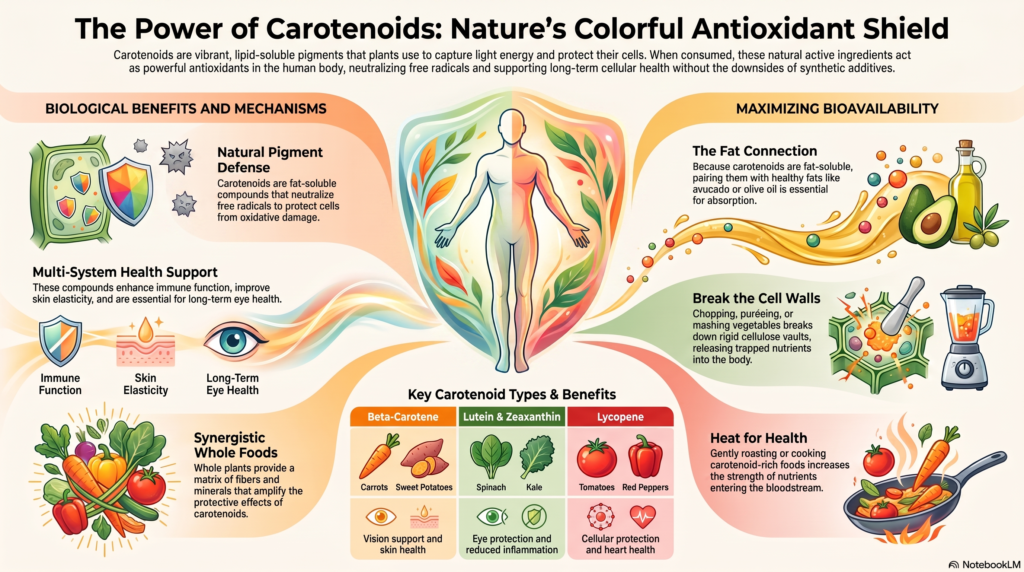
Carotenoids play an essential role in protecting your cells from oxidative damage. Carotenoids are fat-soluble compounds, meaning they are best absorbed with fat. Unlike some protein-rich foods and vegetables, cooking and chopping carotenoid-rich foods increase the strength of the nutrients when they enter the bloodstream.
Their unique structure allows them to neutralize free radicals,which can lead to various health issues. Although carotenoids are natural nutrients rather than an active pharmaceutical ingredient, their antioxidant properties have attracted significant interest in nutrition and health research.
Carotenoid Structure and Function
The fascinating structure of carotenoids plays a crucial role in their function as antioxidants. Their unique molecular configuration, characterized by long conjugated double bonds, allows you to harness their ability to neutralize free radicals effectively.
This structural complexity emerges from various carotenoid biosynthesis pathways, reflecting the remarkable carotenoid pigment diversity found in nature. Each pigment possesses distinct properties that contribute to its specific antioxidant capabilities, enhancing your health benefits.
Mechanism of Action
While you may know that carotenoids are powerful antioxidants, understanding how they function at the molecular level can deepen your appreciation for their benefits.
Carotenoids work by neutralizing free radicals, thereby preventing cellular damage. Their mechanism of action involves:
- Carotenoid absorption: These compounds are absorbed in the intestines, enhanced by dietary fats, which boosts their efficacy.
- Antioxidant synergy: When combined with other antioxidants, carotenoids amplify protective effects, creating a robust defense against oxidative stress.
- Cell signaling: They interact with cellular pathways, promoting health and reducing inflammation.
Health Benefits Overview
Understanding how carotenoids function as antioxidants reveals their significant health benefits.
These powerful compounds combat oxidative stress in your body, boosting immune support and enhancing overall health. By neutralizing free radicals, carotenoids help prevent cellular damage, which can lead to chronic diseases.
Your skin health also stands to gain; carotenoids can improve skin elasticity and reduce signs of aging by protecting against UV damage.
Foods rich in carotenoids, like carrots, sweet potatoes, and spinach, not only nourish your body but also empower your defenses against illness. If you’re also interested in expanding your antioxidant intake, exploring a polyphenols rich foods list can help you include a wider variety of nutrient-dense plant foods in your daily diet.
Incorporating these vibrant foods into your diet can be a transformative step toward achieving ideal health. Embrace the power of carotenoids and access their potential for a stronger, healthier you.
Best Carotenoid-Rich Foods to Include in Your Diet
Incorporating a variety of carotenoid-rich foods into your diet can considerably boost your antioxidant intake and overall health.
These powerful carotenoid sources not only enhance your immune system but also protect your cells from oxidative stress. Pairing them with foods highest in flavonoids, such as berries, citrus fruits, and leafy greens, can help provide an even broader range of antioxidant compounds to support overall health.
To maximize your benefits, consider including the following foods:
- Carrots: Packed with beta-carotene, they’re great for vision and skin health.
- Spinach: Loaded with lutein and zeaxanthin, essential for eye protection and reducing inflammation.
- Sweet Potatoes: Rich in vitamins A and C, they support healthy skin and immune function.
HOW TO INCORPORATE CAROTENOID-RICH FOODS INTO YOUR DIET
From a chemical standpoint, one of the most intriguing aspects of carotenoids is their fat-soluble nature. Unlike delicate water-soluble vitamins that easily leach away or break down under heat, carotenoids actually require a bit of physical transformation and culinary pairing to reach their full biological potential. As a researcher who loves experimenting with herbal infusions and plant extractions at home, I find this overlap between food preparation and applied chemistry absolutely thrilling.
When you eat a raw carrot whole, its tough plant cell walls act like microscopic vaults, trapping much of the beta-carotene inside. But when you chop, purée, or gently roast those same root vegetables in a quality cold-pressed oil, you break down those rigid cellulose matrices. The lipid environment gives the non-polar carotenoid molecules something to dissolve into, dramatically boosting their bioavailability so your digestive tract can absorb them efficiently.
I always encourage readers to skip isolated synthetic supplements and focus on whole-food culinary synergy. When you pair spinach with avocado, or roast bell peppers with a drizzle of extra virgin olive oil, you aren’t just making a delicious meal you are performing a perfectly orchestrated biochemical extraction right in your kitchen. It’s a wonderful reminder that eating for health doesn’t mean sacrificing flavor or culinary enjoyment.
Incorporating carotenoid-rich foods into your diet is easier than you think. Carotenoids are best absorbed with fat in a meal. Chopping, puréeing, and cooking carotenoid-containing vegetables in oil generally increase the bioavailability of the carotenoids they contain.
You can start by creating colorful salad combinations, blending nutrient-packed smoothies, or trying out delicious roasted veggie recipes.
These simple strategies not only enhance your meals but also boost your antioxidant intake.
Colorful Salad Combinations
Colorful salads are an easy and delicious way to boost your intake of carotenoid-rich foods. By combining vibrant textures and colorful ingredients, you can create a visually appealing dish that’s packed with nutrition.
Here are some powerful salad combinations to ponder:
- Spinach and Carrots: The leafy greens provide iron while carrots offer a significant dose of beta-carotene.
- Red Bell Peppers and Kale: These ingredients not only enhance flavor but also deliver antioxidants that support your immune system.
- Tomatoes and Avocados: This duo is rich in lycopene and healthy fats, promoting ideal absorption of carotenoids.
Incorporating these salads into your meals can help you harness the antioxidant benefits of carotenoids, fueling your body with essential nutrients and energy.
Smoothie Power Boosts
Smoothies offer a convenient and tasty way to boost your intake of carotenoid-rich foods while enjoying a revitalizing drink. By blending ingredients like carrots, sweet potatoes, spinach, and mangoes, you can create powerful smoothie combinations that pack a nutrient punch.
These vibrant fruits and veggies are loaded with beta-carotene, lutein, and zeaxanthin, providing essential antioxidant benefits. For an extra nutrient boost, consider adding flaxseeds or chia seeds, which complement the carotenoids with healthy fats.
Experiment with different flavors and textures to keep your smoothies exciting while ensuring you’re fueling your body with the nutrients it craves. Making these delicious drinks a part of your daily routine can enhance your overall health and wellness.
Roasted Veggie Recipes
When you’re looking to boost your intake of carotenoid-rich foods, roasted vegetables provide a delicious and easy option. While artificial dyes and pigments can pose health risks, carotenoids have zero downsides. They’re essentially all healthy, all of the time. That’s because all carotenoids are antioxidants, which are a category of chemicals that occur naturally in foods.
Roasting brings out the flavors of seasonal veggies while enhancing their nutrient profile.
Try these flavor pairings for maximum impact:
- Carrots and ginger: This combo adds a spicy kick and amplifies the carotenoids.
- Sweet potatoes and cinnamon: The sweetness of the potatoes perfectly balances the warmth of cinnamon, creating a comforting dish.
- Bell peppers and garlic: Roasting these together intensifies their natural sweetness and adds depth.
To prepare, simply toss your chosen vegetables with olive oil, seasonings, and roast until tender.
Incorporating these vibrant, roasted vegetables into your meals not only elevates flavor but also maximizes your health benefits through carotenoids.
Health Benefits of Various Carotenoids
Carotenoids, which are pigments found in many fruits and vegetables, offer a range of health benefits that can considerably enhance your well-being.
These powerful compounds, including beta-carotene, lutein, and zeaxanthin, act as antioxidants, protecting your cells from damage and reducing inflammation.
Incorporating carotenoid sources like carrots, sweet potatoes, and spinach into your diet can support eye health, boost your immune system, and promote skin health.
Dietary recommendations suggest aiming for a colorful plate, ensuring you receive a variety of these beneficial compounds.
By focusing on diverse carotenoid-rich foods, you’re not just eating well; you’re empowering your body to thrive and resist disease.
Release the potential of carotenoids and elevate your health today!
Debunking Common Misconceptions About Carotenoids
While many people recognize the health benefits of carotenoids, several misconceptions can cloud their understanding of these essential nutrients.
Let’s clarify some common misconceptions with a myth vs. fact approach:
- Myth: All carotenoids are the same. Fact: Different carotenoids have unique benefits; for example, beta-carotene is essential for vision, while lutein supports eye health.
- Myth: You can get enough carotenoids from supplements. Fact: Whole foods provide a synergistic effect that supplements can’t replicate.
- Myth: Carotenoids only benefit your skin. Fact: They play a critical role in heart health, immune function, and reducing inflammation too.
Understanding these facts empowers you to make informed dietary choices, maximizing the benefits of carotenoids in your life.
Selecting and Storing Carotenoid-Rich Foods
Choosing and storing carotenoid-rich foods correctly can greatly enhance their nutritional benefits. Start by focusing on seasonal selection; fruits and vegetables at their peak ripeness pack the most nutrients. For instance, vibrant carrots, sweet potatoes, and leafy greens are best when in season.
Once you’ve selected your produce, proper storage is essential. Keep carrots and sweet potatoes in a cool, dark place to maintain their freshness. Leafy greens should be wrapped in a damp paper towel and stored in a breathable bag in the fridge.
Avoid exposure to light and air, as these can degrade carotenoids. By being intentional about your choices and storage, you empower yourself to maximize the antioxidant benefits of these powerful foods.
RELATED STUDIES ABOUT CAROTENOIDS ANTIOXIDANT
Incorporating carotenoid-rich foods into your diet is like painting your plate with vibrant colors, each hue representing a boost to your health. These natural antioxidants not only protect your cells but also enhance your energy, making every meal a step toward a brighter, healthier you. By embracing the power of these nutrient-dense foods, you’re not just nourishing your body; you’re cultivating a garden of wellness that can flourish for years to come. So, start adding those colorful fruits and veggies today!
Comprehensive profiling of chlorophylls, carotenoids extracts and their derivatives in leaves of fruit tree species and assessment of antioxidant and enzyme inhibitory activities
This study characterizes the chemical composition and biological potential of chlorophyll- and carotenoid-rich extracts (Ch&C.Ex) derived from the leaves of eight fruit tree species: apple, pear, quince, apricot, peach, plum, sweet cherry, and sour cherry. While fruit tree leaves are abundant agricultural by-products, they remain a largely underutilized source of bioactive compounds.
Chemical Profiling
Using LC-PDA-ESI/QTof-MS and UPLC-PDA, the researchers identified and quantified a total of 52 compounds and derivatives.
- Chlorophylls and Derivatives: 19 chlorophyll-related compounds were detected, including native chlorophylls a and b, as well as degradation products like pheophytins, pheophorbides, and hydroxylated derivatives.
- Carotenoids: 10 carotenoid derivatives were identified, including $\beta$-carotene, lutein, violaxanthin, and neoxanthin, along with various cis-isomers.
- Interspecific Variation: Substantial variability was observed among species. Quince leaf extracts were particularly rich in chlorophylls, while pear, peach, and apricot leaves showed the highest proportions of carotenoids.
Biological Activity
The extracts were evaluated for their antioxidant capacity and their ability to inhibit enzymes linked to metabolic and neurodegenerative diseases.
- Antioxidant Activity: Pear and plum extracts exhibited the strongest antioxidant potential in ABTS assays, while quince extracts showed superior ORAC activity.
- Antidiabetic Potential: Sweet and sour cherry extracts displayed the most significant inhibitory activity against $\alpha$-amylase and $\alpha$-glucosidase, suggesting a potential role in attenuating postprandial glycemic responses.
- Neuroprotective and Anti-inflammatory Activity: Apple, pear, and apricot extracts showed notable anticholinergic potential (AChE and BuChE inhibition). Quince extracts demonstrated the most potent anti-inflammatory profile, with significant inhibition of COX-1, COX-2, and 15-LOX.
Key Findings and Applications
Multivariate statistical analyses, including principal component analysis (PCA), heatmaps, and correlation matrices, established distinct relationships between pigment composition and bioactivity. Chlorophyll derivatives were found to be strongly associated with antioxidant and neuroprotective activities, whereas carotenoids correlated more closely with antidiabetic effects.
The study concludes that fruit tree leaves are a sustainable and valuable source of bioactive pigments, offering promising applications as natural preservatives, functional food ingredients, or nutraceuticals. Further investigation into synergistic interactions between these pigments and other phytochemicals, such as polyphenols and triterpenes, is recommended to fully understand their therapeutic potential.
| REFERENCE: Aneta Wojdyło, Paulina Nowicka, Karolina Tkacz, Igor Piotr Turkiewicz, Comprehensive profiling of chlorophylls, carotenoids extracts and their derivatives in leaves of fruit tree species and assessment of antioxidant and enzyme inhibitory activities, Food Chemistry, Volume 512, 2026, 148868, ISSN 0308-8146, https://doi.org/10.1016/j.foodchem.2026.148868. (https://www.sciencedirect.com/science/article/pii/S0308814626010265) |
Effect of five dietary carotenoids on antioxidant capability and high temperature tolerance of juvenile Chinese mitten crab, Eriocheir sinensis
This study evaluated the physiological, immunological, and stress-tolerance impacts of five dietary carotenoids—astaxanthin (Axn), beta-carotene (beta-car), canthaxanthin (Cxn), lutein (Lut), and zeaxanthin (Zxn)—on juvenile Chinese mitten crabs (Eriocheir sinensis). Given the susceptibility of juvenile crabs to environmental stressors like high temperatures during intensive culture, researchers investigated these carotenoids as potential “health-protective” feed additives.
Key Findings
- Culture Performance: Dietary supplementation of these carotenoids at approximately 100 mg/kg did not significantly affect growth performance, survival, or hepatosomatic index (HSI).
- Antioxidant and Immune Status: Carotenoid supplementation significantly improved antioxidant and immune indicators in the hepatopancreas and hemolymph. The efficacy ranking of these carotenoids was generally Axn > Cxn > beta{-car} > Lut approx Zxn.
- Thermal Stress Tolerance: The study conducted a thermal stress test at 39.5 °C. The control group exhibited the highest mortality, while the group supplemented with astaxanthin (Axn) demonstrated the lowest mortality, showing superior resilience to high-temperature stress.
- Pigmentation: All five carotenoids effectively enhanced the redness ($a^*$) of the crab’s carapace and hepatopancreas. Astaxanthin was the most effective for enhancing pigmentation, likely due to both direct deposition and the metabolic conversion of other carotenoid precursors into astaxanthin.
Conclusion
The study concludes that while all five tested carotenoids can enhance pigmentation and antioxidant capacity in juvenile E. sinensis, dietary astaxanthin (Axn) is the most effective for improving antioxidant properties, thermal tolerance, and coloration. These results provide a scientific foundation for developing functional diets that mitigate environmental stress and improve crab health during juvenile culture.
| REFERENCE: Peng Yi, Xiaodong Jiang, Xugan Wu, Effect of five dietary carotenoids on antioxidant capability and high temperature tolerance of juvenile Chinese mitten crab, Eriocheir sinensis, Aquaculture Reports, Volume 46, 2026, 103357, ISSN 2352-5134, https://doi.org/10.1016/j.aqrep.2025.103357. (https://www.sciencedirect.com/science/article/pii/S2352513425007434) |
Recovery of Carotenoids from Peach Palm Peels
This study investigates the use of supercritical fluid extraction (SFE) with carbon dioxide (scCO_2) as a sustainable and efficient method to recover bioactive carotenoids from peach palm (Bactris gasipaes Mart.) peels, a commonly discarded agro-industrial by-product.
Key Research Findings
- Method Efficiency: Supercritical CO_2 extraction proved to be highly effective, achieving mass yields between 39.1% and 41.4% at pressures of 300–400 bar.
- Optimal Conditions: The highest total carotenoid concentration (2446.9) was obtained at 40{C}, 400 bar, and a CO_2 density of 990kg/m^3
- Antioxidant & Antimicrobial Properties:
- The extract displayed significant peroxyl radical (ROObullet) scavenging capacity, measured at 29.41 \pm 0.35{mol} Trolox equivalent/g.
- The extract demonstrated remarkable antimicrobial activity, with inhibition rates of 81%–83% against Staphylococcus aureus, Salmonella typhimurium, and Fusarium oxysporum.
- Valorization: By producing high-quality, solvent-free carotenoid extracts, this approach offers a viable path for the industrial valorization of underutilized peach palm peels, supporting a biocircular economy and strengthening the fruit production chain.
Conclusion
The research confirms that supercritical extraction is a sustainable and technologically viable method for transforming peach palm processing waste into value-added products suitable for food, pharmaceutical, and cosmetic applications.
| REFERENCE: Saulo Edgar Gomes de Souza, Bruno Alves Nogueira, Anna Paula Pereira Barbosa-Carvalho, Marielba De Los Ángeles Rodriguez Salazar, Raul Nunes de Carvalho Junior, Renan Campos Chisté, Recovery of carotenoids from peels of peach palm fruits (Bactris gasipaes Mart.) using supercritical extraction technology as sustainable alternative to produce extracts with antioxidant and antimicrobial properties, The Journal of Supercritical Fluids, Volume 234, 2026, 106962, ISSN 0896-8446, https://doi.org/10.1016/j.supflu.2026.106962. (https://www.sciencedirect.com/science/article/pii/S0896844626000781) |
CONCLUSION
Looking across the growing body of research from comprehensive chemical profiling of agricultural leaf by-products to advanced supercritical extractions of fruit peels it’s clear that nature’s pigment chemistry holds limitless potential. But you don’t need access to high-pressure extraction labs or isolated nutraceutical compounds to benefit from this scientific marvel today. The most effective, time-tested delivery system for these antioxidant powerhouses remains the humble, colorful plate.
In my work reviewing active ingredients, I am constantly reminded that nature rarely works in isolated single molecules. When we eat carotenoid-rich foods, we aren’t just getting one isolated compound; we are receiving a harmonious matrix of synergistic polyphenols, dietary fibers, vitamins, and minerals that work together to lower inflammation and safeguard cellular vitality.
I encourage you to look at your daily meals through the lens of vibrant botanical diversity. Swap out ultra-processed options for rich, whole plant foods, experiment with fat-paired roasting, and play around with colorful salad combinations. By understanding and respecting nature’s underlying chemistry, we empower ourselves to make food choices that foster real, lasting health one vibrant bite at a time.