
As a formulation chemist who spends his days analyzing surfactant behavior, active concentration curves, and oxidation-reduction reactions, I have a deep, professional respect for hydrogen peroxide (H2O2). In the lab, we spend countless hours engineering complex synthetic molecules, yet one of the most elegant and powerful antimicrobial agents ever discovered consists simply of water with an extra oxygen atom attached. It’s fascinating because that single extra oxygen renders the molecule inherently unstable in the best way possible.
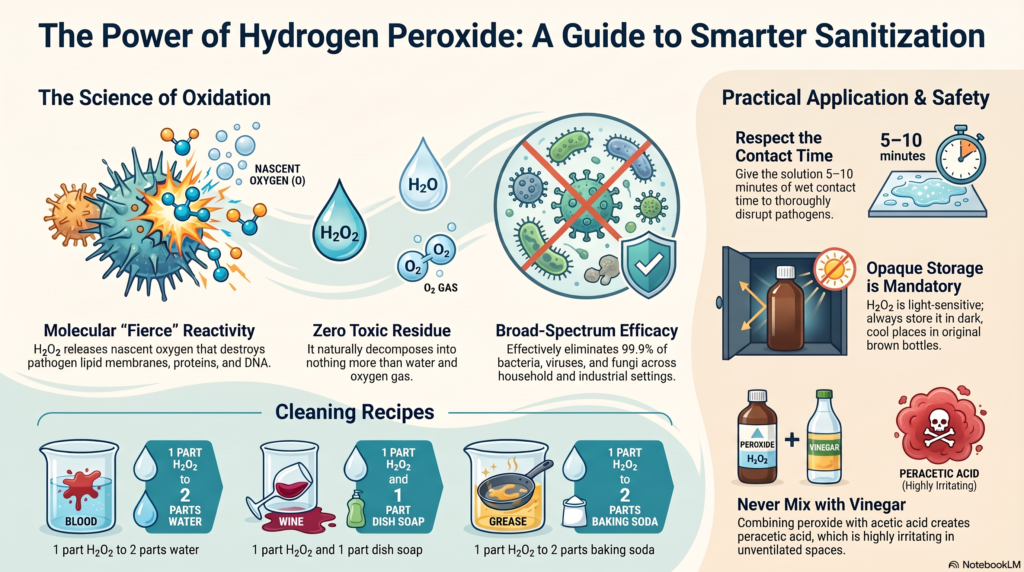
When it comes into contact with organic matter, pathogens, or cellular enzymes, it rapidly releases nascent oxygen, a fiercely reactive species that oxidizes everything in its path, breaking down lipid membranes, proteins, and DNA without leaving a trace of toxic synthetic residue behind.
At home, after a long weekend spent mountain biking or working in my woodworking shop, I often reach for standard 3% hydrogen peroxide over harsh household bleaches. It provides broad-spectrum efficacy against bacteria, viruses, and fungi while naturally decomposing into nothing more than water and oxygen gas. Understanding the fundamental chemistry behind this compound allows you to harness its full potential safely, whether you’re sanitizing kitchen cutting boards, lifting organic stains from fabrics, or evaluating commercial disinfectant formulations.
Hydrogen peroxide is a versatile disinfectant you can use in both household and industrial cleaning. It effectively eliminates bacteria, viruses, and fungi by breaking down cellular components and releasing oxygen. In your home, it sanitizes surfaces, removes stains, and neutralizes odors without leaving harmful residues. In industrial settings, it’s employed for sterilization and bleaching. With the right precautions and storage, hydrogen peroxide can enhance your cleaning routine. Discover more applications and benefits it offers.
KEY TAKEAWAYS
- Hydrogen peroxide effectively disinfects surfaces, eliminating bacteria, viruses, and fungi, making it suitable for both household and industrial cleaning tasks.
- It serves as a potent stain remover for various substances, including blood, wine, and grease, enhancing cleaning efficiency.
- As a biodegradable agent, hydrogen peroxide breaks down into water and oxygen, minimizing environmental impact and chemical residues.
- Its use in pharmaceutical production ensures sterile environments, while in the pulp and paper industry, it acts as an efficient bleaching agent.
- Hydrogen peroxide is a safer alternative to traditional disinfectants, posing a lower risk of developing resistant microorganisms and harmful residues.
THE SCIENCE BEHIND HYDROGEN PEROXIDE AS A DISINFECTANT
When you use hydrogen peroxide as a disinfectant, it works by releasing oxygen, which effectively kills bacteria, viruses, and fungi. Its chemical properties make it a potent antimicrobial agent.
The oxidative properties of hydrogen peroxide facilitate the breakdown of cellular components in pathogens, leading to their destruction. As the active ingredient, it penetrates cell membranes, causing oxidative damage to essential structures. This mechanism is particularly effective due to its ability to penetrate cell membranes, causing oxidative damage to essential structures.
As a result, hydrogen peroxide serves as a versatile disinfectant for various applications. Its efficacy is influenced by concentration; higher concentrations yield stronger oxidative effects.
Understanding these fundamental properties empowers you to employ hydrogen peroxide strategically, maximizing its antiseptic capabilities while ensuring safety and effectiveness in your disinfecting practices.
Household Cleaning Uses for Hydrogen Peroxide
Hydrogen peroxide is an effective tool for household cleaning, offering benefits like surface disinfection, stain removal, and odor elimination. Hydrogen peroxide’s efficacy as a disinfectant stems from its potent molecular structure (H2O2), allowing it to combat a broad spectrum of pathogens. By damaging cell walls and proteins, hydrogen peroxide disrupts the structural integrity of viruses and bacteria, rendering them defenseless. Its ability to decompose organic materials also inhibits the development of tough biofilms, bolstering its effectiveness in preventing the proliferation of harmful infections.
You can use it to sanitize countertops and cutting boards, remove tough stains from fabrics, and neutralize unpleasant smells in your living spaces.
Incorporating hydrogen peroxide into your cleaning routine can enhance both cleanliness and hygiene.
Surface Disinfection Benefits
Although many household cleaners claim to be effective, few can match the disinfecting power of hydrogen peroxide. However, a benzalkonium chloride cleaner is another widely used option for targeting bacteria and viruses on hard surfaces.
Its exceptional disinfectant efficacy makes it a superior choice for surface sanitization techniques in your home. By breaking down into water and oxygen, hydrogen peroxide offers a safe alternative to harsher chemicals, effectively eliminating bacteria, viruses, and fungi on various surfaces.
When applied, it penetrates deeply, ensuring thorough sanitization without leaving harmful residues. This versatility allows you to tackle kitchens, bathrooms, and other high-touch areas with confidence.
Utilizing hydrogen peroxide not only enhances your cleaning routine but also contributes to a healthier living environment. Embrace this powerful disinfectant to achieve unparalleled cleanliness and safeguard your household against potential pathogens.
Stain Removal Techniques
A powerful ally in your cleaning arsenal, hydrogen peroxide excels at removing stubborn stains from various surfaces.
Use it strategically for effective stain removal on:
- Blood stains from clothing and upholstery
- Wine spills on carpets and fabrics
- Grease marks on kitchen surfaces
- Mold and mildew on bathroom tiles
- Grass stains on outdoor gear
To leverage hydrogen peroxide’s potency, apply it directly to the stain, let it sit for several minutes, then blot or scrub gently.
Always test on an inconspicuous area first to ascertain compatibility with your cleaning fabrics.
This remarkable compound not only lifts stains but also disinfects, guaranteeing a cleaner, healthier environment.
Embrace hydrogen peroxide for a powerful cleaning solution!
Odor Elimination Methods
After tackling stubborn stains, you might notice lingering odors that need attention. Hydrogen peroxide is an effective solution for odor removal, thanks to its powerful oxidizing properties.
To eliminate odors, mix equal parts hydrogen peroxide and water in a spray bottle. Target areas like carpets, upholstery, or kitchen surfaces, spraying lightly and allowing it to air dry. This method not only neutralizes odors but also contributes to air purification by breaking down organic compounds that cause unpleasant smells.
For persistent odors, consider soaking affected items in a solution of hydrogen peroxide and water before laundering.
Employing hydrogen peroxide in your cleaning routine guarantees a fresher, healthier environment, empowering you to maintain a pristine space effortlessly.
Top Cleaning Recipes With Hydrogen Peroxide
You can create effective cleaning solutions using hydrogen peroxide for various tasks around your home. Hydrogen peroxide is water with an extra oxygen molecule (H2O2 instead of H2O). That extra boost of oxygen gives it serious cleaning and germ-killing power.
From an all-purpose cleaning solution to specialized stain removal techniques, hydrogen peroxide proves versatile.
Additionally, it disinfects surfaces effectively, ensuring a cleaner and safer environment.
All-Purpose Cleaning Solution
While many cleaning agents contain harsh chemicals, hydrogen peroxide offers a safe and effective alternative for creating an all-purpose cleaning solution. This eco-friendly alternative can tackle a variety of surfaces and messes with ease.
Here’s how you can maximize its potential:
- Mix equal parts hydrogen peroxide and water for a powerful all-purpose cleaner.
- Use it to disinfect kitchen and bathroom surfaces.
- Spray on cutting boards to eliminate bacteria.
- Clean glass and mirrors for a streak-free shine.
- Freshen laundry by adding a cup to your wash.
STAIN REMOVAL TECHNIQUES
From a bench chemist’s standpoint, the real magic and the real challenge of formulating with hydrogen peroxide comes down to contact time, concentration, and surface reactivity. In industrial applications and hospital settings, we often evaluate high-efficiency 4% or stabilized accelerated hydrogen peroxide formulations designed to achieve a rapid 3-log kill rate against tough pathogens like Clostridioides difficile spores and MRSA within just a minute or two. However, in a everyday household scenario using a standard 3% brown-bottle solution, patience is your most critical additive.
When you spray hydrogen peroxide onto a surface, you must give the oxidative reaction time to do its job. It needs at least 5 to 10 minutes of wet contact time to thoroughly disrupt thick cell walls and break down protective viral capsids. Furthermore, because H2O2 is light-sensitive and breaks down when exposed to UV radiation or metal impurities, I always remind people never to transfer their home cleaning mixtures into clear glass or translucent spray bottles.
Keep it in an opaque container, store it in a cool pantry, and never mix it with vinegar or ammonia combining peroxide with acetic acid creates peracetic acid, which, while a potent industrial sterilant, can be far too volatile and irritating for unventilated residential spaces.
Hydrogen peroxide is a powerful ally in the battle against stubborn stains, making it an essential ingredient in your stain removal toolkit. You can effectively tackle various stain types by employing targeted removal techniques. Below is a concise guide to harnessing hydrogen peroxide for stain elimination:
| Stain Type | Removal Technique | Recommended Ratio |
| Blood | Mix 1 part H₂O₂ with 2 parts water | 1:2 |
| Wine | Apply 1 part H₂O₂ and 1 part dish soap | 1:1 |
| Grease | Combine 1 part H₂O₂ with 2 parts baking soda | 1:2 |
| Ink | Use 1 part H₂O₂ with 1 part water | 1:1 |
Utilize these techniques to transform your cleaning regimen and conquer even the most persistent stains.
Disinfecting Surfaces Effectively
When it comes to disinfecting surfaces effectively, hydrogen peroxide offers a versatile solution that combines safety and efficacy.
To guarantee ideal results, implement these surface sanitization techniques and effective application methods:
- Concentration matters: Use a 3% solution for general cleaning and a 10% concentration for tougher jobs.
- Target high-touch areas: Focus on doorknobs, light switches, and countertops.
- Apply directly: Use a spray bottle for even coverage; avoid diluting unless necessary.
- Contact time: Allow at least 10 minutes for the solution to work effectively.
- Rinse when needed: For food contact surfaces, rinse with water after disinfecting.
Safety Tips for Hydrogen Peroxide Use
Using hydrogen peroxide safely is essential to guarantee effective disinfection while minimizing health risks. Unlike isopropanol, hydrogen peroxide is not a type of alcohol. You might recognize its chemical formula, H2O2, as being similar to that of water (H2O). The difference is that hydrogen peroxide has two oxygen atoms instead of one. That one extra oxygen atom makes it a strong oxidizer.
Always wear protective gloves and eyewear to prevent skin and eye irritation, particularly if you have a cocamidopropyl betaine allergy or sensitivity to cleaning product ingredients. Ascertain proper ventilation in your workspace; this helps dissipate any fumes that may arise during use.
Store hydrogen peroxide in a cool, dark place, as exposure to light can degrade its efficacy. If accidental exposure occurs, follow first aid procedures: rinse affected areas with water for at least 15 minutes and seek medical attention if irritation persists.
Avoid mixing hydrogen peroxide with other chemicals, particularly vinegar or ammonia, as this can create toxic compounds.
Hydrogen Peroxide in Industry
In various industries, hydrogen peroxide serves as a versatile and effective agent for disinfection and bleaching. Its industrial applications are expanding, thanks to its powerful oxidizing properties and compliance with peroxide regulations.
You’ll find it utilized in:
- Food processing for sanitizing surfaces and equipment
- Textile manufacturing for brightening fabrics
- Water treatment facilities to eliminate contaminants
- Pharmaceutical production to guarantee sterile environments
- Pulp and paper industries for bleaching processes
How Hydrogen Peroxide Stacks Up Against Common Disinfectants
Although many disinfectants are available on the market, hydrogen peroxide stands out due to its unique combination of efficacy, safety, and environmental benefits.
When you examine disinfectant effectiveness, hydrogen peroxide often outperforms traditional chemicals like bleach and quaternary ammonium compounds. Its ability to degrade into harmless water and oxygen makes it a safer choice for both users and the ecosystem.
Chemical comparisons reveal that hydrogen peroxide exhibits broad-spectrum antimicrobial activity, effectively targeting bacteria, viruses, and fungi. Unlike some harsh disinfectants, it doesn’t leave harmful residues.
Additionally, with a lower risk of developing resistant strains, hydrogen peroxide proves to be a forward-thinking solution in disinfection practices.
Embrace its versatility for a powerful clean that aligns with your health and environmental goals.
Tips for Storing and Handling Hydrogen Peroxide Safely
To guarantee the safe storage and handling of hydrogen peroxide, it’s crucial to follow specific guidelines that minimize risks.
Improper storage can lead to degradation and hazardous reactions.
- Use opaque storage containers to block light exposure.
- Keep containers tightly sealed to prevent contamination.
- Store in a cool, dry place away from heat sources.
- Label all containers clearly to avoid misuse.
- Always wear appropriate personal protective equipment during handling.
RELATED STUDIES ABOUT HYDROGEN PEROXIDE DISINFECTANT
To sum up, hydrogen peroxide is a versatile and effective disinfectant for both household and industrial cleaning. With its ability to kill 99.9% of bacteria, viruses, and fungi, it surpasses many conventional cleaners. Notably, studies show that it breaks down into water and oxygen, making it environmentally friendly. By following safety tips and proper storage guidelines, you can harness its full potential while minimizing risks. Embrace hydrogen peroxide as a powerful tool in your cleaning arsenal.
Spray-dried gum Arabic microcapsules of lemon essential oil: A release kinetics study for odor masking in hydrogen peroxide disinfectants
Hydrogen peroxide is a highly effective, eco-friendly disinfectant, but its pungent odor often limits its adoption in public hygiene compared to alcohol-based alternatives. This study investigated a novel solution to this sensory challenge by utilizing spray-dried, gum arabic-based microencapsulation to deliver lemon essential oil as an odor-masking agent within hydrogen peroxide disinfectants.
Key Findings
- Microcapsule Characteristics: The fabricated microcapsules displayed a predominantly spherical morphology with a mean diameter of approximately 114 µm. Structural analysis confirmed successful encapsulation with an efficiency of 78.02% and a production yield of 76.67%.
- Controlled Release Performance: The study demonstrated a sustained, diffusion-controlled release of the lemon essential oil into the disinfectant medium over a 96-hour period, notably avoiding an initial burst release.
- Release Mechanism: Among four mathematical models tested, the Weibull model provided the best statistical fit for the release data. However, the Fickian sphere model was identified as the most mechanistically accurate description, confirming that the release is governed by diffusion through the biopolymer matrix.
- Sensory Evaluation: Sensory panel testing confirmed that the microencapsulated lemon oil significantly improved product acceptability, with odor intensity dropping from 5.8 ± 0.4 at 24 hours to 2.4 ± 0.7 at 96 hours, while overall acceptability scores rose significantly.
Conclusion
This research validates gum arabic-based microencapsulation as an effective strategy for enhancing the sensory qualities of aqueous hydrogen peroxide disinfectants. By enabling the sustained delivery of masking agents, this technique increases the potential for hydrogen peroxide to be more widely utilized as a safe, cost-effective, and environmentally friendly disinfectant in public spaces. Future work is recommended to evaluate real-world product stability and the potential for scaling these findings to industrial production.
| REFERENCE: Zahra Khodabakhshi Tabar Ahangar, Fatemeh Eslami, Spray-dried gum Arabic microcapsules of lemon essential oil: A release kinetics study for odor masking in hydrogen peroxide disinfectants, Industrial Crops and Products, Volume 242, 2026, 122855, ISSN 0926-6690, https://doi.org/10.1016/j.indcrop.2026.122855. (https://www.sciencedirect.com/science/article/pii/S0926669026002414) |
Effectiveness and real-world materials compatibility of a novel hydrogen peroxide disinfectant cleaner
This study evaluated the efficacy and materials compatibility of a novel 4% hydrogen peroxide-based disinfectant (Sani-HyPerCide) in comparison to other established disinfectants.
Key Findings
- Microbiological Efficacy: The hydrogen peroxide-based disinfectant demonstrated effective sporicidal and antimicrobial activity, achieving greater than a 3-log10 reduction within 1 minute against several pathogens, including:
- Clostridioides difficile spores
- Methicillin-resistant Staphylococcus aureus (MRSA)
- Carbapenem-resistant Escherichia coli
- Two strains of Candida auris
- Materials Compatibility: In laboratory testing involving 130 applications on hospital surfaces, the hydrogen peroxide-based disinfectant did not cause visible adverse effects on a bedside tabletop or a fluid-resistant mattress. Conversely, the sodium hypochlorite (bleach) disinfectant tested caused mild fading and loss of pliability in the hospital mattress.
- Operational Advantages: Compared to other sporicidal agents, this hydrogen peroxide disinfectant is ready-to-use, stable with a long shelf-life, and avoids the corrosive or irritating characteristics associated with bleach-based products.
Conclusion
The study concludes that this novel hydrogen peroxide-based disinfectant is a highly effective sporicidal agent with superior materials compatibility on soft surfaces like mattresses compared to conventional bleach. These findings suggest it may be a valuable addition to the disinfectants currently available for healthcare settings.
| REFERENCE: Jennifer L. Cadnum, Basya S. Pearlmutter, Muhammed F. Haq, Annette L. Jencson, Curtis J. Donskey, Effectiveness and real-world materials compatibility of a novel hydrogen peroxide disinfectant cleaner, American Journal of Infection Control, Volume 49, Issue 12, 2021, Pages 1572-1574, ISSN 0196-6553, https://doi.org/10.1016/j.ajic.2021.08.008. (https://www.sciencedirect.com/science/article/pii/S0196655321005423) |
Evaluation of Buffered Peracetic Acid as a Hospital Disinfectant
This report details an in-use evaluation conducted at a South Australian hospital to address high rates of Clostridium difficile infection (CDI) within its operating theatre. The study compared three hospital-grade disinfectants to identify a solution that optimized infection control while minimizing risks to staff.
Key Findings
- Performance of Prior Disinfectants:
- Chlorine-based disinfectant: While used for terminal cleaning, it was discontinued after five staff members reported adverse respiratory reactions due to strong chlorine odors, resulting in worker’s compensation leave for some employees.
- Hydrogen peroxide-based disinfectant: Trialed as an alternative, it caused significant occupational safety concerns due to a buildup of sticky floor residue, which became slippery when wet. This necessitated an additional, labor-intensive manual cleaning step to remove the buildup. Furthermore, there was limited evidence regarding its efficacy against C. difficile spores.
- Buffered Peracetic Acid (PAA) Results:
- A year-long trial of a buffered PAA-based cleaner/disinfectant demonstrated that it met all required criteria, including efficacy against C. difficile, cost-effectiveness, and workload reduction.
- Staff reported a visible improvement in cleanliness and noted no lingering floor residues.
- Despite a vinegar-like odor, the product caused no respiratory issues, even among staff previously sensitized to chlorine. Staff surveys indicated high satisfaction with the product’s fragrance, ease of use, and overall benefits.
- Economic Impact: A cost analysis showed that while the chlorine-based disinfectant was the cheapest per day ($3.20), the buffered PAA-based product ($26.60) was significantly more cost-effective than the hydrogen peroxide-based disinfectant ($105.72).
Conclusion
The study concludes that the selection of a hospital disinfectant must balance antimicrobial efficacy—specifically against multi-drug resistant organisms and dry surface biofilms—with occupational health and safety considerations. The buffered peracetic acid-based product provided the most balanced solution, successfully meeting infection prevention standards while improving staff satisfaction and minimizing operational risks.
| REFERENCE: Sharon Otterspoor, Jessica Farrell, An evaluation of buffered peracetic acid as an alternative to chlorine and hydrogen peroxide based disinfectants, Infection, Disease & Health, Volume 24, Issue 4, 2019, Pages 240-243, ISSN 2468-0451, https://doi.org/10.1016/j.idh.2019.06.003. (https://www.sciencedirect.com/science/article/pii/S2468045119300227) |
CONCLUSION
Looking at the broader landscape of modern sanitation, hydrogen peroxide represents a brilliant balance between raw antimicrobial efficacy and environmental responsibility. In an era where both commercial facilities and households are increasingly conscious of chemical residues, occupational hazards, and indoor air quality, H2O2 stands out as a forward-thinking active ingredient.
Unlike quaternary ammonium compounds or chlorine bleach, which can leave persistent residues, cause severe respiratory irritation, or prematurely degrade sensitive materials like vinyl and synthetic upholstery, peroxide does its job and cleanly vanishes, breaking down into pure water and oxygen. Recent formulation research has even made great strides in solving its minor drawbacks such as using biopolymer microencapsulation to mask its pungent bite or buffering it for better material compatibility on delicate surfaces.
Whether you are managing hygiene protocols for an industrial manufacturing facility or simply looking for a safer, science-backed way to deep-clean your own living room after a messy family project, understanding the chemistry of hydrogen peroxide empowers you to clean smarter, safer, and far more effectively.