
When people think of groundbreaking advancements in modern metallurgy, their minds usually leap straight to exotic titanium alloys or nickel-based superalloys engineered for extreme environments. Yet, in my 15 years studying structural metals and additive manufacturing processes, I have found that the true workhorse of industrial progress remains a element we often take for granted: manganese.
Throughout my career whether analyzing microstructural grain evolution in research labs at MIT or evaluating structural components for high-stress automotive applications, I’ve seen how fundamentally manganese alters the life cycle of steel. Without it, the basic physics of modern steelmaking simply collapse under the weight of unwanted impurities like sulfur and oxygen.
Manganese is far more than a routine additive; it is the silent equalizer in alloy design that bridges raw bulk strength with structural reliability. As we push toward lightweighting in vehicles and sustainable construction, understanding the precise thermodynamic and mechanical behavior of manganese isn’t just an academic exercise, it’s an absolute prerequisite for engineering the next generation of safe, high-performance structural materials.
Manganese is essential in modern steelmaking, as it notably enhances strength, toughness, and wear resistance in alloys. By refining grain structure and increasing ductility, manganese allows steel to absorb energy without fracturing. This element also forms protective oxides that boost corrosion resistance, making manganese-augmented steel crucial for various high-performance applications. Understanding how manganese integrates into the steelmaking process will deepen your insights into its critical role in alloy production and its impact on material performance.
KEY TAKEAWAYS
- Manganese enhances strength and toughness in steel, making it essential for modern alloy production.
- It improves ductility and wear resistance, allowing steel to absorb energy without fracturing.
- Manganese contributes to deoxidation and sulfur removal, optimizing steel quality during production.
- Its integration leads to superior corrosion resistance and impact strength compared to traditional alloys.
- Advanced extraction technologies and sustainable sourcing practices are enhancing manganese’s role in steelmaking.
WHY MANGANESE MATTERS IN STEEL PRODUCTION
Manganese plays an essential role in steel production, as it enhances the metal’s strength and toughness. Understanding manganese sources is critical for ensuring that your steelmaking process remains efficient and competitive. Manganese is a chemical element with the symbol Mn and atomic number 25. It is a hard, brittle, grey-white metal, naturally found in combination with iron and other minerals. Though not found freely in nature, manganese is the twelfth most abundant element in the Earth’s crust and has widespread industrial significance.
High-quality manganese ore is mainly found in countries like South Africa, Australia, and China, which dominate global manganese availability. By securing reliable manganese supplies, you can stabilize production costs and improve the structural integrity of your steel products.
Additionally, the strategic sourcing of manganese can mitigate risks associated with market fluctuations and geopolitical factors. Investing in advanced extraction and processing technologies can further optimize your manganese utilization, ensuring that your steel achieves the desired performance standards while maintaining cost-effectiveness in a demanding market.
How Manganese Enhances Steel Strength and Toughness
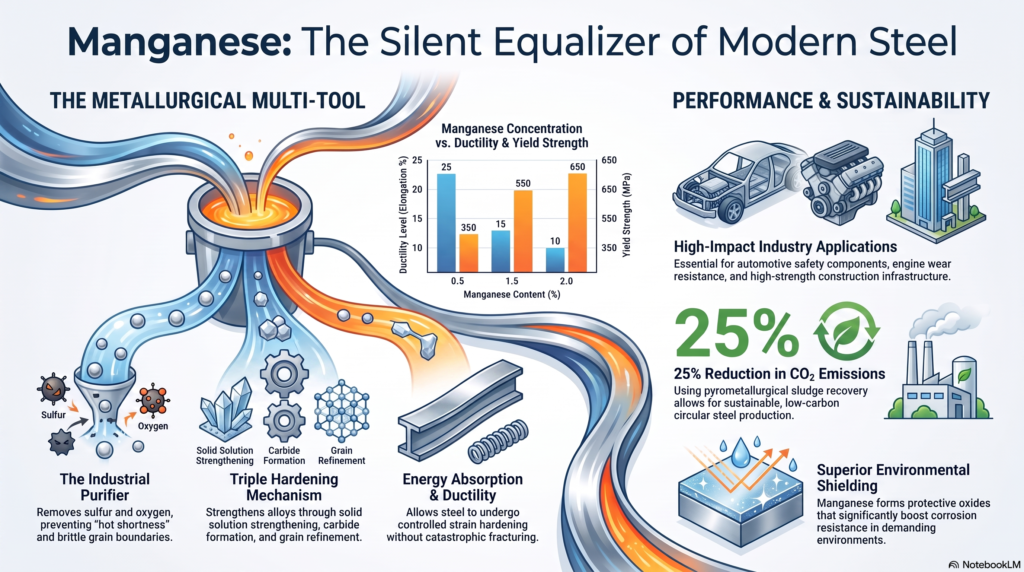
Manganese greatly contributes to steel’s hardening process, directly affecting its strength and toughness. Most manganese is consumed as high-carbon ferromanganese for addition to carbon steels. In steels of lower carbon content, the medium- and low-carbon ferroalloy and even electrolytic manganese are employed. As a desulfurizer, manganese forms stable, high-melting sulfide particles, thereby removing sulfur from the crystalline grain boundaries of the metal, where it can cause “hot shortness” (the inability to stand up to hot working). As a deoxidizer, silicomanganese is more effective than either silicon or manganese alone, since the simultaneous reaction of the two elements with oxygen produces a manganous silicate, which is low-melting and readily separates from the steel.
By increasing ductility levels, it allows the steel to absorb energy without fracturing, which is essential for structural integrity.
Additionally, manganese enhances wear resistance properties, making the steel more durable in demanding applications.
Manganese’s Role In Hardening
The presence of manganese in steel considerably enhances its strength and toughness, making it a critical alloying element in steelmaking.
Manganese alloys contribute to hardening through several mechanisms that elevate performance under stress. Here’s how:
- Solid Solution Strengthening: Manganese dissolves in the iron matrix, increasing resistance to deformation.
- Carbide Formation: It promotes the formation of hard carbides, enhancing wear resistance and contributing to overall hardness.
- Refinement of Grain Structure**: Manganese aids in refining the grain structure, which improves toughness and impact resistance.
These hardening mechanisms guarantee that steel not only withstands greater loads but also maintains structural integrity in demanding applications, making manganese indispensable in high-performance steel production.
Impact On Ductility Levels
While many may focus on the hardening properties of manganese in steel, its impact on ductility levels is equally important. Manganese enhances the mechanical properties of steel by improving alloy flexibility, allowing it to withstand stress without fracturing. This balance between strength and ductility is vital for applications requiring high toughness.
| Manganese Content (%) | Ductility Level (Elongation %) | Yield Strength (MPa) |
| 0.5 | 25 | 350 |
| 1.0 | 20 | 450 |
| 1.5 | 15 | 550 |
| 2.0 | 10 | 650 |
As you can see, optimizing manganese content can greatly influence the ductility and overall performance of steel, making it an essential element in alloy production.
Enhancing Wear Resistance Properties
When considering the overall performance of steel, it’s important to recognize how manganese contributes to enhancing wear resistance properties.
Manganese benefits steel by improving its hardness and toughness, making it more resilient under stress. Here’s how it achieves that:
- Increased Hardness: Manganese forms solid solutions with iron, enhancing the steel’s hardness, vital for resisting abrasion.
- Grain Refinement: It promotes finer grain structures, which greatly improves toughness and wear resistance.
- Deoxidation: Manganese acts as a powerful deoxidizer, reducing inclusions, leading to a more uniform microstructure.
Manganese’s Role in Steel Alloy Composition
Manganese serves as an essential alloying element in steel, greatly influencing its mechanical properties and overall performance. Incorporating manganese enhances strength, toughness, and ductility, making it a vital component in various steel grades. By adjusting manganese content, you can tailor the composition to meet specific engineering demands. In many steel formulations, manganese functions as the active ingredient responsible for improving strength, toughness, and overall alloy performance while supporting efficient metallurgical processing.
| Element | Effect on Steel Alloy Composition |
| Manganese | Increases strength and ductility |
| Silicon | Enhances deoxidation properties |
| Chromium | Improves hardenability |
| Molybdenum | Enhances strength at high temperatures |
While manganese sources are abundant, exploring manganese alternatives can optimize alloy performance. Understanding these dynamics allows you to create high-performance steel tailored for demanding applications.
HOW MANGANESE IMPROVES WEAR AND CORROSION RESISTANCE IN STEEL ALLOYS
From a materials scientist’s perspective, the magic of manganese happens at the atomic level, where fine-grained control dictates macroscopic failure or success. In my lab work on fatigue resistance and structural integrity, I frequently observe how critical solid solution strengthening and grain refinement are when an alloy is subjected to cyclic loading.
Manganese effectively ties up harmful sulfur by forming stable manganese sulfide globules rather than brittle iron sulfide films along grain boundaries, a phenomenon that completely eliminates the dreaded “hot shortness” during hot working operations. Furthermore, when we balance manganese ratios to optimize ductility alongside yield strength, we aren’t just making a harder metal; we are engineering a material capable of undergoing controlled strain hardening without catastrophic fracturing.
This mechanical dynamic is why high-manganese cast and wrought alloys are so exceptionally suited for high-impact environments, whether in heavy machinery liners or safety-critical automotive chassis components. Getting that metallurgical recipe right requires fine-tuning chemical compositions and melt atmospheres, but the resulting structural toughness makes every bit of precision worth the effort.
The inclusion of manganese in steel alloys not only enhances mechanical properties but also greatly improves wear and corrosion resistance.
By leveraging manganese benefits, you can achieve superior performance in demanding environments.
Consider these key improvements:
- Enhanced Hardness: Manganese increases the hardness of steel, making it more resistant to wear during friction and abrasion.
- Improved Toughness: The element contributes to toughness, allowing the steel to withstand impact without fracturing under stress.
- Corrosion Resistance: Manganese forms protective oxides, which shield the steel from corrosive elements, extending the material’s lifespan.
Incorporating manganese into your steel production not only guarantees robustness but also fortifies against environmental degradation, making it essential for high-performance applications. These advantages complement the role of chromium in stainless steel composition, where chromium primarily enhances corrosion resistance while manganese contributes to improved strength, toughness, and wear performance in alloy systems.
How Is Manganese Integrated Into Steel?
While integrating manganese into steel, metallurgists typically add it during the melting process, ensuring an even distribution within the alloy. This precise timing allows for ideal interaction between manganese sources—such as silicomanganese or ferromanganese—and the molten steel.
At the heart of manganese’s significance lies its indispensable role in steel production. Manganese serves as a key alloying addition in the steelmaking process. Although the amount of manganese consumed to make a ton of steel is small, it is an irreplaceable component in the production of this fundamental material. Steel, the world’s most important engineering and construction material, owes much of its strength and durability to manganese. It is no exaggeration to say that without manganese, the modern steel industry would grind to a halt.
By controlling the temperature and atmosphere during melting, you facilitate the dissolution of manganese, enhancing its effectiveness. The alloying process not only promotes strength and toughness but also plays a significant role in deoxidation and sulfur removal, essential for high-performance steel.
Understanding manganese applications in various steel grades empowers you to tailor properties to specific requirements. Therefore, the strategic integration of manganese is important for maximizing the potential of modern alloys, ensuring they meet rigorous industry standards.
Industry Applications of Manganese-Enhanced Alloys
Manganese-enhanced alloys play a critical role in various industries, particularly in automotive and construction applications.
In automotive manufacturing, these alloys improve durability and resistance to wear, which are essential for vehicle components.
Similarly, their use in construction materials enhances structural integrity, making them indispensable in modern infrastructure projects. Many of these industries also benefit from nickel alloy metallurgy applications, where nickel-based alloys complement manganese-enhanced steels by providing exceptional corrosion resistance, high-temperature strength, and long-term durability in demanding operating environments.
Automotive Industry Applications
In the automotive industry, manganese-enhanced alloys play a vital role in meeting the demands for strength, ductility, and weight reduction in vehicle components.
These alloys are essential for optimizing performance and safety. Here are three key applications where manganese alloys excel:
- Structural Components: They provide high tensile strength, important for frame and chassis designs.
- Engine Parts: Manganese enhances wear resistance, extending the life of pistons and crankshafts.
- Body Panels: Lightweight manganese alloys reduce overall vehicle weight, improving fuel efficiency without compromising durability.
Construction Material Enhancements
As construction demands evolve, the integration of manganese in alloys greatly enhances the performance and durability of materials used in various applications. Manganese not only improves tensile strength and corrosion resistance but also guarantees the sustainability of construction practices by optimizing manganese availability. This focus on material performance addresses environmental impacts, promoting longer-lasting infrastructure.
| Property | Manganese-Enhanced Alloys | Traditional Alloys |
| Tensile Strength | High | Moderate |
| Corrosion Resistance | Excellent | Fair |
| Impact Resistance | Superior | Average |
| Environmental Impact | Reduced | Higher |
Incorporating manganese leads to innovative solutions that meet today’s rigorous construction standards while minimizing ecological footprints.
Emerging Trends in Manganese Usage for High-Performance Steel Alloys
While the demand for high-performance steel alloys continues to rise in various industries, the role of manganese is evolving markedly. You’ll notice several emerging trends:
- Integration of Emerging Technologies**: Advanced metallurgical processes are optimizing manganese’s role, enhancing mechanical properties while reducing impurities.
- Sustainable Sourcing Practices: Manufacturers are increasingly sourcing manganese from environmentally responsible suppliers, minimizing ecological footprints and ensuring compliance with regulations.
- Enhanced Alloys Development: New formulations with manganese are leading to steel that exhibits superior strength, ductility, and resistance to wear, catering to sectors like automotive and aerospace.
These trends not only reflect the industry’s drive for innovation but also signify a commitment to producing high-performance materials that meet modern demands.
Embracing these advancements positions you at the forefront of steelmaking excellence.
RELATED STUDIES ABOUT MANGANESE IN STEELMAKING PROCESS
In the intricate dance of steelmaking, manganese emerges as a steadfast partner, enhancing strength and resilience. By seamlessly integrating into alloys, it fortifies steel against wear and corrosion, ensuring longevity in demanding applications. As industries evolve, the role of manganese transforms, paving the way for high-performance materials that can withstand the test of time. Embracing these innovations not only redefines steel’s capabilities but also shapes the future of construction and manufacturing, forging a path toward unparalleled durability.
Life cycle assessment of a new pyrometallurgical approach for dezincing and valorisation of iron and steelmaking sludge in the UK
Overview
This study evaluates a new pyrometallurgical technology designed to remove zinc (dezincing) from iron-rich sludges generated by UK iron and steelmaking processes. This process enables the reintroduction of these sludges into the steel production cycle as a sinter feedstock for blast furnaces (BF). The study employs Life Cycle Assessment (LCA) to evaluate the environmental impacts of treating seven different steelmaking sludges compared to conventional landfill disposal.
Methodology
- Process: The technology utilizes a top-blown rotary converter (TBRC) to roast sludges at approximately 1200^C for 60 minutes. This environment, in the presence of carbon, vaporizes zinc while maximizing the retention of iron oxide.
- LCA Framework: The assessment follows ISO 14040 and 14044 standards. The functional unit is defined as the treatment (dezincing or landfilling) of 1 kg of dry steelmaking sludge.
- Scenarios: Impacts were analyzed under two scenarios:
- Process-only: Considers only the burdens of the dezincing process.
- Avoided-burdens: Incorporates environmental credits for the valorisation of the dezinced product (substituting virgin iron ore concentrate).
Key Findings
- Environmental Performance: Dezincing is beneficial in the majority of impact categories compared to landfilling.
- On average, dezincing results in a 9% reduction in CO2 emissions compared to landfilling.
- This reduction increases to 25% when avoided-burdens credits are included.
- Dezincing offers a 2-3 fold reduction in human toxicity and ecotoxicity impact categories.
- Environmental Hotspots: The primary drivers of environmental impacts within the dezincing process are the drying stage, smelting in the TBRC (heating and oxygen use), and the landfilling of secondary off-gas dust.
- Efficiency: The treatment achieves 78% to 97% zinc removal and an average iron recovery rate of 82%.
Recommendations and Future Opportunities
The study identifies several strategies to further minimize environmental impacts:
- Process Optimization: Reducing energy consumption for drying, optimizing residence times in the TBRC, and reducing carbon usage.
- Value Recovery: Further investigation into the recovery of zinc metal from the generated off-gas dust could provide additional economic and environmental benefits.
- Design Focus: Future iterations should prioritize high iron recovery rates to maximize avoided-burden credits and minimize the volume of off-gas dust requiring disposal.
| REFERENCE: Edis Glogic, Hichem Hakka, Kehinde Makinde, Lucy Smith, Ji Fuzhong, Stuart Higson, Richard Thackray, Life cycle assessment of a new pyrometallurgical approach for dezincing and valorisation of iron and steelmaking sludge in the UK, Cleaner Environmental Systems, Volume 21, 2026, 100453, ISSN 2666-7894, https://doi.org/10.1016/j.cesys.2026.100453. (https://www.sciencedirect.com/science/article/pii/S2666789426000590) |
Integrating optimization and LCA models in the steelmaking process: insights from the ALCHIMIA project
Overview
This study, conducted within the framework of the European project ALCHIMIA, introduces an “Optimized LCA” methodology. The research aims to move beyond traditional, scenario-based Life Cycle Assessment (LCA) by integrating mathematical optimization into the LCA framework to improve the environmental sustainability of Electric Arc Furnace (EAF) steelmaking.
The Methodology: “Optimized LCA”
Traditional LCA relies on “ex-ante” scenarios defined by experts, which may not capture the most sustainable configurations for complex industrial processes. The Optimized LCA approach addresses this limitation through:
- Mathematical Integration: Developing an algorithm where specific Life Cycle Inventory (LCI) flows are treated as variables rather than fixed parameters.
- Goal & Scope Adaptations: Defining an objective function (e.g., minimizing Global Warming Potential) that the algorithm solves based on specified technical constraints.
- Iterative Interpretation: Because optimization algorithms can propose complex or unrealistic real-world solutions, LCA practitioners must verify the consistency of the optimal solution and potentially refine constraints.
Case Study: CELSA Group (France)
The methodology is being applied to a CELSA Group steelmaking plant in France.
- Objective: To calculate the optimal mix of steel scraps and ferroalloys that minimizes the environmental footprint of the steelmaking process.
- System Boundaries: The study uses a “cradle-to-gate” approach, encompassing the Electric Arc Furnace (EAF), a crucible for tapping additions, and a ladle furnace (LF).
- Constraints: The optimization model incorporates mass balances, energy consumption limits, and material quality requirements (e.g., carbon and manganese composition).
Significance and Future Outlook
The study highlights that managing EAF environmental impact is a complex task due to the high variability of input materials and the need to meet strict product quality standards. The primary advantage of the Optimized LCA approach is its ability to reduce the effort required by practitioners to evaluate extensive combinations of scrap and material mixes.
Future work under the ALCHIMIA project will:
- Develop the full multi-objective optimization model, integrating environmental and economic functions.
- Quantify the specific environmental benefits of Optimized LCA compared to traditional methods.
- Implement automated consistency checks to ensure model reliability.
| REFERENCE: Federico Rossi, Monia Niero, Valentina Colla, Antonella Zaccara, Stefano Dettori, Laura Laid, Fabio Iraldo, Integrating optimization and LCA models in the steelmaking process: insights from the ALCHIMIA project, Procedia CIRP, Volume 135, 2025, Pages 812-817, ISSN 2212-8271, https://doi.org/10.1016/j.procir.2025.01.077. (https://www.sciencedirect.com/science/article/pii/S2212827125003567) |
Deeply understanding the physicochemical properties of LCDSP slag from atomic structure to macroscopic properties: A blueprint for the green and low-carbon steelmaking process
Overview
This study provides a comprehensive analysis of slags generated by the Low-Carbon Double Slag converter steelmaking Process (LCDSP). By integrating mineralogy, coexistence thermodynamics (IMCT), and molecular dynamics (MD) simulations, the research examines the structural and thermophysical properties of dephosphorization (De-P) and decarbonization (De-C) slags to establish a blueprint for clean, low-carbon steel production.
Key Findings
- Mineralogy and Phosphorus Enrichment:
- LCDSP slags contain P-rich phases, matrix phases, and metal oxide (RO) phases.
- De-P slag shows superior phosphorus enrichment capabilities compared to De-C slag, with a P-rich phase area fraction approximately twice as large.
- C3P is identified as the key component influencing phosphorus enrichment, contributing over 99% to the phosphorus distribution ratio (Lp).
- Microstructure and Polymerization:
- De-C slag exhibits higher temperatures and a higher ratio of network modifiers to network formers, leading to a looser, more depolymerized oxygen network structure compared to the more compact De-P slag.
- MD simulations and Raman spectroscopy reveal that De-C slag contains a higher proportion of non-bridging oxygen (NBO) and low-order ring structures, indicating lower structural polymerization.
- Thermophysical Properties:
- Due to the looser network structure and higher temperature of De-C slag, its viscosity and surface tension are lower than those of De-P slag.
- Thermal conductivity is also lower in De-C slag, attributed to enhanced anharmonicity of structural units and increased phonon scattering.
Industrial Performance and Sustainability
Industrial experiments comparing LCDSP to conventional steelmaking (Single Slag-Remaining slag process) demonstrate significant environmental and operational advantages:
- Efficiency: LCDSP achieves an average dephosphorization ratio of 62.31% in the De-P stage and 90.82% by the end of the De-C stage.
- Resource Management:
- The P2O5 content in De-P slag increased from 2.20% (conventional) to 3.95% (LCDSP), representing a 79.55% increase in phosphorus concentration, which enhances the potential for resource recovery.
- Average lime consumption was reduced by 28.48% per ton of steel (from 7.76 t/heat to 5.55 t/heat).
Conclusion
The study confirms that LCDSP is a highly competitive, green-sustainable steelmaking technology. By optimizing the growth of P-rich mineral phases and regulating slag structure at the atomic level, the steel industry can significantly reduce lime consumption, minimize waste residue, and improve the efficiency of phosphorus resource enrichment.
| REFERENCE: Han Sun, Jian Yang, Tongsheng Zhang, Dawei Cai, Yang Peng, Jianxiong Mo, Du Zhang, Jianhua Wang, Deeply understanding the physicochemical properties of LCDSP slag from atomic structure to macroscopic properties: A blueprint for the green and low-carbon steelmaking process, Journal of Materials Research and Technology, Volume 36, 2025, Pages 2799-2820, ISSN 2238-7854, https://doi.org/10.1016/j.jmrt.2025.04.008. (https://www.sciencedirect.com/science/article/pii/S2238785425008294) |
CONCLUSION
Looking at the trajectory of modern alloy development, the role of manganese is undergoing a fascinating evolution. As we transition toward greener steelmaking practices such as low-carbon double slag processes, optimized Electric Arc Furnace scrap mixes, and circular pyrometallurgical sludge recovery manganese remains central to balancing industrial sustainability with uncompromised mechanical performance.
In my personal research spanning advanced manufacturing and structural alloy design, I am continuously inspired by how an element deeply rooted in traditional metallurgy is paving the way for cutting-edge materials. Whether we are tailoring nanostructured metal powders for advanced additive printing or developing ultra-high-strength steels for aerospace and transit infrastructure, manganese remains an irreplaceable cornerstone of physical metallurgy.
As our analytical tools improve from molecular dynamics simulations of slag structures to AI-driven alloy optimization models we will only unlock deeper, more efficient ways to harness manganese. It stands as a testament to the fact that even as manufacturing techniques advance, the core chemical fundamentals of steel strength and durability remain forever tied to this essential element.