
Throughout my eighteen years investigating metallurgical failures and designing high-performance alloy systems, I’ve continually returned to a fundamental truth: material reliability under extreme stress relies almost entirely on atomic-level stability. When evaluating component degradation in industrial plants or high-load structural setups, the difference between a catastrophic fracture and years of maintenance-free service usually comes down to chemical composition.
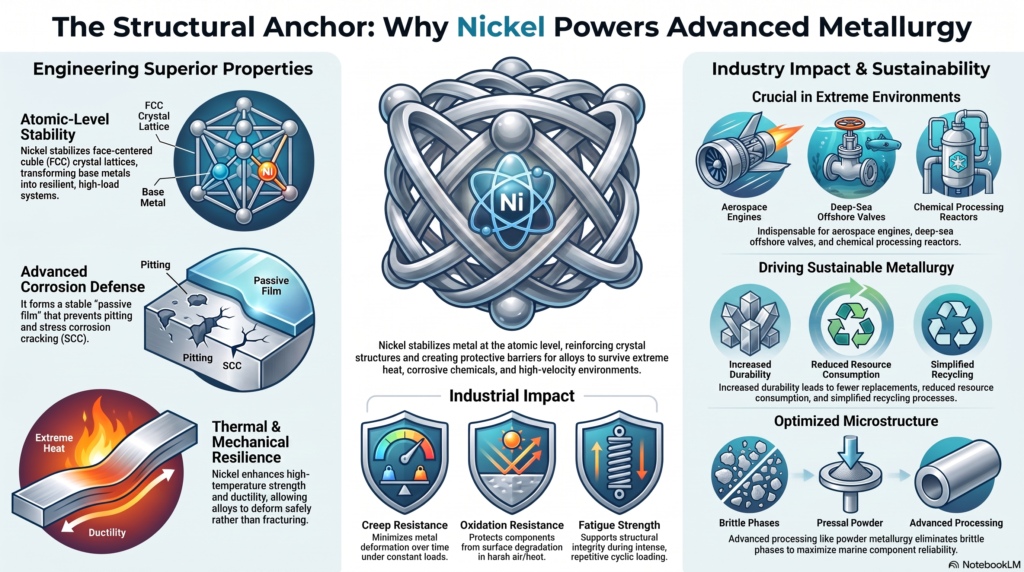
Early in my metallurgical career working on microstructural characterization at Sheffield I spent countless hours analyzing phase transformations under thermal strain. It became clear that nickel isn’t just another additive in the periodic table; it serves as a structural anchor. By stabilizing face-centered cubic (FCC) crystal lattices, nickel transforms base metals into resilient systems capable of resisting oxidation, localized pitting, and stress corrosion cracking.
When we look at modern engineering challenges, from deep-sea offshore operations to high-temperature thermal processing, standard steels routinely fall short. Adding nickel changes the baseline mechanics entirely. It enhances ductility while simultaneously fortifying the passive film that guards against environmental attack. In this guide, we will break down the underlying mechanisms that make nickel an indispensable core element in advanced metallurgy, drawing on real-world processing behaviors and microstructural performance.
Nickel is crucial in alloy metallurgy because it greatly enhances mechanical properties, corrosion resistance, and thermal stability. When you incorporate nickel, you’re improving strength and ductility, which is essential for high-performance applications. Nickel also creates a stable passive film that protects against localized corrosion, making it irreplaceable in harsh environments. Additionally, its ability to maintain strength at elevated temperatures guarantees structural integrity. There’s much more to uncover about nickel’s role in various industries and sustainable practices.
KEY TAKEAWAYS
- Nickel enhances mechanical properties such as strength and ductility, making alloys suitable for demanding applications.
- It improves corrosion resistance by forming a stable passive film on alloy surfaces, ensuring longevity in harsh environments.
- Nickel alloys exhibit superior high-temperature strength, maintaining mechanical integrity under extreme thermal conditions.
- The addition of nickel facilitates the development of tailored materials, optimizing performance for specific industry needs.
- Nickel supports sustainable metallurgy by improving durability, reducing replacements, and promoting recycling efforts in material applications.
THE ESSENTIAL ROLE OF NICKEL IN ALLOY PROPERTIES
Nickel stands as a pivotal element in the composition of various alloys, fundamentally influencing their mechanical and chemical properties. By integrating nickel from diverse nickel sources, you enhance corrosion resistance, ductility, and strength.
This versatility makes nickel essential for alloy applications across industries such as aerospace, automotive, and marine engineering. In stainless steels, for instance, nickel stabilizes the austenitic phase, ensuring that the material can withstand extreme conditions without compromising integrity. While nickel enhances toughness and corrosion resistance, chromium in stainless steel composition plays a complementary role by forming a protective oxide layer that improves durability and helps prevent corrosion in demanding environments.
Similarly, in superalloys, nickel provides high-performance characteristics necessary for high-temperature environments. Understanding the role of nickel in alloy properties empowers you to make informed decisions regarding material selection and application, ultimately optimizing performance and longevity in demanding operational contexts.
Key Benefits of Nickel in Metallurgy
The incorporation of nickel in metallurgy offers a range of significant benefits that enhance alloy performance. Nickel is a metallic element known for its versatility and strength in the world of chemistry. The following properties make nickel a versatile and indispensable material, driving innovation and progress across a wide range of sectors
Nickel applications contribute to superior mechanical properties, including increased strength and ductility, allowing for innovative designs that withstand demanding conditions. Its ability to improve thermal stability guarantees that alloys maintain integrity under extreme temperatures, essential for advanced engineering solutions.
Additionally, nickel facilitates alloy innovations by enabling the development of materials tailored for specific environments, optimizing functionality and longevity. In many advanced alloy formulations, nickel serves as the active ingredient that delivers the mechanical strength, thermal stability, and corrosion resistance required for high-performance industrial applications. This versatility makes nickel indispensable in industries such as aerospace, automotive, and energy.
How Nickel Enhances Corrosion Resistance in Alloys
Nickel markedly enhances the corrosion resistance of alloys by improving pitting resistance and reducing the likelihood of stress corrosion cracking. Pure nickel UNS N02200 is used in the chemical industry for its corrosion resistance – particularly to alkalis. It is also used for its properties in shielding against electromagnetic interference and in transducers.
When you incorporate nickel into your alloy formulations, you create a more stable passive film on the surface, which acts as a protective barrier.
This increased resilience is essential for applications in harsh environments, ensuring longevity and reliability.
Enhanced Pitting Resistance
How does nickel contribute to enhanced pitting resistance in corrosion-resistant alloys? Nickel alloys are engineered metallic materials built around a nickel-rich base and for service in extreme heat, high stress, and corrosive environments. Nickel provides structural stability and controlled chemical reactivity at elevated temperatures, while alloying elements such as chromium, molybdenum, iron, and copper adjust strength, oxidation resistance, and corrosion behavior. Composition determines performance, which allows nickel alloys to meet specific industrial demands rather than serving as a general-purpose metal.
Nickel effectively mitigates pitting mechanisms, which can be a significant concern in harsh environments. Its unique ability to stabilize the passive film on alloy surfaces is essential in alloy formulations, as it promotes a more uniform protective layer.
This stabilization reduces localized corrosion, preventing the initiation of pits that can compromise structural integrity. Additionally, nickel enhances the overall ductility and toughness of the alloy, allowing it to withstand aggressive conditions without succumbing to pitting.
Improved Stress Corrosion Cracking
Improved resistance to stress corrosion cracking (SCC) is a critical factor in the performance of corrosion-resistant alloys, and nickel plays a pivotal role in this enhancement.
The presence of nickel considerably alters the microstructure of the alloy, effectively mitigating the susceptibility to stress corrosion. Nickel stabilizes the austenitic phase, which enhances toughness and ductility, thereby reducing the likelihood of cracking mechanisms initiated by environmental factors.
Additionally, nickel’s unique ability to form protective oxide layers further shields the alloy from corrosive agents. By inhibiting the propagation of cracks, nickel alloys maintain structural integrity in harsh conditions, ensuring reliability in demanding applications.
This advanced corrosion resistance is essential for industries where failure isn’t an option, empowering engineers to push the limits of material performance.

THE IMPORTANCE OF HIGH-TEMPERATURE STRENGTH IN NICKEL ALLOYS
From an engineering perspective, assessing an alloy’s viability requires looking beyond static tensile strength; you must evaluate how its microstructure responds under dynamic loading and aggressive chemical exposure. In my lab evaluations and field failure analyses, the most recurring issues stem from localized attack specifically pitting and stress corrosion cracking (SCC). This is where the specific role of nickel becomes paramount.
When examining nickel-base superalloys and nickel-aluminum bronzes under scanning electron microscopy, the influence of alloying becomes immediately obvious. Nickel alters the stacking fault energy and maintains the stability of the protective oxide layer even when mechanical erosion constantly attempts to strip it away. For instance, in marine cooling systems or offshore valves exposed to high-velocity seawater, mechanical particle impact and electrochemical corrosion work in tandem. Standard cast materials often fail prematurely because brittle phases like retained beta act as stress concentrators.
However, through precise chemistry and tailored powder metallurgy processing such as hot isostatic pressing paired with post-porosity heat treatments we can eliminate these vulnerable phases and precipitate fine, evenly distributed kappa phases. These microstructural refinements directly suppress crack propagation, allowing the component to deform plastically rather than fracturing under cyclic fatigue or thermal shock. Understanding these microstructural dynamics is key to selecting materials that reliably survive extreme service environments.
While many materials struggle to maintain their integrity under extreme temperatures, high-temperature strength in nickel alloys is vital for guaranteeing reliability in demanding applications.
These alloys are engineered to withstand the rigors of high temperature applications, providing thermal stability that’s essential for performance.
Key attributes include:
- Enhanced creep resistance: Minimizes deformation over time under load.
- Superior oxidation resistance: Protects against degradation in harsh environments.
- Consistent mechanical properties: Guarantees predictable behavior across temperature ranges.
- High fatigue strength: Supports structural integrity during cyclic loading.
Ductility: The Key to Nickel Alloy Performance
Ductility plays an essential role in the performance of nickel alloys, enabling them to absorb energy and deform without fracturing under stress. This characteristic is important in applications where mechanical integrity is paramount.
Through rigorous ductility testing, you can evaluate how well a nickel alloy withstands deformation, which directly impacts its reliability in demanding environments. Ductility measurements provide quantifiable data that inform material selection and design choices.
High ductility levels guarantee that nickel alloys maintain structural integrity under dynamic loads, reducing the risk of catastrophic failure. In sectors like aerospace or automotive, where safety and performance are non-negotiable, understanding and maximizing ductility becomes critical.
Prioritizing these attributes can greatly enhance alloy performance and longevity in essential applications.
How Corrosion Resistance Benefits Various Industries
Nickel alloys aren’t only recognized for their impressive ductility but also for their superior corrosion resistance, which considerably enhances their performance across various industries.
This resistance is critical in combatting corrosion mechanisms that threaten structural integrity. For example, equipment used in the gold cyanidation process often incorporates nickel alloys because they provide excellent resistance to corrosive chemicals, helping maintain long-term performance and reliability in mineral processing operations. By leveraging nickel alloys, you can markedly improve the longevity and reliability of your applications.
Key industry applications include:
- Aerospace: Protects components from harsh environments.
- Marine: Resists saltwater corrosion, extending service life.
- Chemical Processing: Safeguards against corrosive agents in reactors.
- Oil and Gas: Minimizes degradation in extreme conditions.
Investing in nickel alloys guarantees your operations maintain efficiency, safety, and durability, ultimately driving success across sectors reliant on robust material performance.
The Role of Nickel Alloys in Sustainable Metallurgy Solutions
As industries increasingly prioritize sustainability, the integration of nickel alloys emerges as a vital solution in metallurgical practices.
These alloys not only enhance material performance but also align with sustainable practices that reduce overall environmental impact. By incorporating nickel, you can greatly improve the durability and lifespan of components, resulting in less frequent replacements and reduced resource consumption.
Additionally, nickel alloys facilitate recycling processes, ensuring that valuable materials are reclaimed and reintroduced into the production cycle. This closed-loop approach minimizes waste and promotes a circular economy, essential for addressing contemporary environmental challenges.
Embracing nickel alloys isn’t just a strategic choice; it’s a powerful step toward achieving a more sustainable future in metallurgy and beyond.
RELATED STUDIES ABOUT NICKEL ALLOY METALLURGY APPLICATIONS
In conclusion, nickel’s notable properties greatly strengthen alloy applications across diverse domains. Its exceptional corrosion resistance, high-temperature stability, and ductility deliver dependable solutions for demanding environments. As industries increasingly prioritize sustainable practices, nickel alloys emerge as pivotal players, promoting performance while minimizing environmental impact. By harnessing nickel’s unique characteristics, you’re not just enhancing material integrity; you’re also contributing to a more sustainable future in metallurgy. Embrace the essential elegance of nickel and its alloys for superior solutions.
Powder metallurgy processing of nickel aluminum bronze: correlation between microstructure and mechanical performance
This study evaluates and compares two distinct powder metallurgy (PM) manufacturing routes for producing fully dense Nickel Aluminum Bronze (NAB) alloys: uniaxial pressing and sintering versus Hot Isostatic Pressing (HIP) of encapsulated powder. The research focuses on establishing a correlation between these processing methods, the resulting microstructures, and the final mechanical performance of the alloys.
Key Findings
- Processing Route Impact: Both powder metallurgy routes successfully produced fully dense NAB alloys, but the microstructural features—such as grain size, phase distribution, and the presence of prior particle boundaries (PPBs)—differed significantly depending on the processing parameters.
- Microstructure-Property Correlation: The study identifies that specific microstructural characteristics formed during the PM process directly influence the mechanical behavior. The distribution and morphology of the $\kappa$-phases and the overall grain structure are critical determinants of the alloy’s strength and ductility.
- Mechanical Performance: The research provides a comprehensive analysis of how the density, porosity, and localized microstructural defects resulting from uniaxial pressing vs. HIP affect tensile properties and hardness. The HIP route generally demonstrates superior consistency in achieving full density, which is essential for marine applications where mechanical integrity is paramount.
Conclusions and Recommendations
The study demonstrates that Powder Metallurgy is a viable, high-performance alternative to traditional casting for producing NAB components. By understanding the influence of processing variables on the final microstructure, manufacturers can tailor the production route to meet the rigorous mechanical requirements for seawater-exposed marine components, such as high strength, ductility, and excellent corrosion resistance.
| REFERENCE: Aintzane Fayanás, Unai Mayo-Ijurra, Nerea Ordás, Julia Perez de Arriluzea, Isaac Valls, Gonzalo Varela, Ángela Veiga, Powder metallurgy processing of nickel aluminum bronze: correlation between microstructure and mechanical performance, Materials Characterization, Volume 230, Part B, 2025, 115788, ISSN 1044-5803, https://doi.org/10.1016/j.matchar.2025.115788. (https://www.sciencedirect.com/science/article/pii/S1044580325010770) |
Erosion-corrosion performance of nickel-aluminium bronze alloys in marine environments: recent developments
Nickel-aluminium bronze (NAB) is a vital material for marine and offshore applications, including power station seawater cooling systems and ship propulsion, due to its strength and inherent corrosion resistance. However, as the industry pushes for longer asset lifetimes and improved energy efficiency, current NAB alloys frequently underperform under complex erosion-corrosion conditions—specifically cavitation and solid particle loading—leading to premature failure.
Key Findings
- Degradation Mechanisms: Degradation is driven by a complex synergy between mechanical erosion and electrochemical corrosion. Mechanical damage (from flow or cavitation) strips away protective surface oxide films, exposing bare metal to accelerated corrosion. This interaction is often quantified as “synergy” (S), where total material loss (T) exceeds the sum of independent erosion (E) and corrosion (C) contributions (T = E + C + S).
- Microstructural Influence: The performance of NAB is highly dependent on its phase composition. The beta-phase is particularly prone to selective phase attack and should be minimized, while fine distributions of kappa-phase precipitates enhance mechanical strength and corrosion resistance.
- Surface Conditioning & Alloying:
- Pre-conditioning: Techniques such as shot peening, laser surface processing, and pre-immersion to develop stable oxide films can mitigate surface damage.
- Alloying Additions: The addition of elements like chromium (Cr) and rare earth elements (Ce, Sm, Yb) has shown promise in refining the microstructure (reducing kappa-phase size) and enhancing corrosion resistance.
- Environmental Threats: The presence of sulphides in seawater is a primary threat, as they react with protective oxides to form non-adherent, porous copper sulphide films that fail to protect the underlying metal.
Conclusions and Recommendations Despite decades of use, this review identifies a critical lack of standardized testing protocols, making it difficult to compare performance across different alloy variants and environmental conditions. The authors emphasize that:
- Standardization is Urgent: There is a pressing need for harmonized protocols to guide design and maintenance.
- Mechanistic Understanding: Future research must move beyond simple surface analysis to examine the three-dimensional nature of erosion-corrosion, specifically how mechanical and electrochemical processes interact within the subsurface microstructure.
- Service-Relevant Testing: Most current research focuses on fundamental mechanisms; testing should increasingly reflect in-service conditions, such as stop-start operational cycles and the presence of sulphide contamination.
Ultimately, optimizing NAB components for high performance requires an integrated approach that considers the interplay between manufacturing route, heat treatment, surface engineering, and the specific synergy of the service environment.
| REFERENCE: Robert JK. Wood, Julian A. Wharton, Erosion-corrosion performance of nickel-aluminium bronze alloys in marine environments: recent developments, Wear, Volume 593, 2026, 206611, ISSN 0043-1648, https://doi.org/10.1016/j.wear.2026.206611. (https://www.sciencedirect.com/science/article/pii/S0043164826001018) |
Correlation between microstructure and erosion-corrosion behavior of a nickel-aluminum bronze produced by continuous casting and powder metallurgy
This study investigates the feasibility of using Powder Metallurgy (PM) to produce fully dense Nickel-Aluminum Bronze (NAB) alloys for marine applications, comparing their performance to commercial continuous-cast counterparts. NAB alloys are critical for marine components (e.g., valves, bearings, propellers) due to their high strength and excellent resistance to corrosion and erosion in seawater.
Key Findings
- Microstructural Comparison: PM-produced NAB alloys exhibit coarser, more equiaxed alpha-phase grains compared to the finer, lath-like structures found in continuous-cast alloys. However, PM alloys demonstrate finer $\kappa$-phase precipitates, which contribute to more homogeneous corrosion behavior.
- Effect of Heat Treatment: Annealing at 700^C for 2 hours successfully eliminated the detrimental retained beta’ phase (a brittle martensitic phase) in all samples. This treatment also promoted the precipitation of a new, fine, needle-like kappa_V phase within the alpha grains, which enhances overall material performance.
- Corrosion Resistance: Electrochemical testing showed that while the as-cast alloy initially exhibits a slightly more noble corrosion potential, the PM and cast alloys show comparable corrosion rates after 480 hours of immersion in a 3.5 wt% NaCl solution. This is attributed to the formation of a protective film of copper chloride hydroxides and aluminum oxides. PM alloys, having more discontinuous interfaces between phases and corrosion products, were found to be more resistant to selective phase corrosion than cast alloys.
- Erosion-Corrosion Performance: The study found that PM alloys possess superior erosion resistance, attributed to their larger alpha-phase grains that can better absorb kinetic energy from impacting particles. While the cast alloy performed better in pure corrosion testing, PM alloys demonstrated comparable or improved erosion-corrosion resistance, suggesting that they are viable candidates for marine engineering components.
Conclusions and Recommendations
The research confirms that fully dense NAB alloys can be successfully manufactured via powder metallurgy routes. These PM-produced alloys meet or exceed the mechanical performance requirements specified by the EN 1982:2024 standard. The study recommends annealing as a crucial step to eliminate the brittle $\beta’$ phase, which significantly improves ductility and enhances the erosion-corrosion resistance of marine components.
| REFERENCE: Aintzane Fayanás, Nerea Ordás, Inés Aguirre, Alejandro Pérez-Alonso, Amadeu Concustell, Sílvia Molas, Gonzalo Varela, Isaac Valls, Ángela Veiga, Correlation between microstructure and erosion-corrosion behavior of a nickel-aluminum bronze produced by continuous casting and powder metallurgy, Journal of Materials Research and Technology, Volume 36, 2025, Pages 3818-3830, ISSN 2238-7854, https://doi.org/10.1016/j.jmrt.2025.04.009. (https://www.sciencedirect.com/science/article/pii/S2238785425008300) |
CONCLUSION
Reflecting on the evolution of materials science over the past two decades, our approach to material selection has shifted dramatically. We no longer design purely for immediate mechanical yield; we design for long-term lifecycle durability and circular economics. Throughout my work in alloy development and technical outreach, I constantly remind young engineers that the true cost of a material isn’t its upfront procurement price, it’s the cumulative cost of downtime, maintenance, and premature failure.
Nickel alloys consistently prove their value by offering unmatched resistance to elevated temperatures, aggressive chemical environments, and mechanical wear. Whether through traditional casting or advanced powder metallurgy processing, leveraging nickel as a foundational element allows us to push structural boundaries safely. By engineering alloys that maintain structural integrity under severe degradation mechanisms, we reduce the frequency of component replacements and cut down on waste, directly aligning metallurgical performance with sustainable engineering practices.
As industrial demands grow more taxing from marine propulsion systems handling sulfide-contaminated waters to high-temperature energy generation the reliance on nickel’s unique chemical stability will only increase. Mastering its application at the microstructural level remains one of our most effective strategies for building resilient infrastructure.