
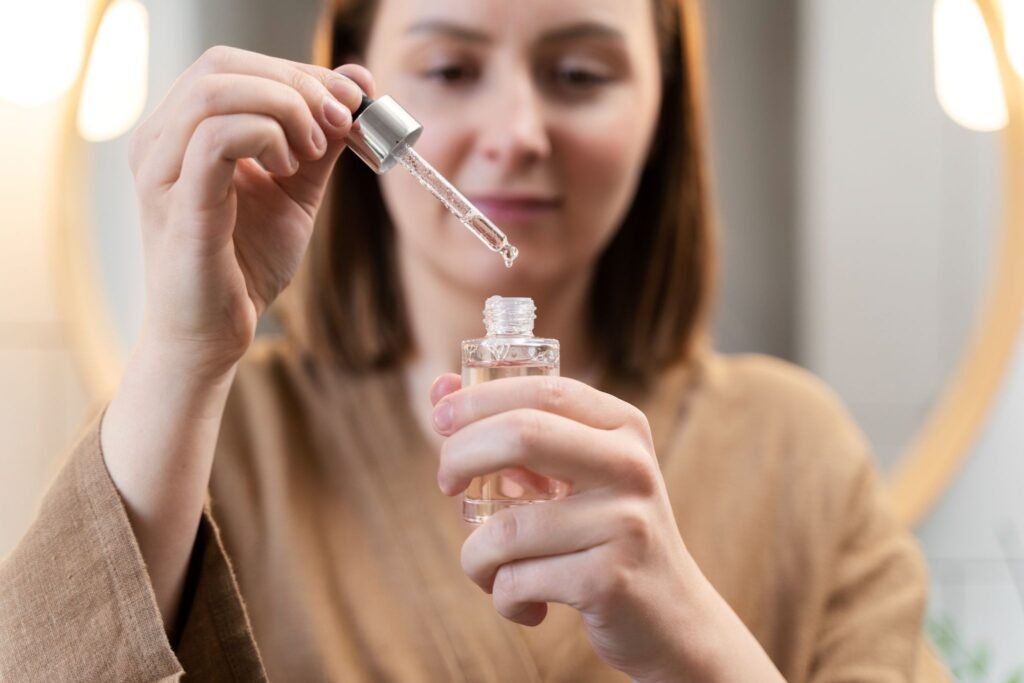
Whenever a new “holy grail” active takes the beauty industry by storm, my instinct in the lab isn’t to look at the glossy marketing campaign, it’s to look at the raw material safety data sheet and run stability testing. Bakuchiol is easily one of the most exciting molecules we’ve seen in clean beauty over the last decade, primarily because it offers a gentler mechanism for stimulating collagen without the classic “retinoid purge” or intense peeling.
But here is the catch that most brands gloss over: just because a botanical active is gentle on the skin barrier doesn’t mean it is inherently stable in the bottle. In my work formulating active emulsions, I’ve seen firsthand how delicate lipophilic compounds like bakuchiol can be when exposed to heat, light, and ambient oxygen. A lot of consumers assume that if a product is “natural,” it’s automatically safe for daytime wear without a second thought.
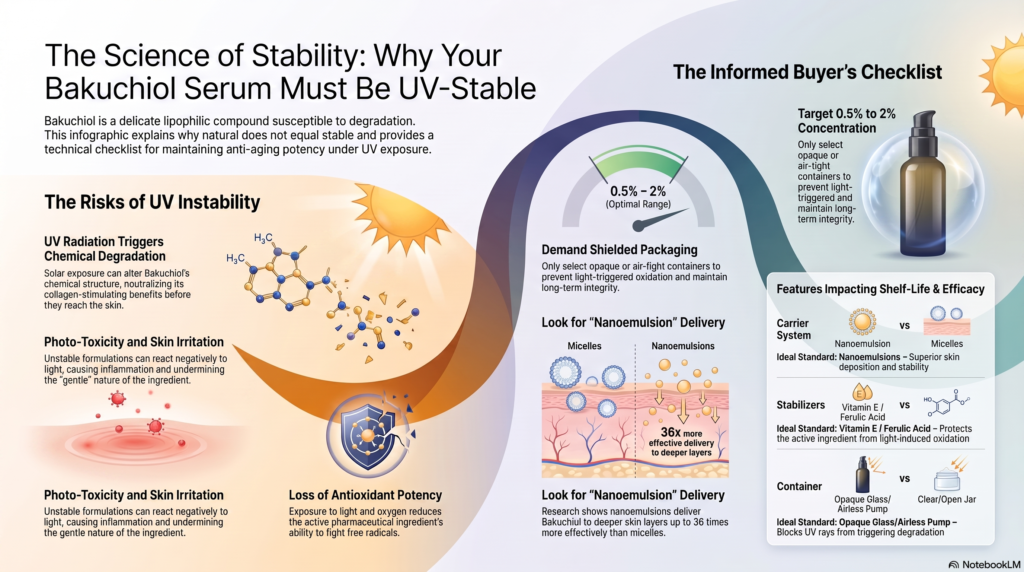
But chemistry isn’t that simple. If a bakuchiol serum isn’t explicitly engineered for photostability, solar UV radiation can alter its chemical structure, degrading the active before it ever gets a chance to work on your skin. To really get those clinical-grade anti-aging results, we have to look past the hype and ensure the formula is genuinely UV-stable and non-photo-toxic.
A UV-stable and non-photo-toxic bakuchiol serum is essential for maintaining its anti-aging benefits. UV exposure can degrade bakuchiol, reducing its effectiveness and risking irritation. By choosing a serum that is UV stable, you guarantee the integrity of the formulation and protect your skin’s health during sun exposure. Look for serums with stabilizing agents and appropriate packaging. You’ll discover more about how to select the best bakuchiol serum suited to your skin’s needs.
Key Takeaways
- UV stability ensures bakuchiol retains its anti-aging properties, maximizing efficacy during sun exposure.
- Non-photo-toxic formulations minimize skin irritation, enhancing user comfort and safety.
- Stability during UV exposure helps maintain serum integrity, promoting long-term skin health.
- Effective bakuchiol serums often contain stabilizing agents, ensuring consistent performance over time.
- Clinical support for UV-stable and non-photo-toxic claims boosts credibility and consumer trust in product effectiveness.
WHAT IS BAKUCHIOL AND WHY IS IT POPULAR?
Bakuchiol, often hailed as a natural alternative to retinol, has gained significant popularity in the skincare community due to its impressive ability to reduce signs of aging without the irritation typically associated with retinoids.
This plant-derived compound offers numerous bakuchiol benefits, including improved elasticity, reduced fine lines, and enhanced skin tone. Its anti-inflammatory properties make it suitable for sensitive skin types, aligning perfectly with current skincare trends favoring gentler formulations.
Clinical studies demonstrate that bakuchiol can stimulate collagen production and promote cell turnover, much like traditional retinoids, but without the risk of photo-sensitivity. If you’re researching how to use retinol, understanding these differences can help you choose the ingredient that best suits your skin and lifestyle.
Why You Need a UV-Stable Bakuchiol Serum
When choosing a bakuchiol serum, ensuring it’s UV-stable is essential for maintaining the efficacy of the active ingredients.
UV exposure can degrade bakuchiol, compromising its potent anti-aging and skin-rejuvenating properties. A UV-stable serum formulation protects these benefits, allowing you to harness the full power of bakuchiol.
Without this stability, you risk wasting your investment and missing out on clearer, firmer skin. Unlike creams with tretinoin, a well-formulated bakuchiol serum is less likely to increase sensitivity to sunlight. Furthermore, a UV-stable serum minimizes photo-toxicity risks, ensuring safety during application.
By prioritizing a UV-stable formulation, you’re not just enhancing your skincare routine; you’re investing in a reliable solution that delivers consistent results.
Elevate your skincare game by selecting a bakuchiol serum that stands up to environmental stressors and maximizes its transformative effects.
Understanding UV Stability in Bakuchiol
Understanding UV stability in bakuchiol is vital for preserving its effectiveness in skincare formulations.
When you’re selecting a serum, consider that UV exposure can degrade bakuchiol, diminishing its antioxidant properties and overall benefits. A UV-stable formulation guarantees that bakuchiol retains its potency, allowing the active pharmaceutical ingredient to remain effective throughout the product’s intended shelf life and during normal sun exposure.
This stability is significant for maintaining the integrity of your serum, as unstable compounds can lead to skin irritation or reduced efficacy.
By choosing a serum that prioritizes UV stability, you empower your skincare routine, maximizing the rejuvenating effects of bakuchiol.
In this competitive market, investing in a well-formulated, UV-stable bakuchiol serum is non-negotiable for achieving radiant, healthier skin.
What to Watch Out For: Photo-Toxicity Risks?
While selecting a bakuchiol serum, it’s important to be aware of photo-toxicity risks associated with certain formulations. Ignoring these can lead to adverse reactions and diminished efficacy.
Here are key factors to take into account:
- Ingredient Interactions: Some compounds, like essential oils, can heighten photo sensitivity concerns when combined with bakuchiol.
- Formulation Stability: Confirm the serum is UV-stable to prevent degradation under sunlight, which may increase toxicity.
- Concentration Levels: Higher concentrations of bakuchiol may increase the risk of irritation, especially when exposed to UV light.
- Skin Type Considerations: Individuals with sensitive skin should be particularly cautious, as they may experience heightened photo sensitivity.
Signs of an Effective UV-Stable Bakuchiol Serum
To guarantee you’re choosing an effective UV-stable bakuchiol serum, look for specific signs that indicate stability and efficacy. Even though Isdin Isdinceutics Melatonik doesn’t contain retinol (so there’s no increased sun sensitivity to worry about), it’s still a nighttime-only serum. In addition to bakuchiol, the other star ingredient, melatonin, works with your skin’s natural overnight repair cycle, acting as an indirect antioxidant to help reinforce its defenses against free-radical damage while you sleep. “The nighttime delivery enables the serum to sink into the skin and renew while you sleep,” says Corey L. Hartman, MD, a board-certified dermatologist based in Birmingham, AL. Plus, there’s vitamin C for added brightening and environmental protection come morning. Between the silky serum-in-oil texture that melts right in, the non-comedogenic formula, and the fact that it skips all the usual retinol drama (read: peeling and purging), this is one bakuchiol serum that earns its luxe price tag.
First, check the serum formulation; an effective product should contain stabilizing agents, such as antioxidants, which protect bakuchiol from UV degradation.
Next, assess the packaging; opaque or air-tight containers help shield the serum from light exposure and oxidation.
Additionally, the product should be backed by clinical studies demonstrating its effectiveness in skin improvement without photo-toxicity.
Labels claiming “UV-stable” or “non-photo-toxic” are essential indicators of safety.
Pay attention to the concentration of bakuchiol; a concentration of 0.5% to 1% is generally considered effective, ensuring you reap the full benefits while minimizing potential instability.
The Importance of Stability for Skin Health
Understanding the significance of UV stability in your bakuchiol serum is essential for maintaining skin health. The anti-aging benefits of retinol are hardly a secret, but there is a plant-based alternative that’s slightly lesser known. The best bakuchiol serums deliver the brightening, tightening effects of retinol, minus the irritation—ever-more imperative as the temperatures dip.
When a serum isn’t UV-stable, it can lead to photo-toxicity, increasing the risk of skin irritation and damage.
Prioritizing stability guarantees that you receive the full benefits of the active ingredients while safeguarding your skin.
UV Stability Significance
When evaluating a bakuchiol formula on paper, the first thing I look for isn’t just the percentage on the label—it’s the carrier system and packaging. Bakuchiol is a highly lipophilic meroterpene, meaning it’s essentially an oil-like molecule with a high octanol-water partition coefficient ($\log K_{o/w} \approx 6.1$). Getting a lipid-heavy active like that into a skin-friendly, non-greasy aqueous serum requires serious formulation skill.
In bench testing, we often see that basic microemulsions or simple micelles don’t always protect the compound from photo-degradation or deliver it deep into the viable epidermis where collagen synthesis actually happens. Furthermore, photo-toxicity isn’t just a theoretical concern, it’s a real formulation risk if a product contains unrefined botanical extracts or photoreactive essential oils alongside the active. I always tell people to check the bottle itself.
If a brand puts a UV-sensitive active in a clear glass dropper bottle, that’s an immediate red flag for me; clear glass allows light to trigger oxidation, degrading the active pharmaceutical ingredient long before you finish the bottle. You want to see opaque or UV-protected packaging, backed by sensible antioxidant stabilizers like vitamin E or ferulic acid, ensuring the active stays intact from the first drop to the last.
When formulating a bakuchiol serum, ensuring UV stability is essential for maintaining its efficacy and protecting skin health. A stable product guarantees that the active ingredients remain effective, promoting ideal skin benefits.
Here’s why UV stability matters:
- Efficacy Preservation: UV stability protects bakuchiol from degrading when exposed to sunlight.
- Enhanced Product Longevity: Stable formulations extend shelf life, ensuring you get the full benefits over time.
- Consistent Results: Reliable formulations yield predictable outcomes, vital for skin improvement.
- Consumer Trust: High-quality, stable products foster confidence in your skincare routine.
Prioritizing UV stability in your bakuchiol serum isn’t just a choice; it’s a commitment to your skin’s health and longevity.
PHOTO-TOXICITY RISKS EXPLAINED
Although many skincare ingredients offer benefits, their effectiveness can be severely compromised by photo-toxicity, which occurs when certain compounds react negatively to UV exposure.
Understanding photo toxicity mechanisms is vital; these reactions can lead to skin irritation, inflammation, or even cellular damage. For example, some compounds may generate reactive oxygen species when exposed to sunlight, undermining their intended effects.
Conducting rigorous safety assessments is critical to identify and mitigate these risks. This guarantees that the formulations you use aren’t only effective but also safe under typical environmental conditions.
Choosing a UV-stable, non-photo-toxic bakuchiol serum means you’re prioritizing your skin’s health and maximizing the benefits of your skincare routine while minimizing potential adverse reactions.
Skin Health Implications
While choosing skincare products, the stability of ingredients like bakuchiol plays an essential role in maintaining skin health. A stable bakuchiol serum can greatly impact your skin barrier and inflammation response.
Here are four reasons why stability matters:
- Effective Delivery: Stable ingredients guarantee maximum potency, enhancing absorption and effectiveness.
- Skin Barrier Protection: A stable formulation supports the skin barrier, preventing moisture loss and environmental damage.
- Reduced Inflammation: Stability minimizes the risk of irritation, promoting a balanced inflammation response.
- Long-Lasting Results: Consistent efficacy over time leads to lasting improvements in skin texture and tone.
Choosing a UV-stable bakuchiol serum empowers you to optimize your skincare regimen for healthier, resilient skin.
How to Choose the Right Bakuchiol Serum for Your Needs?
When selecting a bakuchiol serum, consider your skin type to guarantee compatibility and effectiveness. Bakuchiol is a prenylated phenolic monoterpene known for its ability to mimic retinol’s effects. It stimulates collagen production, promotes cell turnover, and provides antioxidant protection, making it an effective anti-aging ingredient. Unlike retinol, Bakuchiol is less likely to cause irritation, making it suitable for sensitive skin types.
Pay attention to the concentration of bakuchiol, as higher levels may yield better results but could also irritate sensitive skin.
Additionally, evaluate the serum’s additional ingredients, as they can enhance or detract from the serum’s overall benefits.
Skin Type Compatibility
Choosing the right bakuchiol serum for your skin type is crucial for maximizing its benefits and minimizing potential irritation.
Understanding your skin’s needs helps you select the most effective product. Here’s how to choose:
- Oily Skin: Look for lightweight formulations that absorb quickly without clogging pores.
- Dry Skin: Opt for richer serums with hydrating ingredients to enhance moisture retention.
- Sensitive Skin: Choose fragrance-free, hypoallergenic options to reduce the risk of irritation.
- Combination Skin: A balanced serum with moderate hydration works best, targeting both dry and oily areas.
Selecting a bakuchiol serum tailored to your skin type guarantees you harness its full potential while maintaining skin health and well-being.
Concentration of Bakuchiol
The concentration of bakuchiol in a serum greatly influences its effectiveness and suitability for your individual skincare needs.
Research indicates that an ideal concentration of 0.5% to 2% bakuchiol delivers significant anti-aging benefits, including enhanced skin elasticity and reduced appearance of fine lines.
Higher concentrations may yield quicker results, but they can also increase the risk of irritation, especially for sensitive skin types.
To maximize bakuchiol benefits without compromising skin integrity, start with a lower concentration and monitor your skin’s response.
If you’re looking for potent results, consider formulations that balance bakuchiol with other supportive ingredients.
Always prioritize serums that provide evidence-based dosages to guarantee you harness the full power of this remarkable ingredient effectively.
Additional Ingredients Consideration
To effectively choose the right bakuchiol serum for your skincare needs, consider the synergy of additional ingredients that can enhance its benefits.
The formulation synergy between bakuchiol and other components can reveal powerful effects. Here are key additional ingredients to look for:
- Hyaluronic Acid – Provides deep hydration, complementing bakuchiol’s anti-aging properties.
- Vitamin C – Boosts skin brightness and combats free radicals, enhancing overall efficacy.
- Niacinamide – Helps to improve skin texture and tone while reducing inflammation.
- Peptides – Support collagen production and skin elasticity, amplifying bakuchiol’s rejuvenating effects.
RELATED STUDIES ABOUT BEST BAKUCHIOL SERUM
Choosing a UV-stable, non-photo-toxic bakuchiol serum isn’t just a skincare choice; it’s a revolution for your skin’s health! Imagine a world where your serum not only fights aging but also withstands the sun’s relentless rays. Without this stability, your efforts could be sabotaged, leaving your skin vulnerable. So, arm yourself with knowledge and select a serum that champions both stability and efficacy. Your skin deserves nothing less than the best—because anything else could be a skincare catastrophe!
Bakuchiol from Cullen corylifolium and its efficacy on apoptosis and autophagy in HepG2 cells
Overview
Hepatocellular carcinoma (HCC) is the third most prevalent cause of cancer-related fatalities globally, with mortality rates reaching up to 85% in developing nations. This study investigates the anticancer properties of bakuchiol, the primary active component derived from the traditional medicinal herb Cullen corylifolium, against HepG2 liver cancer cells. The research aimed to elucidate bakuchiol’s specific mechanisms in inducing apoptosis, autophagy, and cell cycle arrest when compared to three other structurally similar flavonoids.
Key Findings
- Isolation and Cytotoxicity: Bakuchiol was identified as the most abundant component in the C. corylifolium ethanol extract, yielding $11.02 \pm 0.34$ mg/g. Among the four components evaluated, bakuchiol demonstrated the most potent cytotoxicity against HepG2 cells, recording an $IC_{50}$ of $70.0 \pm 0.67$ $\mu g/mL$.
- Induction of Apoptosis: Bakuchiol acts as a potent inducer of apoptosis by successfully engaging both intrinsic and extrinsic signaling cascades. It dose-dependently increases the ratio of Bax to Bcl-2 (intrinsic pathway markers) and the ratio of tBid to Bid (extrinsic pathway markers). Furthermore, a 100 $\mu M$ concentration of bakuchiol remarkably increased the ratios of cleaved caspase-3 and cleaved PARP, which are critical indicators of programmed cell death.
- Cell Cycle Arrest: Treatment with 100 $\mu M$ of bakuchiol caused a significant cell cycle arrest, increasing the proportion of cells in the sub-G1 phase from 1% to 18%. This arrest is driven by the upregulation of cell cycle inhibitory markers p53, p21, and p27, alongside a simultaneous decrease in the expression of CDK2 and CDK4.
- Promotion of Autophagy: Bakuchiol actively facilitates autophagy by modulating key cellular pathways. It significantly elevates the activity of AMPK (a positive regulator of autophagy) and increases the LC3II/LC3I ratio, while simultaneously suppressing Akt and mTOR (negative regulators of autophagy).
- Molecular Docking and Binding: In molecular docking simulations targeting VEGFR-2—a key mediator of tumor angiogenesis—bakuchiol demonstrated a strong binding energy of -8.54 kcal/mol. It established a successful hydrogen bond with the Cys919 amino acid residue, sharing a binding pocket similar to the known anti-angiogenic drug lenvatinib.
Conclusion This study is the first to report the significant antitumor efficacy of bakuchiol against HepG2 hepatocellular carcinoma cells. By effectively inducing both apoptosis and autophagy, and by modulating crucial signaling pathways, bakuchiol emerges as a highly promising natural therapeutic candidate for liver cancer research and treatment.
| REFERENCE: Yeong-Geun Lee, Seon-A Jang, Hae Seong Song, Jeong Eun Kwon, Minsung Ko, Woojae Hong, Ahyeong Gwon, Se-Eun Park, Yujin Jeong, Hyunggun Kim, Se Chan Kang, Bakuchiol from Cullen corylifolium and its efficacy on apoptosis and autophagy in HepG2 cells, Heliyon, Volume 10, Issue 23, 2024, e40758, ISSN 2405-8440, https://doi.org/10.1016/j.heliyon.2024.e40758. (https://www.sciencedirect.com/science/article/pii/S2405844024167898) |
Cutaneous delivery and biodistribution of a lipophilic natural product – bakuchiol: Comparing nanocarrier performance
Overview
Bakuchiol (BAK) is a lipophilic natural meroterpene widely recognized as a functional analogue of retinol, capable of targeting similar cellular pathways to improve skin photo-damage and stimulate collagen production. However, because it is an oil at ambient temperature and possesses high lipophilicity (log Ko/w 6.1), creating effective, consumer-friendly aqueous formulations presents a significant challenge.
Objective
This study investigated and compared the performance of various nanocarriers—specifically micelles, microemulsions (ME), and nanoemulsions (NE)—in developing aqueous formulations of BAK and facilitating its successful delivery into the skin.
Methodology
The researchers formulated and tested three main types of systems:
- Micelles prepared via solvent evaporation using D-a-Tocopherol polyethylene glycol 1000 succinate (TPGS) and Poloxamer 407 (P407).
- Microemulsions (ME) developed through a water microtitration method using oleic acid, Labrasol, Transcutol P, and water.
- Nanoemulsions (NE) produced via ultrasonication, yielding two variants: NE1 (containing oleic acid) and NE2 (without oleic acid).
Key Findings
- Encapsulation and Size Profile: The optimized TPGS and P407 micelles achieved high encapsulation efficiencies of 96.6 ± 3.2% and 101.5 ± 0.3%, respectively, with very small particle sizes of roughly 27 to 28 nm.
- Emulsion Performance: NE2 demonstrated an encapsulation efficiency of 106.8 ± 5.7%, which was higher than both NE1 (90.2 ± 2.4%) and the ME (86.3 ± 4.6%). The emulsion-based formulations exhibited larger particle sizes than the micelles, ranging from 68 nm (NE2) to 129 nm (NE1).
- Superior Skin Deposition: During finite dose cutaneous delivery tests, the nanoemulsions (NE1 and NE2) achieved 3 to 4 times higher BAK skin deposition than either the micelles or the microemulsion.
- Role of Oleic Acid: The inclusion of oleic acid, a known chemical penetration enhancer, in NE1 did not result in superior skin delivery compared to NE2, which did not contain it.
- Targeted Biodistribution: Nanoemulsions effectively targeted the viable epidermis and dermis, which are the critical sites for BAK’s collagen-stimulating biological effects. Specifically, NE2 successfully deposited BAK concentrations in these deeper skin layers that were up to 36-fold higher than the minimum effective concentration required for efficacy.
Conclusion
The study concludes that for highly lipophilic natural compounds like BAK, nanoemulsions are superior delivery vehicles compared to micelles and microemulsions. Furthermore, the findings indicate that a formulation’s thermodynamic activity and the molecular properties of the penetrant are far more critical for effective skin delivery than simply minimizing the physical size of the nanocarrier.
| REFERENCE: Erga Syafitri, Yogeshvar N. Kalia, Cutaneous delivery and biodistribution of a lipophilic natural product – bakuchiol: Comparing nanocarrier performance, International Journal of Pharmaceutics, Volume 681, 2025, 125886, ISSN 0378-5173, https://doi.org/10.1016/j.ijpharm.2025.125886. (https://www.sciencedirect.com/science/article/pii/S0378517325007239) |
Bidirectional regulation of bakuchiol, an estrogenic-like compound, on catecholamine secretion
Overview
Bakuchiol is a natural phytoestrogen isolated from the seeds of Psoralea corylifolia L., a plant with a long history of use in Traditional Chinese medicine. This study investigates the regulatory effects of bakuchiol on the secretion of catecholamines (CAs)—vital neurotransmitters such as epinephrine, norepinephrine, and dopamine—and evaluates its potential therapeutic efficacy against depression and stress.
Key In Vitro Findings: Bidirectional Regulation
Using cultured bovine adrenal medullary cells as a model, researchers discovered that bakuchiol exerts a unique bidirectional, or dual, effect on CA secretion:
- Stimulation of Basal Secretion: Bakuchiol independently stimulated baseline CA secretion in a concentration-dependent manner. This stimulation acts through bakuchiol’s estrogen-like binding properties and the JNK signaling pathway, occurring even without extracellular calcium.
- Enhancement of CA Synthesis: The compound promotes the synthesis of new CAs by elevating the phosphorylation of tyrosine hydroxylase (the rate-limiting enzyme in CA synthesis) at specific sites (Ser31 and Ser40) via the ERK1/2 and PKA pathways.
- Suppression of Excess Secretion: Conversely, when cells were stimulated by secretagogues like acetylcholine, veratridine, or high potassium, bakuchiol significantly inhibited the resulting excess CA secretion. This inhibitory action is directly related to bakuchiol’s ability to suppress sudden rises in intracellular calcium levels.
Key In Vivo Findings: Behavioral and Physiological Impacts
To assess the practical mental health implications of these cellular mechanisms, the researchers conducted behavioral despair and chronic stress tests on mice:
- Anti-Depressant-Like Activity: In both the tail suspension test and the forced swim test, administration of bakuchiol significantly reduced immobility time in mice, suggesting an anti-depressant effect. Crucially, open-field tests confirmed that bakuchiol achieved this without abnormally altering general locomotor activity.
- Anti-Stress Activity: Using a chronic immobilization stress model, the study showed that bakuchiol significantly reduced stress-induced spikes in plasma epinephrine and norepinephrine levels over a 7-day period.
Conclusion
Bakuchiol acts as a potent bidirectional regulator of the catecholamine system. By safely elevating basal CA synthesis while simultaneously preventing the excessive CA overflow associated with acute stress, bakuchiol emerges as a highly promising candidate for treating clinical depression and stress-related disorders.
| REFERENCE: Haoping Mao, Hong Wang, Shangwei Ma, Yantong Xu, Han Zhang, Yuefei Wang, Zichang Niu, Guanwei Fan, Yan Zhu, Xiu Mei Gao, Bidirectional regulation of bakuchiol, an estrogenic-like compound, on catecholamine secretion, Toxicology and Applied Pharmacology, Volume 274, Issue 1, 2014, Pages 180-189, ISSN 0041-008X, https://doi.org/10.1016/j.taap.2013.11.001. (https://www.sciencedirect.com/science/article/pii/S0041008X13004833) |
CONCLUSION
At the end of the day, cosmetic chemistry is about finding the balance between efficacy, safety, and real-world usability. Bakuchiol has earned its spot as a staple in modern skincare because it bridge-builds between the power of traditional retinoids and the tolerance of sensitive skin. But a ingredient is only as good as the formula holding it together. If a serum breaks down under UV light, you aren’t just losing out on fine-line reduction and skin elasticity; you’re risking phototoxic reactions and localized irritation that defeat the entire purpose of choosing a gentle alternative in the first place.
When you’re shopping for a bakuchiol serum, don’t let flashy claims do the talking. Look for evidence of thoughtful formulation an optimal concentration between 0.5% and 1%, protective packaging, synergistic antioxidants, and formulas designed for stability.
Skincare shouldn’t be a guessing game where you hope your serum survives the morning sun. By prioritizing UV stability and non-photo-toxic integrity, you ensure that every drop you apply delivers genuine, science-backed results to your skin barrier